
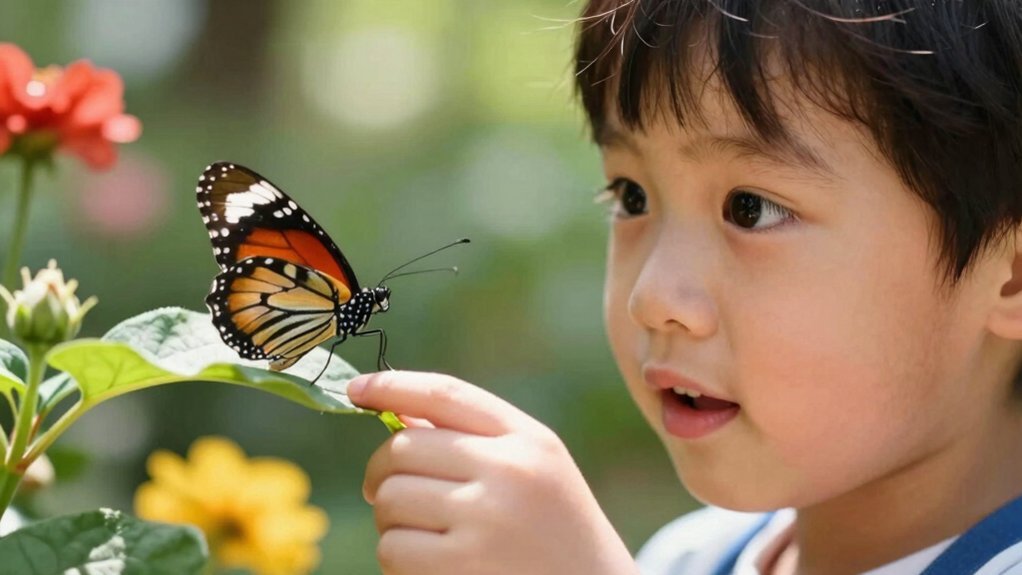
You’ll recognize sensitive periods by watching for sudden intense concentration on specific activities, strong emotional reactions when routines get disrupted, and rapid skill development in particular domains. Track behavioral cues like repetitive actions, unexpected interests in materials they’ve previously ignored, and hyperfocus that resists external interruptions. Notice when your child becomes emotionally distressed by changes to familiar patterns. These signals reveal windows when their brain’s heightened plasticity makes them primed for targeted support. Understanding these markers helps you align your environment with their developmental needs at exactly the right moments.
What Are Sensitive Periods and Why They Matter
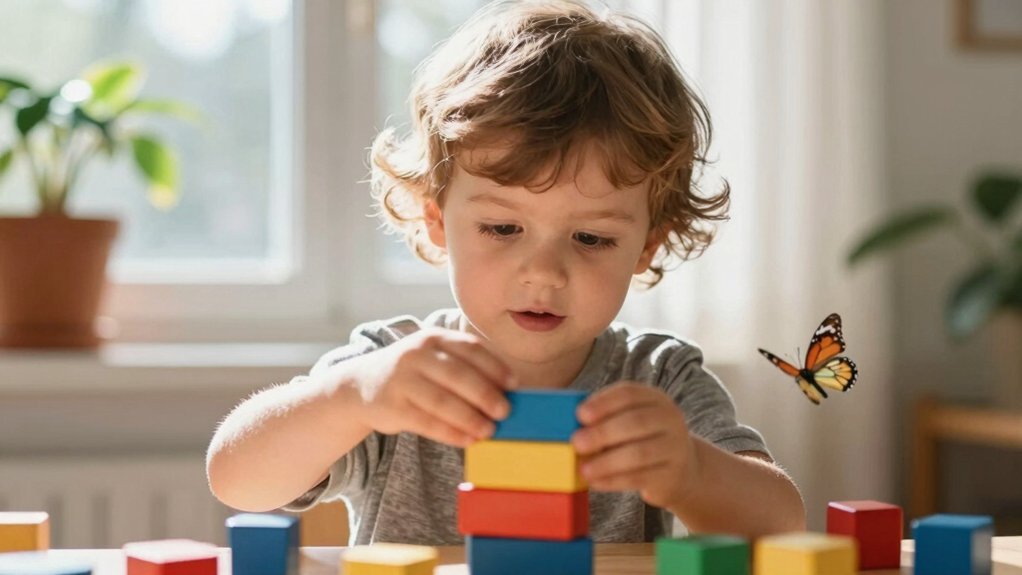
Why do some children suddenly become obsessed with arranging objects or mimicking speech sounds? You’re witnessing sensitive periods—specific developmental windows when your child’s brain becomes exceptionally receptive to learning particular skills and behaviors.
During these phases, environmental experiences profoundly shape neural circuits and organization. Your child acquires abilities rapidly because heightened neuroplasticity makes learning efficient. Unlike critical periods, which cause irreversible changes if experiences are missed, sensitive periods allow continued learning beyond the window, though less effectively. These developmental windows vary in length and timing depending on which skill or behavior is developing.
Understanding these periods helps you recognize optimal times for skill development. When you provide appropriate environmental stimuli during these windows, you support natural developmental timing and prevent emotional disruptions. Missing these experiences produces lasting developmental effects, making recognition essential for nurturing your child’s growth.
The Five Critical Windows: What They Are and When They Open
How can you identify which developmental window your child’s currently navigating? Understanding the five critical sensitive periods helps you recognize when your child’s brain is primed for specific learning.
| Sensitive Period | Age Range | Key Focus |
|---|---|---|
| Order | Birth to 6 years | Routine, predictability, organization |
| Language | Birth to 5 years | Sound absorption, writing (3.5-4.5), reading (4.5-5.5) |
| Sensory Skills | Birth to 6 years | Refining perception, environmental input |
| Movement | Birth to 4.5 years | Coordination, independence, body awareness |
| Social Skills | 2 to 6 years | Group awareness, relationships, emotional expression |
You’ll notice your child displaying behaviors aligned with their active window—organizing toys during the order period or experimenting with friendships during social development. These windows don’t overlap uniformly; some periods begin earlier or extend longer. During the sensory skills window, children develop a system to categorize their environment through sensory experiences by observing and exploring with their senses. Recognizing which window’s open allows you to provide targeted support matching your child’s developmental needs.
Your Recognition Checklist: Is Your Child in a Sensitive Period Right Now?

You’ll notice behavioral cues like intense focus, repetitive actions, and strong emotional reactions when your child enters a sensitive period.
Your environment plays a vital role—observe whether your child’s readiness aligns with developmental milestones and whether you’ve created the structure and materials that support their current learning window. Keeping a small notebook or phone to track patterns of behavior over time will help you identify which sensitive period your child is experiencing and respond with appropriate guidance.
Behavioral Cues and Patterns
Observable behaviors serve as your window into your child’s sensitive periods. Watch for intense, uninterrupted concentration on specific activities—when your child focuses so deeply that interruptions cause frustration, you’re witnessing a sensitive period at work. Notice repetitive actions performed with clear intent: opening drawers repeatedly, arranging objects in particular sequences, or practicing specific movements signals purposeful learning.
Pay attention to sudden, strong interests in materials or tasks that previously held no appeal. Track emotional reactions to disrupted routines—heightened responses to misplaced items or skipped sequences indicate your child’s developmental engagement. These sensitive periods are brief intervals in early development when your child is especially receptive to specific types of learning.
Monitor your child’s craving for order and predictability. When she insists on specific sequences like shoes before jackets, or becomes upset when routines shift, she’s processing her world’s structure. These behavioral markers tell you exactly where your child’s learning energy is focused.
Environmental and Developmental Readiness
When’s the right time to introduce a new skill or environment to your child? You’ll recognize environmental readiness by observing how your child responds to consistent caregiving and physical contact. During sensitive periods, your child’s brain narrows its focus from broad possibilities to specific environmental patterns—similar to how language perception sharpens from universal sounds to native-language phonetics.
Watch for these readiness indicators:
- Your child maintains coordinated responses to your facial expressions and tone
- Stress responses settle quickly when you provide comfort and reassurance
- Your child demonstrates selective attention to familiar routines and people
- Physical contact consistency triggers visible calm and social engagement
- Nutritional stability supports steady developmental progression
When these signs align, your child’s developing brain is primed to absorb new information efficiently. This experience-dependent plasticity allows early interactions to shape neural circuits that support later social and emotional functioning. Mismatched timing—introducing skills before readiness emerges—can extend sensitive periods unnecessarily and create developmental strain.
Intense Focus and Hyperfocus: Your Earliest Warning Signs
You’ll notice your child’s concentration patterns become markedly intense as they signal developmental readiness, with repetitive engagement revealing their underlying mastery drive. When your child’s interruption responses grow resistant or frustrated, you’re witnessing a critical indicator that they’ve entered a sensitive period. These behavioral shifts—sustained focus, purposeful repetition, and protective reactions to disruption—work together as your earliest warning signs that neurological rewiring is actively underway.
Concentration Patterns Signal Readiness
Intense focus and hyperfocus aren’t distractions—they’re your window into neural plasticity. When you observe concentrated attention patterns, you’re witnessing heightened perceptual narrowing that signals a sensitive period’s opening. Your brain’s bottom-up processing dominates, extracting environmental regularities with remarkable selectivity.
These concentration shifts reveal critical readiness markers:
- Heightened sensitivity to sensory input regularities through interaction
- Rapid stabilization of rudimentary representations into higher-order categories
- Perceptual discrimination strengthening with increasingly selective neural responses
- Pulsatile oxytocin activity priming molecular and network assembly
- Transition of inhibitory mechanisms enabling intense engagement phases
You’ll notice your learner shifts from scattered attention to laser-like focus on specific domains. This isn’t random behavior—it’s your nervous system announcing peak plasticity windows. Recognizing these concentration patterns lets you align environmental support precisely when your brain’s most receptive.
Repetitive Engagement Indicates Mastery Drive
Rather than viewing repetition as monotonous behavior, recognize it as evidence of your learner’s emerging mastery drive. When your child repeatedly engages with the same activity—building with blocks, practicing a skill, or exploring a concept—they’re signaling developmental readiness. This isn’t boredom or distraction; it’s purposeful engagement. Your learner’s brain is consolidating neural pathways, deepening understanding, and building competence. The intensity and duration of this repetitive focus reveal where their developmental energy concentrates. Pay attention to what captures sustained attention. These patterns show you which skills your learner is ready to master and when they’re primed for advancement. Just as real-time feedback accelerates practice and adjustment in immersive learning environments, observing repetitive patterns helps you identify the precise moments when your learner benefits most from targeted support and reinforcement. Honoring this repetitive phase accelerates genuine skill development rather than pushing premature progression.
Interruption Responses Reveal Developmental Windows
While repetitive engagement reveals what your learner’s ready to master, how they respond when you interrupt that focus tells you something equally important: whether they’re in an active sensitive period.
When you break their concentration, you’re triggering cognitive systems that expose developmental plasticity. Heightened resistance to interruptions signals ongoing circuit maturation requiring environmental input. You’ll notice:
- Emotional distress or irritability when interrupted, revealing strained emotion regulation
- Difficulty resuming the task, indicating active working memory prioritization
- Confusion or disorientation about what comes next
- Increased omissions after the interruption due to disrupted action schemas
- Hyperfocus that resists external shifts, showing E/I balance realignment
These responses aren’t deficits—they’re windows. Your learner’s brain is reorganizing itself, and interruptions expose exactly where that reorganization’s happening. Remote data collection methods have similarly revealed how environmental disruptions during developmental transitions can either support or hinder continuous neural reorganization in real-world contexts.
Why Your Child Suddenly Obsesses Over Routine and Order
Between birth and age five, your child’s brain enters a remarkable window where it’s primed to absorb structure and order effortlessly. During this sensitive period, you’ll notice your child suddenly becomes obsessed with routines, lining up objects, or organizing belongings with intense focus.
This isn’t random behavior—it’s your child’s brain making sense of a complex world through predictability and control. When you disrupt established routines or move items from their “right place,” your child may react with unexpected frustration or emotional sensitivity. This developmental need typically peaks around age two but continues to influence behavior through age five.
These repetitive actions serve a crucial purpose. Your child’s purposeful repetition builds neural pathways that establish security and mastery. By honoring this developmental need and maintaining consistent routines, you’re supporting optimal learning during this fleeting window.
When Language Clicks In: Spotting the Language Window
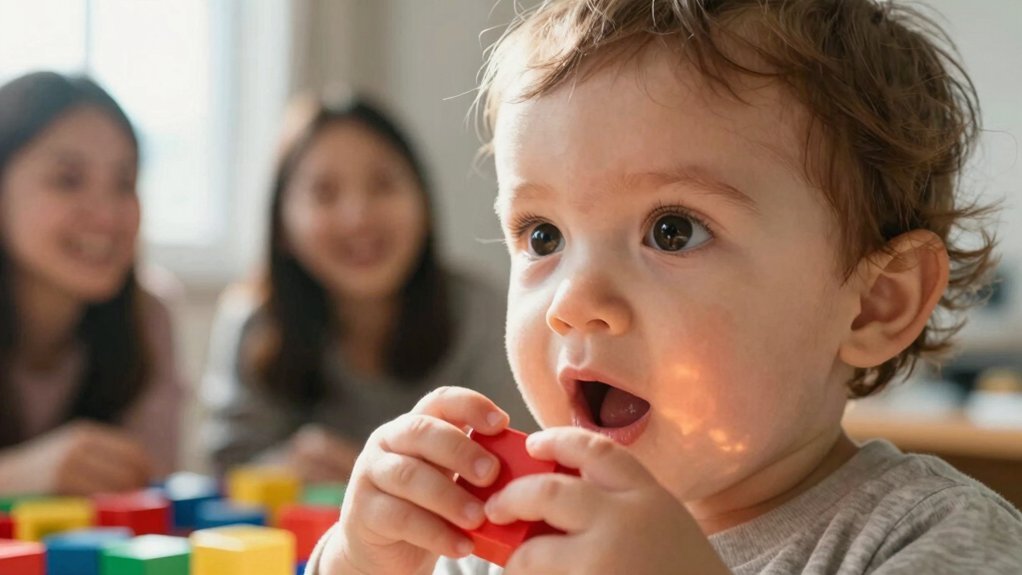
Have you noticed your infant suddenly stops responding to foreign sounds they once recognized? This shift marks perceptual narrowing—a critical window where your child’s brain commits to native language patterns between 6-12 months.
During this period, you’ll observe remarkable changes:
- Your baby’s native speech processing sharpens dramatically
- Sensitivity to non-native phonetic distinctions declines noticeably
- Interactive foreign language exposure at 9 months can reverse this decline
- Neural encoding shifts toward your native language’s sound system
- Early sensory changes become detectable through brain activity measures
This narrowing isn’t loss—it’s optimization. Your child’s brain efficiently prioritizes the sounds they’ll need most. However, interactive engagement with foreign languages during this window maintains multilingual abilities, suggesting that exposure quality matters as much as timing. Research shows that grammar learning ability remains strong through late adolescence, extending the sensitive period well beyond these early months and into the teenage years around 17 or 18 years old.
Movement Breakthroughs and Coordination Leaps
You’ll notice your child’s gross motor skills—running, jumping, and climbing—develop rapidly from birth through age 4, laying the foundation for all physical movement.
As fine motor control emerges around age 2.5, you can observe your child’s growing ability to manipulate small objects, draw, and practice precision tasks with intense focus.
Throughout this progression, balance and coordination improve steadily through repeated practice and free movement in safe spaces, signaling the active sensitive period for building physical competence. Supporting maximum effort during movement tasks—such as allowing your child to carry heavy loads or navigate longer paths—enables deeper physical and mental growth during this critical window of development.
Gross Motor Skill Progression
When do babies transform from immobile newborns into confident toddlers who can walk, run, and jump? You’ll witness remarkable gross motor milestones that unfold in predictable patterns during your child’s early years.
Your baby progresses through distinct stages:
- Newborn to 2 months: Head control and arm/leg coordination develop through tummy time
- 6 to 12 months: Sitting, crawling, and furniture cruising emerge as balance improves
- 12 to 18 months: Walking independently replaces assisted mobility
- 2 to 3 years: Running, stair climbing, and single-foot balancing become possible
- 4 to 5 years: Hopping, skipping, and pedaling demonstrate refined coordination
Each milestone builds upon previous achievements, creating a foundation for complex movement patterns. You’ll notice your child’s strength, balance, and confidence increase systematically. Recognizing these progressions helps you understand sensitive periods when your child’s body naturally readies itself for new physical capabilities. Understanding how gross motor skills develop also helps you identify when early intervention may be beneficial if your child experiences delays in reaching expected milestones.
Fine Motor Refinement Stages
How do infants transform from reflexive graspers into precise tool users? You’ll observe this remarkable journey unfold through distinct stages of fine motor development.
Between birth and twelve months, your infant progresses from reflexive grasping to intentional manipulation. Hand-eye coordination emerges by six months, enabling toy transfers and object banging. The raking grasp develops between six to eight months, followed by pincer grasp development by fourteen months.
During toddlerhood, you’ll notice self-feeding refinement, block stacking, and drawing abilities emerging. The coordination of muscles, joints, and nerves during these activities allows your child to manipulate objects with increasing accuracy and control. By preschool age, your child establishes the tripod grip for writing instruments and masters scissor use.
School-age children achieve effortless writing and consistent ball-catching ability. Throughout adolescence, fine motor skills approach adult-level precision, enabling complex activities demanding intricate hand-finger coordination and sustained performance.
Balance And Coordination Development
Balance and coordination breakthroughs mark one of early childhood’s most crucial sensitive periods. You’ll notice your child experiences rapid development between birth and 4.5 years, when their nervous system becomes primed for motor advancement. During this window, targeted activities create lasting gains that prove difficult to achieve later. Language acquisition and social skills also develop alongside motor abilities during this formative stage.
You can recognize this sensitive period through these key indicators:
- Your child demonstrates increased body awareness and craves structured movement routines
- Balance improvements emerge noticeably after ages 2-3 through beam walking and line activities
- Coordination leaps occur when you provide appropriate climbing and carrying challenges
- Post-puberty, coordination potential declines significantly, making early intervention crucial
- Girls typically show advanced balance and bilateral coordination compared to peers
You’ll maximize development by intervening during these optimal windows before pubertal growth spurts disrupt coordination gains.
Your Child’s Senses Sharpen: What Sensory Refinement Looks Like
You’ll notice your child’s sensory awareness intensifying dramatically between birth and age five, particularly around age three when keen observation peaks. Your child progresses from exploring with their mouth to refined hand manipulation and discrimination of textures, smells, and tastes. These sensory explorations help your child build mental representations that form the foundation for symbolic thought and language development.
| Age Range | Key Development | Observable Behavior |
|---|---|---|
| Birth-2.5 years | Gross and fine motor linking to sensory awareness | Fixation on small objects; mouth-to-hand exploration |
| 2.5-4.5 years | Tactile and visual refinement | Classification by texture; hand-eye coordination in catching |
| 4.5+ years | Sensory integration mastery | Describing material properties; concentration on detailed tasks |
Your child demonstrates classification skills by grouping objects by similar traits and describing textures with growing vocabulary. Hand-eye integration emerges through catching or hitting movements. These refinements build concentration necessary for academic readiness.
Social Skills and the Sensitive Period for Connection

Why does your child suddenly become intensely focused on social rituals like saying “please” and “thank you”? You’re witnessing a sensitive period for social connection, typically emerging between ages three and six. During this window, your child’s brain becomes primed for relationship-building in ways that won’t return.
Between ages three and six, your child’s brain enters a sensitive period uniquely primed for relationship-building that won’t return.
Watch for these telltale signs:
- Increased concentration on turn-taking and harmonious exchanges
- Purposeful practice of grace and courtesy phrases
- Heightened attention to your facial expressions and emotional responses
- Drive toward independence paired with cooperation
- Self-reinforcing smiles that deepen your bond
Your consistent modeling and involvement during this critical phase shape your child’s social brain development. Early, responsive interactions strengthen oxytocin pathways, establishing patterns for lifelong emotional regulation and peer relationships. Research demonstrates that untreated social-emotional challenges can lead to peer rejection and academic difficulties if this sensitive window is not supported with intentional practice and guidance. Seize this fleeting opportunity.
Powerful Emotions and Meltdowns: Decoding the Sensitive Period Signal
Have you noticed your child’s emotional intensity spike during periods of deep concentration? When you interrupt your child mid-sensitive period, you’re witnessing something neurologically significant—not defiance. Their amygdala shows heightened reactivity while frontoamygdala circuitry undergoes rapid reorganization, making emotional regulation temporarily unstable.
These powerful reactions signal active brain development. Your child’s intense focus paired with emotional volatility indicates neural circuits related to emotion regulation are actively reorganizing. Meltdowns frequently occur when you disrupt routines—getting dressed, bathing, bedtime—because your child’s brain is mastering these developmental milestones. During these windows of heightened neuroplasticity, parental inputs work to buffer your child’s stress response systems as their emotional circuitry matures.
Recognize that your emotional state directly influences theirs during these periods. Your child displays heightened sensitivity to your anger or criticism, triggering dysregulation. Understanding this connection helps you provide the external buffering your child’s developing brain requires during sensitive periods.
How to Build an Environment That Supports Sensitive Periods
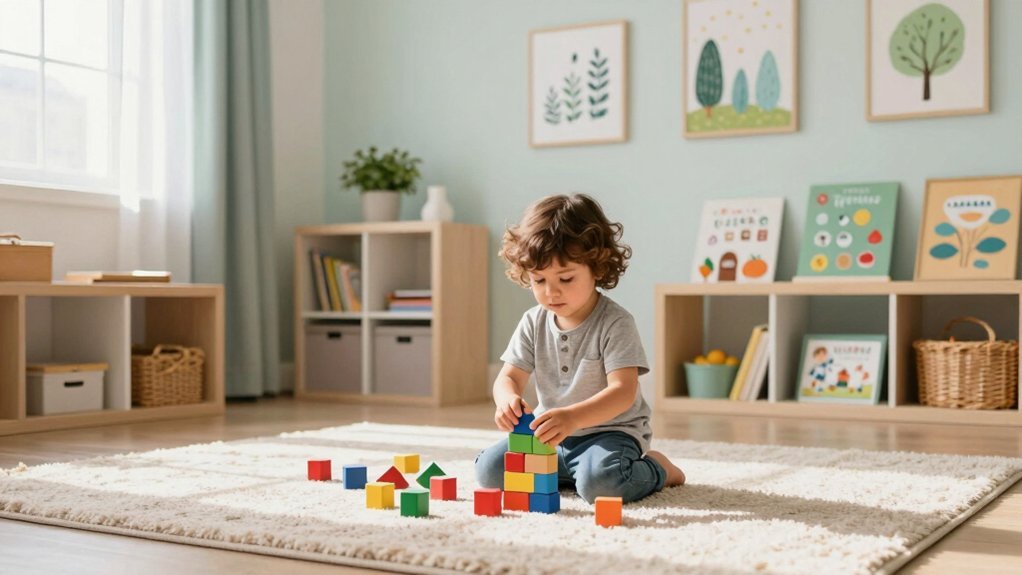
When does your child thrive most—during chaos or calm? You’ll notice your child flourishes in a thoughtfully prepared environment that honors their developmental stage. Here’s how to create that supportive space:
- Establish clear routines and boundaries that provide security while allowing exploration freedom
- Organize materials strategically so your child can independently access activities matching their current interests
- Remove obstacles to create safe pathways for uninterrupted movement and concentration
- Curate purposeful activities emphasizing order, coordination, and practical life skills
- Balance structure with choice, letting your child guide their learning while you maintain consistent expectations
This intentional design reduces frustration and behavior challenges. When your child’s environment aligns with their sensitive period needs, they’re empowered to engage deeply, build confidence, and develop naturally. Recognizing when your child shows particular receptiveness to learning specific skills—such as language acquisition or refinement of movement—allows you to introduce materials and activities at precisely the right developmental moment. You’re essentially removing barriers so growth happens organically.
Frequently Asked Questions
Can Sensitive Periods Be Missed, and What Happens to Development if They Are?
Yes, you can miss sensitive periods. When you do, you’ll face steeper learning curves, need more intensive intervention, and may experience irreversible brain changes depending on what domain you’ve missed and when.
How Do Sensitive Periods Differ Between Typically Developing Children and Neurodivergent Children?
You’ll notice typically developing children follow rigid sensitive period schedules with broad neural tuning that narrows through experience. Neurodivergent children, however, progress on individual timelines with unique touch points that don’t align with standard developmental windows.
What Role Does Screen Time Play During Sensitive Periods in Child Development?
You’ll find that excessive screen time disrupts your child’s sensitive periods by hindering language acquisition, delaying cognitive development, weakening attention spans, and reducing critical face-to-face interactions needed for social-emotional competence during essential developmental windows.
Can Sensitive Periods Be Artificially Extended or Reopened After They Naturally Close?
You can’t truly reopen closed sensitive periods, but you can develop missed skills later with intensive intervention. Your brain remains flexible, though change requires more effort and time than during the original window.
How Should Parents Balance Respecting Sensitive Periods With Addressing Behavioral Concerns?
You’ll balance respecting sensitive periods by intervening early when behavioral concerns emerge. Target emotional and cognitive windows promptly—earlier caregiving enhancements prove optimal, though recovery difficulty increases with your child’s age.
In Summary
You’ll recognize sensitive periods through your child’s intense focus, emotional intensity, and behavioral shifts. By understanding these windows, you’re equipped to support their development effectively. You create the environment they need—organizing their space, respecting their interests, and allowing them to explore safely. You’re not just observing milestones; you’re actively fostering growth during these crucial moments. Trust your instincts and respond thoughtfully.



Leave a Reply