
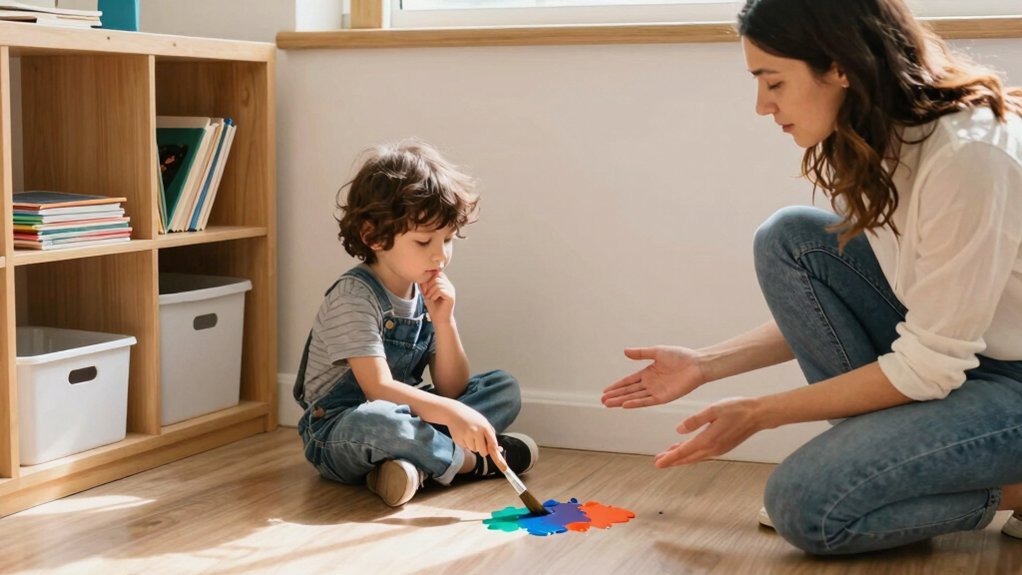
You pair age‑appropriate choices with clear, consistent boundaries so natural outcomes become logical lessons rather than punishments. Offer two options—like two socks or two snack choices—so the child decides within safe limits. When a spill happens, step in calmly, wipe it up, and say, “Let’s try again,” linking the consequence directly to the action. This approach builds responsibility, confidence, and problem‑solving, and if you keep going you’ll discover how to scale it from preschool to middle school.
What Is “Freedom Within Limits” for Parents?

What does “freedom within limits” really mean for parents? It means you give your child age‑appropriate choices while keeping clear, consistent boundaries that nurture self‑mastery. You set up a prepared environment—organized routines, selectable tasks, and predictable daily structures—so independence feels safe, not chaotic. When your child opts for a snack, you let them experience the natural consequences of feeling full or still hungry, without stepping in to punish. Your redirection is calm and deliberate, guiding them to consider others and the setting. By respecting logical, respectful limits, you turn freedom into meaningful self‑discipline, helping your child learn responsibility through everyday experiences. Using tools with features like clear temperature guides can also support teaching moments by promoting safe, independent exploration in everyday activities.
How Natural Consequences Reinforce Freedom Within Limits
You set clear boundaries, so when a child’s action triggers a natural consequence, the result feels logical and fair.
Those outcomes teach responsibility by showing how choices directly affect the environment and the child’s own experience.
As the child sees the link between action and result, they gain confidence to make better decisions and grow within the limits you’ve established.
Using tools that promote fine motor skill development can also reinforce learning through practical, hands-on activities.
Logical Demonstrates Sets Boundaries
How can a child learn responsibility without feeling punished? You show them natural consequences that line up with the rule they broke, so the outcome feels like a logical step, not a punishment. When a toy is left out and it gets stepped on, you calmly help the child clean up, linking the action to the result. This steady pairing of clear expectations—like keeping a plate on the table—creates firm boundaries while preserving freedom. By staying present and guiding them through the required action, you reinforce responsibility and self‑regulation. Consistent use of these consequences internalizes discipline, letting the child understand limits and act independently within them. Incorporating Montessori-inspired wooden puzzles can further support this learning by encouraging independent exploration and problem-solving within set boundaries.
Logical Outcomes Teach Responsibility
Ever wonder why a child who learns the direct link between action and outcome feels freer, not punished? When you let natural consequences unfold, you give kids a clear, logical link between what they do and what follows. If a toy isn’t returned, it becomes temporarily unavailable, teaching the child responsibility without a lecture. You stay calm, consistent, and avoid impulsive reactions, so the child sees the limit as a fair rule, not a punishment.
This approach builds self‑regulation, problem‑solving, and ownership of learning. By aligning outcomes with actions, you reinforce freedom within limits, allowing the child to internalize responsible choices and develop lasting self‑discipline. Using Montessori tools like the Cosyland Toddler Step Stool with Removable Side Guard can further encourage independence by providing safe support as children learn.
Choices Lead To Growth
When logical outcomes show a child that leaving utensils out means a delayed snack and an extra cleanup, the choice becomes a teacher rather than a punishment. You see how natural consequences turn everyday mishaps into lessons about freedom within limits.
By offering a work material and then asking the child to return it, you nurture autonomy while showing that actions have ripple effects. The child learns cause‑and‑effect, internalizes responsibility, and begins to anticipate outcomes.
Over time you’ll notice stronger task persistence, sharper problem‑solving, and calmer dynamics as the child adapts to these logical results. This cycle of choice, consequence, and reflection fuels growth, reinforcing self‑regulation and confidence. Practical tools like a compact mini dustpan and brush combo support this learning by empowering children to manage small messes independently.
Setting Age‑Appropriate Boundaries Without Stifling Choice
You’ll set clear, age‑appropriate limits that still let kids pick among a few meaningful options, so they feel in control while staying safe.
By offering choice‑focused materials—like a set of tools that each serve a specific purpose—you guide them toward the right behavior without micromanaging.
When they test a boundary, the natural consequence that follows reinforces the rule and keeps the learning environment orderly.
Choice Scoping Limits
How can you set boundaries that feel like freedom rather than restriction? You create Montessori boundaries that nurture autonomy while keeping safety and order intact. By defining clear, logical limits, you give children a framework where choices matter and consequences are natural. Your role is to model calm enforcement and gentle redirection, preserving independence within structured limits.
- Limit material access to age‑appropriate shelves, allowing toddlers a few toys to pick from.
- Designate work areas where children move freely only while engaged in chosen activities.
- Use consistent rules—materials must return to their place before starting a new task.
- Observe readiness and gradually expand options as concentration and self‑regulation grow.
These boundariesWithinLimits support a and fostering autonomy,, without autonomy. Additionally, choosing tools designed with age ranges and developmental suitability helps maintain safety while encouraging skill growth.
Choice‑Focused Materials
Ever wonder how a simple shelf can become a powerful tool for autonomy? In a Montessori environment you place a low, curated shelf with just a few age‑appropriate toys or activities. Those choice‑focused materials give children freedom within limits: they can pick, experiment, and return items, but the selection stays small enough to keep focus and safety. A snack station might offer two or three healthy options, and a sequencing board guides the order of steps without open‑ended chaos. You, the materials, matching them to developmental readiness and gradually expanding the range as independence grows. This structure lets kids practice self‑regulation, responsibility for their choices, and respect for shared spaces—all while feeling empowered. Choosing natural play silks that are safe, durable, and sized appropriately can enhance sensory exploration within these carefully considered boundaries.
Creating a Toddler‑Friendly Prepared Environment
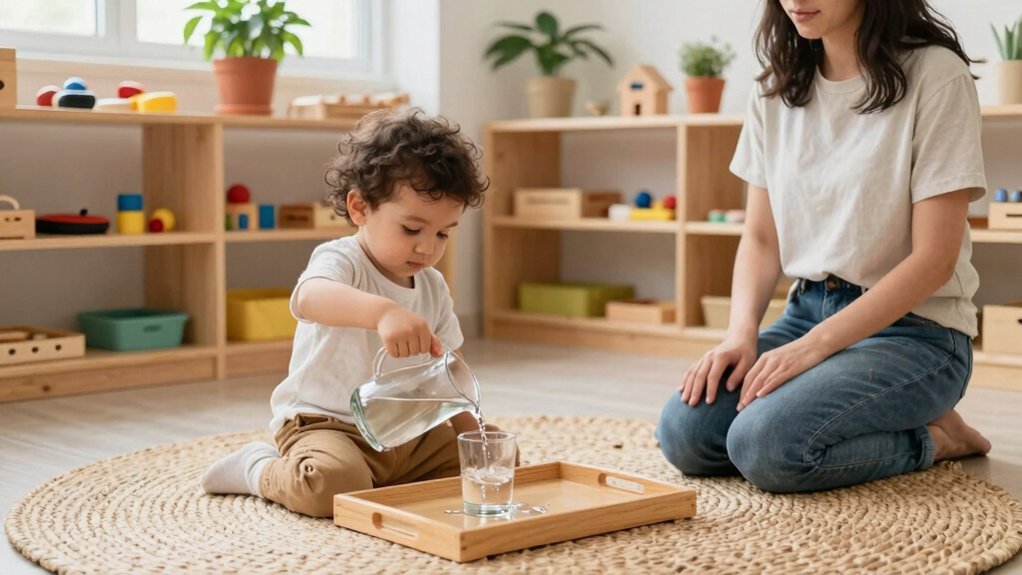
Ever wondered how a toddler can explore independently while staying safe? You can set up a prepared environment that balances freedom and limits, letting your child make simple choices without risking danger.
Create a safe, prepared space where toddlers freely explore, making simple, supervised choices.
Place a curated selection of toys on low shelves so they can reach and focus on one item at a time.
Offer two socks or shoes and two snack options to teach decision‑making within safe boundaries.
Keep dishes and water in the sink or a designated area, letting your toddler help with real‑life tasks under your watchful eye.
The routine stays flexible, yet consistent, and your presence guides self‑directed learning.
Parent‑Guided Water‑Safety Within Freedom‑Within‑Limits
After setting up low shelves and dual‑choice options, you can extend the same freedom‑within‑limits philosophy to water safety. You let your child reach for real dishes and a cup of water, but you keep the faucet at a low height and stay nearby. When they pour, you watch for spills; if a splash lands on the floor, the natural consequences—wet feet, a quick wipe, and a brief pause—teach them to control the flow. You answer questions about floor water with a calm “no,” reinforcing boundaries while encouraging independent decision‑making. Supervision is present but not hovering, so the child feels trusted. This approach blends water safety, freedom within limits, and natural consequences into everyday routine.
Language That Supports Freedom Within Limits

Language that supports freedom within limits hinges on calm, respectful phrasing that links a rule to its logical outcome—“If you spill water, we dry the table and put the towel back.” By offering choices (“You can put the book back on the shelf or ask for help”), you honor the child’s autonomy while keeping boundaries clear. Use brief, observable language, match the child’s readiness, and frame natural consequences as helpful, not punitive. Reflective prompts invite problem‑solving and reinforce why the limit exists.
- State the rule, then the logical outcome.
- Offer two concrete, positive choices.
- Tie the explanation to the child’s current behavior.
- Ask a reflective question to guide next steps.
These steps embed freedom within limits and make natural consequences clear.
The “Try Again” Strategy Within Freedom‑Within‑Limits Parenting
How can you turn a child’s mistake into a calm learning moment? Use the “try again” strategy. When a rule is broken, apply a natural consequence that mirrors the misstep, then gently guide the child back to the correct behavior.
Offer a brief pause and say, “Let’s try again,” giving them a chance to redo the task—like returning a toy to its spot—without shaming. This approach fits freedom within limits, because the child experiences the result of their action while still feeling safe to correct it.
Scaling Freedom and Limits From Preschool to Middle School
Ever wonder how the same principle of freedom within limits can stretch from a toddler’s tiny shelf choices to a middle schooler’s self‑directed projects? You’ll see the shift from simple, short tasks to extended, self‑managed projects, each stage building graduated responsibility and self‑regulation. The prepared environment evolves: preschoolers pick from a few shelves, middle schoolers plan, collaborate, and manage materials within clear group norms. Guidance moves from direct instruction to subtle facilitation, letting natural consequences internalize.
- Preschool – limited choices, immediate cues.
- Early elementary – slightly broader options, short reflections.
- Upper elementary – independent planning, peer feedback.
- Middle school – long‑term projects, logical consequences, self‑regulation.
Frequently Asked Questions About Freedom Within Limits in Montessori Parenting
Curious about how freedom within limits actually works at home? You’ll find that Montessori parenting lets kids pick tasks and move within safe, respectful boundaries while you stay ready with natural consequences. When a rule’s broken, you give a gentle reminder, then a logical outcome—like a spilled block set prompting cleanup—that teaches cause and effect without punishment. You observe readiness, offering materials that match development, and you redirect kindly if they stray. Consistent routines and calm modeling help them internalize limits, building self‑discipline and responsible choices. Questions often arise about balance, but remembering that freedom within limits is about guided autonomy, not laissez‑faire, keeps the approach clear and effective.
Frequently Asked Questions
How Do Cultural Differences Affect “Freedom Within Limits” Implementation?
Cultural norms shape how you set boundaries and interpret autonomy; collectivist societies may stress group harmony over individual choice, while individualist cultures often prioritize personal freedom, altering both expectations and enforcement.
Can “Freedom Within Limits” Be Applied to Children With Special Needs?
Yes, you can apply freedom‑within‑limits to children with special needs; adapt boundaries to their abilities, offer clear choices, and reinforce natural outcomes, fostering autonomy while ensuring safety and support.
What Role Does Technology Play in Enforcing Natural Consequences?
Technology lets you set clear, automatic outcomes—like timed lockouts or usage caps—so kids see immediate results of their actions, reinforcing responsibility without constant adult supervision.
How Should Parents Handle Sibling Rivalry Under “Freedom Within Limits”?
You set clear boundaries, let them negotiate, and intervene only when safety or fairness is at risk, so they learn respect, empathy, and self‑regulation while enjoying their freedom.
Is “Freedom Within Limits” Compatible With Religious or Spiritual Teachings?
Yes, you’ll find “freedom within limits” aligns with many religious and spiritual teachings that emphasize balance, responsibility, and self‑discipline, encouraging you to nurture growth while respecting moral boundaries.