
Create a predictable, child‑sized environment with low shelves and clear zones, then set a consistent daily routine that mirrors the 0‑6‑year planes. Offer language‑rich moments—talk, label, read aloud—while using sandpaper letters and sight‑word cards for early literacy. Provide hands‑on sensorial and motor activities like the Pink Tower, crawling tunnels, and practical‑life tasks that match each sensitive period. Encourage graceful social interactions through cooperative work and modeled courtesy. Keep exploring, and you’ll discover deeper ways to support each developmental stage.
Apply Montessori Developmental Stages to Create a Predictable Environment
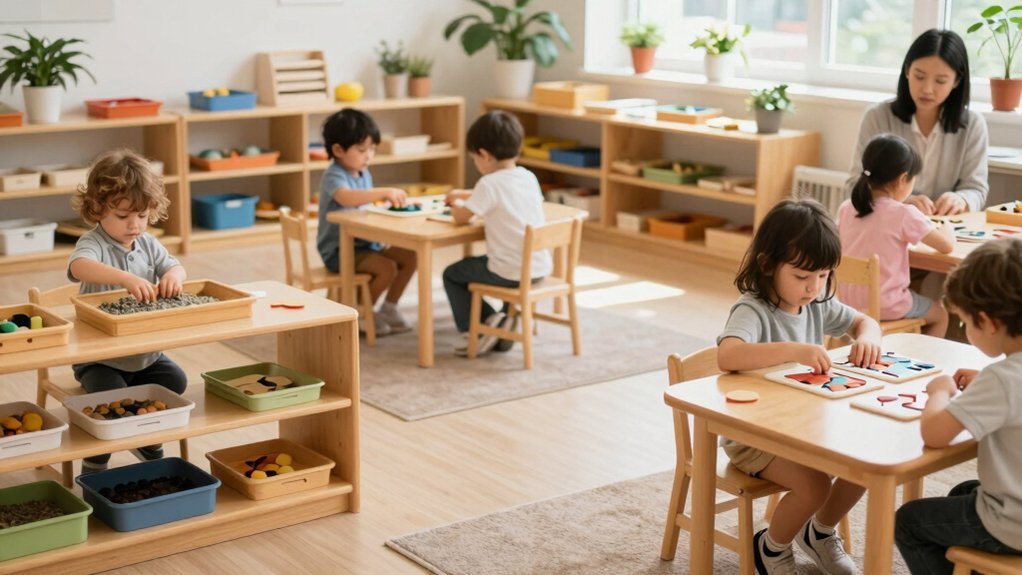
By aligning your classroom with the 0‑6‑year plane—splitting it into the absorbent phase (0‑3) and early childhood (3‑6)—you create a predictable environment that matches children’s sensitive periods for movement, language, sensorimotor exploration, and order. You set up a prepared environment using child‑sized furniture and low shelves, so every material is within reach and invites independent work. Organize the space into three‑year cycles, letting the absorbent mind progress from simple to complex tasks as the first plane of development unfolds.
Predictable routines—arrival, work cycle, snack, cleanup—reinforce grace and courtesy while minimizing external coercion. Observe each child’s pacing, adjust the sequence, and let the age 0–6 window guide your choices, ensuring natural exploration and self‑correction. Including tools with clear safety features and certifications supports a secure and trustworthy environment for young learners.
Set up a Child‑Friendly Order and Routine Aligned With Sensitive Periods
A predictable environment sets the stage for a child‑friendly order and routine that syncs with the sensitive period for order (6 months–3 years).
You arrange a prepared environment with low shelves, labeled cubbies, and one‑place‑one‑use items so the child knows where everything belongs.
Keep the daily schedule consistent: arrival, practical life work, snack, free choice, and goodbye.
Integrate Practical Life activities—washing tables, pouring water, arranging flowers—to build concentration and independence.
Integrate Practical Life activities—washing tables, pouring water, arranging flowers—to foster concentration and independence.
For 0–3 years, focus on simple, repeatable tasks; for 3–6 years, expand the spiral‑sequential materials, still within the same domain, to deepen order understanding.
This routine nurtures social development, reinforces the Montessori sensitive periods, and gives the child a reliable framework for growth.
Choosing tools like a Montessori kitchen helper tower can further support independence and growth through practical life activities.
Introduce Language‑Rich Experiences That Match the Birth‑to‑Six Sensitive Period

How can you turn everyday moments into language‑rich experiences that honor the birth‑to‑six sensitive period? You start by creating a language‑rich environment: speak clearly, label objects, describe actions, and invite questions. Your verbal interaction builds receptive language and speaking language while you read aloud, sing, and narrate daily routines. Use Montessori materials—like sandpaper letters and picture cards—to introduce early writing and alphabet awareness around age three and‑five.
Rotate simple sight‑word cards and let children trace them, fostering reading readiness. Keep conversations purposeful, repeat key vocabulary, and pause for the child to respond. By weaving these practices into meals, play, and cleanup, you nurture language development throughout the sensitive period. Supporting a child’s independence with tools like the Kitchen Step Stool for Kids with Safety Rail encourages confidence during these formative years.
Design Hands‑On Sensory‑Motor Activities for Movement and Sense Development
Where can you find the perfect blend of movement and sense exploration for a child’s sensitive period? In a Montessori prepared environment, you stage birth‑on activities that weave gross and fine motor development with sensory discovery.
Offer outdoor/indoor tasks like crawling tunnels, rolling balls, and indoor threading or drawing to nurture pincer grip and coordinated movement.
Rotate sensorial materials—Knobbed Cylinders, Pink Tower, Red Rods, Smelling Bottles, Bell/Tone Bars—so the child repeatedly refines order, attention, and independence.
Embed Practical Life chores such as table washing, food preparation, and flower arranging; these give purpose, build concentration, and reinforce motor skills.
Spiral the sequence over three years, gradually increasing complexity while preserving the child‑sized tools and clear work zones that support self‑directed exploration during these sensitive periods.
For language growth, incorporating Noun and Verb Classification Activities can further enhance vocabulary and grammar understanding alongside motor skills.
Teach Graceful Social Interactions and Independence Through Cooperative Tasks
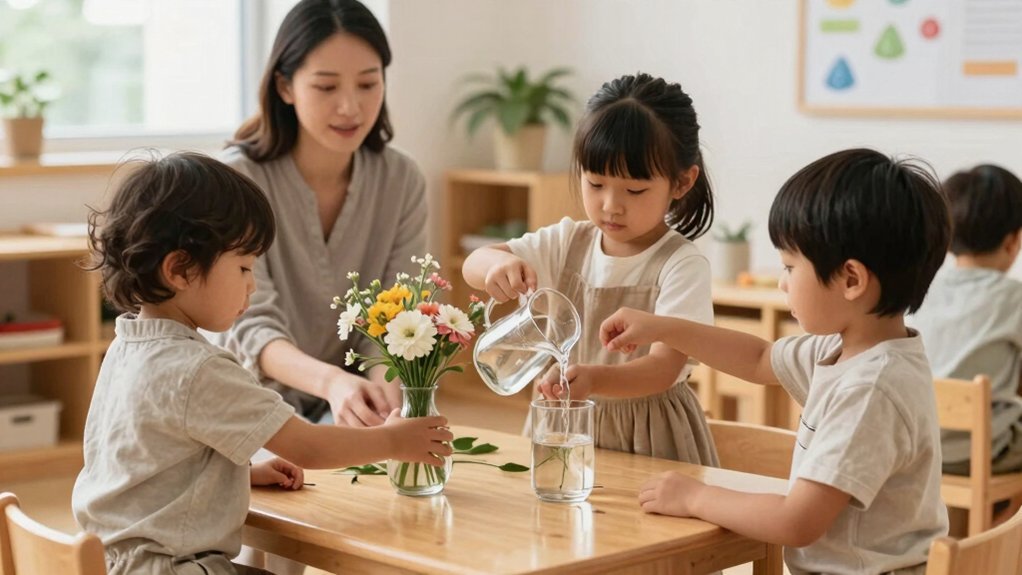
Ever wondered how a simple group activity can turn a child’s natural curiosity into graceful social skill? You can shape graceful social interactions and independence by designing cooperative tasks that match the social window and sensitive periods. A prepared environment with low shelves, clearly labeled trays, and simple rules invites turn‑taking, sharing materials, and self‑regulation. Model grace and courtesy—please, thank you—while children clean, sort, or tell stories together. Observe their choices, then adjust the setup to keep cooperation smooth and purposeful. Incorporating age-appropriate tools such as Montessori kitchen tools can further enhance independence and confidence in practical life skills.
| Task | Goal | Expected Skill |
|---|---|---|
| Shared cleaning | Turn‑taking, independence | Graceful social interactions |
| Collaborative story building | Sharing materials, self‑regulation | Grace and courtesy |
| Group sorting game | Cooperation, social window | Independence |
Frequently Asked Questions
How Can I Adapt Montessori Materials for Children With Sensory Processing Challenges?
You can simplify textures, dim lighting, and offer quieter tools; use weighted or soft objects, break tasks into short steps, and let kids choose materials that feel soothing while still encouraging independent exploration.
What Signs Indicate a Child Is Entering a New Sensitive Period?
You’ll notice heightened curiosity, intense focus on a specific activity, repeated attempts to master it, and spontaneous exploration of related skills—these cues signal a new sensitive period emerging.
How Do I Balance Montessori Independence With Safety in High‑Risk Activities?
You set clear, simple rules, supervise lightly, and choose age‑appropriate tools; let kids try, step back when they’re safe, and intervene instantly if danger appears, fostering confidence and responsibility.
Can Montessori Principles Be Applied in Multilingual Households?
Yes, you can weave Montessori principles into multilingual homes by offering materials in each language, encouraging child‑led exploration, and respecting their developmental pace while fostering cultural curiosity and linguistic confidence.
What Role Should Technology Play in a Montessori‑Prepared Environment?
You should treat technology as a purposeful tool, not a distraction; let it support hands‑on exploration, reinforce concepts, and foster independence, while always prioritizing tactile, real‑world experiences first.




Leave a Reply