

Montessori screen time guidelines prioritize hands-on learning over passive viewing because your child’s development depends on tactile exploration, sensory engagement, and real-world manipulation. You’ll want zero screens from birth through 18 months, then gradually introduce quality content with co-viewing. For school-age children, limit screen time to one to two hours daily, always followed by hands-on activities that reinforce learning. Keep devices out of bedrooms and dining areas, power down an hour before sleep, and model balanced tech habits yourself. Understanding how screens actually impact your child’s motor skills, focus, and sleep reveals why this framework matters most.
Why Montessori Rejects Passive Screen Time
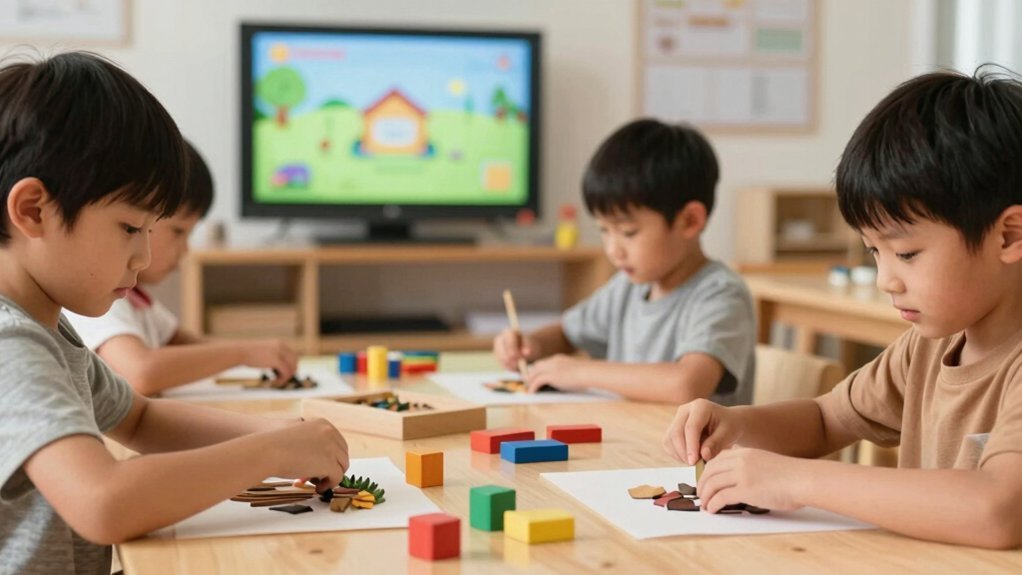
Why does the Montessori method fundamentally oppose passive screen time? Because it contradicts everything Montessori education stands for.
You’re meant to be an active creator of your learning, not a passive recipient watching content unfold.
When you use screens, you’re positioned in a stationary role that replaces the hands-on exploration essential to development.
Real Montessori materials invite you to manipulate, experiment, and discover through direct experience.
Screens eliminate this active engagement.
You miss out on developing fine-motor skills, problem-solving abilities, and genuine curiosity.
You’re not negotiating with peers, moving freely, or engaging your senses meaningfully.
Instead of imagining solutions, you consume pre-made answers.
During the absorbent mind period of early childhood, the brain is primed for rich sensory experiences and human interaction that screens simply cannot replicate.
Montessori rejects screens because they fundamentally undermine the independence and active learning that drive authentic development.
Age-Specific Screen Limits From Birth to Teens
You’ll find that Montessori screen time recommendations shift dramatically as your child grows from birth through the teen years, with infants requiring near-total avoidance while older children can handle gradual increases in quality content. Each developmental stage—from toddlerhood through school-age and into the teen years—demands different limits that align with your child’s emerging cognitive abilities and social needs. Understanding these age-specific boundaries helps you create intentional media practices that support Montessori principles rather than undermine them. Australian Health guidelines suggest limiting to no more than one hour daily for 2-5-year-olds, reflecting the importance of protecting early childhood development through balanced screen exposure.
Birth Through Toddlerhood
Screen time in early childhood fundamentally shapes how your child’s brain develops. Zero screen time is recommended from birth through 18 months, with the exception of live video calls with family. From 18 to 24 months, you can introduce high-quality educational content only while co-viewing together.
For ages 2 to 3, limit screen time to one hour daily of quality programming that you watch alongside your child. Consider these guidelines:
- Prioritize active screen time with interaction over passive viewing
- Avoid screens 90 minutes before bedtime
- Keep bedrooms screen-free zones
- Replace screen time with physical play and multi-sensory experiences
Model healthy screen habits yourself. Research shows excessive screen time alters brain architecture and delays developmental milestones. Movement aids learning about the environment and supports the physical development that screens cannot provide during these critical early years.
School-Age And Teens
As your child enters school, screen time management becomes increasingly complex, yet the foundational principle remains constant: quality matters more than quantity. You should limit screen time to 1-2 hours daily across early school age through adolescence, prioritizing educational content over passive entertainment.
Research demonstrates that children exceeding these guidelines suffer developmental setbacks. Kids ages 8-10 currently average six hours daily on screens, contributing to physical inactivity and reduced outdoor engagement. You’ll notice that interactive educational games and problem-solving activities align better with Montessori values than passive cartoons. Studies show that limiting screen time to less than 30 minutes daily is linked to reduced loneliness and depression in children.
Establishing structured schedules for homework, outdoor play, and screen use helps your teen develop healthy technology habits. Consistent monitoring ensures screens support rather than hinder development throughout these critical growth periods.
What Screens Do to Your Child’s Touch, Balance, and Coordination
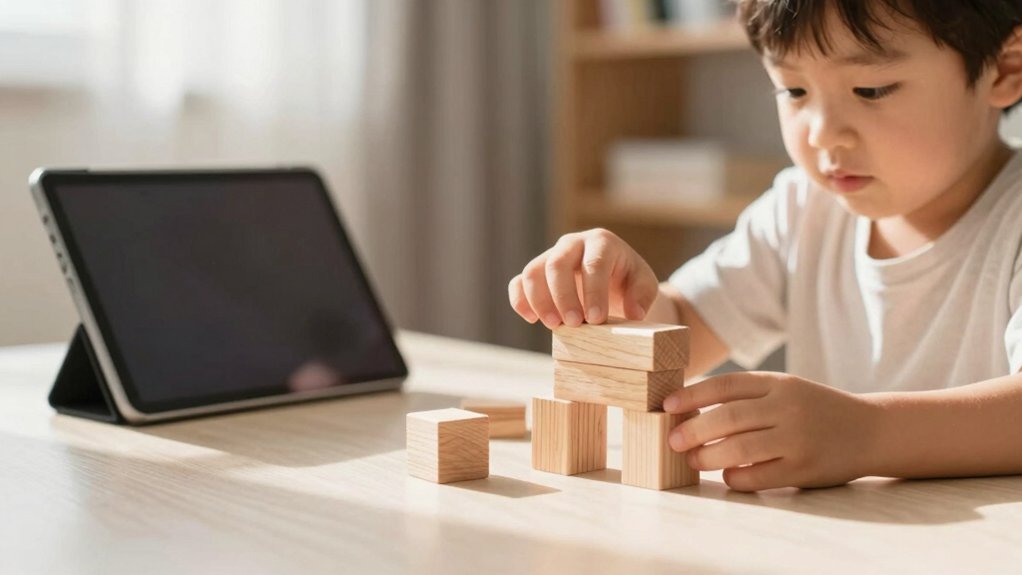
The developing child’s body relies on constant physical engagement to build the neural pathways that control movement, balance, and fine-motor skills—and excessive screen time disrupts this critical process. When you prioritize screens over hands-on play, you’re limiting your child’s motor development in measurable ways.
Excessive screen time disrupts the neural pathways children need to develop movement, balance, and fine-motor skills through hands-on play.
Research shows that heavy screen usage creates documented problems:
- Visual-motor integration weakens with increased touch screen time (correlation: r = −0.37)
- Fine-motor skills like drawing and grasping decline markedly by age 2
- Balance development suffers when physical activity replaces screen engagement
- Overall motor coordination lags in children with four+ daily hours of screen exposure
Your child’s coordination, dexterity, and physical confidence depend on real-world movement, not repetitive swiping. Non-electronic play builds the motor skills screens simply can’t develop. Activities such as sand play, dough-molding, bead threading, and block building provide the varied tactile experiences necessary to counteract the limitations of repetitive touch-based device interactions.
How Excessive Screen Time Affects Sleep and Focus
While your child’s body suffers from sedentary screen habits, their brain faces a different but equally serious threat: sleep deprivation and attention problems.
Screen exposure suppresses melatonin production, delaying sleep onset and shortening total sleep duration. Each hour of screen time costs approximately 10 minutes of sleep in young children. Blue light disrupts circadian rhythms, particularly affecting preschoolers whose larger pupils absorb more light than adolescents.
| Age Group | Sleep Impact | Quality Reduction | REM Sleep Effect | Attention Consequence |
|---|---|---|---|---|
| Preschool | 10 min/hour | Severe | Significant | Hyperactivity increase |
| School-age | Delayed onset | Moderate | Reduced | Focus problems |
| Adolescent | Late bedtimes | Moderate-severe | Notable | Academic decline |
Poor sleep quality directly triggers hyperactivity, anxiety, and depression. Your child’s struggling attention isn’t laziness—it’s neurological exhaustion demanding restorative sleep. Sleep disturbances create a positive feedback loop where inadequate rest intensifies behavioral issues, which further disrupts sleep patterns the following night.
Creating Screen-Free Zones in Your Home
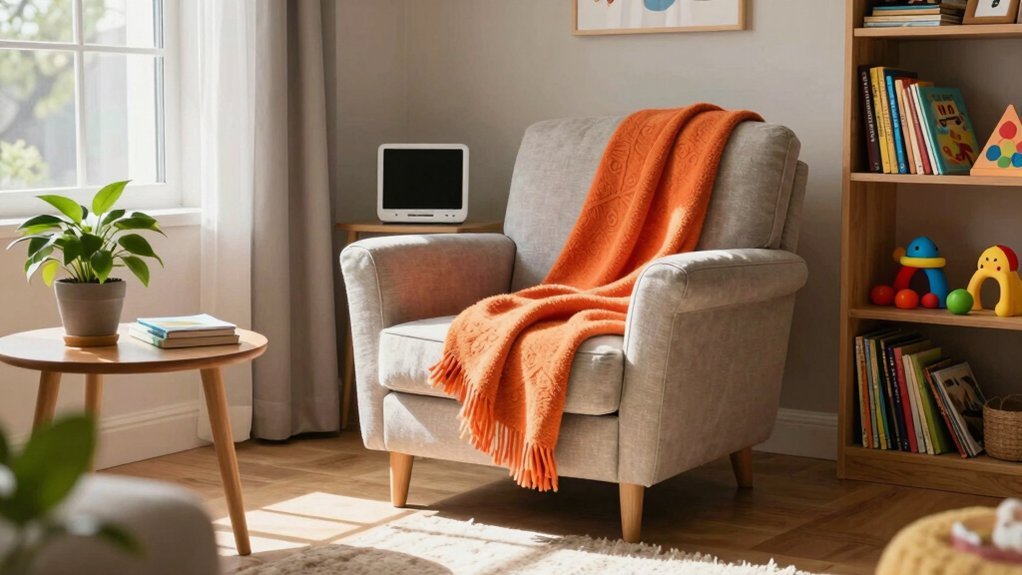
Your home’s physical layout shapes your child’s behavior more powerfully than rules alone ever could. By strategically designating screen-free zones, you create natural boundaries that support healthier development.
Consider these key areas:
- Bedrooms—establish them as tech-free sanctuaries to promote quality sleep and relaxation
- Dining spaces—reserve mealtime areas for face-to-face conversation without digital distractions
- Common areas—create play zones with child-sized furniture that redirect toward hands-on engagement
- Reading nooks—set up dedicated spaces for independent exploration and creative activities
Keep screens in supervised common areas only. Turn off televisions during daytime hours and power down devices an hour before bedtime. Model screen-free behavior yourself during meals and designated times. This intentional approach aligns with Montessori principles by supporting self-regulation while encouraging real-world exploration and practical skill-building. Creating these environmental supports reduces the need for constant adult intervention, allowing children to naturally gravitate toward hands-on activities and develop independence through their surroundings.
Preventing Tantrums and Negotiation: Setting Non-Negotiable Screen Limits
Once you’ve established screen-free zones throughout your home, the next critical step is defining exactly when and how long screens are available—and committing to those limits without exception.
Non-negotiable boundaries prevent endless discussions and tantrums. When you set firm limits with visual timers, children understand what to expect and transition away from screens more smoothly. This predictability reduces resistance because kids aren’t constantly negotiating for “just five more minutes.” Research shows that blue light exposure before bedtime can significantly disrupt a child’s sleep patterns, making evening screen cutoffs particularly important for their overall health and development.
| Age Group | Daily Limit | Best Practice | Enforcement |
|---|---|---|---|
| Under 2 | Zero | No screens | Consistent boundaries |
| Ages 2-5 | 1 hour max | Interactive content | Kitchen timer |
| Ages 5-17 | 2 hours max | Designated times | Clear end point |
| All ages | 90 min before bed | Screen-free wind-down | Reduced brightness |
Your unwavering commitment to these limits teaches self-regulation and demonstrates that boundaries aren’t flexible based on circumstances or mood.
High-Quality Content vs. Entertainment Consumption
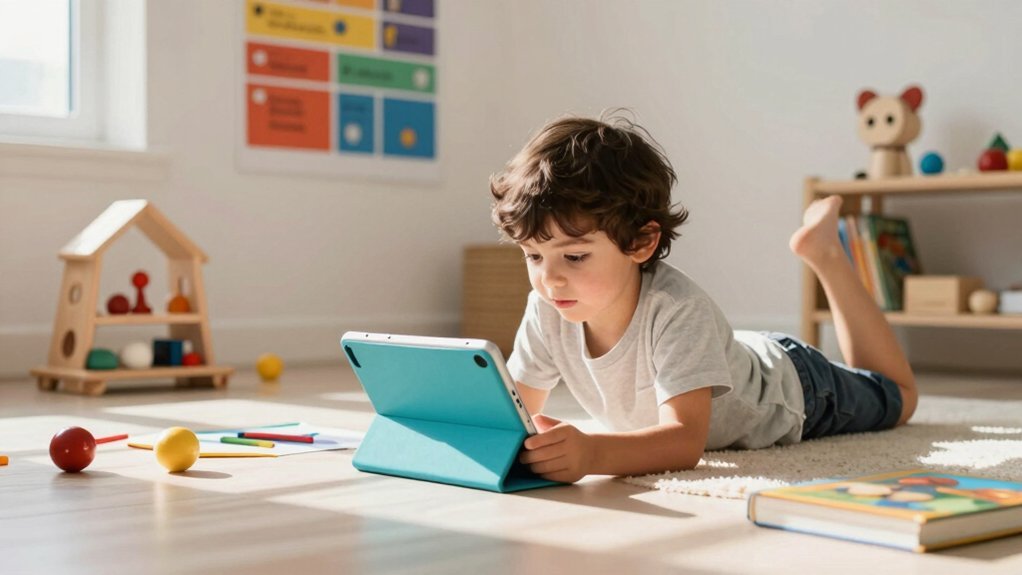
You’ll want to distinguish between content that builds skills and content designed primarily for entertainment—the difference fundamentally shapes your child’s relationship with screens. Interactive programs featuring real people and hands-on learning opportunities engage your child’s critical thinking, while passive cartoons and endless video streams encourage mindless consumption that contradicts Montessori principles. Selecting developmentally appropriate material that aligns with your child’s interests and stage ensures screens serve as purposeful tools rather than recreational babysitters. Co-viewing these programs with your child strengthens the learning experience by enabling discussion and contextual understanding that deepens engagement with the content.
Educational Content Selection Strategy
How do we distinguish between content that genuinely supports a child’s development and entertainment that merely occupies their attention?
You’ll want to apply intentional selection criteria when choosing educational material. Consider these key strategies:
- Prioritize quality over quantity—select short, purposeful content aligned to your child’s developmental stage rather than lengthy viewing sessions
- Opt for interactive programs that prompt engagement over passive cartoons that require no participation
- Link screen content to real-world activities, like nature documentaries followed by outdoor exploration. Research shows that multi-sensory experiences are essential during preschool years when early experiences shape neural development and foundational brain networking.
- Use supportive features such as blue light filters to reduce stimulation during approved viewing
Passive Versus Interactive Learning
What separates genuinely developmental screen experiences from mere distraction? The critical distinction lies in whether your child actively engages or passively consumes.
When you choose interactive apps like Khan Academy Kids, your child becomes a creator solving problems and exploring concepts. You’re aligning with Montessori principles that value active participation over passive reception. Co-viewing amplifies this benefit—you can point out details and spark conversations that deepen understanding.
Conversely, endless cartoons represent entertainment consumption that interferes with development. Passive viewing engages only eyes and ears, ignoring your child’s body, mind, and emotions. You’ll notice this preference signals developmental red flags when screens replace hands-on play. Research shows that excessive screen time and challenges in attention, sleep, and social-emotional development are closely linked, making the choice between active and passive viewing even more consequential.
The solution? Intentionally select content encouraging interaction and real-world skill application. Turn passive viewing into purposeful learning through your active involvement and thoughtful content curation.
Developmental Alignment And Engagement
Now that you’ve identified which screen experiences truly engage your child, the next consideration is whether that content actually supports their developmental needs.
Your child’s age determines appropriate screen time limits and content types:
- 18-24 months: Limit co-viewed educational content to 15-20 minutes maximum
- 2-5 years: High-quality programming capped at one hour daily per AAP guidelines
- Preschoolers: Interactive or purposeful content only, restricted to 0-1 hour daily
- Under 6 years: Prioritize hands-on activities for optimal brain development over screens
The Montessori philosophy treats technology as a tool, not a necessity. You’ll strengthen your child’s learning by linking screen content directly to real-world interests—watching a cooking tutorial before baking together, for example. Tangible materials and real-world tasks enhance focus and persistence far more effectively than passive screen consumption. Follow screen time immediately with hands-on activities, ensuring screens complement rather than replace tactile, creative experiences essential for development.
Co-Viewing and Extending Learning Beyond the Screen
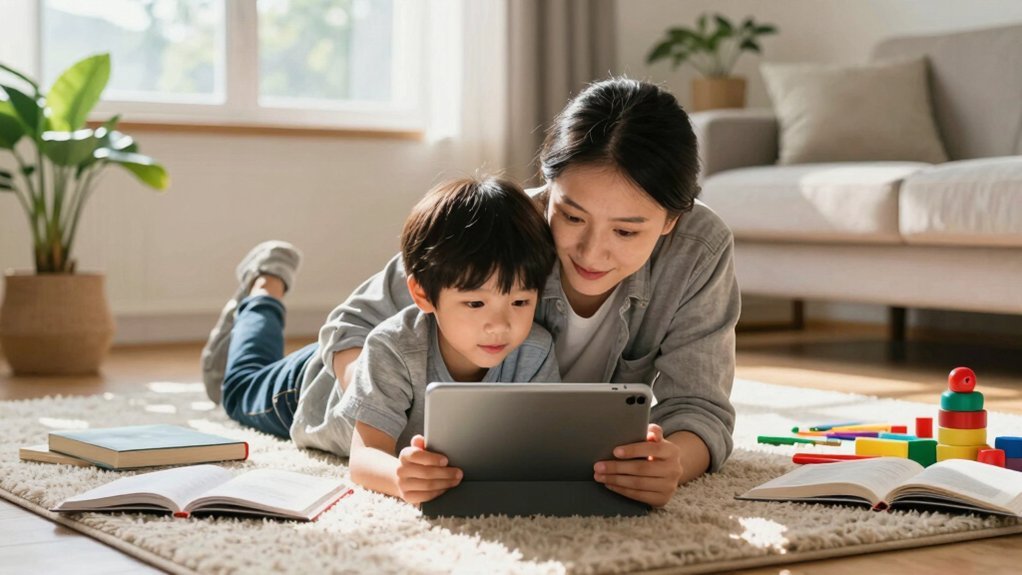
When you’re sitting beside your child during screen time, you’re transforming passive viewing into an interactive learning experience that mirrors how children naturally develop—through connection, conversation, and meaningful context. You’ll pause videos to discuss ideas, answer questions, and provide explanatory details that deepen understanding.
The real learning happens after the screen turns off. You might sketch pictures from a nature documentary, explore your garden to spot creatures you watched, or cook a recipe inspired by something you viewed together. These hands-on extensions solidify concepts and build critical thinking skills. By engaging in screen-free activities afterward, you reinforce the vocabulary and comprehension your child gained during co-viewing and help them apply new knowledge to their physical world.
Building Daily Routines That Keep Screens Secondary
You’ll build a Montessori-aligned routine by establishing screen-free zones throughout your home, particularly in bedrooms and dining areas, which physically reinforces that screens aren’t central to family life. Scheduling purposeful screen time at predictable moments—like after lunch or following outdoor play—prevents constant requests and positions digital activity as a structured reward rather than a default option. Modeling balanced tech habits yourself demonstrates that screens serve specific purposes in your life, teaching your children through observation that technology doesn’t dominate your attention or theirs. Consider establishing must-dos before screens, such as completing homework, practicing an instrument, or spending time outdoors, which reinforces that screen access is earned through completing meaningful activities first.
Creating Screen-Free Zones
Establishing physical spaces where screens don’t belong forms the foundation of a balanced Montessori environment. You’ll create intentional zones throughout your home that support screen-free engagement and deeper focus.
- Bedrooms – Designate sleeping areas as technology-free sanctuaries that promote relaxation and quality sleep without digital distractions.
- Dining areas – Keep meal spaces free from screens to encourage face-to-face conversation and mindful eating together.
- Play zones – Maintain hands-on activity areas with building blocks, puzzles, and art supplies that naturally draw your child’s attention away from devices.
- Storage solutions – Store devices out of sight in non-screen zones to limit accessibility and reduce temptation.
You’ll notice that removing screens from these spaces naturally shifts your child’s focus toward creative play and meaningful interactions.
Scheduling Purposeful Screen Time
Now that you’ve created physical spaces free from screens, the next step involves building routines that keep digital devices secondary to meaningful activities. You’ll schedule screens at specific times—perhaps after lunch—rather than allowing random access throughout the day. This integration into your routine reduces demands for unscheduled viewing and establishes predictable boundaries.
You should stop screens at least 90 minutes before bedtime to allow proper wind-down. Avoid screens during meals to prioritize family interaction and digestion. By placing purposeful activities like practical life tasks before screen time, you reinforce that hands-on learning takes priority. Use visual timers to enforce limits, and consider tying screen access to completed routines, making it a privilege rather than an entitlement.
Research from the American Academy of Pediatrics supports the maximum 2 hours daily recommendation for children’s sedentary screen time to support healthy development.
Modeling Balanced Tech Habits
The most powerful way to shape your child’s screen habits is through your own behavior. When you demonstrate mindfulness about your device use, you’re teaching self-regulation more effectively than any rule ever could.
Consider these practical approaches:
- Keep your phone out of sight during family meals and playtime
- Put devices away an hour before bedtime to model sleep hygiene
- Engage in screen-free activities alongside your child daily
- Acknowledge when you’re using screens purposefully versus habitually
Your consistent moderation creates a household culture where screens remain tools, not defaults. Children internalize what they observe, adopting your balanced approach as their own standard. This modeling establishes the foundation for lifelong healthy tech habits, far more influential than any restriction you could impose.
How Hands-On Work Builds Focus, Problem-Solving, and Independence
Why do children in Montessori classrooms develop stronger focus than their traditionally schooled peers? You’ll find the answer in sustained, uninterrupted hands-on work that engages multiple brain areas simultaneously. When you choose your own activities and manipulate concrete materials—like counting beads or tracing letters—you’re building fine motor skills while strengthening executive function.
| Skill Development | Mechanism | Outcome |
|---|---|---|
| Focus | Long work periods + sensory engagement | Higher attention scores by kindergarten |
| Problem-Solving | Self-paced experimentation | Deeper comprehension than rote learning |
| Independence | Child-directed choices + cleanup | Intrinsic motivation and self-regulation |
You’re not just learning academically; you’re developing self-discipline and decision-making autonomy. This hands-on approach cultivates lasting cognitive benefits that persist into middle school, unlike traditional preschool advantages that fade. These concrete materials activate multiple sensory pathways, allowing children to construct deeper understanding through physical engagement rather than passive observation.
Why Montessori Prioritizes Real Experiences Over Screens
When you engage your child with hands-on materials—sorting, building, pouring—they’re developing sensory pathways that screens simply can’t activate. Physical manipulation of real objects teaches your child how the world actually works, building genuine problem-solving skills grounded in concrete experience rather than passive observation. This tactile foundation creates the neural connections necessary for abstract thinking later, making real experiences the irreplaceable building block of Montessori learning.
Hands-On Learning Builds Deeper Understanding
At the heart of Montessori education lies a fundamental truth: you’ll retain what you touch, manipulate, and discover far better than what you passively observe on a screen.
When you engage with hands-on materials, multiple brain regions activate simultaneously—creativity, problem-solving, cognition, sensory, and motor areas all fire together. This neural integration strengthens memory into your teenage years.
Consider how tangible learning works:
- Manipulating math blocks transforms abstract numbers into concrete understanding
- Sequencing cards and movable alphabets build language skills through active testing
- Sketching animals and observing weather develops conceptual science knowledge
- Touching soil while gardening embeds pollination concepts through direct experience
Screens offer passive observation; Montessori materials demand active participation. You construct meaning through your own hands, building conceptual understandings that transfer to real-world applications—the foundation of genuine learning. This immersive intellectual engagement is what distinguishes Montessori’s approach from conventional screen-based instruction.
Sensory Development Requires Physical Engagement
How does your brain distinguish between silk and sandpaper, or recognize a familiar voice in a crowded room? You’re engaging your senses directly—something screens can’t replicate. Montessori education prioritizes physical materials because real-world interaction builds neural pathways that passive digital stimuli simply don’t create.
When you touch a knobbed cylinder or sort color tablets, you’re developing refined perception that extends beyond the classroom. You’re categorizing sensory attributes—foundational skills for abstract thinking. Screens offer flat, two-dimensional experiences, while wooden materials provide texture, weight, and spatial awareness your hands need to explore.
Your brain thrives on authentic engagement. Stereognostic bags, sensory bins, and practical activities like baking stimulate multiple senses simultaneously, fostering curiosity and independence. These tangible experiences cultivate confidence through genuine sensory judgment—something virtual environments can’t authentically provide. Taste and smell activities broaden environmental understanding alongside visual and tactile exploration, deepening the richness of learning that screens fundamentally cannot achieve.
Managing Screen Time During Travel and Illness
During travel and illness, you’ll maintain Montessori principles while adapting boundaries flexibly. You’re not abandoning guidelines—you’re adjusting them thoughtfully within consistent limits.
- Limit tablet time during road trips to reduce anxiety and edginess, prioritizing hands-on toys instead
- End screen time 90 minutes before bedtime to preserve sleep quality, even when schedules change
- Designate specific screen times after must-do activities like reading or outdoor time
- Keep screens away from classrooms and post-medical appointments, maintaining screen-free environments
You’ll set freedom within boundaries, allowing occasional flexibility without losing structure. Rather than relying on screens during illness absences, you’re leveraging the Montessori curriculum’s adaptability. The AAP recommends maximizing one to two hours daily for all ages, but Montessori settings minimize even this. Your consistency matters more than perfection. When communicating about your child’s absence due to illness, contact your guide or campus leadership to inform them of the disruption to your child’s regular routine.
Modeling Balanced Technology Use as a Parent
Your children are watching you more closely than they’re watching any screen. When you demonstrate intentional technology use, you establish credibility that rules alone can’t achieve. Audit your own screen habits first—then reduce personal usage during family activities to show that devices aren’t constant necessities.
Be purposeful about your screen time. Select quality content and explain your viewing choices to model thoughtful consumption. Engage critically with media rather than passively scrolling. This intentional approach prevents technoference, where devices receive more attention than the people around you and harm family relationships.
Create screen-free zones and times, then honor them yourself. Restrict devices to designated moments only, like after lunch. Use black-and-white mode to reduce blue light exposure, signaling genuine concern for digital wellness.
Your consistency transforms screen time guidelines from arbitrary rules into genuine family values your children will internalize.
Gradually Weaning Your Child Off Screens Without Conflict
When you’ve established screen limits, the real work begins: helping your child adjust without daily power struggles. You’ll succeed by implementing gradual changes that feel natural rather than punitive.
- Start reducing screen time incrementally—cut 10-15 minutes weekly rather than eliminating it overnight
- Replace screens with engaging hands-on activities like cooking, gardening, or building projects
- Use timers collaboratively, letting your child help set and monitor them
- Celebrate wins with praise when your child accepts transitions without resistance
Frame the shift positively by highlighting what you’re gaining—more outdoor time, creative play, family conversations—instead of what you’re losing. When you redirect your child’s attention toward Montessori-aligned activities before frustration builds, you’ll notice resistance diminishes significantly.
Frequently Asked Questions
How Do I Handle Screen Time Requests When Other Parents Allow Unlimited Access?
You’ll stay firm on your family’s limits by explaining your reasoning to your child calmly. Set consistent boundaries, use timers for clarity, and offer engaging alternatives like physical play, reading, or building projects instead.
What Educational Apps Genuinely Support Montessori Learning Versus Marketing Gimmicks?
You’ll find genuine Montessori apps encourage hands-on problem-solving, creativity, and movement—not passive consumption. They’re supplementary tools only. You’ll recognize marketing gimmicks by their flashy animations, rewards systems, and replacement of tactile learning. Prioritize real-world exploration first.
Can Screen Time Replace Outdoor Play During Bad Weather Safely?
No, you can’t safely replace outdoor play with screens during bad weather. You need 180 daily minutes of physical activity for your child’s development. Instead, you’ll find indoor alternatives like fort-building, cooking, and active play preserve essential multi-sensory learning.
How Much Screen Time Is Acceptable for Online Learning or Remote Schooling?
You shouldn’t exceed 1-2 hours daily for remote schooling, balancing screen time with hands-on activities. You’ll prioritize interactive, high-quality content over passive viewing during virtual classes to align with active learning principles.
Should Teenagers Have Different Screen Guidelines Than Younger Children for Social Media?
You shouldn’t give teenagers different social media guidelines than younger children. You’ll apply the same 1-2 hour daily limit universally, monitoring their usage closely and prioritizing mindful, intentional engagement over quantity for everyone’s development.
In Summary
You’ll find that implementing these screen time guidelines isn’t about perfection—it’s about intentionality. You’re creating a childhood rich with hands-on exploration, real-world connections, and genuine rest. By setting boundaries, modeling balanced tech use, and prioritizing tangible experiences, you’re honoring your child’s developmental needs. You’re investing in their coordination, focus, and sleep quality while building resilience against screen dependency. Your consistent, thoughtful approach pays dividends across every area of their growth.




Leave a Reply