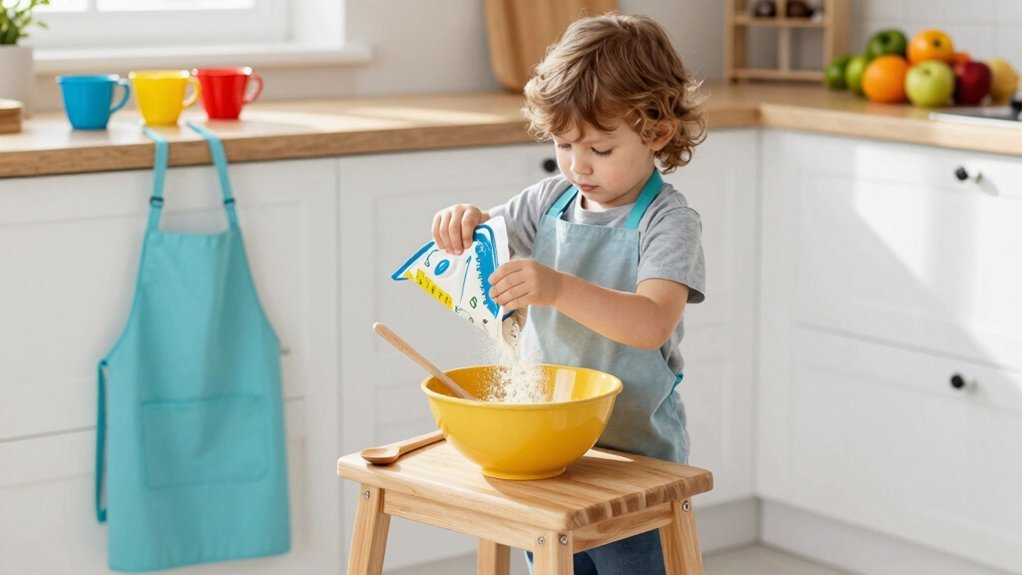
You’ll build your child’s independence faster through kitchen activities than traditional Montessori practices because cooking combines real, purposeful work with immediate, tangible results. Start with pouring and produce washing at child height, then progress to spreading, stirring, and mixing tasks that strengthen fine motor skills. As readiness develops, introduce real knives, table setting, and cleanup routines. Each activity demands problem-solving, engages all five senses, and delivers direct feedback that reinforces learning and autonomy—foundations that extend far beyond the kitchen itself.
Why the Kitchen Builds Independence Faster Than Traditional Montessori Activities
Why do kitchen activities accelerate independence more effectively than isolated skill work? You’ll find that cooking combines genuine, purposeful tasks with immediate, tangible results. Unlike abstract exercises, you see the direct outcome of your efforts, strengthening cognitive connections rapidly.
Cooking demands sequential problem-solving where you follow logical steps to achieve concrete goals. You’re simultaneously engaging all five senses—sight, touch, taste, smell, and hearing—creating richer neural pathways than traditional Montessori activities can develop alone. Through these sensory exploration opportunities, you develop heightened perception that supports cognitive growth and decision-making skills.
The multi-step cooking process requires sustained concentration and hand-eye coordination that isolated practical life exercises don’t demand as intensely. You’re developing independence through real-world relevance. When you prepare food for yourself and others, you experience personal accountability and recognize these skills as essential for your future autonomy. That recognition fuels your motivation to master them.
Building a Montessori Kitchen: Child-Height Setup and Safety Prep
You’ll create a functional Montessori kitchen by positioning storage, tools, and equipment at your child’s eye level and within their physical reach. Safety requires you to eliminate hazards, secure heavy items, and establish clear boundaries around hot surfaces and sharp implements. Your thoughtful ergonomic design—from step stools to child-sized utensils—removes obstacles that’d otherwise demand your constant intervention. A tall, safe step stool known as a learning tower enables your child to safely access counter height for hands-on food preparation and sink access.
Accessible Storage And Organization
How does a child gain independence in the kitchen? Through thoughtfully organized, accessible storage that puts everything within reach.
You’ll want to position low open shelves at your child’s height, displaying plates, cups, and utensils without cabinet doors. This visibility encourages free choice and self-directed learning. Place daily-use items in child-height drawers so your child retrieves what they need without asking for help.
Use clear bins for non-readers to identify contents visually, and label solid bins for older children. Organize items by type or function for quick retrieval. When interest in certain tools or activities wanes, rotate items out and reintroduce them later to maintain engagement and reduce clutter.
Consider Montessori shelving units, rolling carts, or wooden storage solutions that fit your space. Maximize vertical areas with fitted shelves spaced 15 cm apart inside cupboards. These intentional arrangements transform your kitchen into an environment where your child confidently handles tasks independently.
Safety Features And Hazard Prevention
While accessible storage builds your child’s confidence, thoughtful safety measures protect them as they explore. You’ll want to install child-safety locks on cabinets containing knives, sharp objects, and cleaning chemicals. Store hazardous materials on high shelves beyond reach, designating only low cabinets for non-toxic items. Arrange scaled-down real tools with rounded edges and non-toxic materials at eye level, enabling safe independent access. During slicing or peeling tasks, maintain vigilant supervision. Establish firm rules about staying away from open flames and hot ovens, requiring explicit permission and heavy oversight. Teach your child to use both hands when carrying fragile items one at a time. Immediately clean wet spills to prevent slipping, emphasizing responsibility through careful practice. Using real tools scaled down for little hands teaches safety and responsibility while building respect for objects in the kitchen environment.
Ergonomic Design For Small Bodies
The foundation of independent kitchen participation rests on proper height alignment.
You’ll want your child’s hands to reach counter level comfortably without stretching or hunching.
Learning towers offer adjustable platforms at 12.5, 15.5, and 18.5 inches to match your child’s developmental stage.
Match your child’s height to the appropriate setting: children 28-32 inches tall use the highest platform, those 32-38 inches use the middle setting, and 38-44 inches require the lowest.
You’ll know the platform fits correctly when the guardrail sits above your child’s belly button and they can stand hands-free.
This ergonomic alignment reduces fatigue, prevents strain injuries, and empowers your child to participate meaningfully in kitchen tasks.
You’re creating an environment where your child reaches, grasps, and engages naturally. Stability and safety depend on ensuring the tower is properly positioned on level flooring and monitored during use.
Pouring Without Spills: Mastering Coordination and Confidence
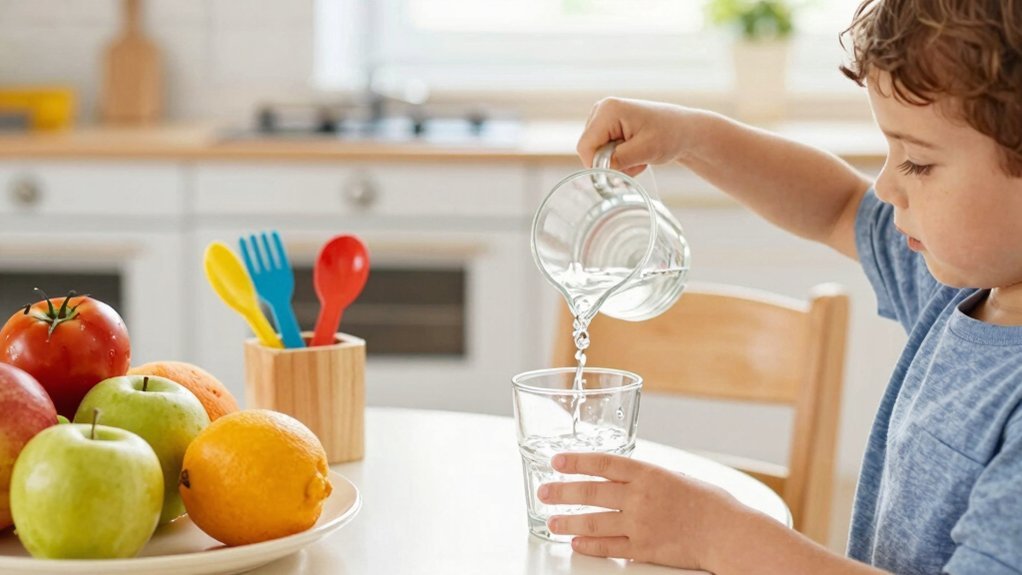
You’ll develop your child’s motor control by practicing pouring exercises at a low table designed to their height, where they can see their hands and the pouring stream clearly.
When spills inevitably happen, you’re teaching them that cleanup isn’t punishment but a natural part of the process, building responsibility and respect for their environment. Using a sponge for cleanup reinforces that environmental care is an immediate and integral part of the activity.
This combination of controlled practice and consequence-based learning creates a foundation for independence that extends far beyond the kitchen.
Low Tables Build Motor Control
Properly positioned low tables become the foundation for developing precise pouring skills and coordination. At child height, you’ll notice your child’s arms naturally align with the pour path, refining hand-eye coordination without strain. Low tables enable isolated practice of essential movements—grasping, tilting, and rotating pitchers—allowing focused repetition that builds wrist strength for controlling water flow.
You’ll observe how this optimal height lengthens your child’s coordination span through absorbed water pouring activities. The table design facilitates smooth transitions from sponge transfers to precise pitcher pours, each step building motor control progressively. Starting with dry pouring using two identical cups and dry beans or rice establishes coordination fundamentals before introducing water and its unpredictable movement. Your child can practice pause-and-correct moments during overpour scenarios, developing the fine motor awareness necessary for real-world pouring independence.
Spill Cleanup Teaches Responsibility
Spills aren’t failures—they’re built-in teachers in Montessori pouring work. When you set up shallow trays and supply sponges nearby, you’re creating an environment where children self-correct naturally.
Spilled water provides immediate visual feedback, prompting your child to adjust their grip and technique without your intervention.
You’ll notice something remarkable: as your child practices pouring daily, spills decrease dramatically. Within two weeks, most children develop the precision and control needed for spill-free pouring.
More importantly, they learn that mistakes are manageable and recoverable.
Through independent cleanup, your child builds responsibility and accountability. They discover that completing a task includes restoring the workspace. This practice strengthens their fine motor skills as they manipulate sponges and wring out water with controlled movements.
This autonomy extends beyond the kitchen—your child internalizes that they’re capable of managing their own learning and environment.
Washing Produce: How Real Work Builds Responsibility
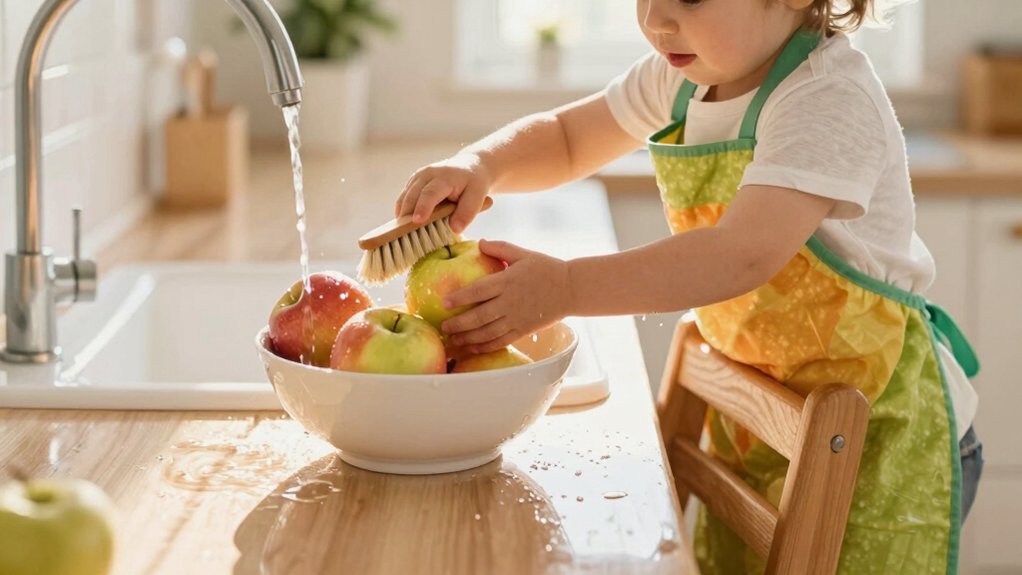
When children wash produce at a properly-sized station, they’re not just cleaning vegetables—they’re developing the independence and responsibility that defines Montessori learning.
You set up success by placing water pitchers, basins, soap, and scrubbers at their height, allowing them to complete the entire task cycle independently.
As your child pours, scrubs, rinses, and dries produce, they strengthen gross and fine motor skills while building focus and sequencing abilities.
They learn that their effort directly contributes to family meals, instilling genuine ownership and pride in their work.
This real responsibility extends beyond the kitchen. The supervised setup prevents wasteful water overflow while allowing extended practice time. The hygiene habits they develop transfer to self-care routines, and the accountability they practice prepares them for advanced tasks like dishwashing, creating a foundation for lifelong independence.
Spreading, Stirring, Mixing: Fine Motor Foundations
How do you build the hand strength and coordination your child needs for writing, dressing, and countless daily tasks? Kitchen activities offer practical solutions through everyday cooking experiences.
You’ll develop your child’s fine motor skills through three foundational techniques:
- Spreading — Have your child spread hummus, nut butter, or jam on crackers, refining hand control and finger strength through repetitive practice with adult demonstrations.
- Stirring — Guide circular spoon movements in bowls, strengthening wrists and fingers while building bilateral coordination as your child holds steady bowls with one hand.
- Mixing — Combine ingredients with wooden spoons or whisks, sequencing steps and enhancing dexterity through measuring, scooping, and blending activities. In the Montessori approach, emphasis on sequence ensures children understand the order of steps while building confidence in their ability to complete tasks independently.
These repetitive tasks strengthen the pincer grip and prepare your child for buttoning, shoe-tying, and writing readiness while building genuine independence through real work.
When Ready: Introducing Real Knives by Age and Skill
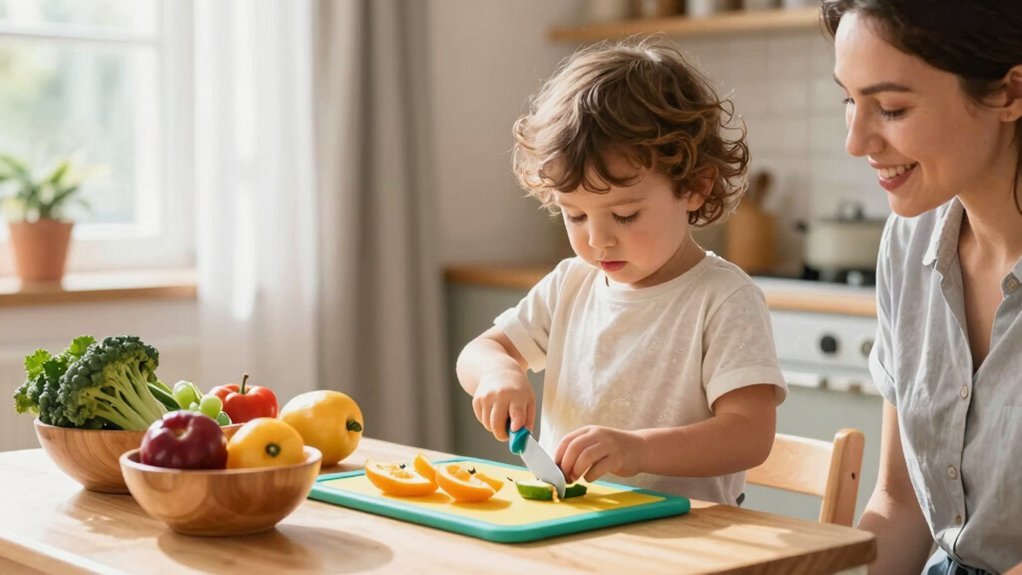
At what point does your child transition from wooden spoons to actual knives? The answer depends on your child’s fine motor readiness rather than age alone.
| Age Range | Tool Type | Foods |
|---|---|---|
| 15 months | Wavy chopper knife | Bananas, soft fruits |
| 3-5 years | Plastic or serrated knife | Soft fruits, cooked vegetables |
| 6+ years | Child-sized real knife | Firmer vegetables, fresh produce |
You’ll begin with demonstrations on soft foods, guiding your child’s hands through cutting motions while maintaining control. As confidence builds, gradually reduce your guidance. Choose knives with rounded edges, blunt tips, and non-slip handles—lightweight designs your child can comfortably grip. Safe knife use develops fine motor skills, food-preparation knowledge, and encourages healthy food relationships through independent practice.
Start on stable surfaces with foldable cutting boards. Allow imperfect cuts to build confidence. Your child develops independence, fine motor skills, and healthy food relationships through these real kitchen tasks.
Setting the Table: Teaching Social Grace and Courtesy
Beyond the knife skills you’ve cultivated, your child’s kitchen education extends into the dining room where they’ll learn table setting as a gateway to independence and social awareness.
You’ll guide your child through practical steps using a self-correcting placemat with outlined placement spots. They’ll arrange plates, utensils, napkins, and glasses with precision, building hand-eye coordination and sequencing skills. As competency grows, you’ll introduce complementary lessons:
- Napkin etiquette and proper utensil usage during meals
- Polite conversation and respectful table behavior
- Role-playing hosting scenarios to reinforce social graces
You’ll gradually expand from individual placemats to full family table setups, allowing your child to contribute meaningfully to household routines. This progression transforms a simple task into meaningful practice for responsibility, respect, and genuine social grace that extends far beyond mealtime. Through these table-setting experiences, your child develops a sense of responsibility for shared dining spaces while reinforcing orderly routines.
From Prep to Plate: Closing the Learning Loop Through Cleanup
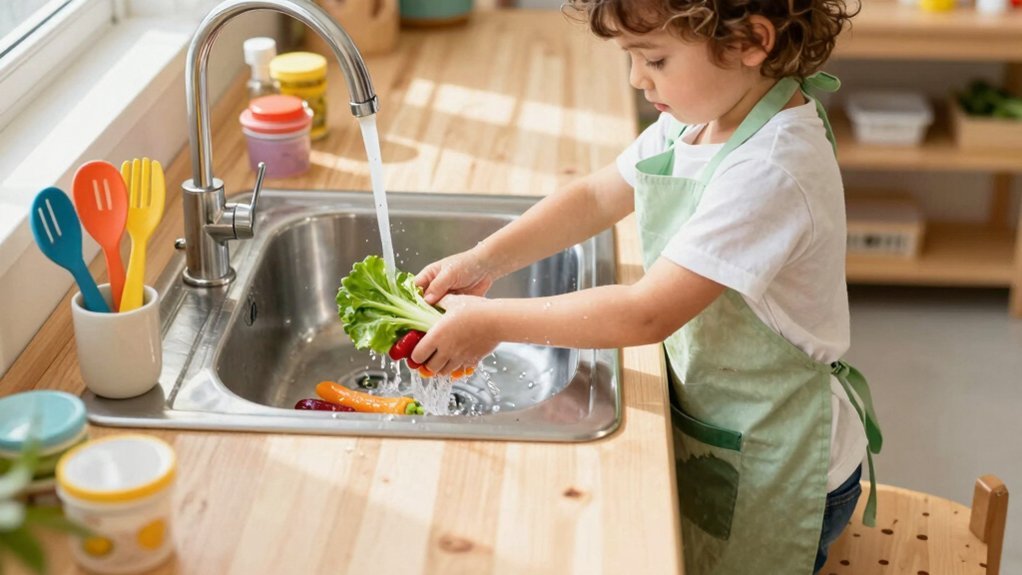
The kitchen learning loop doesn’t end when your child finishes eating—it completes when they’ve cleared their plate and restored order to the dining space. You’ll guide them through a purposeful sequence that builds responsibility and practical skills.
Start with scraping food remnants using child-sized tools, developing hand strength and precision. Your child then rinses plates independently from a step stool, controlling water flow while removing debris. They wipe tables with damp cloths, reinforcing concentration and order. Sweeping with appropriately-sized brooms targets spilled food around the dining area, fostering gross motor skills and spatial awareness. This cleanup sequence aligns with Montessori practical life skills that extend learning beyond the initial cooking activity.
Finally, your child returns cleaned dishes to low shelves and hangs wet towels on designated hooks. This organized completion creates satisfaction and intrinsic motivation, closing the full cycle of independence you’ve cultivated.
Frequently Asked Questions
How Do I Handle Food Allergies and Dietary Restrictions During Montessori Kitchen Activities?
You’ll create allergen-free workspaces with dedicated tools and surfaces, select safe ingredients, supervise constantly, teach proper handwashing, and gradually expand tasks based on your child’s specific dietary needs and abilities.
What Should I Do if My Child Refuses to Participate in Kitchen Preparation Tasks?
Don’t force participation. Extend calm invitations instead, allowing your child to observe first. Model enthusiasm yourself, permit them to step away, and offer repeated gentle invitations later when they’re ready.
How Can I Adapt Kitchen Activities for Children With Sensory Sensitivities or Aversions?
You’ll adapt kitchen activities by using child-sized utensils from natural materials, choosing soft foods like bananas, positioning work at comfortable heights, and introducing tasks gradually—starting with pouring before advancing to peeling or scrubbing.
What’s the Appropriate Ratio of Adult Supervision to Child Independence During Food Preparation?
You’ll want to establish minimal intervention through prepared environments, allowing your child to lead while you observe nearby. You’re gradually reducing assistance as they master tasks, building independence through supportive presence rather than constant direction.
How Do I Encourage Siblings of Different Ages to Work Together in the Kitchen?
You’ll foster cooperation by assigning complementary tasks—younger children peel while older siblings slice, then combine ingredients together. Arrange separate workstations so each child contributes meaningfully without competing for space or resources.
In Summary
You’ll find that Montessori kitchen activities create genuine independence faster than traditional materials because your child engages in purposeful, real-world work. When you pour, wash, prepare, and clean actual food, you’re building practical life skills alongside coordination and responsibility. You’re not just practicing—you’re contributing meaningfully to your family’s daily life, which transforms how your child views their own capabilities and role.


Leave a Reply