

You help kids self‑correct when the environment gives them instant, tangible cues—like a click when a cylinder fits, a visual gap when a block is out of order, or a gentle adult observation that nudges them without giving the answer. Mechanical, perceptual, and social signals turn errors into feedback, letting children pause, adjust, and succeed on their own. This builds confidence and a growth mindset, and if you keep exploring, you’ll discover how to set up these cues at home and in the classroom.
How Does Self‑Correction Work in a Montessori Classroom?
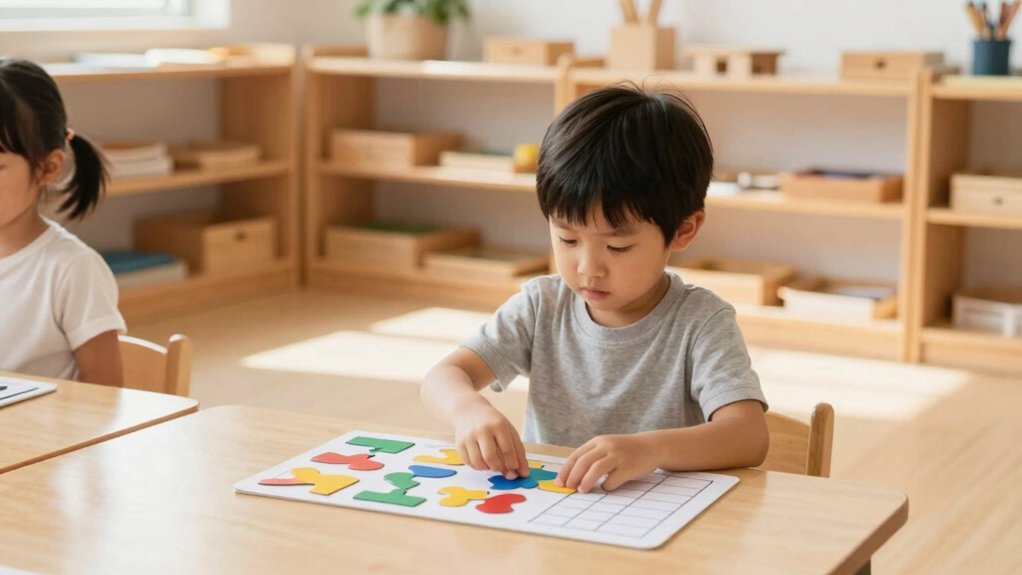
Self‑correction in a Montessori classroom hinges on the material’s built‑in error signals, not on adult prompts. You notice a puzzle piece that doesn’t fit, a bead that rolls off the tray, or a pattern that looks off; each cue tells you something’s wrong. The mechanical fit, perceptual cue, and sometimes a quiet adult observation all guide you to pause, reflect, and try again.
Because the material refuses to function incorrectly, you’re forced to adjust your approach, reinforcing concentration and inner motivation. You learn to trust your own judgment, repeat the task until it works, and feel independence rather than shame. This cycle of error‑driven feedback cultivates a mindset that learning continues beyond any single activity. Using Montessori-friendly tools like a Kitchen Step Stool for Kids with Safety Rail supports independence and safe exploration, further encouraging self-correction skills.
Why Self‑Correction Needs a Safe, Error‑Controlled Environment?
Why does a child need a space where errors are contained, not condemned? You’ll notice that when mistakes stay within a safe, error‑controlled environment, the child can observe the discrepancy without fear of judgment. The materials themselves signal when something’s off, so you guide’t have to step in with direct correction. A clutter‑free, appropriately scaled setup lets the child focus on the task, while you observe from a distance, preserving autonomy. This design encourages the child to reflect, adjust, and try again, building trust, courage, and resilience. By framing errors as learning cues rather than shameful failures, you nurture intrinsic motivation and keep self‑correction an empowering, ongoing process. Incorporating hands-on exploration capabilities further supports this self-correcting process by engaging children actively with tangible tools and immediate feedback.
What Are Mechanical, Perceptual, and Social Controls of Error?

You’ll notice that a piece only snaps into place when it’s correctly aligned, giving you instant physical confirmation. Your eyes and hands then pick up any mis‑alignments or odd textures, letting you spot errors without anyone pointing them out. Finally, adults watch quietly and later re‑present the task, nudging you toward self‑correction while preserving your independence. This process is supported by tools like wooden balance boards that promote vestibular system stimulation, aiding in the development of self-awareness and error correction.
Mechanical Fit: Physical Confirmation
Ever notice how a puzzle piece won’t click unless it’s in the right spot? You feel the misfit instantly, and that tactile cue tells you something’s off. That’s mechanical error control in action: the material itself forces you to notice and fix the mistake. When you assemble blocks, snap‑together parts, or slide beads onto a string, the correct fit produces a satisfying click or smooth glide, while a wrong placement sticks, wobbles, or refuses to lock. You don’t need a parent’s voice to point it out; the object’s constraints give you immediate, physical confirmation. This hands‑on feedback sharpens concentration, builds independence, and teaches you to adjust until the fit feels just right.
Perceptual Cue: Sensory Detection
A perceptual cue is a sensory signal—visual, tactile, or auditory—that instantly tells you something’s off without anyone’s prompting. When you see a block misaligned or feel a puzzle piece’s edge jutting, those perceptual cues flag the error before an adult intervenes. You compare the current appearance or texture to the expected pattern, noticing gaps, unevenness, or wrong ordering. This inner detection drives you to pause, adjust grip, or re‑position the piece, fostering independent correction.
Unlike mechanical fit, which relies on a physical snap, or social cues that depend on adult feedback, perceptual cues arise from your own senses. They encourage slower observation, reflection, and fine‑tuned action, turning sensory detection into a powerful self‑regulation tool. Similar to how child-safe tools, such as whisks with ergonomic handles and heat resistance, are designed for independent and safe use, these cues enable children to manage tasks on their own securely.
Montessori Materials That Enable Self‑Correction
You’ll notice that Montessori tools embed mechanical error controls—like cylinders that only fit one way—so you instantly see when something’s wrong. Perceptual error signals, such as tactile or visual cues on the Pink Tower, guide you to correct the mistake without adult prompting. Social guidance cues appear in language cards and movable alphabets, where matching images to labels or forming words lets you self‑correct through built‑in feedback. Similarly, educational toys with fine motor skills development and clear feedback mechanisms encourage independent problem-solving and correction.
Error Mechanical Error Control
How does a child know a piece is wrong without a teacher’s voice? You’ll see mechanical error control at work when a cylinder block refuses to drop into a mismatched hole, or a spindle box stays shut until the exact number of beads is placed. The material itself signals the error, so the child feels, adjusts, and succeeds without verbal cues. This tactile feedback builds autonomy and trust in their own problem‑solving.
- Cylinder blocks – each rod has a unique diameter that only fits its matching opening.
- Spindle boxes – the lid opens only after the correct bead count is entered.
- Puzzle boards – pieces click into place only when edges align perfectly.
These designs let you watch a child discover mistakes, correct them, and gain confidence through pure physical feedback. Additionally, Montessori materials often include non-toxic dyes and carefully sized components to ensure safe and responsive learning experiences.
Perceptual Error Signals
Ever notice how a child can spot a misplaced bead or an off‑center puzzle piece without anyone pointing it out? That’s perceptual error signals at work. When you give a child a set of beads that only fit a specific pattern, the visual mismatch or the tactile “wrong‑fit” instantly tells them something’s off.
A wooden puzzle that won’t lock together unless each piece aligns perfectly creates the same effect: the material itself signals the error. You’ll see the child pause, adjust, and try again, driven by the sensory feedback rather than adult instruction.
This self‑generated correction deepens concentration, builds confidence, and reinforces the idea that learning is a personal, perceptually guided process. Montessori materials made from natural wood with water-based paint encourage safe, tactile exploration that supports this self-correcting behavior.
Social Guidance Cues
What role do adults play when a child encounters a Montessori puzzle that seems “off”? You step back, observe, and later re‑present the task, letting the child notice the mismatch and self‑correct. Your non‑judgmental presence keeps autonomy intact while you model problem‑solving strategies. This social guidance cue creates a collaborative space where the child negotiates solutions with minimal interference.
- Pause and watch – notice where the child hesitates without intervening.
- Re‑introduce later – present the same puzzle after a short break, prompting reflection.
- Facilitate discussion – ask open‑ended questions about the correct outcome rather than giving the answer.
How Adults Can Choose and Set Up Self‑Correcting Materials
Where to start? Pick self-correcting materials that match the child’s skill level and the type of error you want to target—mechanical, perceptual, or social. Choose items that give immediate, invisible feedback, like cylinder blocks that won’t fit unless the size is right, or a pink tower that collapses when the sequence is wrong. Set them out on a low‑traffic table, keep the area uncluttered, and let the child work alone first. Observe quietly, then intervene only to re‑present the tool if the child seems stuck.
| Error Type | Example | Cue |
|---|---|---|
| Mechanical | Cylinder blocks | Physical fit |
| Perceptual | Moveable Alphabet | Phonetic sound |
| Social/Adult | Three‑part cards | Observation |
| Sequencing | Pink Tower | Visual order |
Self‑Correction Builds Confidence and a Growth Mindset

Why does watching a child fix their own mistake feel so empowering? You see confidence bloom as they take control, and a growth mindset takes root when errors become stepping stones, not setbacks. Self‑correction gives them precise feedback, reduces fear, and builds trust in their own abilities. Over time, repeated successes nurture independence and resilience, shaping a positive attitude toward future challenges.
- Control – When children notice a mismatch and correct it, they feel ownership of learning.
- Motivation – Intrinsic drive spikes because they see mistakes as learning pathways, not personal failures.
- Resilience – Regular self‑correction practice strengthens perseverance, turning setbacks into opportunities for growth.
How Parents Can Apply Montessori Self‑Correction at Home?
When you set up a clutter‑free space with Montessori‑style materials that give instant, built‑in feedback, children can spot and fix errors on their own, turning mistakes into learning moments. Choose puzzles, beads, or clamps that only work when assembled correctly, so the error signals themselves prompt reflection. Step back and let your child try, intervening only if safety is at risk. Observe calmly, resist the urge to correct immediately, and model quiet self‑talk like “Let’s see what’s wrong.” Celebrate each successful self‑correction and remind them that mistakes are data, not failure. Over time, these low‑pressure activities build independence, letting kids move from guided practice to autonomous problem‑solving.
Self‑Correction’s Long‑Term Benefits for Critical Thinking and Resilience
Ever wonder how a simple act of spotting and fixing an error can shape a child’s mind for life? When you let kids practice self‑correction, they learn to pause, notice the gap, and try a new strategy. That habit builds deeper concentration, inner motivation, and a quiet confidence that lasts. Over time they treat every setback as a clue, not a failure, strengthening critical thinking and resilience.
Spotting and fixing errors nurtures focus, resilience, and lifelong confidence in children.
- Focused attention – noticing mistakes sharpens concentration and fuels intrinsic drive.
- Persistent mindset – continual self‑correction teaches that learning never ends, fostering resilience.
- Strategic problem‑solving – reflecting on errors improves long‑term analytical skills and self‑trust.
You’ll see children become independent thinkers who test ideas, adapt quickly, and bounce back from challenges with ease.
Frequently Asked Questions
What Is the 3-3-3 Rule for Children?
You use the 3‑3‑3 rule by pausing after three errors, counting three seconds to reflect, then trying three corrective strategies before seeking help, fostering independent self‑correction.
What Are Three Warning Signs That a Child May Have a Learning Disorder?
You’ll notice persistent negative self‑talk, frequent mood swings or anxiety, and a clear gap between effort and achievement—especially when they misread words or can’t apply skills across situations.
What’s the Psychology Behind Making Mistakes?
You see mistakes as feedback that triggers curiosity, so you’re motivated to resolve the gap, learn, and improve, turning errors into opportunities for growth and deeper understanding.
What Is the 10-10-10 Rule for Kids?
You use the 10‑10‑10 rule by asking yourself what will happen in ten minutes, ten months, and ten years, then you pause, weigh those outcomes, and choose a better action.