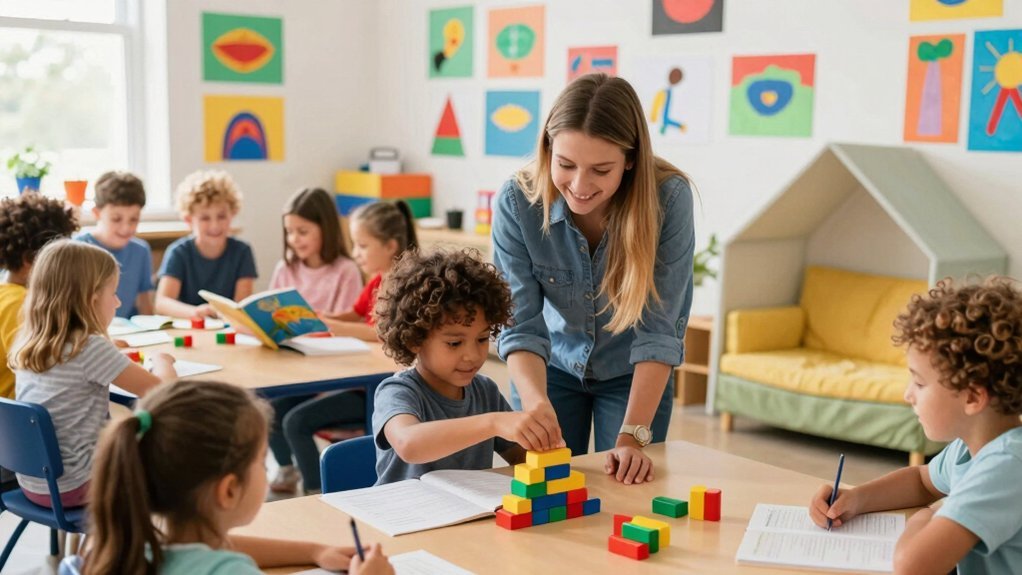
You’ll unlock ten transformative benefits when you place children of different ages together. Natural mentoring emerges as older students guide younger peers, reinforcing their own mastery. You’ll witness genuine empathy develop through perspective-taking and authentic relationships. Peer scaffolding accelerates learning while individualized pacing reduces anxiety. Mixed-age settings disrupt bullying dynamics, boost language skills, and build protective bonds. Confidence transfers between ages, enabling greater complexity in play, math, and reading. Long-term teacher relationships deepen instruction quality. Discover how each mechanism strengthens your child’s development.
How Mixed-Age Classrooms Create Natural Mentors
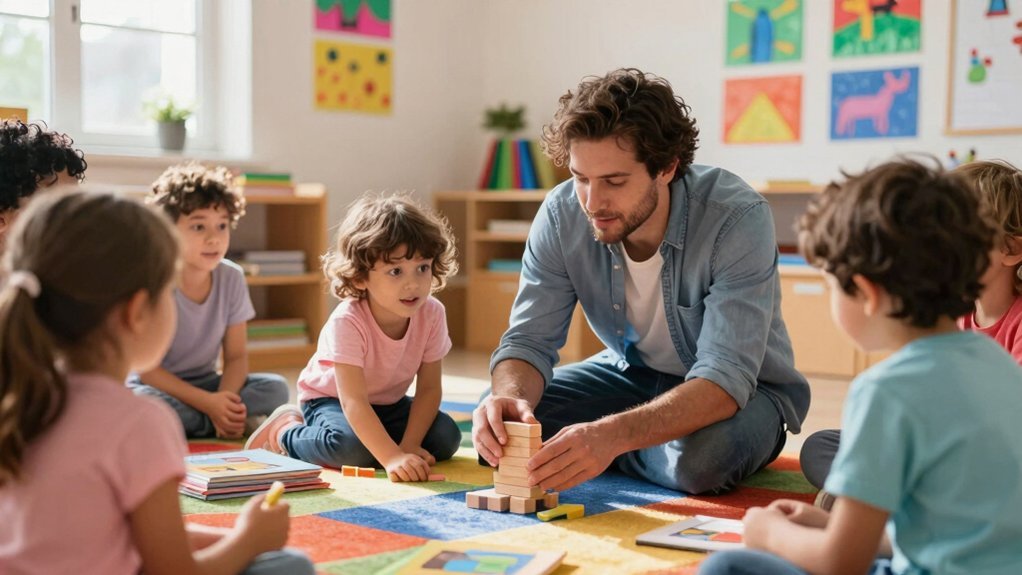
Why do older children in mixed-age settings so readily embrace teaching roles? You’ll find that mentorship emerges naturally when you combine different age groups in one classroom. Older students naturally gravitate toward expert roles, teaching younger peers complex tasks without forced buddy systems. As you guide younger classmates, you’ll reinforce your own knowledge through explanation. You’ll develop leadership skills and responsibility while younger children observe and emulate your actions. The relationships you form aren’t artificial—they’re genuine connections built over time. You’ll progress from needing help to providing guidance, solidifying mastery through your capstone year. This organic mentorship creates harmonious peer relationships that mirror real-world family dynamics, fostering both academic and social-emotional growth. Through these mentoring experiences, older children internalize that progress and skills are developed over time through continued practice and teaching others.
Why Age Gaps Build Genuine Empathy
You’ll develop genuine empathy when you encounter peers at different developmental stages, forcing you to consider perspectives vastly different from your own. As you mentor younger classmates or observe older peers’ problem-solving approaches, you’re building compassionate leadership that extends beyond classroom walls. These age gaps naturally push you to recognize and honor the unique needs of others, transforming abstract empathy into lived experience. Through peer-assisted learning, you gain practical experience in supporting others’ growth while developing your own emotional intelligence.
Perspective-Taking Through Developmental Differences
How does a child learn to see the world through another’s eyes? In multi-age classrooms, you witness this transformation daily as children navigate relationships across developmental stages.
When you interact regularly with peers at different maturity levels, you naturally develop perspective-taking skills. Consider what happens:
- You observe how younger children struggle with tasks you’ve mastered, building compassion
- You adjust your explanations using relatable language, deepening your own understanding
- You recognize that helping requires meeting others where they’re developmentally
- You begin anticipating needs before being asked, strengthening emotional awareness
This constant exposure to varying abilities reshapes how you think about others’ mental states. Rather than assuming everyone processes information identically, you learn that development unfolds differently. You’ll discover that genuine empathy emerges not from similarity, but from understanding those differences and responding with patience and care. Peer interactions across ages foster this daily practice of considering multiple viewpoints simultaneously.
Mentoring Builds Compassionate Leadership
What transforms a student into a leader? Mentoring younger peers in multiage classrooms. When you guide younger children, you’re developing genuine compassion alongside leadership skills. You’ll learn to recognize developmental differences, adjusting your communication to meet each child’s needs. This process builds self-confidence as you position yourself as an expert guide.
Through mentoring, you’ll naturally develop empathy—not through forced lessons, but through meaningful relationships. You’ll discover how to nurture rather than compete, creating collaborative environments where everyone thrives. As you provide guidance and inspiration, you’re strengthening your own leadership abilities while fostering caring behaviors in others. Research shows that older students reinforce their own learning by teaching younger peers, deepening their mastery of concepts while simultaneously building their mentoring capacity.
This mentoring dynamic reduces bullying and creates spaces where acceptance flourishes. You’re not simply teaching content; you’re cultivating compassionate leaders who understand how to support others thoughtfully and authentically.
How Peer Scaffolding Accelerates Learning
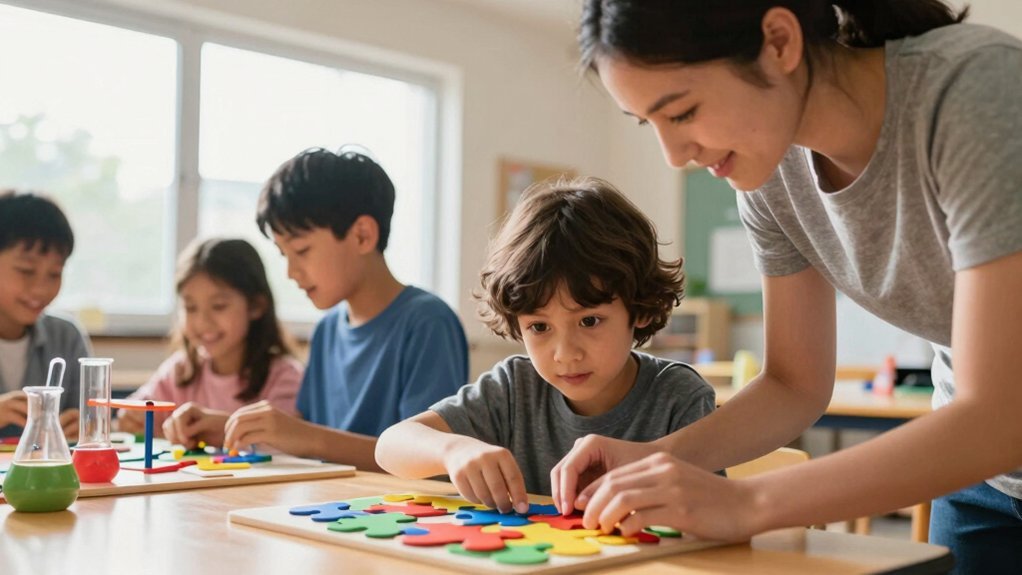
Why do children often learn faster from their peers than from traditional instruction alone? Peer scaffolding creates dynamic learning opportunities where you’re guided by someone who recently mastered the same skills. This approach accelerates your progress through:
Peer scaffolding creates dynamic learning opportunities where guidance from someone who recently mastered the same skills accelerates your progress.
- Real-time feedback that adjusts to your immediate needs
- Relatable explanations using language you naturally understand
- Collaborative problem-solving that strengthens your independence
- Mixed-ability interactions that expose you to advanced concepts
When peers scaffold your learning, they diagnose gaps and fade support as you gain confidence. You’re not passively receiving instruction—you’re actively engaging in dialogue that builds understanding. The scaffolding process transforms peers into effective teachers, enabling you to advance faster while developing self-directed learning habits that extend beyond the classroom. These peer interactions also strengthen pro-social behaviors and create meaningful classroom connections that enhance your motivation to participate and support others.
Why Mixed Groups Disrupt Bullying Dynamics
When you mix ages in a classroom, you’re disrupting the aggressive power structures that thrive in same-age groups by replacing dominance hierarchies with age-based social organization.
As older students take on mentoring roles, they develop protective bonds with younger peers rather than seeking status through bullying, which fundamentally shifts how they interact with all their classmates. Research-based bullying prevention programs like the Second Step Bullying Prevention Unit teach students to recognize and report bullying behaviors, reinforcing these protective dynamics across all age groups.
You’ll notice that these cross-age relationships naturally discourage the peer networks that reinforce bullying patterns in single-grade environments. When staff are trained through comprehensive prevention strategies, they better support the integrated approach needed to maintain these safer social structures in mixed-age settings.
Diverse Social Hierarchies Reduce Power
Because bullies depend on stable social structures to maintain dominance, mixed-age and mixed-ability classrooms fundamentally disrupt the rigid hierarchies that enable aggression to flourish. You’ll observe how diverse groupings flatten power imbalances through several mechanisms:
- Classroom composition varies victimization proportions across schools, preventing uniform bullying patterns
- Student roles shift yearly—aggressors transition to uninvolved status through targeted interventions
- High-involvement students experience membership changes, destabilizing established peer dominance
- School-level factors influence classroom climate, disrupting consistent hierarchies
These dynamics require you to implement individualized interventions tailored to each classroom’s unique social climate. Rather than applying uniform anti-bullying strategies, you’ll address specific involvement patterns within your setting. This precision approach recognizes that heterogeneous environments naturally weaken the stable power structures bullies exploit. Evidence from integrated prevention programs involving students, teachers, and parents demonstrates that comprehensive interventions reduce both victim and aggressor behaviors across multiple follow-up periods, supporting the effectiveness of tailored approaches in diverse educational settings.
Peer Mentoring Builds Protective Bonds
While disrupted hierarchies weaken bullies’ structural advantage, you’ll find that intentional peer mentoring relationships actively build the protective bonds that prevent aggression from taking root in the first place.
When you participate in structured peer mentoring within multi-age classrooms, you experience increased school belonging and social connectedness that directly counters bullying vulnerability.
These mentoring relationships foster trust and empathy through frequent, in-person contact—creating psychological safety where you feel valued and supported.
You’ll develop stronger peer relationships and improved self-perception as mentors model prosocial behaviors guided by genuine care.
The personal connections you build through shared experiences and informal dialogues strengthen your resilience against social aggression.
You’re basically surrounded by protective support networks that make bullying both less appealing and less effective.
Individualized Pacing Removes Academic Anxiety

How much of a student’s struggle stems not from the material itself, but from racing through it? In multi-age classrooms, individualized pacing dismantles this anxiety by letting you learn at your own speed. You’re no longer trapped by rigid deadlines or forced to advance before mastery.
When you learn at your own speed, anxiety dissolves and mastery becomes possible—not racing against the clock.
When you control your learning timeline, several transformations occur:
- Stress plummets as you eliminate pressure to keep pace with peers
- Confidence rebuilds through weekly accomplishments and authentic mastery
- Retention improves dramatically—you remember content longer when you’re not rushed
- On-task behavior increases by 17% on average, with engagement jumping from 25-50% to 50-75%
This personalized approach reveals your unique learning rhythm. You advance when ready, not by schedule. The anxiety dissolves because you’re no longer racing against time. Without the pressure to maintain predetermined pacing, students face fewer prerequisites that were incompletely learned, allowing them to build stronger foundational skills before progressing.
How Teaching Younger Peers Deepens Understanding
When you teach younger peers, you’re forced to organize your thoughts clearly and identify gaps in your own understanding—a process that transforms surface-level knowledge into genuine mastery. Your explanations using language fresh from your recent struggles become more relatable and effective than any textbook definition, which simultaneously reinforces your comprehension while strengthening theirs. This reciprocal dynamic means you’re not simply reviewing material; you’re actively constructing deeper understanding through the cognitive work of articulating complex ideas. As older students assume leadership roles while mentoring younger ones, they practice empathy and communication skills that extend their development beyond academic content alone.
Reinforcement Through Teaching Roles
Why does teaching others solidify your own understanding? When you explain concepts to younger peers, you’re forced to organize your knowledge coherently, exposing gaps in your comprehension. This process strengthens neural pathways and anchors concepts deeper in your memory.
Teaching roles create measurable benefits:
- Reinforced mastery – You reorganize information systematically, transforming passive knowledge into active expertise
- Regulated interactions – Managing younger students’ questions develops your emotional control and patience
- Strengthened bonds – Consistent teaching relationships build trust and mutual respect
- Enhanced retention – Explaining material multiple ways cements understanding through varied cognitive pathways
In multi-age classrooms, your teaching role isn’t supplementary—it’s transformative. You’re not simply sharing information; you’re reconstructing your own understanding while developing social-emotional competencies. The responsibility catalyzes deeper learning for both you and your younger classmates. Through collaborative peer learning, you also build confidence and critical thinking skills that extend beyond the immediate teaching moment, fostering a supportive community within the classroom environment.
Mastery Via Peer Instruction
Teaching younger peers doesn’t just reinforce what you already know—it fundamentally reshapes how you understand concepts at deeper levels. When you explain ideas to others, you’re forced to reorganize your mental models and clarify gaps in your own thinking. You’ll discover that teaching demands precision; vague understandings crumble when questioned. This process strengthens neural connections far beyond passive review. You’ll also notice that peer instruction creates abstract knowledge representations you couldn’t achieve alone. The responsibility of helping others master material solidifies your personal knowledge depth enduringly. Research shows students switch from incorrect to correct answers at significantly higher rates after peer discussions—65% versus just 13% reverting. Your mastery deepens through the teaching role itself, transforming temporary learning into lasting competence. When you verbalize your strategies and reasoning to younger students, verbalization of coping strategies aids their internalization of task approaches while simultaneously reinforcing your own conceptual framework.
Cognitive Growth From Explaining Concepts
How does articulating an idea to someone else transform your understanding of it? When you explain concepts to younger peers, you’re forced to break down complex ideas into digestible parts. This process deepens your own mastery substantially.
Consider what happens when you teach:
- You reorganize knowledge into logical sequences, revealing gaps in your own understanding
- You select precise language, forcing clarity about fuzzy concepts
- You anticipate questions, strengthening predictive thinking about the subject matter
- You reinforce neural pathways through repeated explanation and refinement
Teaching requires you to scaffold information effectively, which demands thorough comprehension. You can’t fake understanding when explaining to someone actively learning. This reciprocal dynamic solidifies your skills while simultaneously supporting younger students’ development. The act of teaching becomes your most powerful learning tool. In multi-age classroom environments, older students naturally emerge as immediate mentors who provide guidance and role modeling through these teaching interactions.
Why Mixed-Age Settings Boost Language Skills Faster
What makes a child’s vocabulary explode in a mixed-age classroom? You’ll find the answer in peer modeling. Older children naturally demonstrate advanced vocabulary and speech patterns, while younger peers observe and imitate these language behaviors. This dynamic creates constant opportunities for meaningful interaction.
Your younger students gain receptive and expressive skills through watching skilled communicators in action. Meanwhile, older children reinforce their own language abilities by explaining concepts to less experienced peers. You’re essentially creating natural tutoring relationships that benefit everyone. Real-time scaffolding from teachers further supports understanding during these peer interactions.
Research confirms that classrooms with a maximum 24-month age range show the greatest vocabulary gains. The key lies in intentional planning and teacher quality. When you structure mixed-age groups strategically, you’re not just improving communication—you’re fostering cognitive growth that single-age settings simply can’t match.
How Confidence in Older Peers Unlocks Younger Student Growth
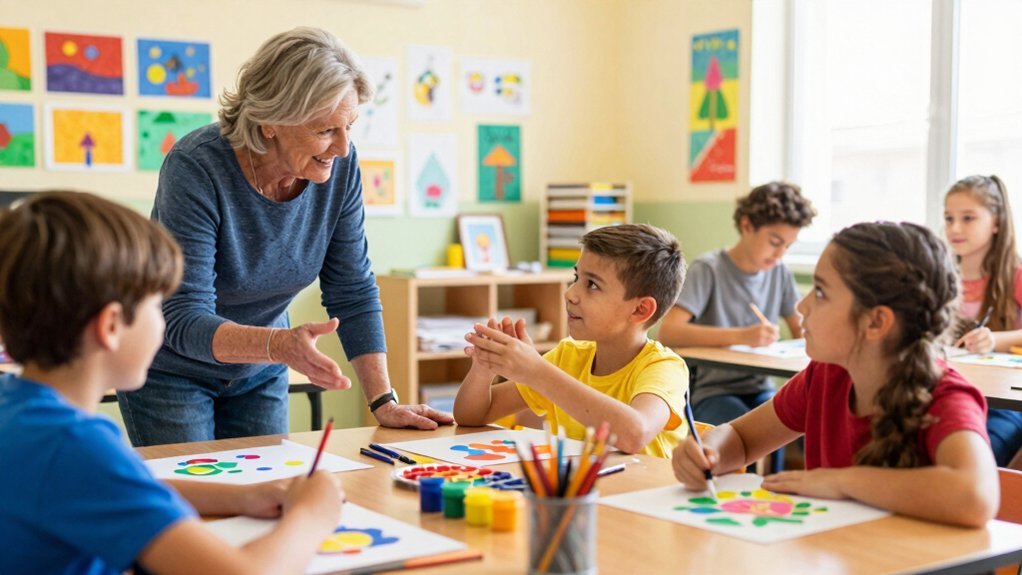
When you place a younger student alongside a confident older peer, something shifts in that child’s perception of what’s possible. That older student becomes a living blueprint for growth.
A confident older peer becomes a living blueprint for growth, shifting younger students’ perception of what’s possible.
You’ll witness tangible changes as younger students internalize confidence from observing peer mastery:
- They watch older peers tackle challenging tasks without hesitation, normalizing effort and persistence
- They observe problem-solving strategies firsthand, internalizing academic and social approaches
- They see recognition of competency, understanding that mastery builds confidence
- They experience direct guidance that feels collaborative rather than hierarchical
This dynamic creates a powerful catalyst. When younger students recognize that their older peers aren’t fundamentally different—just further along their development—they embrace their own potential. Confidence becomes contagious, transforming how younger students approach learning and social interactions within the classroom community.
Research indicates that peer mentorship opportunities in mixed-age settings help deter bullying and foster positive social relations among students of different ages. This protective social environment reinforces the confidence-building process, allowing younger students to thrive alongside their older classmates.
Greater Complexity in Play, Math, and Reading
Once younger students internalize confidence from their older peers, they’re primed to engage with more sophisticated learning opportunities. You’ll notice children attempting complex tasks they’d ordinarily avoid, supported by mentors who model advanced skills.
| Domain | Younger Students | Older Students |
|---|---|---|
| Play | Observe and replicate intricate activities | Demonstrate complex task performance |
| Math | Progress at individual pace | Mentor through cooperative activities |
| Reading | Replicate advanced peer techniques | Model sophisticated comprehension strategies |
| Cognitive Growth | Experience disequilibrium and challenge | Reinforce learning through teaching |
| Engagement | Skill-matched partnerships boost motivation | Role modeling sustains curiosity |
You’ll witness accelerated development across all three domains. Younger children tackle reading comprehension previously beyond reach, attempt multi-step math problems with peer guidance, and engage in imaginative play requiring advanced planning. This complexity-driven environment eliminates boredom while removing pressure to keep pace, fostering genuine intellectual growth through authentic peer collaboration. Teachers in multi-age settings possess deep knowledge across developmental abilities to differentiate instruction and ensure each child progresses toward their next developmental milestone.
Long-Term Teacher Relationships Transform Instruction
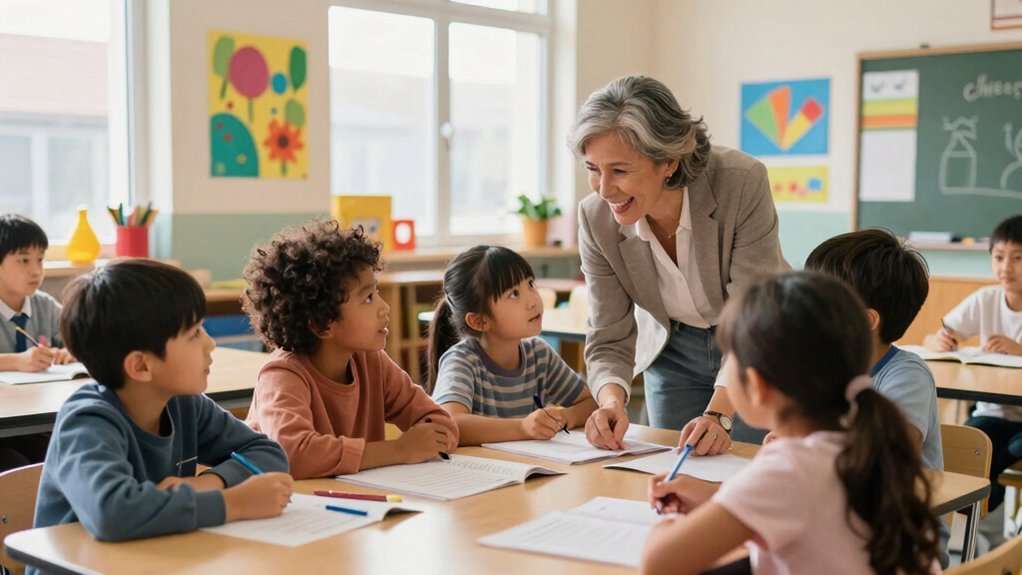
How does a teacher’s relationship with a student transform over multiple years in the classroom? You’ll witness profound shifts as sustained contact deepens your understanding of each child’s learning style, family dynamics, and readiness levels. This continuity allows you to:
- Tailor instruction precisely to known student capacities and growth patterns
- Build emotional security through consistent expectations and behavior
- Create family-like community dynamics that reduce classroom stress
- Track multi-year development, informing personalized planning
Your long-term presence mitigates transition challenges and strengthens warmth over conflict. You’ll experience enhanced job satisfaction observing student growth unfold across years. These enduring relationships correlate with fewer conduct problems and foster mutual caring. Essentially, you’re not simply teaching subjects—you’re cultivating transformative connections that shape children’s developmental trajectories.
Frequently Asked Questions
What Age Range Combinations Work Best in Multi-Age Classroom Settings?
You’ll find that 2-5 year combinations, Grades 1-2, Grades 3-4, Grades 5-6, and Grades 6-9 groupings work best. These spans let you balance developmental differences while fostering peer modeling, cooperation, and cognitive growth across maturity levels effectively.
How Do Teachers Manage Curriculum Standards Across Different Developmental Levels?
You differentiate instruction through flexible structures and curriculum frameworks, organizing small-group lessons by developmental readiness rather than age. You’ll conduct termly audits, build scaffolded pathways, and offer tiered options ensuring you’re meeting individual standards effectively.
Does Mixed-Age Grouping Disadvantage Advanced Learners Academically Compared to Peers?
You’ll find mixed results regarding advanced learners in mixed-age settings. While you gain social benefits and mentoring opportunities, you may experience reduced academic progress in math and literacy when younger peers comprise significant classroom portions.
What Training Do Educators Need to Effectively Teach Multi-Age Classrooms?
You’ll need mastery in differentiation, classroom management strategies for mixed ages, collaborative team-teaching models, and assessment training. You’ll develop skills grouping students by ability rather than age and implementing peer mentoring structures.
How Do Parents Transition Children Into Mixed-Age Classroom Environments Successfully?
You’ll shift your child successfully by gathering input during planning, ensuring peer groups or siblings stay together, sharing mixed-age benefits with staff, and maintaining predictable schedules while building comfort with older and younger peers.
In Summary
You’ll find that multi-age classrooms create powerful learning environments where you naturally develop alongside peers of different ages. You’re not just gaining academic skills—you’re building empathy, confidence, and resilience through meaningful mentorship. You’re challenged appropriately at your own pace while you contribute uniquely to your classroom community. You’re learning that growth doesn’t happen in isolation; you’re thriving because you’re connected to others at every developmental stage.




Leave a Reply