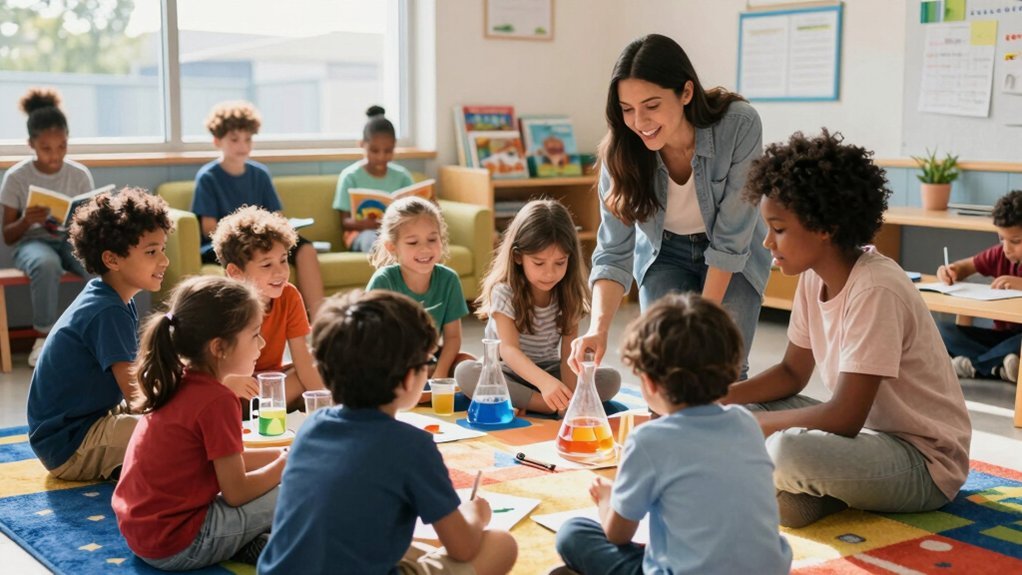
You’ll discover that mixed-age classrooms transform social development through natural mentoring relationships, deeper cross-age friendships, and genuine confidence-building. Kids absorb advanced language from older peers, develop stronger empathy, and experience reduced bullying through increased bystander awareness. They build emotional resilience by observing diverse coping strategies, practice real-world collaboration skills, and celebrate individual strengths beyond competition. Cooperative play sparks creativity while structured programs ensure sustainability. Each benefit interconnects to create inclusive communities where students thrive—and there’s considerably more to uncover about how these dynamics reshape entire school cultures.
How Peer Mentoring Builds Confidence and Leadership Skills
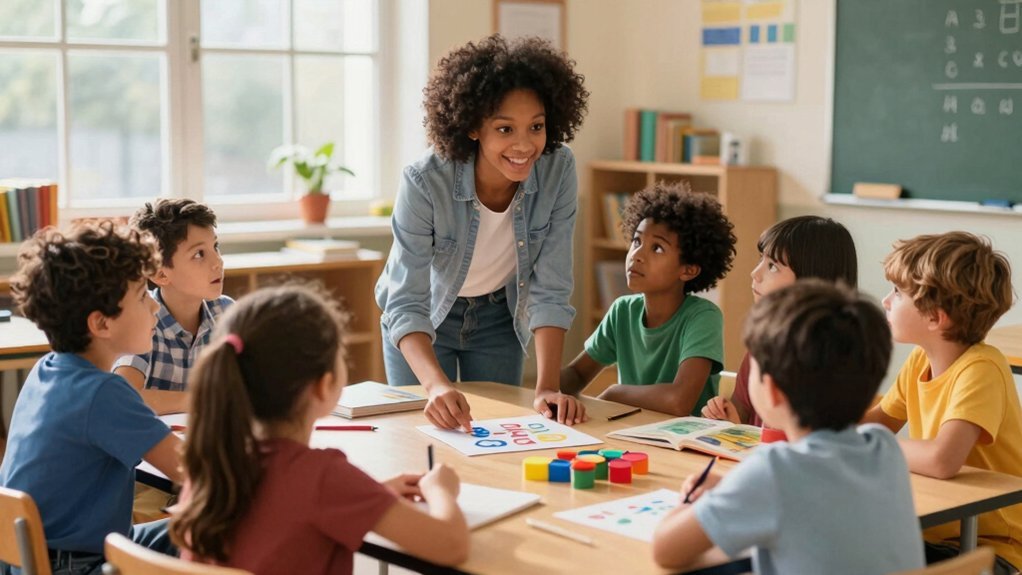
Why do some students flourish when given the chance to guide their peers? When you take on a mentoring role with younger classmates, you’re building genuine confidence through visible impact. As you observe how your guidance directly helps others learn, you recognize your own competencies expanding. This isn’t abstract self-esteem—it’s grounded in real achievement.
Leadership naturally emerges when you model appropriate behavior and support less experienced peers. You’ll develop problem-solving skills and interpersonal communication abilities that extend far beyond the mentoring relationship. Structured programs with adult oversight amplify these effects significantly. These enhanced social skills prepare you for collaborative environments throughout your academic and professional life.
You’re not just helping younger students; you’re transforming how you see yourself. The mentoring position positions you as an expert contributor to your school community, fundamentally reshaping your self-perception and your place within it.
Why Mixed Ages Reduce Bullying and Social Isolation?
When you’re surrounded by peers across different ages in a classroom, something powerful shifts in how students treat one another. Mixed-age settings reduce bullying through structured cross-age interactions that naturally build empathy and connection. You’ll witness increased affective empathy—the emotional understanding that drives genuine compassion—which directly minimizes aggressive behaviors.
Bystander training in these environments raises bullying awareness from 54.5% to 63.6%, empowering you to intervene confidently. The age diversity itself combats social isolation by creating multiple peer relationships and support networks. When you collaborate across age groups, you’re not just learning academics; you’re developing the social awareness and defender behaviors that eliminate the loneliness bullying creates. Coaching-based interventions like Classroom Check-Up provide teachers with structured problem-solving approaches to detect and respond to bullying more effectively.
This combination transforms classrooms into communities where exclusion simply can’t take root.
How Kids Pick Up Advanced Language From Older Peers
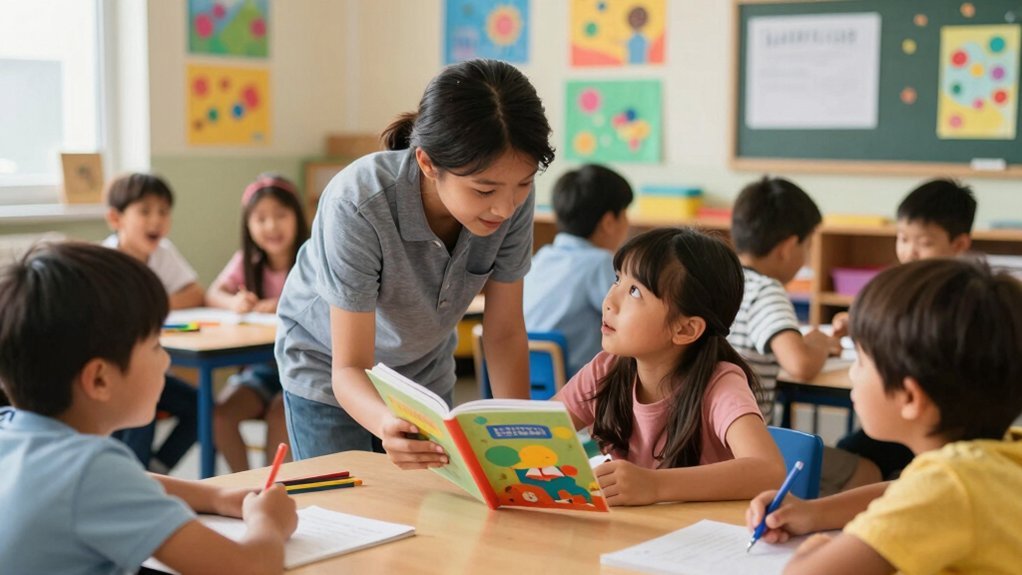
Beyond the social bonds that eliminate bullying, mixed-age classrooms create a unique linguistic advantage: younger students naturally absorb advanced language from their older peers. You’ll notice your child picks up sophisticated vocabulary and complex sentence structures simply by listening to older classmates interact. This exposure happens passively—they’re not sitting through formal lessons but rather absorbing mature speech patterns during daily conversations and collaborative activities.
You’ll see your younger child’s expressive language flourish as they observe problem-solving discussions and academic exchanges between older students. They preview advanced concepts and developmental milestones by witnessing what’s possible. Through mentoring relationships and group projects, they develop adaptable communication skills suited for interacting with diverse age groups. This natural language acquisition strengthens both receptive and expressive abilities more effectively than traditional same-age classroom settings. When older children reinforce their own understanding by teaching concepts to younger children, both groups benefit from the cognitive engagement this interaction provides.
Building Empathy Through Cross-Age Friendships
As your child interacts with peers across different ages, they’re developing a deeper understanding of others’ perspectives and needs. Mixed-age friendships foster genuine connections that transcend chronological boundaries, allowing your child to bond with peers at their own developmental level rather than age alone.
| Friendship Aspect | Same-Age Classrooms | Mixed-Age Classrooms |
|---|---|---|
| Average age difference | 6 months | 14 months |
| Connection basis | Chronological similarity | Shared interests & development |
| Empathy development | Limited perspective exposure | Broader emotional understanding |
| Relationship depth | Surface-level bonds | Meaningful, genuine friendships |
Your child discovers shared interests within classroom culture and play, creating stronger emotional bonds. These cross-age relationships help your child recognize diverse needs and viewpoints, cultivating authentic empathy that extends beyond the classroom into their broader social life. When older peers take on mentorship roles, they practice patience and communication while younger children observe and model these prosocial behaviors, reinforcing empathetic responses throughout the entire mixed-age community.
Cooperative Play in Mixed-Age Settings Sparks Creativity
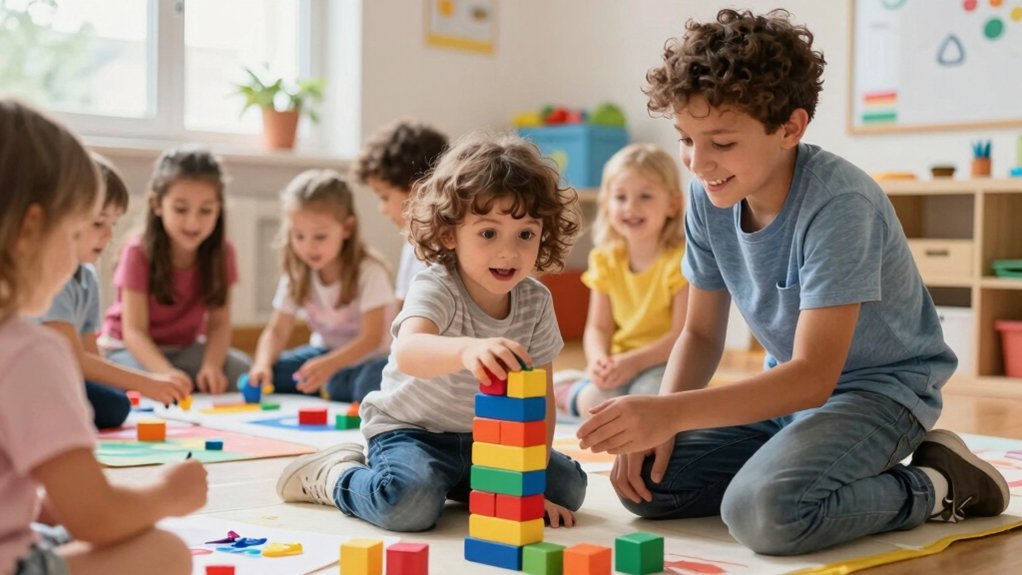
When you engage in cooperative play within mixed-age groups, you’re witnessing imagination flourish as older children construct sophisticated games that challenge younger peers to think creatively. You’ll notice that novices gain confidence by learning from expert playmates who model advanced concepts and adapt their explanations, deepening the learning experience for everyone involved. Your children develop motor originality and spontaneous creativity through this dynamic interaction, where diverse models and collaborative problem-solving transform ordinary playtime into extraordinary learning opportunities. These peer interactions also reduce competition and create a supportive atmosphere where all children feel valued regardless of their developmental stage.
Imaginative Games Build Confidence
How do children develop genuine confidence? When you place younger children in mixed-age settings, they gain it by observing and mimicking older peers. You’ll notice them pushing their physical limits and attempting new activities they’d normally avoid. Participation in these classrooms produces significant positive effects on their prosocial behavior and self-assurance.
As you watch older children lead relaxed, joyful activities, you’re witnessing them build confidence as natural nurturers. They practice leadership while younger children absorb these positive models. With proper support and encouragement, younger children progress remarkably through observation. Through mentorship and leadership opportunities, older children develop a stronger sense of purpose and identity within the group.
Mixed-age play helps you foster more empathetic, confident learners. Both age groups develop essential social-emotional skills—younger children gain courage through imitation, while older children strengthen their identity as capable guides and mentors.
Novices Learn From Experts
Why do younger children in mixed-age classrooms demonstrate more complex, creative play than their same-age peers? You’ll find the answer in observational learning.
When you’re a younger student, you watch older classmates complete challenging tasks and internalize their processes. You gain familiarity with routines and materials through careful observation, then participate in activities beyond what you’d typically initiate alone.
This exposure transforms your play. You experience more mature, cognitively complex activities that stretch your thinking. Meanwhile, older children expand their own creativity when teaching you, and your cooperative interactions become less competitive and more playful. Together, you think more, learn more, and remember more while taking greater pleasure in the learning process itself. Research shows that social interaction directly influences cognitive development, meaning the friendships and collaborative moments you share in mixed-age settings actively strengthen your thinking skills.
Learning at Your Own Pace Without Grade Pressure
You’ll notice that mixed-age classrooms shift the focus from competing with peers to measuring your own progress, which removes the anxiety that often accompanies traditional grade-level benchmarks. When you’re learning alongside students at various stages, you can advance in subjects where you’re ready without feeling rushed in others, allowing genuine mastery rather than surface-level performance. This environment celebrates where you’re in your learning journey instead of where you should be, making developmental progress the real measure of success. Older students serving as mentors to younger students reinforces their sense of responsibility while creating a supportive dynamic that reduces anxiety across all age levels.
Developmental Progress Over Competition
What if your child could advance through school without the constant pressure of competing against classmates or meeting rigid grade-level benchmarks?
In mixed-age classrooms, you’ll notice your child progresses at their own developmental pace. They’re not racing against peers or feeling stressed by standardized timelines. Instead, observation-driven planning guides movement forward, and flexible groupings form around actual skills and interests rather than arbitrary age markers. When older children mentor younger peers, they reinforce their own learning while strengthening neural pathways and building leadership confidence that extends beyond academics.
| Traditional Settings | Mixed-Age Environments |
|---|---|
| Rigid benchmarks | Individual trajectories |
| Competition focus | Collaborative growth |
| Performance anxiety | Nurturing support |
| Grade-based grouping | Skill-based flexibility |
| Peer comparison | Personal progress |
Your child experiences academic growth without performance stigma, building emotional resilience while discovering their unique learning style and strengths.
Individualized Growth Without Constraints
How differently might your child’s education unfold if advancement depended on readiness rather than age? In mixed-age classrooms, you’ll find your child progresses based on genuine mastery, not calendar expectations.
Teachers tailor instruction to individual levels, eliminating the stress of grade-level competition that often undermines confidence.
Your child moves through math, reading, and other subjects at their own pace without artificial benchmarks dictating when they’re “supposed” to learn something.
This flexibility particularly benefits gifted students who’d otherwise feel held back, and struggling learners who’d face discouragement from forced advancement.
Without grade-level pressure, your child focuses on personal growth and understanding rather than competing with same-age peers. Research shows that younger children benefit from interactions with older, more mature peers who model advanced thinking and language development.
They develop intrinsic motivation, becoming invested in their own learning journey instead of external performance metrics.
Celebrating Different Strengths Across Mixed-Age Groups
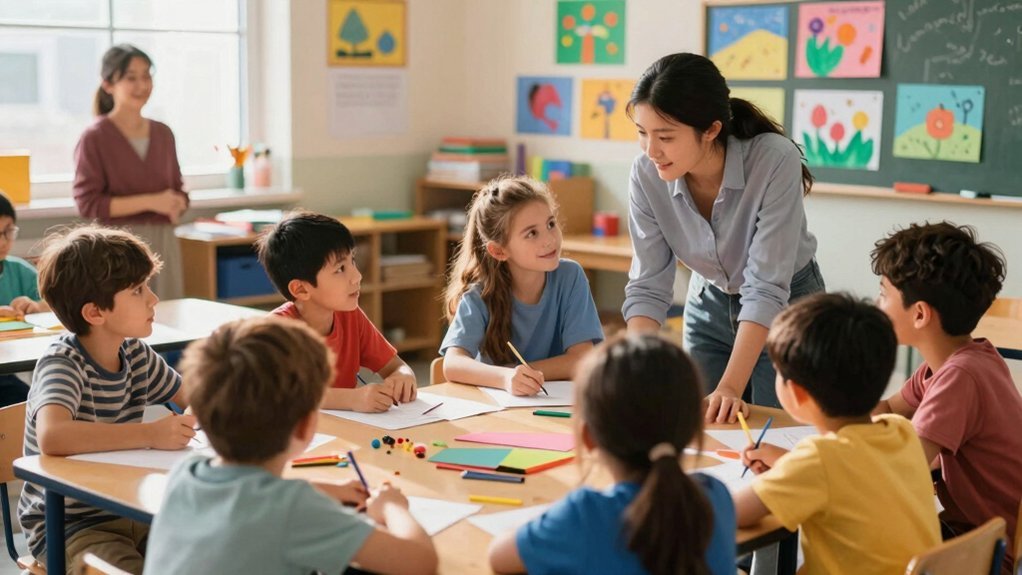
When children work alongside peers at different developmental stages, they’re exposed to a broader spectrum of abilities and talents than same-age classrooms offer. You’ll notice that older students naturally mentor younger ones, while younger children learn by observing more advanced peers.
Older students mentor younger peers while younger children learn through observation, creating exposure to a broader spectrum of abilities than same-age classrooms offer.
This dynamic shifts focus from competing for resources to appreciating what each child contributes uniquely.
In mixed-age settings, you create environments where underachievers discover strengths they might’ve overlooked in traditional classrooms. A struggling reader might excel at problem-solving or creative thinking, gaining confidence through recognition of these abilities. Similarly, academically advanced students develop leadership and patience by guiding classmates.
You’re fostering an appreciation for diverse capabilities rather than standardized performance metrics, allowing every child to recognize their individual value within the community.
How Watching Older Kids Cope Builds Emotional Strength
When you watch older classmates navigate frustration and setbacks, you’re absorbing real-time lessons in emotional regulation that textbooks can’t teach.
You naturally pick up their problem-solving strategies and perspective-taking approaches, building your own toolkit for handling life’s challenges.
Over time, this observation transforms how you view yourself—you’re not just learning resilience; you’re becoming more resilient by seeing it in action around you every day. These long-term interactions with diverse ages strengthen your social-emotional development in ways that age-separated classrooms cannot replicate.
Modeling Resilience Through Observation
Why do children in mixed-age classrooms develop stronger emotional resilience? You witness older students navigate setbacks and challenges daily, absorbing their strategies firsthand. When you see classmates master difficult skills over time, you understand that abilities aren’t fixed—they’re developed through persistence. This observation motivates you to push through your own developmental challenges rather than give up.
You also gain confidence watching your contributions valued within the community. Observing peers successfully handle real-world social interactions builds your own courage. You recognize that struggling doesn’t mean failing; it means growing. By watching how older children bounce back from difficulties without shame, you internalize that resilience is learnable. This continuous modeling transforms how you approach obstacles, making you adaptable and emotionally stronger. At MKU, personalized teacher attention ensures each child receives support tailored to their individual emotional needs, reinforcing the resilience they observe in their peers.
Learning Coping Strategies Naturally
How do you learn to manage emotions without explicit instruction? You watch older kids navigate challenges and absorb their strategies naturally. In mixed-age classrooms, you’re constantly exposed to more mature problem-solving approaches that you can model and adapt. When you observe peers handling frustration or conflict, you’re building a mental toolkit of coping mechanisms.
This observation strengthens your emotional skills through real-world examples rather than lectures. You develop flexibility, resilience, and patience by witnessing how different age groups manage stress. Peer-to-peer talk increases as you watch older classmates discuss their feelings, helping you practice emotional expression safely. Older children modeling caregiving behaviors creates an environment where compassion and empathy naturally flourish alongside emotional development.
You’re not just passively observing—you’re actively absorbing practical strategies that build your emotional foundation, making you better equipped to handle life’s challenges independently.
Real-World Preparation: Why Diverse Ages Matter
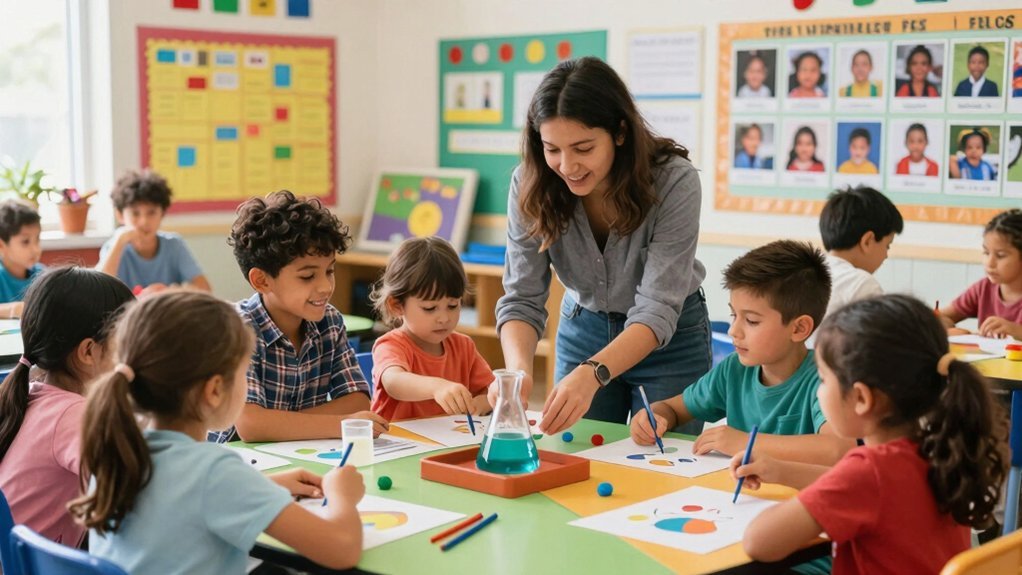
Imagine stepping into an office where you’ll collaborate with colleagues ranging from recent graduates to seasoned veterans, or a community where you’ll interact with people of all ages and backgrounds. Mixed-age classrooms prepare you for exactly this reality.
You’re not confined to age-segregated bubbles that don’t reflect how society actually works. Instead, you navigate diverse perspectives, abilities, and experiences daily. Older students model professional behaviors and communication styles you’ll encounter in workplaces. Younger peers challenge you to explain concepts clearly—a skill employers value highly.
This exposure builds your adaptability and flexibility. You learn to adjust your approach based on who you’re working with, strengthening emotional intelligence essential for career success. Through peer-based interaction, you develop the communication skills needed to work respectfully with people of different ages and backgrounds. You’re developing the interpersonal toolkit that real-world environments demand.
Creating Sustainable Mixed-Age Programs That Work
What separates thriving mixed-age classrooms from those that struggle? You’ll find sustainability depends on intentional planning and robust support systems.
Sustainability in mixed-age classrooms hinges on intentional planning and robust support systems that remove barriers and empower educators.
You need three critical elements:
- Reduce implementation barriers by minimizing transitions, keeping sibling groups together, and planning adequate financial and human resources to support your program.
- Invest in staff training through regular reflective practice, embedded supervision, and deep child development knowledge so educators adapt strategies to individual needs. When teachers receive individualized coaching approaches, they report greater confidence and lower burnout while scaling instructional quality across their classrooms.
- Design purposefully with flexible small groups, tiered materials, and responsive routines that limit competing demands on teachers.
You’ll also discover that coach ratings predict sustainability more accurately than teacher ratings. Teachers identify competing demands as the main barrier, so focus on removing obstacles rather than simply highlighting benefits. This strategic approach ensures your mixed-age program thrives long-term.
Frequently Asked Questions
How Do Mixed-Age Classrooms Handle Significant Developmental Gaps Between Oldest and Youngest Students?
You’ll address developmental gaps through individualized pacing strategies, fluid grouping, and lower staff-to-child ratios. You’ll tailor observation of each child’s needs across three-year cycles, ensuring you’re meeting everyone where they’re developing.
What’s the Ideal Age Range Spread for Effective Mixed-Age Classroom Composition and Peer Mentoring?
You’ll find that a two-year age span works best for you. This range lets you balance peer mentoring benefits while keeping developmental gaps manageable. Older kids naturally mentor younger ones without creating overwhelming differences.
How Do Teachers Assess Individual Progress Without Traditional Grade-Level Benchmarks in Mixed-Age Settings?
You’ll track individual growth through student portfolios, observation logs, and performance tasks aligned to personalized learning goals. You’re documenting progress against each child’s previous work, not grade-level standards, using formative assessment cycles.
Can Mixed-Age Classrooms Accommodate Children With Learning Disabilities or Developmental Delays Effectively?
Yes, you’ll find mixed-age classrooms effectively accommodate children with learning disabilities and developmental delays. You’ll benefit from reduced frustration when readiness levels don’t match grade expectations, and you’ll experience stronger social-emotional development through peer interactions.
How Do Parents Transition Children From Traditional Single-Grade to Mixed-Age Classroom Environments Successfully?
You’ll transition your child successfully by starting with short classroom visits, pairing them with a supportive older peer, maintaining familiar routines, and actively communicating with teachers about their adjustment progress.
In Summary
You’ll find that mixed-age classrooms transform how kids develop socially and emotionally. By engaging with peers across different ages, you’re building leaders, reducing isolation, and fostering genuine empathy. You’re creating environments where children naturally develop confidence, strengthen their communication skills, and learn from real-world diversity. When you commit to these programs, you’re investing in children who’ll navigate life with greater emotional resilience and authentic connections to others.


Leave a Reply