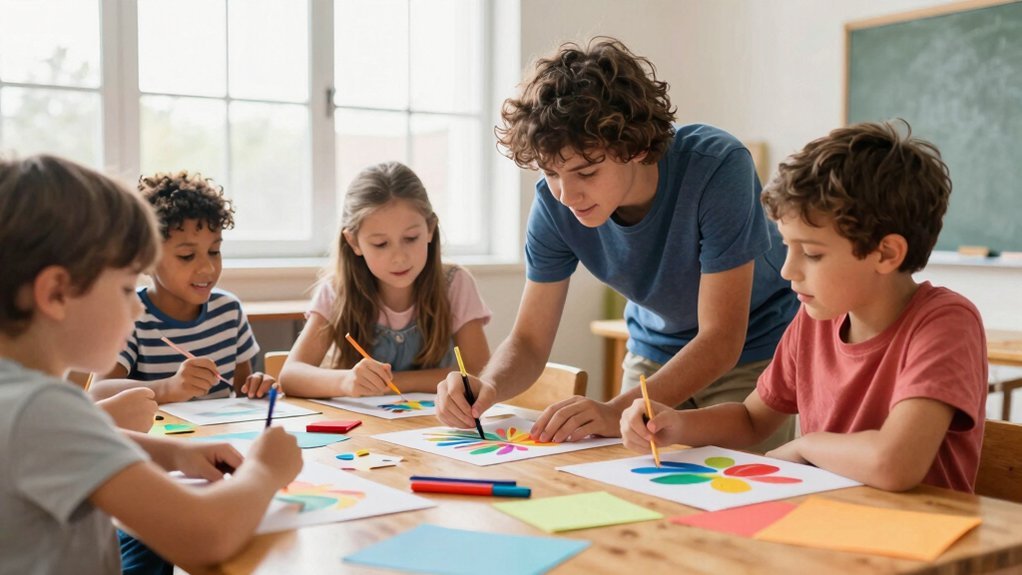
You’ll discover that mixed-age classrooms transform how children collaborate and grow. When older kids mentor younger peers, they deepen their own understanding while building leadership skills. Younger students absorb sophisticated vocabulary and see themselves as capable learners. Together, they develop genuine empathy through authentic relationships, practice perspective-taking naturally, and solve problems creatively. Competition dissolves into shared discovery. Your students build resilience by normalizing different learning paces. The full picture of how these dynamics unfold reveals surprising benefits for academic confidence and long-term workplace readiness.
How Mixed-Age Classrooms Reduce Academic Pressure and Competition
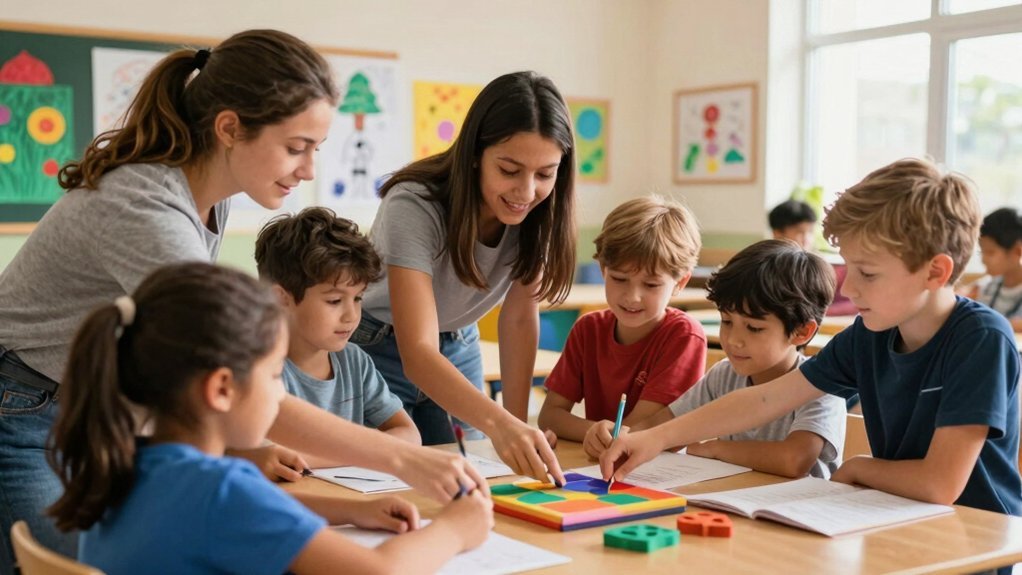
How do mixed-age classrooms shift the focus away from competition? When you place children of different ages together, you naturally redirect parental attention from peer comparisons to individual progress. This structural change transforms how you view your child’s achievement—you’re measuring their personal growth rather than ranking them against classmates.
You’ll notice a collaborative atmosphere emerges, resembling a family unit where children interact with diverse peers instead of same-age rivals. This age diversity dilutes competitive pressure significantly. Teachers adapt their practices to accommodate varied skill levels, eliminating the pressure for uniform advancement. Your child experiences less anxiety about standardized benchmarks because instruction focuses on personalized development. However, research indicates that older children’s academic gains in math and language skills may decline when younger peers make up a significant portion of the classroom.
Research shows no significant achievement gaps between mixed-age and single-grade classes, confirming that this approach doesn’t sacrifice academic outcomes while reducing the stress both you and your child experience.
Why Teaching Younger Kids Makes Older Children Better Learners
When your older child explains a concept to someone younger, they’re not just helping—they’re fundamentally deepening their own understanding. This bidirectional learning transforms tutoring into a powerful academic strategy that strengthens their own knowledge.
Teaching younger peers builds your child’s competence in ways independent study can’t match:
- Simplifying concepts forces them to reorganize their thinking and identify gaps
- Repeated explanations create fluency in reading, writing, and math skills
- Leadership opportunities cultivate self-esteem and recognition of their abilities
- Problem-solving modeling refines their cognitive flexibility and resilience
- Sustained mentorship roles mirror family dynamics, deepening their emotional investment
When your older child teaches, they’re reinforcing their own learning while developing genuine mastery. This collaboration transforms education from solitary effort into mutual growth, where both tutor and learner advance together. Beyond academics, these teaching experiences help older children develop capacities to nurture and lead, essential skills that extend far beyond the classroom into their future relationships and professional lives.
Leadership Skills Kids Develop in Mixed-Age Settings

Beyond academic reinforcement, the mentorship role your older child assumes in mixed-age settings cultivates genuine leadership competencies that extend far beyond the classroom.
As your child guides younger peers through concepts and challenges, they’re developing decision-making abilities in low-stakes environments where mistakes become learning opportunities rather than failures.
Your older child practices perspective-taking by adapting explanations to different developmental levels, building cognitive flexibility essential for true leadership.
They recognize their own growing competencies while modeling positive behavior and maturity.
This heightened sense of responsibility encourages your child to step up, providing meaningful guidance that strengthens their confidence. Through these informal mentoring moments, your child learns to observe and respond to others’ needs, developing the empathy and patience that are hallmarks of genuine leadership.
Managing interactions across diverse developmental stages naturally develops the problem-solving and communication skills that define effective leaders.
How Mixed-Age Environments Build Empathy and Prosocial Behavior
You’ll find that mixed-age classrooms naturally cultivate empathy as older children mentor younger peers, creating opportunities for both groups to practice patience and perspective-taking through authentic peer relationships.
When you engage in collaborative tasks across age groups, you’re developing genuine prosocial skills that consider others’ needs rather than following prescribed lessons.
Through consistent exposure to peers at different developmental stages, you’ll strengthen both your ability to understand others’ emotions and your inclination to respond with compassion and support. This mentorship structure reinforces responsibility in older students while building confidence and trust in younger learners.
Nurturing Through Peer Support
How do mixed-age environments transform children into more empathetic, caring individuals? When you place children of different ages together, you’re creating spaces where genuine nurturing naturally flourishes.
- Younger children learn perspective-taking earlier through consistent interaction with older peers
- Older children develop confidence by meeting the authentic needs of younger companions
- You’ll witness reduced competition as children focus on collaborative rather than comparative play
- Peer support builds resilience as children adjust expectations to developmental differences
- Sustained relationships foster genuine care, reducing the emotional labor on staff
Through peer support, you’re not simply facilitating friendships—you’re actively cultivating empathy. Children internalize that caring matters. They practice meeting others’ needs in low-stakes environments, building the emotional foundations they’ll carry forward. Mixed-age settings don’t just teach prosocial behavior; they embed it into children’s identities.
Developing Prosocial Skills Naturally
Prosocial skills don’t emerge from worksheets or lectures—they’re built through genuine interaction. When you place children across different ages together, you’re creating a natural laboratory for empathy development. Younger children observe and mirror the caring behaviors of older peers, while older children cultivate genuine compassion through mentoring roles. Research demonstrates that social interaction influences cognitive development, creating a foundation where emotional growth and learning are deeply intertwined.
| Skill | Younger Children | Older Children |
|---|---|---|
| Empathy | Learn through observation | Develop through caregiving |
| Communication | Enhance verbal abilities | Model mature dialogue |
| Problem-solving | Absorb advanced strategies | Reinforce understanding through teaching |
| Confidence | Gain from peer support | Build through helping others |
| Social awareness | Recognize developmental differences | Appreciate varied perspectives |
You’ll notice aggressive behaviors decrease while positive social conduct flourishes. Mixed-age settings naturally foster the emotional reciprocity and sustained relationships that develop prosocial capacities organically.
Advanced Vocabulary and Literacy Growth Through Cross-Age Interaction

When younger and older children learn together, they’re exposed to fundamentally different language models that accelerate vocabulary growth. You’ll notice remarkable changes as students engage across age lines.
In mixed-age settings, you experience:
- Younger children absorbing sophisticated vocabulary from older peers naturally, sharpening both receptive and expressive skills
- Older students reinforcing their own literacy by explaining concepts, deepening comprehension through teaching
- Dynamic peer mentorship that builds confidence and responsibility while modeling positive communication
- Cross-age conversations that normalize diverse learning paces and reduce stigma around language development
- Environmental supports like writing displays and book selections that amplify vocabulary gains for all ages
Research confirms that classrooms with 24-month age ranges show the greatest vocabulary growth. You’re creating inclusive environments where every child develops advanced communication skills through authentic interaction. These peer explanations reinforce concepts more deeply than traditional instruction alone, allowing younger learners to grasp complex ideas through relatable language from near-peer models.
Better Problem-Solving When Kids Learn Across Ages
Beyond vocabulary development, mixed-age learning environments sharpen problem-solving abilities in ways that single-age classrooms can’t replicate. When you collaborate with peers at different developmental stages, you’re exposed to diverse problem-solving strategies that expand your toolkit. Older children model sophisticated approaches, while younger peers observe and adapt these methods through hands-on participation.
You’ll develop flexibility by adjusting to different competency levels, building resilience as you encounter varied challenges. The reduced competition in mixed-age groups lets you focus on shared solutions rather than individual achievement. As you teach others, you reinforce your own learning—experiencing firsthand how explaining concepts deepens understanding. Through joint problem-solving, you identify, analyze, and evaluate multiple solutions collaboratively, cultivating skills that transfer across contexts and fostering the belief that competence grows through effort and learning. Older children modeling caregiving behaviors demonstrates how peer mentorship strengthens both the teacher and learner in mixed-age environments.
Normalizing Developmental Differences in a Family-Like Classroom

How does a mixed-age classroom transform your perspective on what children can’t do?
When you’re in a family-like classroom, you’ll witness developmental differences normalize naturally. Instead of frustration, you’ll see flexibility flourish. Your child’s struggles won’t signal failure—they’ll signal readiness waiting to happen.
You’ll notice:
- Younger children viewing themselves as capable classroom contributors
- Older peers modeling patience and understanding
- Competition dissolving into genuine discovery
- Skills perceived as learned, not predetermined traits
- Expectations adjusting to individual competencies rather than age benchmarks
This environment ingrain empathy deeply. You’ll watch your child develop resilience by observing peers at different stages. Progress becomes celebrated across all levels. When developmental timelines vary without judgment, children internalize that differences aren’t deficits—they’re simply part of human growth. Research shows that four-year-olds in mixed classrooms experience smaller academic gains in math and literacy compared to peers in single-age settings. Your family-style classroom becomes a partnership laboratory.
How to Design Mixed-Age Play That Scaffolds Complex Learning
The secret to opening complex learning in mixed-age classrooms lies in thoughtful play design. You’ll want to structure play areas with intentional literacy and numeracy props—books, coupons, pencils—that naturally invite collaboration. Create extended playtime opportunities spanning at least two years of mixed abilities, allowing organic scaffolding to emerge naturally.
Design collaborative social play episodes that draw younger children into increasingly complex interactions. When you facilitate cross-age interactions beyond simple grouping, older peers model problem-solving behaviors that younger children observe and practice. Observational learning enhances both social and cognitive development as younger children engage in activities beyond their solo capability with peer support.
Position yourself to encourage these interactions strategically rather than directing them. Your role involves differentiating activities by vocabulary and social demands while maintaining consistency in relationships. This approach lets trial-and-error learning flourish, generating more sophisticated play than same-age groupings produce.
Teaching Perspective-Taking: Collaboration Skills for Future Workplaces
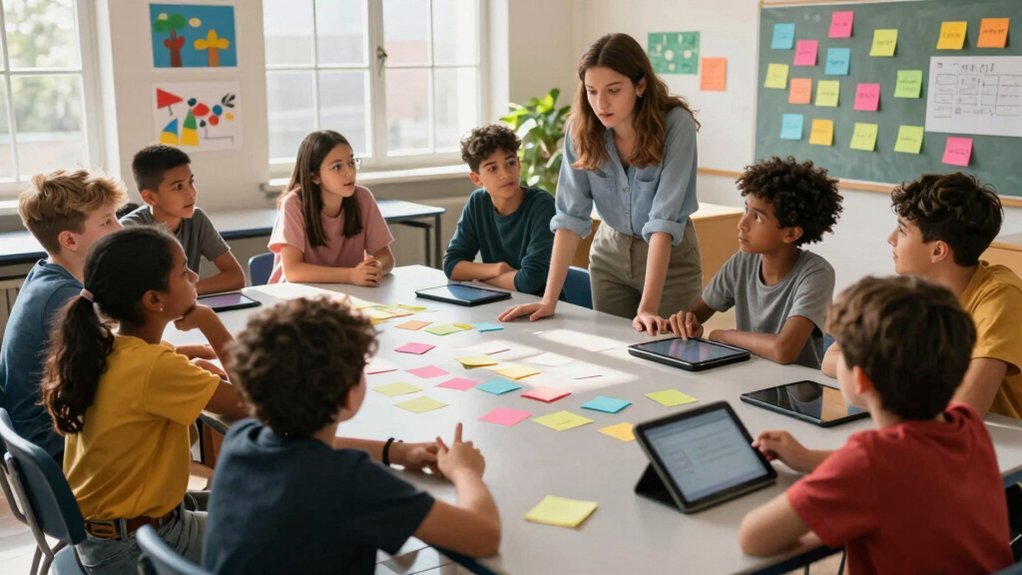
While mixed-age play environments cultivate organic collaboration skills, you’ll want to intentionally develop perspective-taking—the cognitive ability to understand others’ viewpoints and anticipate their needs.
Perspective-taking transforms workplace dynamics in measurable ways:
Perspective-taking transforms workplace dynamics through measurable gains in negotiation, collaboration, trust, innovation, and decision-making.
- Negotiation success increases by 3%+ when you anticipate counterparts’ moves in competitive situations
- Collaboration willingness jumps 29% through empathy in cooperative scenarios
- Trust deepens by distinguishing perspective-taking from empathy on the job
- Innovation thrives when teams integrate diverse viewpoints for collective breakthroughs
- Decision-making sharpens through deeper thinking and creative problem-solving
You can develop these skills through virtual reality simulations, art discussion exercises, and systematic group processes. These methods account for more viewpoints while building applicable business capabilities. However, perspective-taking and empathy remain largely separate skills, each contributing distinct value to different workplace contexts. By fostering perspective-taking early, you’re equipping future workers with essential collaboration competencies that drive organizational success.
Emotional Intelligence in Mixed-Age, Judgment-Free Classrooms
You’ll discover how peer support naturally cultivates empathy when older students mentor younger classmates, creating genuine connections that transcend typical academic hierarchies. By removing comparative pressures in judgment-free environments, you’ll notice students reduce academic stress and focus instead on collaborative problem-solving. Through these authentic interactions, you’re developing compassionate leaders who understand that strength lies in lifting others up rather than competing against them. Mixed-age classrooms promote empathy and leadership through peer help, deepening the emotional bonds that form when students of different ages work together toward common goals.
Empathy Through Peer Support
How do children develop genuine empathy in classroom settings? When you place kids of different ages together, you’re creating powerful opportunities for authentic emotional growth through peer support.
In mixed-age environments, you’ll notice children naturally learn empathy by:
- Observing older peers model compassionate problem-solving and emotional regulation
- Engaging in complex play that exposes them to diverse perspectives and approaches
- Receiving mentorship that builds understanding of others’ feelings and needs
- Practicing active listening during peace education activities
- Experiencing hands-on collaboration that reveals different problem-solving methods
You’re not forcing empathy through lessons—it emerges organically through genuine relationships. Younger children absorb maturity from older role models, while older kids reinforce their own emotional intelligence by supporting peers. This bidirectional socialization strengthens both younger and older children’s capacity to recognize and respond to others’ emotional needs. This bidirectional exchange transforms how children understand themselves and others, creating resilience that extends far beyond classroom walls.
Reducing Academic Pressure Together
Picture a classroom where children don’t scramble to keep pace with arbitrary grade-level benchmarks or fear judgment when they learn differently than their peers. You’ll notice younger students thrive in nurturing environments that prioritize growth over performance evaluation. Mixed-age settings eliminate the stress of forced advancement or retention, allowing each child to progress at their natural pace. When you remain with the same teacher across multiple years through looping structures, you experience stability that reduces academic pressure significantly. Research confirms that older children maintain equal academic performance while gaining substantial social-emotional benefits. By removing competitive dynamics and embracing collaborative learning, you create spaces where children focus on understanding rather than grades, fostering genuine intellectual curiosity and confidence in their abilities.
Building Compassionate Leadership Skills
What happens when children mentor one another across age differences? You’ll witness compassionate leaders emerging naturally from mixed-age environments.
When you place older students in mentoring roles, they develop genuine responsibility and confidence. Younger peers learn emotional awareness through observation, while mentors strengthen their own self-regulation and empathy. This dynamic creates authentic leadership grounded in care rather than control. Adults act as mediators and guides in these interactions, supporting children through conflict resolution opportunities rather than imposing solutions.
You’ll notice:
- Older children gain confidence guiding classmates through challenges
- Mentoring reinforces emotional awareness and caregiving abilities
- Younger students internalize calm communication and problem-solving
- Peer-to-peer modeling builds collaborative instincts
- Natural leaders emerge who prioritize others’ growth
In judgment-free classrooms, you’re not producing authoritarian figures. Instead, you’re cultivating compassionate leaders who understand diverse perspectives, communicate constructively, and lead through genuine connection rather than hierarchy.
Sustained Relationships and Resilience Through Age Diversity
Why do children flourish when they’re surrounded by peers at different developmental stages? You’ll find that mixed-age grouping creates family-like dynamics where relationships deepen over time. As you experience rotating roles—sometimes youngest, sometimes oldest—you develop genuine empathy and patience with others’ perspectives.
When you loop with the same teacher across multiple years, you build sustained bonds that reduce anxiety and foster belonging. You’re exposed to a wider variety of children than same-age groups allow, expanding your social understanding.
This diversity teaches you resilience by normalizing different learning paces. You learn that needs aren’t always met immediately and discover appropriate ways to handle limitations. Through these extended relationships, you internalize compassion naturally, transforming it from a skill into an ingrained part of how you connect with others.
Frequently Asked Questions
What Age Range Differences Work Best in Mixed-Age Classroom Groupings?
You’ll find that groupings spanning more than two years work best, like ages 1-5 or 3-6. You’ll observe optimal benefits when you’ve got younger students observing older peers, middle-year students bridging roles, and older students mentoring classmates effectively.
How Do Teachers Manage Behavior Issues Across Different Developmental Stages?
You’ll manage behavior across developmental stages by establishing clear rules, monitoring consistently, and adapting your environmental or curricular strategies. High management ratings correlate with effective behavior control regardless of age composition.
Can Mixed-Age Learning Work in Virtual or Remote Learning Environments?
You can absolutely make mixed-age learning work virtually by using synchronous platforms for real-time interaction, leveraging peer mentoring, and employing collaborative tools like Jamboard. You’ll sustain engagement through skilled facilitation and flexible pacing.
What Training Do Teachers Need to Effectively Facilitate Mixed-Age Classrooms?
You’ll need specialized training in child development, responsive teaching, and classroom organization. You’ll master differentiation strategies, observation skills, and facilitation techniques. You’ll also benefit from reflective supervision and collaborative planning time with colleagues.
How Do Parents Support Mixed-Age Learning at Home With Siblings?
You’ll support mixed-age learning by creating opportunities for older siblings to teach younger ones, encouraging collaborative play, modeling problem-solving together, and praising their efforts in helping each other grow academically and emotionally.
In Summary
You’ll find that mixed-age learning transforms how children develop academically and emotionally. By collaborating across age groups, you’re building leaders who naturally mentor others while strengthening your own understanding. You’re fostering empathy, resilience, and workplace-ready skills that standardized classrooms can’t easily replicate. These diverse learning environments don’t just reduce pressure—they’re creating emotionally intelligent, adaptable learners prepared for real-world complexity.


Leave a Reply