
You’ll experience less competition in multi-age classrooms because they replace age-based ranking with individualized progress tracking and skill-based grouping. Instead of competing against classmates, you’re measured by your own growth through portfolios rather than standardized grades. Direct peer comparison disappears, and your motivation shifts from external benchmarks to collaborative achievement with peers of different developmental stages. Teachers focus on facilitating your learning rather than rushing you toward grade-level benchmarks. This fundamental restructuring transforms how you view success itself. Understanding exactly how this shift happens reveals surprising benefits for your confidence and deeper learning.
How Multiage Grouping Removes Academic Comparison
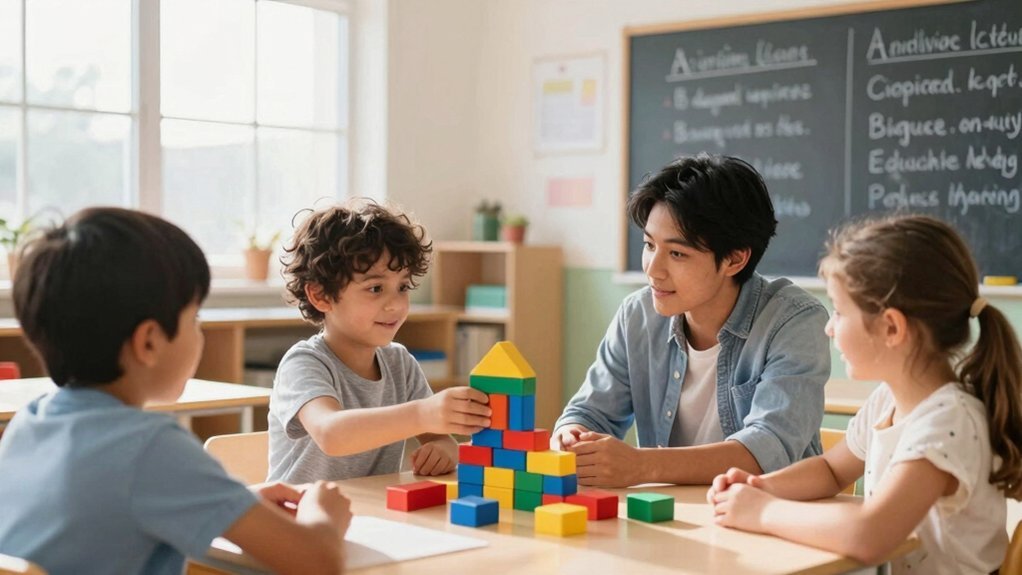
How do multiage classrooms fundamentally reshape the way students perceive their academic standing? By eliminating grade-level distinctions, you escape the rigid comparison inherent in traditional single-age cohorts. You’re not constantly measured against peers born within the same year, which removes the pressure of standardized benchmarks.
Instead, you find belonging through shared interests rather than chronological age. This shift dissolves age-based hierarchies that typically fuel competition. Social groups form organically around what you care about, not where you rank academically. When teachers leverage differentiated instruction to address individual learning needs rather than grade-level standards, the focus shifts from how you perform relative to classmates to how you progress at your own pace.
The multiage structure actively prevents the psychological weight of constant comparison. You’re working alongside students at varying developmental levels, which normalizes different abilities as natural rather than deficient. This environment fundamentally reframes how you see yourself academically, shifting focus from competitive standing to individual progress.
When Kids Learn at Their Own Pace, Pressure Disappears
When you learn at your own pace in a multi-age classroom, you’re focused on your individual progress rather than competing with peers around you. You’ll discover that growth becomes the measure of success instead of how quickly you move compared to classmates, which fundamentally shifts the competitive pressure most traditional settings create. This personalized approach lets you celebrate your own achievements without the stress of keeping up or falling behind others. Since you can revisit topics as many times as needed and skip material you already know, personalized learning ensures that mastery becomes the true indicator of progress rather than the pace at which you advance.
Individualized Progress Removes Comparison
Why do we insist on measuring every child against the same yardstick? In multi-age classrooms, you’ll find that individualized progress replaces comparative achievement as the primary measure of success. Rather than tracking whether you’re ahead or behind grade-level benchmarks, you focus on your own learning trajectory. You move faster in subjects where you’re ready and slower in areas requiring mastery. This approach acknowledges that growth isn’t linear—you’ll experience periods of significant advancement, plateaus, and occasional setbacks without judgment. Teachers recognize your unique readiness timeline instead of forcing rigid, standardized schedules. When you’re evaluated on personal development rather than peer comparison, the pressure dissolves. Spiraled curriculum opportunities allow you to revisit concepts across different contexts and grade levels, deepening understanding without the anxiety of fixed timelines. You can concentrate on genuine learning instead of anxiously monitoring your standing relative to classmates.
Growth Over Competition Thrives
What happens to your motivation when you’re no longer racing against your classmates?
In multi-age classrooms, you shift from competing for rankings to focusing on genuine growth. This fundamental change transforms how you approach learning and develop as a student.
- Internal drive replaces external pressure – You’re motivated by personal progress rather than outperforming peers, creating sustainable engagement with material.
- Mentoring builds responsibility – Teaching younger classmates reinforces your understanding while developing leadership skills and pride in supporting others. Peer interaction strengthens mastery as you explain concepts in multiple ways to accommodate different learning styles.
- Behavior improves naturally – When encouraged to help struggling peers, you refocus energy from seeking status toward modeling positive conduct.
- Complex projects engage deeper thinking – Gifted learners tackle creative, open-ended challenges instead of chasing top grades through rote memorization.
Growth becomes intrinsic rather than something you chase for recognition.
Why Teaching Younger Students Deepens Older Kids’ Skills

When you teach younger students, you’re forced to organize your own thinking clearly, which reinforces what you’ve already learned and pushes you toward mastery. Taking on mentoring roles builds your leadership capacity and sense of responsibility as you guide peers through challenges and model positive behavior. Through these teaching experiences, you’ll sharpen your critical thinking skills by answering tough questions and adapting explanations to different learning styles. As older students assume mentorship roles, they naturally transition from observer to leader in a way that honors their individual developmental timeline rather than forcing an abrupt shift.
Reinforcing Knowledge Through Teaching
How does explaining a concept to someone else transform your understanding of it? When you teach, you’re forced to articulate ideas clearly, exposing gaps in your own knowledge. This active recall process solidifies your memory and deepens mastery.
In multi-age classrooms, you’ll experience:
- Immediate self-correction – mentees’ questions reveal misunderstandings you didn’t know you had
- Refined explanations – repetitive teaching sharpens your ability to communicate complex ideas
- Strengthened neural pathways – revisiting concepts without stigma embeds knowledge more deeply
- Enhanced conceptual depth – diverse questions from younger peers challenge you to think sophistically
You’re not simply repeating information; you’re reconstructing understanding through interaction. Research confirms this phenomenon dramatically improves older students’ IQ scores and academic performance, making teaching itself the most powerful learning tool available. This peer mentorship dynamic, central to multi-age classroom design, directly supports personalized learning while fostering social and emotional growth across age groups.
Building Leadership and Responsibility
Beyond the academic gains you’ve already experienced through teaching, something equally powerful unfolds: you’re developing into a leader. Multi-age classrooms distribute leadership opportunities across different domains rather than concentrating them among a few extroverted personalities. Your mathematical talents might guide problem-solving initiatives, while an organized classmate establishes systems, and an artistic peer directs creative projects. You’re practicing responsibility in low-stakes situations before facing higher-pressure scenarios. This graduated approach lets you discover that leadership encompasses quiet forms of contribution beyond being “in charge.” You’re learning that different people strengthen your community in distinct ways, with particular strengths carrying value regardless of personality type. These experiences remove artificial ceilings on your potential, validating diverse leadership styles you’ll carry throughout life. Research confirms that older student-teachers deepen their own understanding by teaching and clarifying gaps in their knowledge, creating a reciprocal learning dynamic where both mentor and student benefit academically.
Developing Critical Thinking Skills
Why does explaining a math concept to a younger classmate suddenly reveal gaps in your own understanding? When you mentor peers, you’re forced to break down complex ideas into logical components, which strengthens your critical thinking immediately.
- Articulation demands precision – You must use exact language and clarify assumptions, sharpening your verbal reasoning and forcing deeper comprehension.
- Questions expose weaknesses – Younger students’ inquiries push you to examine why concepts work, developing metacognitive awareness of your own thinking processes.
- Problem-solving expands – Addressing challenges from different developmental perspectives broadens your strategic toolkit and adaptability. This bidirectional socialization allows both mentors and younger peers to develop enhanced communication and problem-solving abilities through reciprocal learning.
- Accountability validates reasoning – The responsibility of guiding learners compels you to recognize knowledge gaps and study deeper.
Teaching isn’t just helping others—it’s fundamentally transforming how you think.
Finding Your Peer: How Mixed-Age Friendships Form

What draws children together across age gaps in multi-age classrooms? You’ll find that shared interests and classroom culture create natural connection points regardless of developmental differences.
| Factor | Impact |
|---|---|
| Shared games & music | Builds common ground |
| Classroom identity | Fosters collective belonging |
| Play practices | Creates routine interactions |
| Developmental similarity | Influences peer selection |
| Fluid groupings | Prevents fixed divisions |
You’ll notice friendships form fluidly as children bond over mutual play experiences rather than age alone. While entrenchments around similarity persist, your classroom’s collective identity—think “Crimson class”—encourages cross-age interactions routinely. Nearly three-quarters of children develop best friendships across ethnic backgrounds, and most form top-five friendships from different social classes. You’ll observe that friendship memberships shift based on common interests, allowing children to find compatible peers who share their developmental level and passions. Research shows that indirect strategies, such as joining play through shared objects or goals rather than direct requests, support more sustained friendships across age gaps.
The Looping Effect: One Teacher, Deeper Understanding
When you spend two consecutive years with the same teacher, you’re building a foundation of trust that transforms how you learn and grow.
Your teacher knows your learning style, your strengths, and your struggles deeply enough to create personalized pathways tailored specifically to you. This continuous teacher-student relationship enables teachers to observe cognitive and affective needs over an extended period, allowing for better instructional adjustments and individualized support.
This familiarity also reduces the anxiety you might feel about achievement, since you’re progressing within a relationship where you’re already known and valued.
Building Trust Over Time
Most significant educational relationships don’t form overnight—they develop through sustained, meaningful interaction. When you stay with the same teacher across multiple years, you build a foundation of trust that transforms your classroom experience.
This continuity creates profound shifts in how you engage with learning:
- You feel safer taking academic risks without fear of judgment from an unfamiliar authority figure
- Anxiety decreases because you’ve already mastered the teacher’s expectations and classroom rhythms
- Your motivation strengthens when you know your teacher genuinely understands your abilities and challenges
- Emotional regulation improves through secure, consistent relationships that support your developing brain
Research confirms that looping relationships directly correlate with higher academic success. You’re not starting from zero each September—you’re building on established rapport that allows deeper learning to flourish. Teachers can customize lessons quickly to help all students progress at their own pace when they already know their learners’ strengths and needs.
Personalized Learning Pathways
How does your learning transform when your teacher knows not just your name, but your exact strengths, struggles, and pace? In multi-age classrooms with looping teachers, personalized pathways emerge naturally through sustained relationships. Your teacher adjusts content difficulty every 48 hours based on diagnostic assessments, identifying knowledge gaps you didn’t know existed. Rather than following standardized routes, you progress along customized trajectories that leverage your existing strengths. AI-driven recommendations match resources to your learning profile with over 90% accuracy, while incremental algorithms update only affected knowledge areas, preserving what you’ve already mastered. This precision acquisition directly promotes knowledge internalization. You’re not competing against classmates on identical timelines—you’re advancing through appropriately challenging material at your own rhythm, fostering deeper comprehension and sustained engagement. Research demonstrates that personalized learning paths significantly improve task completion rates and learning satisfaction compared to unified curriculum approaches.
Reduced Achievement Anxiety
What if you could shed the knot of anxiety that tightens in your stomach every September?
Looping classrooms transform how you experience academic pressure. When you return to the same teacher, the uncertainty dissolves. You already know the routines, expectations, and classroom dynamics. This familiarity creates psychological safety that encourages risk-taking without fear of judgment.
Your anxiety decreases because:
- Established relationships eliminate fear of the unknown
- You understand classroom expectations, reducing performance pressure
- Your teacher knows your learning style and adjusts accordingly
- Security strengthens your willingness to engage academically
You’re not competing against invisible standards or starting from scratch. Instead, you build on existing trust and understanding. This foundation allows you to focus energy on learning rather than managing transition stress, ultimately supporting vulnerable learners who thrive in predictable, supportive environments.
How Multiage Classrooms Rewire What Kids Compete For
In traditional age-segregated classrooms, students compete primarily for grades and teacher approval—a zero-sum game where one child’s success often means another’s relative failure. Multiage environments fundamentally shift this dynamic by reframing what matters.
You’ll find competition redirects toward personal mastery rather than peer comparison. When students engage in individualized projects aligned with their abilities, they’re competing against their own previous performance, not classmates. Skill-based grouping removes the age comparison entirely—a seven-year-old and nine-year-old work together without ranking by developmental stage.
This restructuring reduces anxiety significantly. You’re no longer chasing grades tied to arbitrary age standards. Instead, you’re pursuing genuine competence in areas that challenge you specifically. The competitive energy transforms into collaborative achievement, where your progress doesn’t diminish someone else’s success. However, research shows that teacher quality and instructional methods matter more than multiage structure alone in determining whether these competitive shifts actually benefit student outcomes.
Why Learning Slowdowns Don’t Trigger Shame
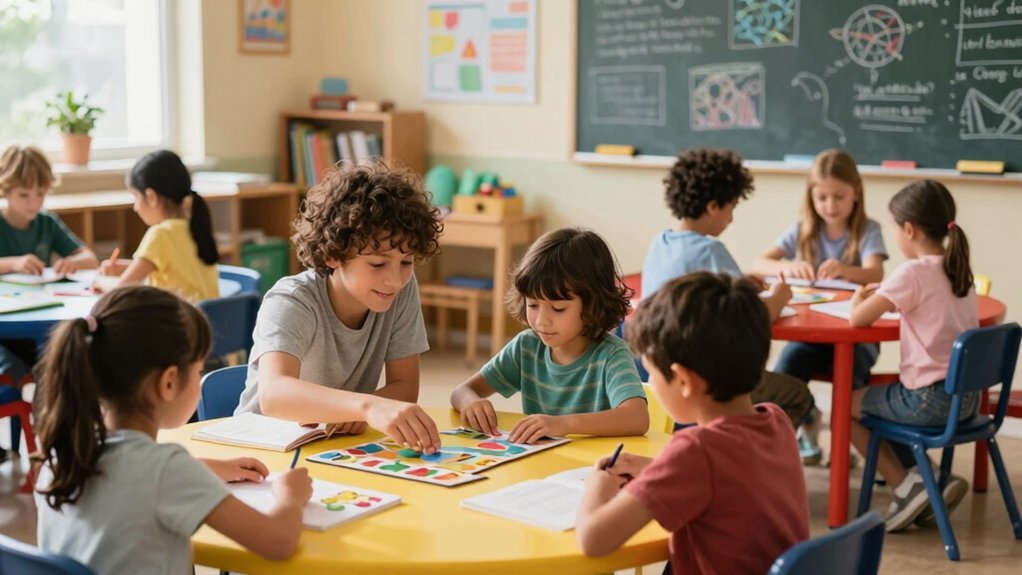
The shift away from peer comparison does more than reshape what students compete for—it fundamentally changes how you experience struggle. When you’re learning alongside children at various developmental stages, you’re not constantly measured against same-age peers. This structural difference eliminates the shame that typically accompanies slowdowns.
Your progress gets tracked through portfolios rather than grades, so you see growth without ranking. Teachers focus on facilitating your learning instead of rushing you toward standardized benchmarks. You’re not labeled by achievement level, which removes the stigma surrounding slower pacing.
Consider these protective factors:
- Mixed-age groupings prevent direct peer ranking
- Portfolio-based assessment replaces comparative grading
- Individual timelines replace rigid grade-level expectations
- Mentorship roles shift focus from competition to cooperation
This environment lets you struggle productively without shame.
The Behavior Shift: Modeling Over Performance
How does behavior change when you’re surrounded by older students naturally demonstrating skills rather than performing for grades?
You’ll notice a fundamental shift. Instead of competing for marks, you’re observing authentic modeling. Older peers showcase appropriate classroom behavior and social interactions without performance pressure. You absorb language development, problem-solving approaches, and leadership naturally through observation.
| Aspect | Traditional Classrooms | Multi-Age Settings |
|---|---|---|
| Motivation | Grade competition | Peer observation |
| Behavior | Performance-driven | Authentically modeled |
| Skills Transfer | Individual achievement | Collaborative learning |
| Anxiety Level | High from comparison | Low from acceptance |
| Behavioral Needs | Frequent interventions | Minimized through modeling |
This environment reduces behavioral interventions significantly. You’re motivated by watching capable peers rather than chasing grades. Leadership reinforces older students’ own skills while you develop naturally through genuine observation and collaborative problem-solving. Research supporting multiage education demonstrates that positive student engagement occurs when learners focus on growth through peer interaction rather than competitive achievement.
Where Bullying and Isolation Lose Their Foothold

What happens when you’re placed in an environment where age hierarchies naturally flatten? Bullying loses its power.
In pedagogically-designed multigrade classrooms, you’ll notice victim-bully relationships occur significantly less frequently than in single-grade settings. This isn’t coincidental—it’s structural. Here’s why:
- Reduced dominance-seeking: Mixed ages discourage aggressive competition for hierarchical positions that fuel bullying
- Prosocial modeling: Older students naturally nurture younger peers, creating protective relationships rather than exploitative ones
- Diminished victimization: Younger children face lower risk of peer aggression when integrated intentionally into mixed-age groups
- Weakened peer networks: Bullying perpetration decreases when social structures emphasize cooperation over status competition
The distinction matters: administratively-formed multigrade classrooms don’t produce these benefits. Only intentional pedagogical design—where mixed-age interaction embeds prosocial values into your school’s philosophy—creates environments where isolation and bullying genuinely lose their foothold. Research on anti-bullying program effectiveness demonstrates that structured interventions measuring pre- and post-intervention outcomes in controlled settings show approximately 17-20% reductions in victimization, suggesting that intentionally designed environments can substantially alter peer dynamics.
How to Spot Real Growth (Beyond Test Scores)
Once you’ve dismantled the social hierarchies that breed bullying, you’ll notice something equally compelling: children begin showing growth that standardized tests can’t capture. Watch for shifts in self-perception—students who once doubted themselves now tackle challenges with genuine confidence.
You’ll spot increased participation in complex problem-solving and sophisticated conversations that reveal expanding vocabulary and thinking. Observe leadership emerging naturally as older students mentor younger peers, building responsibility and pride. These mentor relationships also deepen the confidence of younger students who benefit from direct guidance and role modeling.
Notice attendance climbing and discipline referrals dropping as engagement deepens. Track how children view themselves within their community, recognizing their contributions as both learners and supporters.
These markers—confidence, intellectual curiosity, collaborative spirit, and genuine belonging—reveal the profound development happening daily in multiage environments where children grow into their authentic potential.
Social and Emotional Gains That Stick With Kids
The transformation that unfolds in multiage classrooms extends far beyond academic metrics—it’s measurable in how children view themselves and relate to others. You’ll witness gains that genuinely stick because they’re rooted in authentic relationships and daily practice.
- Confidence blooms through peer modeling – Older students inspire younger ones, while younger students help older peers recognize their own progress and strengths.
- Empathy develops naturally – Exposure to diverse developmental stages teaches you and your peers to celebrate differences rather than judge them. This observation-driven learning across age groups deepens the ability to take another person’s perspective.
- Secure attachments foster resilience – Sustained relationships with the same teacher across multiple years reduce stress and support lasting emotional security.
- Prosocial skills become habits – Responsibility, leadership, and positive interactions replace aggression, creating behaviors that transfer beyond classroom walls.
Frequently Asked Questions
How Do Multiage Classrooms Handle Standardized Testing and Grade-Level Accountability Requirements?
You’ll administer standardized tests at cycle’s end, using alternative assessments like portfolios and observations throughout. You’ll emphasize growth over grade comparisons while navigating accountability mandates through flexible, skill-based grouping strategies.
What Percentage of Instructional Time Goes to Mixed-Age Versus Individual Learning Activities?
You’ll find that the background information doesn’t specify exact percentages for mixed-age versus individual learning time. However, you’ll note that teachers rely heavily on independent seat-work when parallel curriculum approaches dominate their multi-grade classrooms.
How Do Teachers Manage Vastly Different Developmental Stages Within One Classroom Daily?
You manage vastly different developmental stages by using flexible grouping strategies, differentiating instruction to meet individual needs, and employing peer tutoring where older students mentor younger ones daily.
Do Parents Report Concerns About Younger Children Holding Back Older Students Academically?
You’ll find no direct parental surveys substantiate concerns about younger children holding back older students. Current research lacks documentation of significant parent-reported academic achievement losses in multiage settings.
What Training Do Teachers Need to Effectively Implement Multiage Classroom Instruction Models?
You’ll need comprehensive training in differentiated instruction, developmental knowledge across age ranges, multi-age classroom management strategies, and collaborative planning with colleagues. You’re developing personalized teaching methods and flexible grouping skills continuously.
In Summary
You’ll find that multi-age classrooms transform how your child views learning and success. When you remove constant academic comparison, your kids naturally reduce their competitive stress. You’re creating an environment where they focus on personal growth rather than outperforming peers. Your students develop genuine friendships across ages, build stronger emotional skills, and discover that learning itself—not grades—matters most. You’re fostering lifelong learners who value progress over performance.




Leave a Reply