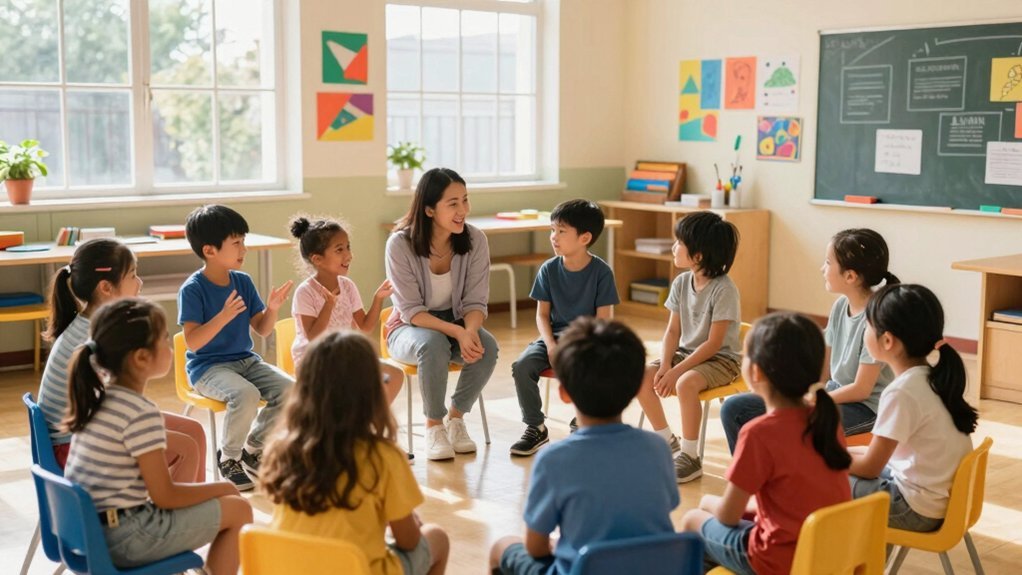
When you mix ages in one classroom, you’re creating natural mentorship that turbocharges communication growth. Older peers model sophisticated language patterns while younger students absorb vocabulary through authentic interaction—not worksheets. You’ll notice kids speak up more freely because mixed-age settings reduce bullying and competitive pressure. Flexible pacing lets everyone contribute without anxiety. Trust builds across ages through honest dialogue, making language exploration feel safer. The real magic happens when you discover how these dynamics transform not just speaking skills, but genuine confidence.
How Peer Tutoring in Multiage Classrooms Strengthens Speaking Skills

Have you ever noticed how students speak more confidently when teaching a classmate? Peer tutoring in multiage classrooms creates powerful opportunities for you to strengthen speaking skills through authentic interaction. When you’re paired with a slightly older tutor, you’ll experience maximum verbal stimulation, which accelerates vocabulary development and fluency. Your tutor provides immediate feedback in a supportive environment, reducing anxiety while building your confidence. Research shows experimental groups using peer tutoring demonstrate significant improvements in speech sound proficiency, fluency, and comprehension compared to traditional instruction.
The collaborative nature of tutoring—whether through discussions, role-plays, or explanations—keeps you actively engaged in real language use. You’ll also benefit from jigsaw activities where peers teach you specific concepts, reinforcing learning through varied perspectives and practical application. Studies employing classroom action research methodologies have documented how tutees in multiage settings achieve significantly higher learning success compared to control groups not participating in peer-tutoring interventions.
Why Mixed-Age Settings Create Safer Spaces for Open Communication
You’ll find that reduced bullying in mixed-age classrooms builds the confidence children need to speak openly without fear of ridicule.
Age diversity naturally promotes tolerance across developmental stages, creating an atmosphere where you’re less likely to encounter the rigid social hierarchies that stifle authentic expression.
Secure environments enable you to share ideas and take communication risks, knowing that older peers model respect and younger classmates look to you as an example. When children observe mentorship and empathy demonstrated consistently by older peers, they internalize these behaviors and replicate them in their own interactions with classmates.
Reduced Bullying Builds Confidence
Why do mixed-age classrooms feel safer for communication? Reduced bullying directly builds your confidence to speak openly. When you’re in a multigrade setting, you’re less likely to experience peer victimization than in age-segregated classrooms. This decrease in aggression creates psychological safety—you don’t worry constantly about social threats. Programs like Olweus demonstrate that intervention reduces bullying perpetration and victimization simultaneously, lowering your anxiety. As bullying diminishes, you develop stronger self-esteem and willingness to express yourself authentically. You’ll notice increased perceptions of adult intervention in structured programs, reinforcing that you can communicate concerns without retaliation. This protective environment transforms you into a confident communicator who engages more readily with peers across age ranges, strengthening your overall communication skills. Implementation of multi-level components at the school, classroom, and individual levels creates sustained systemic change that protects communication development over time.
Age Diversity Promotes Tolerance
When you interact with peers across different ages, you naturally develop tolerance for differences you might otherwise dismiss. Mixed-age settings normalize diverse learning paces and styles, reducing frustration from rigid age expectations. You observe classmates progressing at their own speed, which builds emotional intelligence and deeper appreciation for individual differences. This real-world exposure to diversity minimizes stigma around how others learn and develop. You’re less likely to judge peers harshly when you recognize that everyone has unique strengths and timelines.
The collaborative atmosphere creates safer spaces where open communication flourishes because you’ve learned to value rather than criticize differences. This foundation of tolerance enables you to communicate more authentically and listen more generously to perspectives unlike your own. Research shows that time in large mixed groups can build relations and reduce bullying by increasing security and confidence among students.
Secure Environments Enable Authentic Expression
How do you find your voice when competition’s breathing down your neck? In mixed-age classrooms, you don’t have to. You’re surrounded by mentors and peers working together rather than against each other, creating psychological safety that unlocks authentic communication.
When you’re not constantly comparing yourself to same-age classmates, you can express yourself freely:
- You share ideas without fear of judgment
- You ask questions without worrying about appearing “behind”
- You contribute at your own pace and developmental level
- You celebrate differences instead of hiding them
This secure atmosphere—one that mirrors family dynamics—allows you to communicate genuinely. Younger children feel nurtured rather than judged, while older students develop empathy through mentoring. Everyone benefits from reduced stigma around differences, enabling you to show up as your authentic self and develop communication skills rooted in trust rather than anxiety. Long-term consistent teacher relationships across two-year spans further reinforce this stability and deepen the trust that supports open communication.
How Kids Pick Up Vocabulary From Older Peers Faster
You’ll notice that older peers naturally become language models your child watches and mimics, creating cognitive gaps that actually drive vocabulary gains rather than hinder them. When you group younger children with older classmates, they’re exposed to more sophisticated word choices and conversational patterns they’re motivated to adopt. This peer interaction accelerates word development far more effectively than traditional age-segregated instruction, because your child isn’t just learning vocabulary—they’re learning it from someone they genuinely want to emulate. Research shows that input frequency and in-depth word processing during these peer interactions significantly influence how successfully younger learners acquire and retain new vocabulary from their older classmates.
Language Models Shape Young Learners
Why do children in multi-age classrooms pick up vocabulary faster from older peers than language models learn from raw data? You’ll find the answer in how humans learn versus how algorithms process information.
Language models rely heavily on:
- Frequency statistics rather than meaningful social interaction
- Token patterns that miss the sensorimotor richness you experience
- Distributional data without emotional context or real-world application
- Unigram probabilities that ignore your dynamic peer relationships
Children in mixed-age settings absorb vocabulary through authentic communication, observation, and social cues that models simply can’t replicate. You’re leveraging embodied learning—gestures, facial expressions, and genuine engagement—while algorithms mechanically process frequencies. Research demonstrates that articulatory effort inversely correlates with vocabulary acquisition success, suggesting that efficient motor coordination during speech production facilitates faster learning outcomes. This fundamental difference explains why your interactions with older peers create deeper, more durable vocabulary acquisition than any computational approach.
Cognitive Gaps Drive Vocabulary Gains
The real power of multi-age classrooms lies in something more tangible than language models’ statistical patterns: the cognitive gaps between children create natural learning opportunities. When you group younger children with older peers, you’re establishing a built-in vocabulary advantage. Younger children naturally view advanced language as aspirational, accelerating their word pickup through observation and peer modeling.
Older children’s sophisticated vocabulary and complex problem-solving strategies become your child’s learning blueprint. Rather than passively absorbing language, your child actively engages with elevated discourse during complex play and conversations.
This cognitive gap isn’t a limitation—it’s a catalyst. Your younger learner fills vocabulary gaps faster by positioning themselves as an apprentice to older peers’ lexicon, reinforcing language use through responsibility and participation in advanced interactions.
Peer Interaction Accelerates Word Development
How do children absorb new vocabulary so rapidly from their peers? Research reveals that you’ll pick up words faster from classmates than from adults. When older peers speak, their language mirrors your own production, creating an ideal learning match. You don’t just learn from direct conversation—you naturally absorb novel words by overhearing peer exchanges.
Multi-age settings amplify this advantage:
- You encounter diverse vocabulary through older children’s conversations
- Language sticks because peer input matches your developmental level
- Spontaneous peer dialogue creates authentic learning moments
- Conversational turns directly predict vocabulary growth
Studies tracking 1,500 hours of preschool recordings confirm that more peer interactions correlate with larger vocabularies. Individual experiences with classmates predict your word knowledge better than classroom averages. You’re not passively listening—you’re actively building linguistic competence through meaningful peer engagement. This collaborative learning environment also develops critical thinking and negotiation skills alongside vocabulary acquisition.
How Multiage Cooperative Learning Builds Verbal Confidence
Multiage cooperative learning environments create unique opportunities for students to develop verbal confidence through structured peer interactions and collaborative activities. When you participate in role plays and games with mixed-age peers, you shed inhibitions that same-age competition typically triggers. You’ll find that cooperative settings normalize classroom dynamics, encouraging you to contribute ideas without fear of judgment.
Younger students gain confidence by observing advanced verbal behaviors from older peers, while you as an older student strengthen your own articulation through teaching roles. Through collaborative discovery and verbal sharing of findings, you build self-esteem directly linked to increased verbal participation. This acceptance and reduced pressure foster genuine self-expression, transforming shy students into active communicators who volunteer answers confidently. Research demonstrates that social competence in early years predicts later academic and social success, making these formative communication experiences in multiage settings particularly valuable for long-term development.
How Both Younger and Older Students Benefit From Mixed-Age Pairing

While verbal confidence flourishes through cooperative learning, the real power of mixed-age classrooms emerges when you examine how younger and older students actively shape each other’s growth.
You’ll witness transformative dynamics when pairing different ages together:
- Younger students absorb advanced vocabulary and sophisticated communication patterns from observing older peers, dramatically expanding their linguistic capabilities
- Older students reinforce their own understanding by explaining concepts clearly, deepening comprehension while building genuine confidence
- Both groups form wider peer relations, reducing isolation and creating genuine interdependence rather than competition
- You create inclusive environments where diverse learning paces normalize, fostering emotional resilience
These mixed-age partnerships don’t just teach communication—they cultivate mutual respect and shared responsibility. Younger students view themselves as capable community members while older students develop authentic leadership. When older toddlers guide younger peers through introducing spaces and activities, they model prosocial behavior while facilitating smoother transitions for newcomers. Together, you’re building communicators who connect across differences naturally.
Why Peer Bonds Make Kids Braver About Speaking Up
When you create safe, trusting relationships between students of different ages, you’re fundamentally changing how willing they’ll be to take communication risks. Peer bonds reduce the intimidation factor that often accompanies learning from adults. Your students find it easier to ask questions, make mistakes, and experiment with ideas when they’re working alongside relatable peers who’ve recently mastered those same skills.
Peers use language and examples your students genuinely understand—drawing from shared experiences rather than abstract instruction. This accessibility builds confidence. When multiyear placements establish continuity, trust deepens further. Your students develop genuine mentoring relationships that boost self-assurance on both sides. Research confirms that peer teaching strengthens understanding for both the younger learner and the older student-teacher, creating a reciprocal benefit that enhances communication development across ages.
As anxiety decreases and belonging increases, children become braver communicators. They’re willing to speak up, contribute ideas, and engage authentically because they feel secure within their mixed-age community.
How Multiage Classrooms Use Flexible Pacing to Reduce Speech Anxiety

How do you help anxious speakers find their voice? Flexible pacing in multiage classrooms removes the pressure that silences children. When you aren’t locked into grade-level constraints, you let students revisit concepts without shame or stigma. They don’t feel “behind”—they feel supported.
Flexible pacing removes pressure. When students aren’t locked into grade-level constraints, they feel supported—not behind.
Consider what this freedom creates:
- No forced participation timelines that trigger anxiety
- Personalized instruction matched to readiness, not age
- Safe revisiting of material without peer judgment
- Tailored support that acknowledges individual development
You’re replacing lockstep pressure with continuity. Students experience consistent routines and known expectations, which builds security. When children feel safe, they talk. They ask questions. They experiment with language without fear of falling behind classmates. Extended time with the same teacher deepens understanding of students’ needs, creating accountability for recognizing and addressing communication barriers before anxiety takes root. This emotional safety transforms reluctant speakers into confident communicators who genuinely want to participate.
Why Mixed-Age Learning Communities Foster Honest Dialogue
Beyond individual emotional safety lies another powerful dynamic: the natural conversations that emerge when children of different ages interact authentically. You’ll notice that mixed-age settings eliminate the pressure to conform to a single peer standard, allowing kids to express themselves more genuinely. Younger children feel comfortable asking questions without fear of judgment, while older peers respond with patience rather than mockery. This reduced competitive atmosphere encourages vulnerability—children risk sharing ideas they might otherwise hide. You’ll see honest dialogue flourish because age differences create natural role distinctions that replace the hierarchy of same-age peer groups. Kids collaborate toward shared goals rather than competing for status. This authenticity builds trust across age groups, making communication feel safer and more purposeful for everyone involved.
Frequently Asked Questions
What Classroom Management Strategies Work Best for Maintaining Order in Multiage Settings?
You’ll maintain order in multiage settings by establishing clear expectations, using flexible grouping strategically, and empowering students with responsibility. You’ll leverage peer mentoring so older students model appropriate behavior while younger students follow their lead naturally.
How Do Teachers Assess Individual Communication Progress in Mixed-Age Learning Environments?
You’ll track individual communication progress through student portfolios, talking journals, and anecdotal observations. You’ll use authentic assessments, audiotapes, and self-monitoring techniques that capture each child’s unique growth across mixed-age interactions.
What Age Combinations Create the Most Effective Peer Tutoring Relationships?
You’ll find that pairing slightly older peers with younger students creates the most effective tutoring relationships. Research shows you’ll achieve stronger results when tutors are moderately older, fostering cognitive growth through appropriate challenge levels.
How Can Parents Support Multiage Classroom Communication Development at Home?
You’ll support multiage communication development by encouraging your child’s older siblings to mentor younger ones, modeling peer teaching behaviors at home, and facilitating family activities where children assume leadership roles with different age groups.
Does Multiage Grouping Benefit Students With Speech or Language Disorders Specifically?
Yes, multiage grouping considerably benefits your child with speech or language disorders through increased peer language exchange, supportive mentoring, and reduced social isolation that encourages verbal participation and accelerates communication development.
In Summary
You’ll find that multi-age classrooms transform how you communicate. When you’re grouped with peers of different ages, you’re naturally pushed to speak up, ask questions, and express yourself more freely. You’ll develop confidence through peer tutoring, absorb new vocabulary faster, and build genuine bonds that make speaking feel safer. The flexible pacing reduces your anxiety about performing, while honest dialogue becomes the classroom norm. You’re ultimately becoming a more confident, articulate communicator.




Leave a Reply