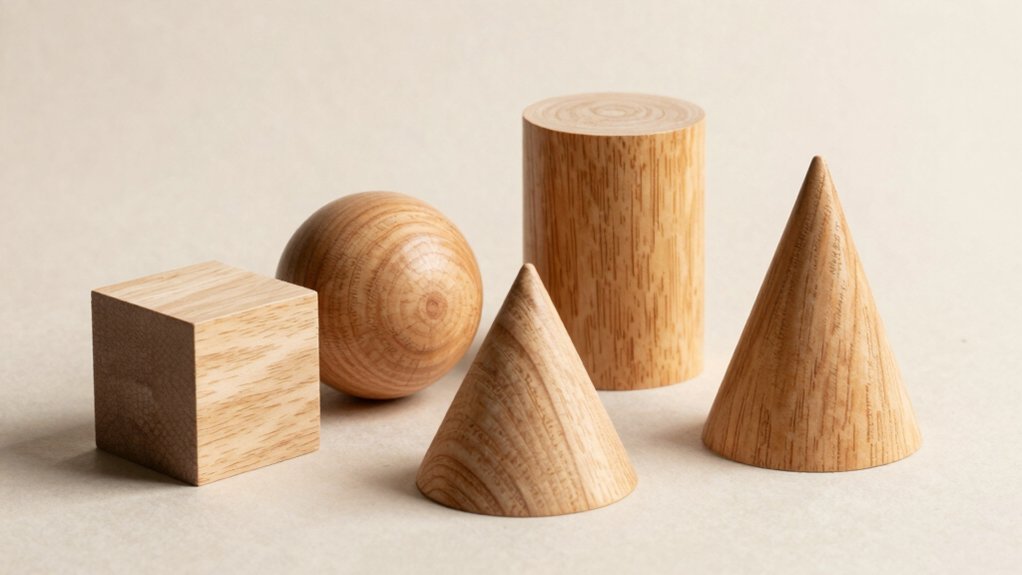
You’re looking for ways to strengthen your child’s spatial reasoning and shape recognition. Wooden geometric solids offer a tactile, Montessori-aligned approach that’s proven effective. But with numerous sets available, you’ll need to know which ones deliver real learning value. We’ll break down the top five options and what makes each one stand out for your needs.
| Learning Resources Geometric Solids Wooden Shapes (Set of 12) |  | Classic Introduction | Piece Count: 12 pieces | Target Age: Ages 6+ | Included Shapes: Sphere, cylinders, prisms, cube, cone, hemisphere | CHECK ON AMAZON | Read Our Analysis |
| Syhood 15 Pcs 3D Geometric Wooden Shapes Montessori Set |  | Best for Montessori | Piece Count: 15 pieces | Target Age: Preschool to elementary | Included Shapes: Cube, cuboid, cylinder, pyramids, cone, sphere | CHECK ON AMAZON | Read Our Analysis |
| Learning Resources Wood Geometric Solids Set (19 Pieces) | 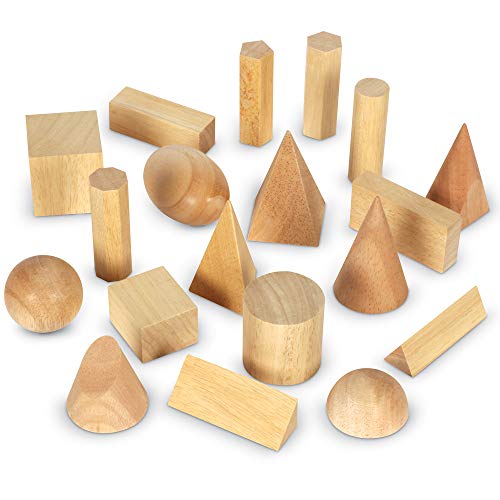 | Most Comprehensive | Piece Count: 19 pieces | Target Age: Ages 9+ | Included Shapes: Cube, cylinders, hemispheres, spheres, ellipsoids, cones, pyramids, prisms | CHECK ON AMAZON | Read Our Analysis |
| BOHS Geometric Solids Wooden Montessori Toys Set |  | Best Interactive Learning | Piece Count: 10 pieces | Target Age: Ages 3+ | Included Shapes: Cube, cuboid, prisms, cylinder, pyramids, cone, ovoid, ellipsoid, sphere | CHECK ON AMAZON | Read Our Analysis |
| Syhood Wooden 3D Geometric Shapes Montessori Learning Blocks | | Ultimate Large Set | Piece Count: 30 pieces | Target Age: Preschool to elementary | Included Shapes: Cube, cuboid, cylinder, pyramids, cone, sphere, and more | CHECK ON AMAZON | Read Our Analysis |
More Details on Our Top Picks
Learning Resources Geometric Solids Wooden Shapes (Set of 12)
Looking for a thorough introduction to 3-D geometry? You’ll find it in the Learning Resources Geometric Solids Wooden Shapes set. This 12-piece collection includes essential shapes like spheres, cylinders, cubes, cones, and various prisms that help children aged 6+ understand spatial relationships before tackling 2-D representations. The smooth, solid wooden construction feels natural in young hands. You’ll explore pattern recognition and volume concepts through hands-on investigation. The included activity guide provides structured learning opportunities, while the storage jar keeps everything organized. This set bridges the gap between abstract geometric concepts and concrete understanding, making it an invaluable classroom or home learning tool.
- Piece Count:12 pieces
- Target Age:Ages 6+
- Included Shapes:Sphere, cylinders, prisms, cube, cone, hemisphere
- Material Quality:Solid, smooth wood
- Learning Approach:Pattern and volume exploration, geometry introduction
- Included Accessories:Activity guide and storage jar
- Additional Feature:Includes convenient storage jar
- Additional Feature:Introduces 2-D shape representation
- Additional Feature:Explores volume and patterns
Syhood 15 Pcs 3D Geometric Wooden Shapes Montessori Set
Want your child to master 3D geometry while building essential fine motor skills? The Syhood 15 Pcs set delivers exactly that. You’ll get diverse shapes—cubes, cylinders, pyramids, cones, and spheres—crafted from quality wood with smooth, polished finishes. These lightweight blocks support hands-on exploration and creative construction, strengthening manual dexterity and imaginative thinking. The Montessori-oriented design makes them ideal for teaching early geometry and basic math concepts. You can use them as teaching aids, art tracing tools, or game pieces. Whether you’re a teacher, homeschooler, or parent, this versatile set promotes play-based learning that genuinely develops divergent thinking and spatial reasoning skills.
- Piece Count:15 pieces
- Target Age:Preschool to elementary
- Included Shapes:Cube, cuboid, cylinder, pyramids, cone, sphere
- Material Quality:Quality wood, durable, polished surfaces
- Learning Approach:Shape recognition, spatial relationships, divergent thinking
- Included Accessories:None specified
- Additional Feature:Art tracing tool capability
- Additional Feature:Versatile classroom and home use
- Additional Feature:Lightweight and portable design
Learning Resources Wood Geometric Solids Set (19 Pieces)
The Learning Resources Wood Geometric Solids Set stands out as an excellent choice for children aged 9 and up who are ready to deepen their understanding of three-dimensional shapes. This 19-piece collection features smooth, solid wood construction and includes cylinders, hemispheres, spheres, ellipsoids, cones, and various pyramids and prisms. You’ll appreciate how the set’s diverse shapes enable hands-on exploration and comparison of geometric properties. Measuring 2–3 units each, these tactile pieces follow Montessori-inspired principles, making them ideal for both classroom and home learning environments. Your child can identify, analyze, and distinguish between different solids while developing spatial reasoning skills that support advanced mathematical thinking.
- Piece Count:19 pieces
- Target Age:Ages 9+
- Included Shapes:Cube, cylinders, hemispheres, spheres, ellipsoids, cones, pyramids, prisms
- Material Quality:Smooth, solid wood
- Learning Approach:3D shape identification and comparison, hands-on geometry
- Included Accessories:None specified
- Additional Feature:Largest set with 19 pieces
- Additional Feature:Includes ellipsoid and parabola cones
- Additional Feature:Multiple cylinder width variations
BOHS Geometric Solids Wooden Montessori Toys Set
If you’re searching for a Montessori-aligned educational tool that combines tactile learning with interactive play, BOHS’s Geometric Solids Wooden set won’t disappoint. This 10-piece collection features essential shapes—cube, cuboid, triangular prism, cylinder, square pyramid, triangular pyramid, cone, ovoid, ellipsoid, and sphere. You’ll appreciate the solid wood construction with smooth finishes that enhance tactile exploration. The included shape names card supports vocabulary development. Your child can engage in multiple play modes: guess-the-shape games using the canvas bag or hide-and-seek activities. Designed for ages three and up, it’s perfect for preschool settings. The durable construction ensures lasting educational value, making it a worthwhile investment in foundational geometric understanding.
- Piece Count:10 pieces
- Target Age:Ages 3+
- Included Shapes:Cube, cuboid, prisms, cylinder, pyramids, cone, ovoid, ellipsoid, sphere
- Material Quality:Solid wood, smooth finish
- Learning Approach:Interactive guess-the-shape game, tactile learning
- Included Accessories:Shape names card and canvas bag
- Additional Feature:Interactive guess-the-shape game included
- Additional Feature:Canvas bag for hide-and-seek play
- Additional Feature:Shape names learning card included
Syhood Wooden 3D Geometric Shapes Montessori Learning Blocks
Montessori educators and homeschool parents seeking a thorough, screen-free learning tool will find Syhood’s 30-piece geometric set invaluable for building spatial reasoning skills. You’ll receive diverse shapes—cubes, cylinders, cones, spheres, and pyramids—crafted from high-quality, polished wood. The set’s smooth surfaces and lightweight construction make it perfect for classroom instruction or home exploration. As your students manipulate these shapes, they’ll develop visual-spatial abilities, strengthen early geometry understanding, and exercise creative thinking. You can use them for art tracing, pattern building, or imaginative construction play. The burlywood finish and durable construction ensure this investment withstands years of educational use, making it an excellent choice for developing foundational mathematical concepts through hands-on learning.
- Piece Count:30 pieces
- Target Age:Preschool to elementary
- Included Shapes:Cube, cuboid, cylinder, pyramids, cone, sphere, and more
- Material Quality:High-quality wood, durable, polished surfaces
- Learning Approach:Shape recognition, spatial visualization, early geometry and math
- Included Accessories:None specified
- Additional Feature:Largest collection with 30 pieces
- Additional Feature:Visualizes spatial relationship building
- Additional Feature:Multiple construction combination possibilities
Factors to Consider When Choosing Wooden Geometric Solids for Three-Dimensional Shape Learning
When you’re selecting wooden geometric solids, you’ll want to evaluate your child’s age and current skill level to ensure they can engage meaningfully with the shapes. You should also compare set sizes and shape varieties across products, then assess material quality, safety certifications, and how well each option aligns with your educational approach. Finally, consider the durability and long-term value you’ll get from your investment, since quality wooden sets can serve multiple children or years of learning.
Age Appropriateness And Skill Level
How do you know which wooden geometric solids will actually engage your child’s learning? Age and skill level determine which shapes work best for your learner.
For ages 3–5, stick with foundational solids like cubes, spheres, and cylinders. These simpler shapes help young children build basic recognition skills without overwhelming them.
Once your child reaches 6 and beyond, you can introduce more complex forms—ellipsoids, pyramids, and prisms. These challenge developing spatial reasoning.
Set complexity should match progression too. Beginner learners benefit from 6–10 shapes for foundational work. As your child advances, sets with 15–30 shapes support sophisticated sorting and combination tasks.
Don’t jump ahead too quickly. Matching complexity to your child’s current level ensures genuine engagement rather than frustration or boredom.
Set Size And Shape Variety
Why does your child need more than a handful of shapes? Larger sets of 15–30 pieces give you access to cubes, prisms, pyramids, cylinders, cones, spheres, hemispheres, and ellipsoids. This variety fuels diverse construction activities and deepens spatial understanding.
Multiple examples of the same shape let your child compare dimensions and proportions directly. You’ll watch them notice how two cylinders differ or how prisms vary.
A mix of simple forms like cubes and spheres alongside complex shapes like triangular and octagonal prisms strengthens solid recognition. Including both regular and irregular solids—rectangular blocks, oblongs, and ovoids—expands volume estimation skills.
Ensure consistency across pieces: smooth edges, no chips, and similar dimensions. This reduces handling variability and keeps your child focused on exploring shape diversity safely.
Material Quality And Safety Standards
Your child’s hands will spend considerable time exploring these shapes, so the wood’s quality directly impacts both their safety and learning experience. You’ll want solid wood with smooth surfaces and edges that minimize splinters and allow comfortable handling during learning activities.
Verify that the finish is odor-free and non-toxic, ensuring safe contact throughout your child’s exploration. Durable construction resists bending or cracking with regular classroom or home use, protecting your investment and maintaining shape integrity for accurate geometric comparisons.
Consistent dimensions across all pieces support reliable shape recognition and comparison skills. If your set includes joints or joins, confirm they’re secure enough to withstand frequent manipulation without loosening, which could compromise both safety and educational value.
Educational Approach And Learning Objectives
When you’re selecting wooden geometric solids, the educational approach underlying the set matters as much as the materials themselves. You’ll want sets that encourage hands-on, tactile exploration rather than passive observation. Look for collections that progress from simple to complex shapes, allowing your child to build pattern recognition and spatial reasoning systematically.
Montessori-inspired sets excel here, emphasizing self-directed discovery and constructive play. You should prioritize sets that integrate volume concepts and enable shape combinations for deeper understanding. Verify that the collection supports developing foundational geometry vocabulary—cube, prism, cone—alongside visual identification skills.
Strong sets allow you to assess both recognition accuracy and your child’s ability to combine shapes into meaningful constructions, revealing genuine spatial comprehension rather than rote memorization.
Durability And Long-Term Value
How do you know whether a wooden geometric solid set will hold up through years of classroom use and maintain its educational value? Look for solid wood construction with smooth finishes that resist chipping and maintain their tactile quality despite repeated handling. Heavier wood retains shape and dimensions better than composites, ensuring accurate geometry exploration across multiple grade levels. Tight tolerances and fewer internal defects keep shapes consistently recognizable as children grow and interact with them. Durable construction minimizes edge splintering, reducing safety hazards and replacement costs. Sets that include storage solutions and activity guides enhance long-term value by promoting sustained use and preventing component loss. These features transform your initial investment into an enduring educational resource.
Frequently Asked Questions
Are Wooden Geometric Solids Safe for Children With Splinter-Prone or Sensitive Skin?
You’ll want to choose sanded wooden geometric solids with smooth finishes for sensitive skin. You should inspect pieces regularly for rough spots, and you can apply food-safe finishes for extra protection. Quality brands minimize splinter risks considerably.
How Do Wooden Geometric Solids Compare to Plastic Alternatives in Durability and Longevity?
You’ll find that wooden geometric solids outlast plastic alternatives considerably. They’re more resistant to warping, UV damage, and sustained wear. Properly maintained wood develops character while plastic degrades, yellows, and becomes brittle over years of use.
What Age Range Is Appropriate for Introducing Wooden Geometric Solids to Children?
You’ll find wooden geometric solids work best for children ages 18 months and up. Toddlers enjoy exploring shapes tactilely, while preschoolers develop spatial reasoning. You can introduce them earlier with supervision, adjusting complexity as your child grows.
Can Wooden Geometric Solids Be Used Effectively in Homeschooling Versus Traditional Classroom Settings?
You’ll find wooden geometric solids work excellently in both settings. You can manipulate them hands-on during homeschooling for personalized pacing, while classrooms benefit from group demonstrations and collaborative problem-solving activities using the same materials.
How Should Wooden Geometric Solids Be Cleaned and Maintained for Optimal Hygiene?
You’ll keep your wooden geometric solids clean by wiping them weekly with a damp cloth and mild soap. You should dry them immediately, avoid soaking them, and you’ve got to store them in a dry place to prevent warping and mold growth.


Leave a Reply