

You’re giving your child the foundation for lifelong learning when you step back and let them lead their own play. Child-led play taps into intrinsic motivation, building genuine self-confidence, problem-solving skills, and resilience that extend far beyond playtime. It strengthens cognitive flexibility, emotional regulation, and social development while reducing anxiety and depression risks. Your role? Provide safe supervision without interference, allowing natural curiosity to flourish. Discover how to set up spaces, choose materials, and avoid common interruptions that derail this transformative learning.
What Is Child-Led Play and Why It Matters

Imagine watching your child become completely absorbed in an activity they’ve chosen themselves—building with blocks, creating a pretend world, or exploring how things work. That’s child-led play, and it’s fundamentally different from adult-directed activities. You’re not imposing rules or directions; instead, you’re following your child’s lead while they select materials, direct activities, and set their own guidelines.
This autonomy matters because it taps into your child’s intrinsic motivation. When children pursue their genuine interests without external pressure, they develop stronger persistence and performance. You’ll notice deeper engagement, better long-term retention, and enhanced creativity as they make personal meaning from their discoveries. Your role involves providing safe supervision without interference, allowing genuine exploration that builds self-confidence, problem-solving abilities, and a foundation for lifelong learning. Through following their lead, you help your child leverage their natural curiosity to learn through play in ways that feel effortless and joyful.
How Child-Led Play Builds Cognitive Skills
When you follow your child’s natural curiosity during play, you’re igniting the intrinsic motivation that drives them to experiment and problem-solve independently.
Through hands-on exploration with loose parts and pretend scenarios, your child strengthens their ability to think flexibly and navigate real-life challenges.
These creative play experiences also enhance memory retention by engaging multiple senses and emotional connections, deepening how your child encodes and recalls information. Unstructured play particularly supports the development of executive functions like working memory, cognitive flexibility, and impulse control that are essential for success in school and beyond.
Curiosity Drives Intrinsic Motivation
Why do children’s brains thrive when they’re exploring on their own terms? You’re witnessing intrinsic motivation at work. When your child pursues natural curiosity through play, they’re building flexible learning skills that last a lifetime. This joyful engagement doesn’t just feel good—it strengthens brain structure and develops 21st-century aptitudes.
| Curiosity Element | Brain Benefit |
|---|---|
| Self-directed exploration | Flexible thinking patterns |
| Hands-on experimentation | Strengthened neural pathways |
| Iterative idea testing | Adaptive problem-solving |
| Imaginative engagement | Enhanced symbolic thinking |
| Social interaction | Integrated learning experiences |
Your child’s natural scientist behavior drives adaptation and discovery. When you step back and let them lead, you’re not removing guidance—you’re honoring how their brain develops best. Play transforms world exploration into meaningful cognitive growth, connecting curiosity to lasting neural development. Research shows that play-based learning provides long-term advantages in academic performance and attitudes toward school, outpacing direct-instruction approaches over time.
Experimentation Strengthens Problem-Solving Skills
Beyond curiosity lies the laboratory of your child’s mind—a space where experimentation transforms tentative ideas into robust problem-solving strategies. When you allow child-led play, you’re enabling hypothesis building and hands-on testing that develops critical cognitive processes.
Your child plans, explores, investigates, and questions through playful engagement. They collaborate with peers, negotiating solutions and learning from setbacks. This experimentation cultivates communication skills, perseverance, and emotional intelligence. Each failed attempt strengthens resilience rather than discouraging further exploration.
Play-based learning acquires foundational cognitive skills like self-regulation and attention. Your child builds confidence navigating challenges independently. Research shows just five minutes of child-led play improves problem-solving and self-regulation. Through experimentation, your child doesn’t simply solve immediate problems—they develop flexible, transferable strategies for complex future challenges. When children lead their own play sessions, they gain greater self-control and resilience through improved coping with setbacks and emotional challenges.
Creative Play Enhances Memory Retention
How does your child transform a pile of blocks into a castle, a story, a scientific structure? Through creative play, they’re building memory pathways you can’t see. When your child engages in pretend play, their brain strengthens working memory and executive function simultaneously. Loose parts—blocks, fabric, natural materials—activate cognitive flexibility as they iterate and explore. This hands-on experimentation integrates new learning directly into long-term memory stores more effectively than direct instruction ever could. Research confirms that play-based learning yields lasting cognitive advantages. Your child’s joyful curiosity isn’t just entertaining; it’s optimizing their neural development. The symbolic thinking required during creative play develops flexible memory skills that persist into adulthood, establishing cognitive foundations for lifelong learning and adaptation. When you ask probing questions during your child’s play, you elevate their exploration toward deeper understanding while preserving their sense of discovery and agency.
Social and Emotional Skills Child-Led Play Develops
When you let children lead their own play, you’re giving them the autonomy to build genuine confidence in their abilities and decision-making.
Through child-directed activities, they’ll naturally develop communication and collaboration skills as they navigate interactions with peers and solve problems together.
This self-directed environment also strengthens their emotional resilience, teaching them to manage challenges and regulate their own behavior without constant adult intervention. By observing choice, wonder, and delight during play, you can assess the quality of their self-directed learning and see how they’re developing these critical emotional competencies.
Building Confidence Through Autonomy
What happens when you let your child take the lead during playtime? You’re giving them a powerful tool for building confidence through autonomy.
When your child directs their own play, they experience genuine decision-making without adult interference. They learn they’re capable of figuring things out independently, which communicates competence and responsibility. This self-directed environment allows them to take risks, make mistakes, and self-correct in a safe space—essential experiences for developing resilience. Research shows that just five minutes of child-led play can reduce challenging behaviors while strengthening the parent-child relationship.
Your child realizes their personal power when they’re not constantly guided by adults. They discover they can initiate activities, solve problems, and navigate challenges on their own terms. This autonomy-driven play builds a strong sense of self-direction and genuine self-confidence that extends beyond playtime into their everyday lives.
Developing Communication and Collaboration
Through child-led play, your child naturally develops the communication and collaboration skills that form the foundation of all social relationships.
When you follow your child’s lead, you expand their communication beyond words. They’ll strengthen eye contact, gestures, and vocalizations while practicing reciprocal conversations. Floortime approaches show that this child-directed engagement significantly improves social interaction, particularly for children with ASD. Play deprivation in early childhood is linked to increased depression, anxiety, isolation, decreased self-confidence, and reduced resilience and self-control, making child-led play essential for healthy development.
| Skill Development | What Happens | Your Role |
|---|---|---|
| Verbal Communication | Your child uses sophisticated language with playmates | Follow their lead |
| Non-Verbal Cues | They read and give social play signals | Model and respond |
| Collaboration | They co-construct play scenarios together | Support joint attention |
Your child learns to express needs, share ideas, and navigate relationships authentically through play they control and direct.
Fostering Emotional Resilience and Self-Direction
How does your child develop the emotional strength to navigate life’s challenges? Child-led play provides the answer. When you allow your child to direct their own activities, they build genuine confidence through autonomous decision-making. They discover what they’re capable of by solving problems independently and overcoming small obstacles.
This self-directed exploration creates a powerful sense of control. Your child learns to manage emotions naturally as they encounter challenges, experience small victories, and test different responses in low-pressure settings. A caring adult’s presence during play strengthens this emotional development by providing consistent support and unconditional acceptance. Pretend play becomes particularly valuable here—they safely act out worries and practice emotional responses without real-world consequences.
Physical Skills Children Gain Through Child-Led Play
Children develop remarkable physical abilities when they’re free to play on their own terms. When you allow self-directed exploration, you’re building the foundation for lifelong fitness and motor competence.
Self-directed play builds the foundation for lifelong fitness and motor competence in children.
Your child strengthens crucial skills through child-led play:
- Gross motor development: Running, jumping, and climbing naturally build muscle strength, endurance, and coordination without forced instruction
- Fine motor refinement: Manipulating objects during imaginative play enhances muscular control and dexterity more effectively than structured drills
- Balance and proprioception: Navigating obstacles and loose parts independently develops spatial awareness and body control
Unstructured play with materials you provide encourages your child to engage physically at their own pace. This autonomy builds confidence alongside competence, creating active, capable children who embrace movement naturally rather than viewing exercise as obligation. Through adventurous play, your child also reduces anxiety and develops greater emotional resilience alongside physical mastery.
Child-Led Play Versus Adult-Guided Play: Which Matters When
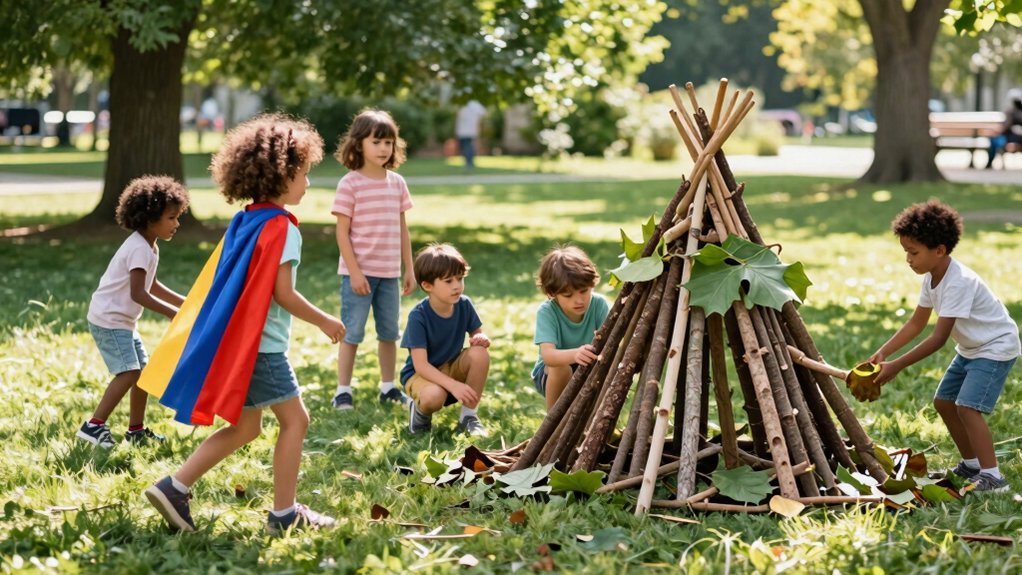
While your child’s self-directed exploration builds physical competence, the question becomes more nuanced when you consider how learning happens best. Research shows that guided play—where you scaffold learning through questions and co-play—outperforms both free play and direct instruction for academic content in children under eight. Your three-year-old thrives in classrooms dominated by one consistent approach, while your four-year-old shows greater school readiness with increased child-initiated activities. The sweet spot? A blended approach combining both. You’ll prepare environments and offer materials that spark discovery, allowing your child autonomy while subtly guiding toward learning goals. Guided play achieves particularly strong outcomes in math-specific domains like numeracy and spatial skills development. This balanced strategy harnesses play’s joy while ensuring broader cognitive gains in literacy, math, and executive function.
Why Kids Learn Better When They Choose What to Play
When your child picks their own play activity, you’re witnessing a cognitive shift that transforms learning from passive reception into active engagement. They’re not simply following instructions—they’re driving their own development.
Child-led play activates your child’s brain differently than adult-directed activities. When children choose what to play, they:
- Build metacognitive awareness by reflecting on their own thinking and decision-making processes
- Strengthen problem-solving skills naturally through self-directed challenges and experimentation
- Develop genuine curiosity that fuels deeper learning retention and creative thinking
This autonomy matters profoundly. Your child’s self-directed choices boost their sense of agency and self-confidence. They’re invested in outcomes they’ve determined, not tasks assigned to them. This intrinsic motivation creates conditions where learning sticks—not because someone told them to learn, but because they wanted to discover. Research shows that stress-free playful learning also promotes creativity within a calm environment, allowing children to explore and experiment without the pressure of external evaluation.
How to Recognize Your Child’s Play Signals

You’ll notice your child’s body language shifts dramatically during different play phases—leaning forward signals deep concentration, while hunched posture reveals imaginative absorption. By observing whether they’re bouncing with open arms or pulling away from interruptions, you can gauge their engagement level and respect their natural rhythm. Reading these physical cues helps you determine when they’re ready for social play versus solo exploration. Consider posting reflective aluminum signs in your neighborhood to create safe play zones where children can engage in these natural developmental activities without traffic distractions.
Reading Body Language Cues
How does a child communicate when words aren’t enough? You’ll find the answer in their body language. Children express their emotional states and intentions through facial expressions, eye contact, and physical positioning. By observing these signals closely, you’ll develop a deeper understanding of what your child needs during play.
Watch for these key indicators:
- Positive engagement: Your child maintains eye contact, leans forward, and directs hand movements toward objects with animated facial expressions
- Frustration signals: Furrowed brows and increased body tension reveal when play becomes overwhelming
- Discomfort or withdrawal: Turning away, reduced eye contact, and decreased toy interaction show your child needs space
Position yourself at your child’s level, maintain eye contact, and mirror their expressions. This attentiveness strengthens your connection and helps you respond appropriately to their play cues. Consistent responsiveness to these observable cues builds a sense of safety and trust that supports your child’s emotional regulation over time.
Observing Engagement and Focus
What separates distracted play from genuine engagement? You’ll notice your child exhibits sustained focus during tasks like puzzles or storytelling, demonstrating true involvement rather than passing interest. Watch for persistence—they’ll continue working through challenges without giving up, showing high energy and vigor throughout.
You can identify flow states when your child loses track of time, fully absorbed in their activity. They’ll display a sense of control, making choices independently without needing constant direction from you. During these moments, they’re naturally motivated and exploring solutions through strategy use. Research shows that open-ended play activities support problem-solving and executive function development in young learners.
Pay attention to how they monitor their own progress, adjusting approaches when needed. These observable behaviors—attention, on-task focus, enthusiasm, and self-directed problem-solving—reliably predict kindergarten academic success and indicate deep, meaningful play engagement.
Set Up a Safe Space for Unstructured Exploration
Creating a safe space for unstructured exploration requires thoughtful design that balances freedom with protection. You’ll want to establish an environment where children can take appropriate risks while remaining secure.
Start by organizing distinct play zones that define activities without restricting movement. Use visual dividers like shelves and curtains to create focused spaces for creativity, construction, quiet reading, and pretend play. This layout helps children navigate independently and engage deeply. Incorporating soft furniture and warm lighting into your space fosters a homelike atmosphere that encourages children to explore comfortably and authentically.
Next, implement essential safety measures:
- Install cushioned surfaces with six-foot safety zones around all equipment, positioning swings on the periphery away from other structures
- Arrange materials and resources at child height to promote independence and curiosity
- Conduct daily safety checks, removing broken toys and unsafe items immediately
You’ll create an environment that nurtures exploration while protecting their wellbeing.
Why Unstructured Materials Matter More Than Fancy Toys

You’ve probably noticed that children often ignore expensive toys in favor of a cardboard box or a stick. That’s not accident—it’s because unstructured materials spark genuine creativity in ways fancy toys simply can’t.
Loose parts like tires, hoops, and natural elements invite endless possibilities. Without predetermined purposes, your child becomes the designer, not a passive user following built-in instructions. They problem-solve, innovate, and adapt materials to their vision.
These simple resources foster deeper learning than structured toys with fixed functions. A stick becomes a sword, a wand, or a bridge. Cardboard transforms into a fortress or spaceship. Your child’s imagination drives the exploration, building resilience and original thinking. Through this child-led play, they develop critical thinking skills and emotional regulation that structured toys cannot provide.
When you provide open-ended materials, you’re removing limitations and unlocking your child’s natural capacity for discovery and growth.
5 Ways Parents Accidentally Interrupt Child-Led Play
Even when your child’s deeply engaged in play, well-meaning interruptions can derail the very development you’re trying to support. You mightn’t realize how frequently you’re breaking their focus with corrections, suggestions, or questions—but these moments matter considerably.
Well-meaning interruptions during play derail development. Your frequent corrections and questions break focus more often than you realize—and it matters considerably.
Research shows that constant guidance during active play disrupts self-regulation skills and hampers executive function development. Your child needs uninterrupted time to practice sustained attention independently.
Common interruptions you may unconsciously make:
- Asking questions or offering commentary while they’re concentrating on a task
- Redirecting their attention to different toys instead of following their lead
- Providing corrections or instructions despite them being on task
Stepping back requires restraint, but it’s essential. Your child builds independence through unguided play, strengthening the very skills they need for emotional regulation and focus later. Studies measuring parent-child interactions second-by-second reveal that over-engagement during focused moments particularly impacts hot executive functions—the emotional regulation abilities children rely on in challenging situations.
Why Child-Led Play Builds Academic Confidence
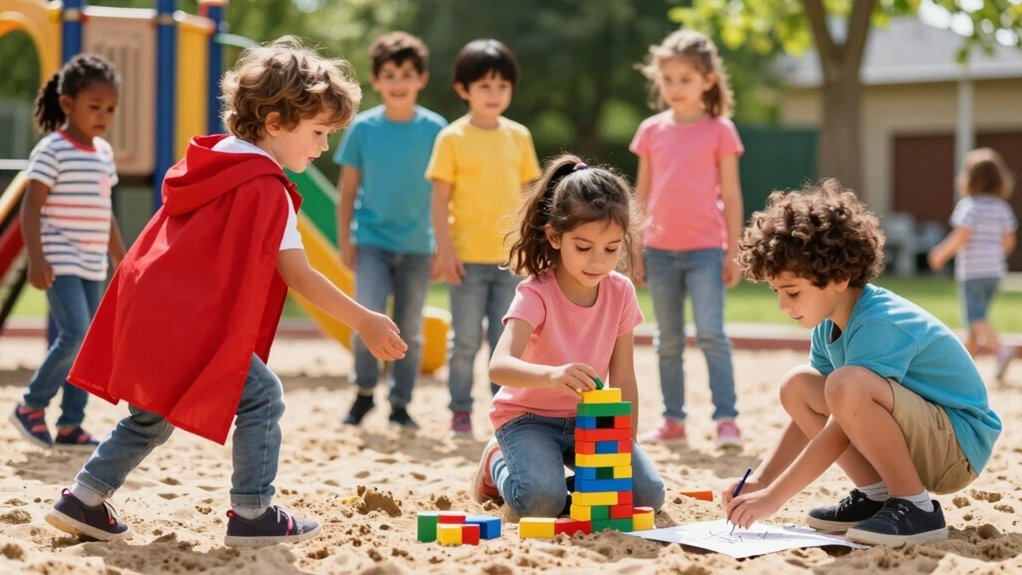
How does unstructured play translate into classroom success? When you allow your child to lead play, they’re building confidence through safe experimentation. They test ideas, face challenges, and develop resilience—all without the pressure of grades or evaluation.
Child-led play establishes positive relationships with learning itself. Your child develops higher self-esteem and greater motivation because they’re driving their own discoveries. This intrinsic motivation carries into academic settings, where they approach tasks with persistence rather than anxiety.
Through play, your child builds confidence in their problem-solving abilities. They learn they can navigate challenges independently, fostering the emotional intelligence needed for classroom success. This balanced approach creates meaningful understanding that lasts, transforming play-based confidence into genuine academic achievement. Research shows that playful learning enhances problem-solving, communication, decision-making, and creative skills that directly support long-term academic performance.
Set Up Your First Child-Led Play Session
When you’re ready to begin, start by observing what naturally captures your child’s attention—whether that’s toys, environmental features, or physical movements like jumping in puddles. These observations guide your setup and help you create meaningful play experiences.
Next, prepare your space intentionally:
- Stock your area with accessible toys, art supplies, blocks, and sensory materials like colored scarves and sandbox play
- Arrange a comfortable rug with cushions and labeled bookshelves organized by category
- Keep resources minimal initially, focusing on familiar, simple items that won’t overwhelm
Schedule regular sessions—15 minutes in the evening or 30 minutes on weekends works well. Consistency matters more than duration. You’re creating predictable opportunities for your child to lead, explore, and communicate naturally. Coordinate with parents to learn home interests so you can reuse available similarities in toys and activities. Start with ages two and up, adjusting based on your child’s developmental stage.
Frequently Asked Questions
How Much Unstructured Playtime Does My Child Need Daily for Optimal Development?
Your child needs a minimum of 60 minutes daily unstructured play, though 3-4 hours is ideal. You’ll want to prioritize at least 1 hour outdoors. Ensure you’re providing twice as much unstructured time as structured activities.
What Should I Do if My Child Refuses to Engage in Any Play Activities?
You should first investigate what’s causing the refusal—fear, sensory discomfort, or misunderstanding. Then you’ll want to make activities accessible without pressure, model play enthusiastically nearby, and prioritize fun over expectations.
Can Child-Led Play Replace Formal Education or Structured Learning Programs Entirely?
No, you can’t replace formal education entirely with child-led play. You need guided learning for systematic skill development in literacy and math. You’ll achieve optimal results by combining unstructured play with structured instruction.
How Do I Balance Screen Time With Child-Led Play in Modern Parenting?
You’ll limit screen time to under one hour daily, prioritizing child-led play for language and cognitive development. You’re protecting sleep, behavior, and emotional health by creating screen-free zones and maximizing caregiver interaction instead.
At What Age Should Parents Begin Encouraging Child-Led Play With Their Children?
You can start encouraging child-led play from birth through unstructured exploration. By 2-3 years, you’ll notice your child naturally shifting toward interactive play. You should continue supporting this progression with at least one hour daily of free play.
In Summary
You’ve discovered that child-led play isn’t just entertainment—it’s how your child naturally develops. When you step back and let them direct their own exploration, you’re building their confidence, creativity, and problem-solving skills. You don’t need expensive toys or structured schedules. You just need to trust the process and give your child the space they’re asking for. Start today, and watch them thrive.



Leave a Reply