You guide your child’s learning by watching their natural curiosity unfold, then shaping the environment and prompts to deepen that self‑directed exploration. Observation becomes the core: you note play, chatter, and interests, turning those moments into data that inform a developmentally aligned, child‑height space with open‑ended materials. You shift from directing to guiding, using brief notes, photos, or voice memos to decide when to extend, introduce, or step back. This approach builds confidence, fuels motivation, and keeps learning fluid—continue to discover how to turn everyday moments into lasting growth.
Define Child‑Led Learning and Its Observation Core

When you let a child’s curiosity steer the day, you shift from directing to observing, and that observation becomes the core of child‑led learning. You watch play, listen to chatter, and note how children gravitate toward certain objects or ideas. Those notes turn into data that shape an environment rich enough for self‑directed exploration while staying developmentally aligned. You act as a guide, not a director, using observation to decide when to extend a theme, introduce a new material, or simply step back. Documentation slips into routine moments, so you capture authentic progress without relying on standardized tests. Each insight informs next steps, home extensions, and curriculum tweaks, turning fascination into meaningful, tailored learning experiences. Incorporating tools like the Montessori Binomial Cube allows children to explore concrete concepts through tactile and visual learning that aligns with their developmental stage.
Spot Emerging Interests in Real‑Time Play
How do you catch a child’s spark the moment it ignites? You watch closely, noting every pause, grin, and repeated action during real‑time play. Your observations reveal emergent interests—like a buzzing insect that stops a group or a water‑pouring experiment that captivates a single child. You jot down the exact moment, the language they use, and the problem‑solving steps they take. Then you make environment adjustments, adding open‑ended materials or new vocabulary that align with that fascination. This rapid feedback loop lets you steer the day’s activities without imposing a rigid schedule, keeping learning fluid and child‑driven. Using thoughtfully designed tools like Montessori-friendly step stools can also support independence and engagement during these learning moments.
| Observation | Emergent Interest | Environment Adjustment |
|---|---|---|
| Child repeatedly watches a ladybug | Insect curiosity | Add magnifying glasses, picture books |
| Group pours water into containers | Fluid dynamics | Provide varied vessels, measuring cups |
| Solo builds towers with blocks | Structural play | Offer larger blocks, ramps |
| Pair mimics animal sounds | Animal communication | Supply animal figurines, sound cards |
Turn Curiosity Into Fun Learning Activities

Spotting a child’s fascination is just the first spark; the next step is to turn that spark into a playful learning experience. You watch the child’s curiosity, then you‑ child‑led, observation‑driven learning activities that deepen the interest. If a bug is the focus, set out magnifying glasses, a simple guide, and a safe outdoor area for a mini‑hunt. Ask open‑ended questions like, “What do you think will happen if we put the bug in water?” to explore capacity and cause‑and‑effect. Provide loose parts, blocks, or art supplies that invite spontaneous experiments. Record how the child’s play evolves, then gently introduce related concepts—counting bugs, describing colors, or writing a story—while keeping the child’s voice at the center. This loop turns curiosity into purposeful, fun learning.
Set Up an Observation‑Friendly Home Environment
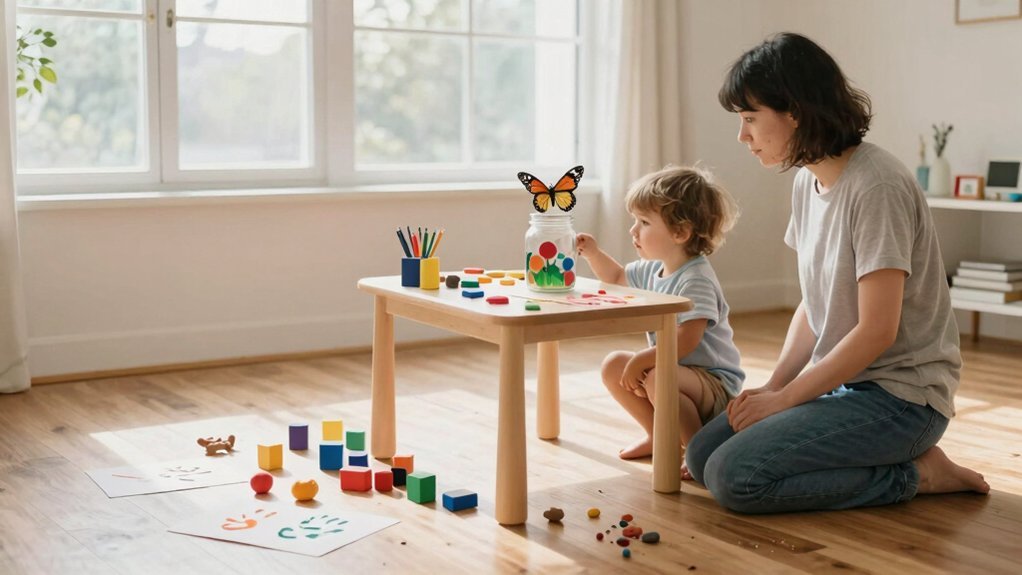
After you’ve sparked a child’s curiosity with a fun, observation‑driven activity, the next step is to shape the home so the child can keep exploring effortlessly. Arrange a dedicated space at child height, stocked with open‑ended materials like blocks, loose parts, and art supplies. Keep these resources near existing play zones—books, water tables, and small‑world figures—so the child can weave themes together without moving far. Add a low stool or chair as an unobtrusive observation spot; you’ll watch the child’s actions without breaking their flow. Rotate and label items to match current interests, noting any shifts over days. Capture brief notes or photos during play; they’ll guide future prompts and deepen child‑led learning within your home environment.
Use Open‑Ended Questions to Extend Focus

You can spark insightful prompts by asking “why,” “how,” or “what if” questions that link directly to what the child is doing. This encourages deeper thinking, prompting them to predict, reflect, and justify their ideas.
As they answer, you’ll notice their curiosity growing and the conversation naturally extending their focus.
Prompt Insightful Prompts
Open‑ended prompts act like bridges, extending a child’s current activity by inviting speculation and explanation rather than dictating outcomes. You weave child‑led learning and observation together, turning play into inquiry‑based learning. When you ask “What might happen if you add this piece?” you respect the child’s autonomy while nudging deeper thinking. Keep prompts tied to the materials at hand, avoid yes/no questions, and give generous pause time so the child can formulate ideas. This balance of scaffolding and freedom builds language, critical reasoning, and self‑regulation.
- “Which block fits here and why?”
- “What do you think will happen next?”
- “Tell me more about how this mechanism works.”
- “Can you compare these two colors?”
- “What would you change to make it work better?”
Encourage Deeper Thinking
How can a simple question turn a child’s curiosity into sustained focus? By slipping an open‑ended question into a child‑led learning moment, you stretch observation into deeper thinking. When a child pours water, ask, “What do you think will happen if we add more?” The pause invites prediction, language, and metacognition. Follow with “What did you notice just now, and what sparked that idea?” to cement reflection. Minimal scaffolding—just a timely prompt—keeps ownership while expanding analysis. Incorporating multisensory tools like sensory mats can further enhance language development and problem-solving during these learning moments.
| Prompt | Goal |
|---|---|
| “Why did you choose that block color?” | Reveal interests, boost language |
| “How could we solve this problem another way?” | Foster flexibility, problem‑solving |
| “What do you think will happen if we pour more water?” | Extend focus, deepen observation |
Foster Ongoing Curiosity
Often a simple, open‑ended prompt—like “What do you notice?”—can turn a fleeting observation into a sustained investigation. In child‑led learning, you invite the child to pause, think, and expand their curiosity. By linking new observations to prior interests, you keep the learning environment fluid and meaningful. Capture brief reflections for families, then reuse them to plan next steps that preserve the child’s ownership of the focus.
- Pose questions such as “What would happen if we try…?” to stretch attention.
- Allow silence after answers, giving time for deeper reasoning.
- Connect current discoveries to earlier experiments (e.g., water flow).
- Provide movable materials and rotating prompts for independent branches.
- Document momentary insights and turn them into future inquiry.
Capture Moments: Simple Documentation Tools for Parents
You can capture the magic of your child’s learning moments with just a few simple tools that fit naturally into your daily routine. A pocket notebook lets you jot quick observation notes during play, while a voice memo app records spontaneous conversations without stopping the flow. Photo snapshots of a building block tower or a nature walk serve as visual documentation you can later annotate. Create a shared digital folder where you upload images and brief reflections, inviting family members to comment and ask questions. This routine of low‑tech observation and documentation strengthens family engagement and reinforces child‑led learning. By weaving these habits into bedtime talks or snack time, you build a continuous record that guides future experiences.
Link Observations to Child‑Led Learning Milestones & State Standards
When you match the moments you’ve documented to developmental milestones and state early‑learning standards, the observations become a roadmap for purposeful, child‑led growth. You can translate each note into a concrete goal, weave family insights into the plan, and replace generic tests with authentic evidence of progress. Aligning observations with Child‑Led Learning ensures that every activity builds on real interests while meeting Developmental Milestones and State Standards. This synergy lets you track growth, adjust curriculum, and celebrate achievements without losing the child’s voice.
- Review play notes for emerging language patterns and map them to the language milestone chart.
- Compare group activity observations with social‑emotional standards to set peer‑interaction goals.
- Use conversation excerpts to align math concepts with the early‑learning math standards.
- Incorporate family‑shared observations to contextualize literacy goals within home routines.
- Update documentation weekly, linking each new observation to the next developmental milestone.
Balance Freedom With Gentle Guidance in Play
Linking observations to milestones shows where a child’s interests naturally lead, and that insight guides how you balance freedom with gentle guidance in play.
Observations reveal interests, guiding the balance of freedom and gentle guidance in play.
In child‑led learning, you watch the child choose blocks, loose parts, or art supplies, noting patterns and questions that arise. Your observation informs open‑ended prompts—“What might happen if you stack these?”—that extend thinking without taking over.
Arrange the space so materials are within reach, inviting independent decision‑making.
When a child hesitates, offer gentle guidance through timely scaffolding, modeling language or suggesting a next step that aligns with developmental goals.
Document each interaction, then share highlights with families so they can echo the balance at home, reinforcing play‑based learning and the child’s sense of ownership.
Integrate Cultural & Linguistic Contexts Into Observation
How can you capture the rich tapestry of each child’s language and culture during observation? You notice multilingualism in play, record code‑switching, and note family traditions that shape interaction. Your notes become observation‑informed practice, feeding culturally responsive planning that respects each child’s background. You involve native speakers or interpreters to clarify meaning, and you collect work samples in the home language to validate competencies across languages. Reflective documentation reveals how cultural norms and language use affect engagement, learning goals, and pacing, guiding individualized supports.
- Listen for and transcribe multilingual utterances.
- Ask families about cultural celebrations and embed them in activities.
- Use interpreters or liaison staff for accurate interpretation.
- Include home language work samples in portfolios.
- Connect observations to culturally responsive planning and pacing
Share Observation Records With Caregivers & Teachers
You’ll want to use simple documentation strategies—photos, quotes, and sample work—to capture each child’s authentic moments.
Then, invite caregivers and teachers into collaborative reflection, sharing those records so everyone can see interests, progress, and next‑step goals.
This clear feedback loop turns observations into concrete supports and activities at home and school.
Documentation Strategies
Ever wonder how a simple observation note can become a bridge between classroom and home? When you capture a child’s play, conversation, or task, you’re creating documentation that fuels development and invites family collaboration. You embed these notes in daily routines, turning every moment into authentic assessment rather than a one‑off test. By sharing them promptly with caregivers and teachers, you extend learning outward, guiding next steps and strengthening the home‑school partnership.
- Use a portable notebook or sketch pad during free play.
- Record brief, objective observations with timestamps.
- Highlight developmental milestones and emerging interests.
- Summarize key points in a one‑page “home‑school link” for families.
- Schedule regular, low‑tech check‑ins to discuss the notes together.
- Incorporating age-appropriate tools that foster fine motor skills can deepen insights into a child’s developmental progress.
Collaborative Reflection Practices
Your observation notes become the foundation for collaborative reflection when you share them promptly with both caregivers and teachers. By sending concise documentation of play sequences, spontaneous conversations, and adult‑structured contexts, you give families and staff a clear picture of the child’s current interests and emergent skills. This shared Observation drives child‑led learning, because caregivers can add home insights while educators interpret the data to plan next steps.
Keep records confidential, use simple language, and invite questions so everyone feels comfortable discussing the child’s development. Regularly reviewing the Observation together helps adjust routines, extend learning opportunities, and align goals with families’ input, turning documentation into a powerful tool for ongoing collaborative reflection. Including ergonomic handle design principles can enhance children’s engagement and comfort during observational and hands-on activities.
Avoid Over‑Observing: 5 Common Mistakes Parents Make
When parents try to capture every tiny interaction, they often end up stuck in analysis paralysis, spending more time coding each micro‑action than guiding meaningful play. Over‑observing can drown you in data, pulling focus away from the child‑led learning moments that truly shape development and responsiveness.
Over‑observing stalls growth; prioritize intuitive, meaningful moments over endless data logging.
- Record sparingly; choose a few meaningful observations instead of logging every gesture.
- Trust your intuition over rigid metrics; let natural play signal progress.
- Reflect promptly; delay turns insights into missed opportunities.
- Prioritize quality: note interests, not just frequency of actions.
- Balance documentation with presence; stay engaged rather than detached.
- Incorporating Montessori-inspired features into play spaces can enhance independence and cognitive development during observation.
Celebrate Small Wins to Keep Motivation High
When you spot a tiny achievement, name it right away so the child feels the progress. By noting these moments—whether in a quick note or a photo—you create a clear record that fuels momentum.
This simple habit turns each small win into a stepping stone for the next learning adventure.
A Moments Win
Ever wondered why a tiny triumph can feel like a breakthrough? You’ll notice that each moment win—like a child finally tying shoelaces—creates a spark that fuels intrinsic motivation. When you document these micro‑achievements, you turn fleeting successes into concrete data that guides observation‑guided learning. Sharing a quick note with parents strengthens family communication and keeps the momentum alive across home and school. Celebrate the small steps, and the child’s confidence will grow, making larger challenges feel doable.
- Highlight a specific micro‑achievement in a brief comment.
- Use a visual cue (sticker, smiley) to mark progress.
- Relate the win to the child’s observed interests.
- Send a short message to families for real‑time feedback.
- Encourage the child to reflect on how the win feels.
Boost Progress Momentum
How can you keep a child’s enthusiasm soaring? By celebrating small wins, you turn each observation into a confidence boost. When a child in the Early Years solves a puzzle after four tries, name that achievement and capture it with a quick note or photo. Link the success to their passion—perhaps a mini‑book about insects after a bug hunt—so the progress feels personal.
Schedule brief, frequent milestones, two or three per day, and use a plan‑do‑review cycle with families to reflect on how past wins shape the next steps. Prioritize developmentally appropriate increments each week, raising challenges just enough to keep Momentum Momentum alive while staying attainable. This focused, Child‑Led Learning approach sustains motivation and fuels continual growth. Incorporating hands-on Montessori toys like the Wooden Egg and Cup Set can enhance fine motor skills and engage children meaningfully throughout their learning journey.
Frequently Asked Questions
What Do Children Learn Through Observation?
You notice children absorb social cues, language patterns, problem‑solving steps, emotional regulation, and cultural norms just by watching peers and adults, shaping their skills and attitudes without explicit instruction.
What Is an Example of Child Led Learning?
You could set up a bug hotel after the child watches insects, letting them choose materials, arrange tunnels, and record observations, turning curiosity into hands‑on science, math, and language learning.
What Are the 4 Stages of Observational Learning?
You go through attention, retention, reproduction, and motivation. First you notice the behavior, then you remember it, next you imitate or apply it, and finally you’re driven by reinforcement or feedback.
What Is an Example of Learning Through Observation?
You notice a toddler repeatedly stacking blocks, then you record the pattern, discuss the strategy with parents, and design a new activity that expands the child’s spatial reasoning and language skills.