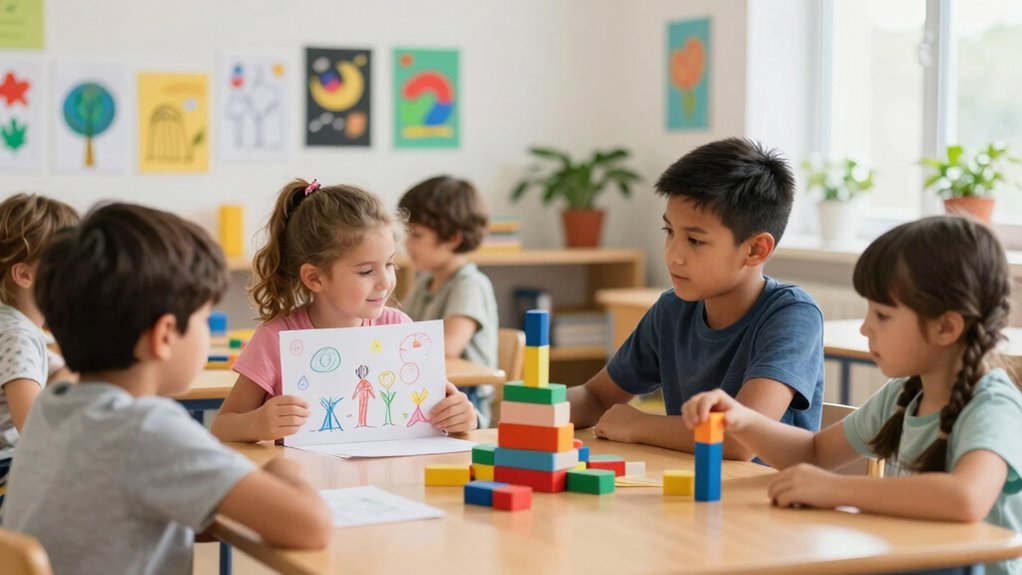
You’ll develop stronger mental flexibility when your child learns alongside peers of different ages, because cognitive conflict from varied perspectives forces their brain to constantly recalibrate and adapt. Older students scaffold complex concepts while younger children model observation skills, creating bidirectional learning. Mixed-age grouping exposes diverse problem-solving paths, strengthening critical thinking through collaborative dialogue. This dynamic environment builds neural circuits trained for handling increasingly complex situations. Discover how these five mechanisms work together to transform your child’s cognitive growth.
How Cognitive Conflict Builds Mental Flexibility?
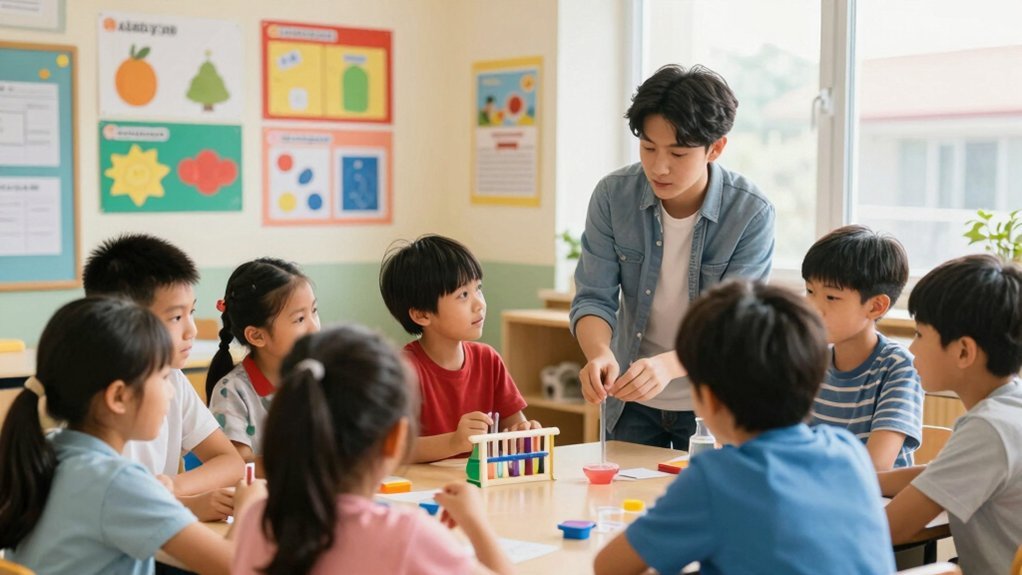
How does your mind adapt when you’re faced with competing information that pulls you in different directions? That’s cognitive conflict, and it’s your brain’s catalyst for building mental flexibility.
When you encounter conflicting demands, your brain triggers dynamic adjustments in thinking and behavior. This process, called conflict adaptation, involves your brain recalibrating response thresholds and inhibiting incorrect motor outputs. As competing targets increase deviation toward wrong answers, you’re simultaneously strengthening your monitoring systems. These dynamic processes enable your brain to adapt thinking and behavior across different contextual demands, supporting your ability to handle increasingly complex situations.
Your fronto-central regions activate, enhancing response selection while decreasing unnecessary conflict monitoring signals. Through sequential trial-by-trial adjustments, you’re training your neural circuits to shift attention and update strategies fluidly. This ongoing competition between alternatives isn’t frustrating—it’s your mind’s mechanism for developing the cognitive flexibility you need to navigate complex, changing demands effectively.
Peer Scaffolding: Why Both Older and Younger Children Learn Together
When you place children of different ages in the same classroom, you’re not just mixing grade levels—you’re creating a dynamic learning ecosystem where cognitive development accelerates for everyone involved. Older students deepen their understanding by simplifying complex concepts for younger peers, while younger children access challenging tasks through guided support. This bidirectional scaffolding strengthens metacognitive awareness in older learners and bridges developmental gaps for younger ones. You’ll notice younger children engage in more cognitually sophisticated play when observing advanced peers, while older students encounter fresh perspectives that challenge their thinking. Both groups exercise agency over their intellectual growth, developing social competence through sustained cross-age relationships that foster mutuality in learning. Research demonstrates that social competence in early years predicts later academic and social success, making the peer interactions in mixed-age settings particularly valuable for long-term development.
Why Mixed-Age Modeling Creates Deeper Skill Retention

Mixed-age modeling creates deeper skill retention because observation transforms abstract learning into concrete, observable behavior. When you watch older peers demonstrate problem-solving and language skills, you internalize techniques more effectively than through instruction alone. This active observation engages your cognitive processes differently, anchoring new skills to real-world application. Younger students learn more readily from slightly older peers than from adults for certain concepts, making the peer relationship itself a key component of knowledge transfer.
| Learning Type | Observation Method | Retention Rate | Behavioral Outcome |
|---|---|---|---|
| Direct instruction | Lecture-based | Lower | Passive absorption |
| Peer modeling | Active observation | Higher | Demonstrated mastery |
| Collaborative practice | Guided interaction | Highest | Internalized competence |
| Mixed-age groups | Integrated modeling | Superior | Sustained application |
You retain information longer when you’ve seen it performed naturally by relatable peers, strengthening both academic achievement and motivation through meaningful social interaction.
Age-Heterogeneous Grouping Teaches Multiple Problem-Solving Paths
While observing older peers demonstrates skills effectively, you’ll deepen your problem-solving abilities even further when you’re grouped with students of varying achievement levels. Heterogeneous grouping exposes you to diverse approaches that challenge your thinking and promote cognitive growth. When you tackle problems alongside peers with different abilities, you test hypotheses together and discover multiple solution pathways. This varied perspective significantly strengthens your critical thinking skills. You’ll recognize thinking gaps in yourself and others, which fosters advanced problem-solving strategies. Collaborative dialogue in mixed-ability settings generates more explanations and idea-sharing than homogeneous groups. You activate prior knowledge while reflecting on alternative methods, building flexibility in how you approach challenges and enhancing your overall problem-solving toolkit. Research demonstrates that cognitive growth is stimulated by exposure to diverse ideas and perspectives across varied achievement levels within the same learning group.
What Research Shows About Mixed-Age Cognitive Growth
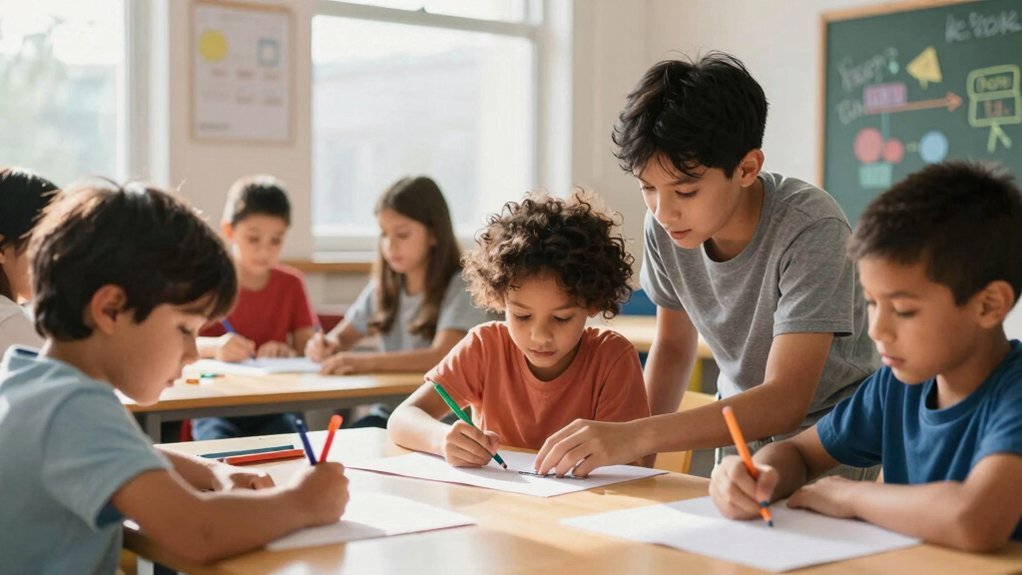
How substantial are the cognitive and developmental gains from mixed-age classrooms? Research reveals compelling evidence of meaningful progress across multiple dimensions.
Research reveals compelling evidence that mixed-age classrooms produce meaningful cognitive and developmental progress across multiple dimensions.
You’ll find that children in mixed-age settings demonstrate:
- Higher performance on reading exams after three years in multi-age environments
- Increased motor, cognitive, and communication abilities compared to single-age peers
- Strongest academic benefits among minoritized students
Younger children exhibit mature, cognitively complex play with older peers, sharpening their receptive and expressive communication skills. Teachers with high skill levels amplify these language and vocabulary gains significantly. Through peer mentorship and modeling, older children develop self-confidence and leadership while younger children access scaffolded learning opportunities that accelerate skill acquisition. You’ll notice consistent outperformance on literacy tests in mixed-age Montessori settings, where peer-to-peer modeling accelerates learning. These documented gains reflect genuine cognitive growth, not temporary performance spikes, positioning your students for sustained academic success.
Frequently Asked Questions
At What Age Do Multiage Classroom Cognitive Benefits Begin Showing Measurable Results?
You’ll see measurable cognitive benefits start appearing in preschool settings with three-year-olds. Your younger children gain vocabulary rapidly through peer interaction, while you’re observing faster cognitive developmental progress compared to same-age classroom peers.
How Do Teachers Manage Significantly Different Developmental Levels Within One Classroom Effectively?
You’ll manage diverse developmental levels by implementing differentiated instruction tailored to individual needs, utilizing flexible grouping strategies, and fostering peer mentoring where older students support younger classmates through collaborative learning experiences.
What Specific Classroom Factors Eliminate Cognitive Flexibility Gaps Between Age Groups?
You’ll eliminate cognitive flexibility gaps by implementing mixed-ability grouping, fostering peer scaffolding, and designing student-directed learning environments. You’re maximizing verbal stimulation through collaborative interactions while continuously adjusting instruction based on individual developmental stages.
Do Multiage Settings Benefit Advanced Learners Differently Than Struggling or Typical Students?
You’ll find that advanced learners benefit most through mentoring roles and self-directed learning, while struggling learners gain from peer tutoring and individualized pacing. Typical students develop balanced leadership and social skills across both experiences.
How Do Parents Prepare Children for Transitioning Into Multiage Classroom Environments?
You’ll establish predictable home routines mirroring classroom rhythms, involve your child in practical life tasks, expose them to mixed-age interactions, and communicate regularly with teachers about their readiness and concerns.
In Summary
You’ll find that multi-age classrooms fundamentally transform how your students think. When you expose them to diverse perspectives and learning strategies, you’re building cognitive flexibility that serves them well beyond the classroom. You’re not just teaching content—you’re developing adaptable minds capable of tackling complex problems from multiple angles. The research is clear: you’ve got a powerful tool for fostering deeper learning and resilience.




Leave a Reply