
You’ll discover that multi-age classrooms build genuine community through mixed-age relationships, consistent teacher partnerships, and peer mentoring. Kids progress at their own pace, eliminating shame and fostering authentic confidence. Older students develop empathy and leadership while younger peers accelerate vocabulary growth through natural peer interaction. Looping strengthens belonging and trust, while flexible assessment celebrates individual progress. Siblings stay together, reducing transitions and supporting family continuity. You’re about to uncover how these ten benefits transform your child’s entire educational experience.
How Mixed-Age Classrooms Build Community From Day One
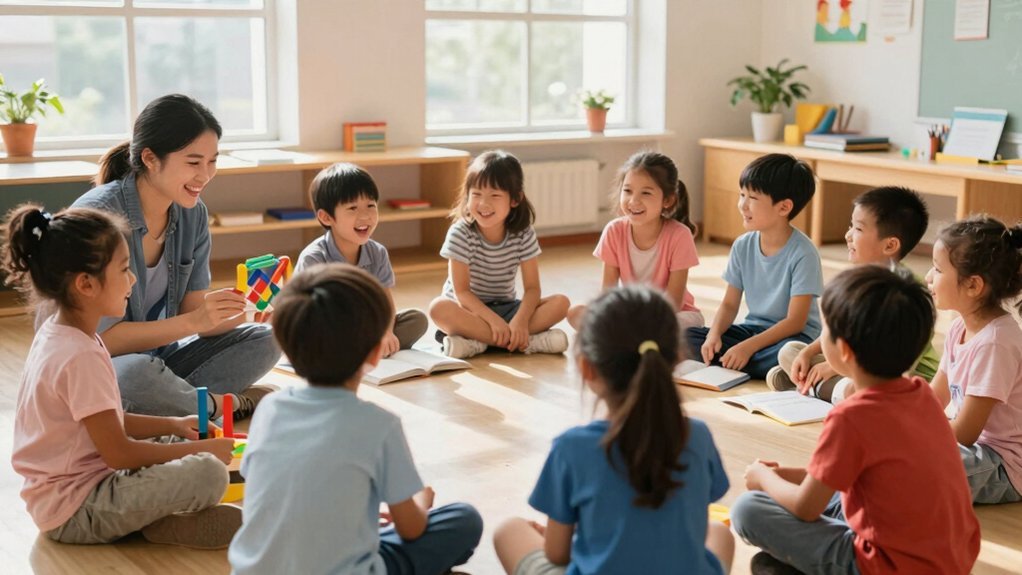
Why do some classrooms feel like families while others remain collections of strangers? Mixed-age classrooms build community from day one by creating family-like environments where you naturally develop deeper relationships across a wider variety of peers and teachers. When you stay with the same teacher and classmates over multiple years—a practice called looping—you build genuine belonging and reduce unhealthy competition. Older students embrace nurturing roles, while younger ones gain confident models to learn from. Regular routines and responsive relationships decrease stress, helping you feel secure and valued. Research shows that social competence in early years predicts later academic and social success, making these formative community connections essential for long-term development. This structure transforms your classroom into a true community where commitment runs deep, not just a temporary grouping of same-aged peers passing through.
When Kids Progress at Their Own Pace, Shame Disappears
You’ll discover that when students progress at their own pace, you’re actively redefining success beyond standardized benchmarks that often trigger shame and inadequacy.
By normalizing the learning journey—acknowledging that growth looks different for each child—you create space where children accept their individual timelines without comparison or self-judgment. When classroom rapport is strong, students experience higher perceived control over their learning, which according to Control-Value Theory reduces the achievement emotions like shame that emerge from feeling helpless or compared to peers.
This acceptance builds genuine confidence because kids aren’t measuring themselves against peers but celebrating their authentic progress.
Redefining Success Beyond Benchmarks
What happens when we stop measuring every child against the same timeline? You create space for genuine success to emerge.
In multi-age classrooms, you’re not confined to rigid benchmarks that label slower paces as failure. Instead, you’re tracking criterion-referenced progress toward fixed standards—metrics that remain stable regardless of peer comparisons. You’re shifting focus to skill targets that matter.
Your assessment approach transforms when you embrace this mindset:
- Portfolio-based work captures ongoing development without test-driven pressure
- Multiple mastery attempts build self-efficacy and perceived support
- Longitudinal data reveals each student’s unique growth trajectory
- Holistic views prioritize long-term advancement over benchmark deficits
- Asset-based measurement frames unfinished learning as opportunity, not shortcoming
You’re redefining what success looks like for each learner, honoring their individual pace while maintaining high expectations for growth. When you analyze student work samples across time, you develop clearer hypotheses about what each child needs next to progress toward grade-level standards.
Normalizing The Learning Journey
When children work at their own pace, something shifts—the constant comparison that fuels anxiety and self-doubt simply vanishes. You’ll notice students no longer feel rushed or held back, which eliminates the shame that thrives in traditional classrooms where everyone moves together.
In multi-age settings, diverse learning journeys become normalized rather than stigmatized. You create an environment where progressing differently isn’t a deficiency—it’s simply reality. Each student meets their current level without judgment, allowing them to focus on their own growth instead of measuring themselves against peers. This personalized approach means students can revisit topics as many times as needed to achieve genuine mastery rather than surface-level understanding.
This acceptance transforms how kids view themselves as learners. You’re not just removing anxiety; you’re building a community where varied progress is expected and respected, making room for genuine confidence to flourish.
Building Confidence Through Acceptance
How does shame dissolve when children aren’t constantly measured against their peers? In multiage classrooms, you’ll witness remarkable transformation as students progress at their own readiness levels without stigma.
When you remove artificial competition, something powerful happens:
- Kids stop questioning whether they’re “smart enough”
- They revisit concepts freely, without embarrassment
- Advanced learners accelerate without ceiling limits
- Flexible pacing acknowledges individual developmental timelines
- Tailored instruction eliminates one-size-fits-all pressure
You’ll notice children shift their focus from self-doubt to their next learning steps. They set self-directed goals, take ownership of their education, and build genuine confidence rooted in personal progress rather than comparison. This acceptance creates an environment where every child feels valued exactly where they are. Research shows that older students serving as role models reinforces this cultural shift, as peer mentoring normalizes diverse developmental pathways and strengthens the belief that growth takes many forms.
How Peer Mentoring Transforms Both Ages Into Leaders
One of the most transformative aspects of multi-age classrooms is how peer mentoring cultivates leadership in students of all ages.
| Leadership Outcome | Older Students | Younger Students |
|---|---|---|
| Role Development | Model behavior and mentor peers | Learn from advanced examples |
| Confidence Building | Gain self-assurance through expertise recognition | Receive encouragement and guidance |
| Skill Reinforcement | Solidify knowledge by explaining concepts | Absorb understanding naturally |
| Reciprocal Growth | Strengthen teaching abilities while leading | Develop resilience and perspective-taking |
You’ll discover that mentoring isn’t one-directional. Older students reinforce mastery by teaching, while younger peers gain mentors who understand their challenges. This reciprocal dynamic transforms both groups into confident leaders. Mentors experience heightened school participation and improved mental health, while mentees benefit from accessible guidance without stigma. Through cross-mentoring, you’re creating an environment where leadership emerges naturally, strengthening the entire classroom community. When you teach students that helping others means guiding, rather than simply providing answers, you deepen their understanding of true mentorship and responsibility.
Younger Kids Build Vocabulary Faster From Older Peers
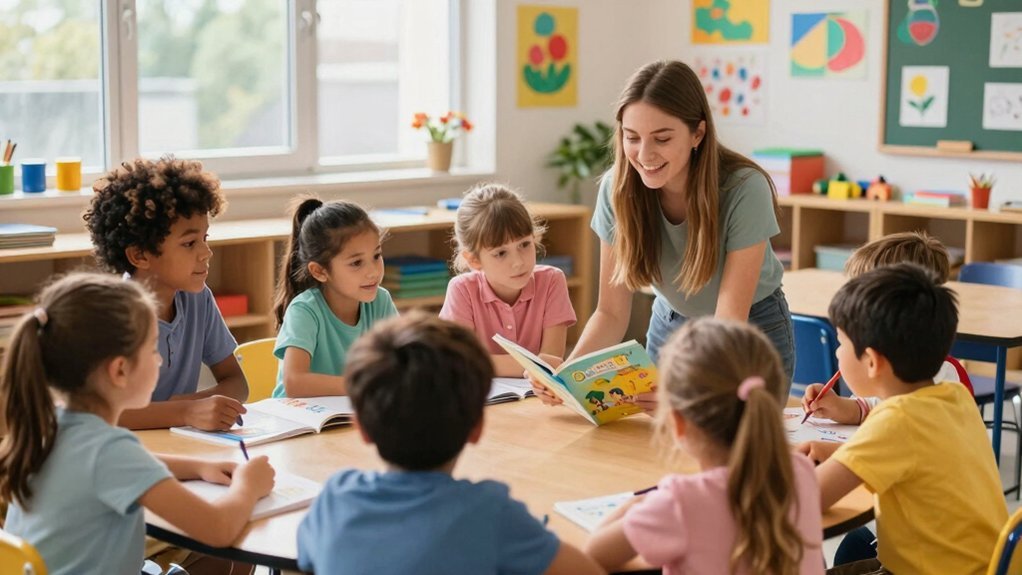
Why do younger children absorb new words so rapidly when surrounded by older peers? Research reveals that children learn vocabulary faster from age-mates than adults because peer speech mirrors child-directed speech while remaining developmentally appropriate.
When you place younger children with older peers, you unlock powerful learning mechanisms:
- Older children use vocabulary slightly beyond younger children’s current level, creating optimal challenge
- Peer speech naturally incorporates repetition and simplified complexity younger learners need
- Children pay heightened attention to peers compared to adult instruction
- Conversational turns between peers strengthen vocabulary retention more effectively than passive listening
- Multi-age interactions create authentic language exchanges that formal instruction can’t replicate
Your younger students don’t just hear words—they observe how peers use language naturally in social contexts, accelerating vocabulary growth beyond what single-age classrooms typically achieve. Studies tracking 8,650 children from age two to kindergarten demonstrate that larger vocabularies at age two predict better academic achievement and behavioral functioning in school, underscoring the critical importance of vocabulary-rich environments during early childhood.
Natural Leaders Emerge When Children Help Each Other
When you assign peer mentoring roles in multi-age classrooms, you’re naturally developing leaders who understand what it feels like to struggle because they’ve been there.
You’ll notice that children who’ve received help themselves become more attuned to when their peers genuinely need assistance versus when they’re capable of solving problems independently.
This empathetic awareness transforms how they regulate their own emotions and responses, creating a cycle where responsibility and self-regulation reinforce each other. Through explaining concepts to others, both the mentor and the student deepen their understanding while building the collaborative skills that extend far beyond the classroom.
Responsibility Through Peer Mentoring
In multi-age classrooms, peer mentoring naturally cultivates responsibility as older students guide their younger classmates through academic and social challenges. You’ll witness how this reciprocal relationship transforms children into accountable leaders who recognize their influence matters.
When you pair students strategically, you create meaningful opportunities for growth:
- Older students develop a genuine duty to model positive behavior
- Younger peers gain confidence from personalized guidance
- Mentors internalize lessons more deeply through teaching
- Children build lasting memories of helping others succeed
- Multi-year relationships strengthen commitment to classroom community
You’re not just creating mentors; you’re fostering lifelong values of responsibility. As older students invest in newcomers’ success, they understand that their actions shape classroom culture. This accountability extends beyond academics, building character traits that serve them far into adulthood. Research demonstrates that mentors retain information more effectively when they teach concepts to younger peers, reinforcing their own mastery while strengthening the entire learning community.
Empathy Builds Self-Regulation Skills
Picture a classroom where a frustrated kindergartener learns to calm down because an older student models patience and breathing techniques—that’s empathy in action. When you interact with children across developmental stages, you’re building something powerful: the foundation for self-regulation skills.
As you help younger classmates, you naturally reinforce your own behavioral mastery. You pause, reflect, and demonstrate control—strengthening your emotional regulation in the process. Meanwhile, younger children absorb these skills through observation and direct guidance. Multi-age environments reduce stress through predictable routines and responsive relationships, creating space where emotional growth happens naturally. Looping with the same teacher deepens these relationships and strengthens the trust necessary for children to feel secure practicing new emotional regulation strategies.
You’re not just learning empathy; you’re practicing it daily. This consistent practice transforms how you manage your own emotions, turning compassion into concrete self-regulation abilities that extend far beyond the classroom walls.
How Advanced Learners Stay Challenged While Mentoring
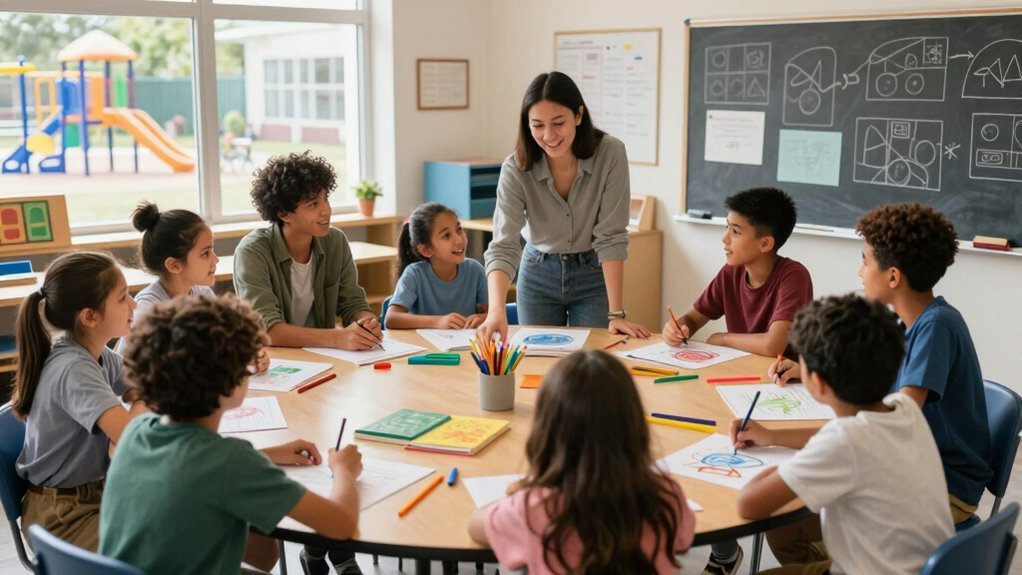
How do advanced learners maintain intellectual rigor while supporting their peers? You’ll find that multi-age classrooms create a dynamic balance where mentoring doesn’t diminish challenge—it amplifies it.
Multi-age classrooms create a dynamic balance where mentoring amplifies intellectual challenge rather than diminishing it.
When you guide younger students, you’re forced to deepen your own understanding. Teaching concepts requires mastery you can’t fake. Simultaneously, you’re tackling enriched curriculum material designed for higher grade levels, keeping your mind engaged. In mixed-age classrooms, this structure naturally develops leadership and empathy alongside academic growth.
Your dual role creates sustained intellectual growth:
- Complex problem-solving activities replace repetitive work
- Open-ended projects demand creativity and critical thinking
- Teaching reinforces concepts through explanation and adaptation
- Advanced curriculum remains accessible regardless of mentoring duties
- Leadership responsibilities develop alongside academic advancement
You’re not choosing between challenge and contribution—you’re experiencing both simultaneously. This balanced approach ensures advanced learners continue progressing while building meaningful community connections.
Kids Who Learn Differently Thrive Without Forced Pacing
You’ll find that multiage classrooms release students from the pressure of arbitrary grade-level benchmarks, allowing them to progress at their own developmental pace. When you’re not forced to keep up with a standardized timeline, you can master concepts thoroughly rather than rushing through material you haven’t yet internalized. This flexibility means you’re advancing based on genuine understanding and readiness, not the calendar. Teachers in these environments meet students where they are, enabling personalized pathways that honor each child’s unique developmental trajectory rather than forcing all learners into the same narrow timeline.
Flexible Timelines Honor Individual Progress
When students aren’t locked into a one-size-fits-all pace, they’re free to accelerate through concepts they’ve mastered and linger where they need support—a shift that transforms how struggling learners experience school.
You’ll notice real changes when flexible timelines become your classroom norm:
- Math strugglers finally grasp foundational skills without shame or rushing ahead unprepared
- Advanced learners pursue deeper exploration instead of treading water during review lessons
- Students build genuine confidence through mastery rather than surface-level completion
- Anxiety drops when deadlines flex for health challenges, therapy, or overwhelming circumstances
- Personalized progress becomes visible daily, fueling intrinsic motivation and agency
This autonomy within structure cultivates belonging. When you honor each learner’s timeline, you’re affirming their worth and capability—essential ingredients for thriving in multi-age communities where diversity strengthens everyone’s growth. Flexible scheduling also enables students to balance academics with extracurricular pursuits like athletics, arts, and entrepreneurship without sacrificing academic rigor or falling behind.
Mastery Over Grade-Level Benchmarks
Why do so many struggling learners suddenly flourish when teachers abandon grade-level benchmarks? When you focus on mastery rather than grade-level progression, you remove the artificial pressure that holds kids back. Low-performing students show the biggest gains under this approach—90% reach scores previously earned only by the top 10%.
You’re not forcing pacing; instead, you’re assessing based on predetermined standards, not peer comparison. Students get multiple attempts to demonstrate understanding through targeted feedback and activities. This shift dramatically reduces test anxiety while boosting confidence, particularly in math. Kids who learn differently finally get what they need: individualized timelines that honor their genuine progress, not arbitrary grade-level constraints. Research on adaptive learning systems demonstrates that higher mastery levels in foundational skills correlate with significantly better performance in subsequent lessons, enabling students to build knowledge more efficiently when prerequisites are truly secured rather than assumed.
Empathy Deepens When Older Students Guide Younger Peers

Older students who mentor younger peers don’t just help them academically—they fundamentally reshape how both groups understand and respond to others’ emotions. You’ll witness genuine growth as mentors develop heightened empathic concern through sustained interactions. This cross-age guidance creates powerful opportunities for perspective-taking:
- Mentors practice negotiating conflicts while supporting younger students’ emotional needs
- Younger peers observe and internalize empathic behaviors modeled by relatable role models
- Both groups strengthen their ability to recognize and validate others’ internal states
- Shared spaces enable natural moments where compassion emerges organically
- Mentorship transforms empathy from abstract concept into lived experience
When you position older students as guides, you’re not simply pairing them together—you’re cultivating emotional intelligence that extends far beyond your classroom walls. Research demonstrates that social-emotional learning interventions enhance student development in skills and behaviors while contributing to long-term wellness outcomes.
Why Consistent Teachers Know Each Child’s Learning Style
Building on that emotional foundation, consistent teachers create another powerful advantage: they understand how each student actually learns. You observe patterns in formative assessments and anecdotal notes, recognizing which strategies work for individual students. You adjust instruction based on prior achievement data, identifying gaps before they widen. You incorporate students’ backgrounds and interests into lessons, strengthening engagement. You vary your teaching methods—alternating between visual demonstrations, auditory explanations, and hands-on activities—because research shows varied approaches outperform single-method teaching. You recognize that prior knowledge and strategic instruction matter more than matching predetermined learning preferences. Your consistency enables you to anticipate difficulties and personalize support, ensuring every child masters content through methods proven effective for them, not stereotyped learning styles. Rather than labeling students as fixed types of learners, you embrace multimodal thinking by combining multiple formats—stories, diagrams, role play, and kinesthetic activities—to reinforce understanding and reach diverse learners.
How Mixed-Age Communities Create Stronger Family Bonds
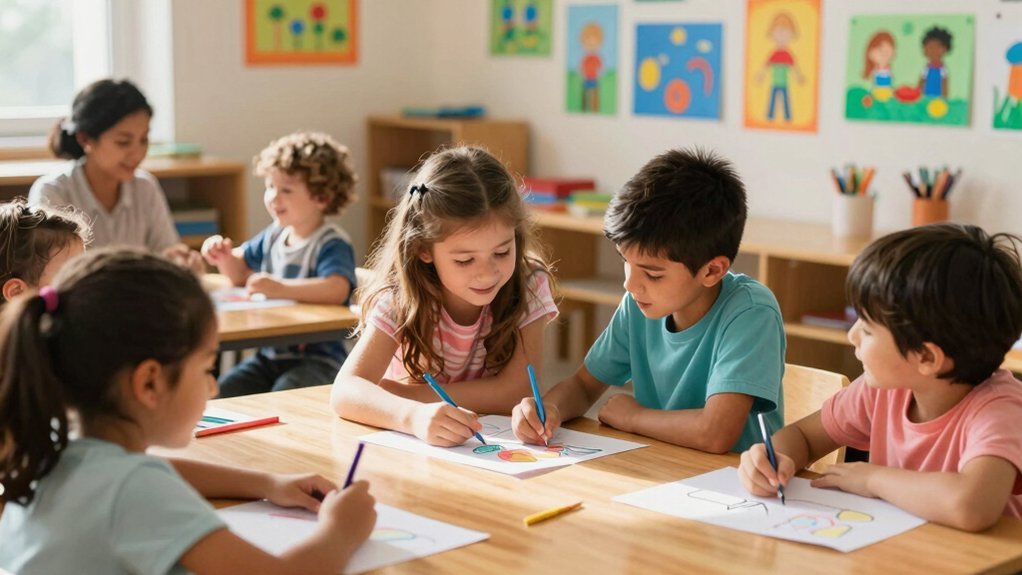
How do you create the sense of belonging that transforms a classroom into something more meaningful—a genuine community where children and families feel truly connected?
Mixed-age groupings cultivate this by fostering authentic family-like environments where relationships deepen over time. You’ll witness:
- Siblings remaining together, reducing transitions and strengthening family continuity
- Older children developing empathy as caregivers, building self-esteem through nurturing
- Consistent teachers learning individual needs and building genuine partnerships with families
- Children experiencing multiple roles—youngest and oldest—within sustained relationships
- A collaborative atmosphere that replaces competition with belonging
When you keep children with the same teacher and peers for two years, you’re not just managing a classroom. You’re building a true community where prosocial behavior flourishes, aggressive behaviors decline, and every family member feels genuinely valued and connected. Research on continuity of care demonstrates that stable caregiver relationships directly support children’s attachment-related behaviors and social outcomes in mixed-age settings.
Frequently Asked Questions
How Do Multi-Age Classrooms Manage Behavior and Discipline Across Different Developmental Levels?
You’ll establish clear expectations collaboratively, tailor age-appropriate activities to diverse needs, build strong individual relationships, use flexible groupings, implement consistent consequences, and employ visual reminders to help students self-regulate their behavior effectively.
What Classroom Size and Age Span Work Best for Effective Community Building?
You’ll find that 15-17 students across a narrow age span work best for community building. This size lets you facilitate morning meetings where every voice gets heard, fostering genuine connections and collaborative projects that strengthen group bonds.
How Do Parents Transition Children From Single-Age to Multi-Age Classroom Environments?
You’ll ease your child’s transition by maintaining consistent communication with the new teacher, visiting the classroom beforehand, and reinforcing that they’ll work with kids of different ages, which strengthens social skills.
What Teacher Training Is Necessary to Successfully Facilitate Multi-Age Learning Communities?
You’ll need training in differentiated instruction, peer mentoring facilitation, multiage curriculum planning, team-teaching strategies, and classroom management specific to mixed-age settings. You’ll also develop skills in assessing diverse learners and building self-directed learning communities.
How Do Standardized Testing and Grade-Level Benchmarks Work in Multi-Age Settings?
You’ll group students by skill levels rather than strict grades, replacing standardized tests with portfolios, observations, and conferences. You’re progressing students individually while avoiding peer comparisons, aligning assessment with multi-age philosophy.
In Summary
You’ll discover that multi-age classrooms transform how your children learn and grow together. When you embrace mixed-age environments, you’re building a community where shame dissolves, natural leaders emerge, and every child thrives at their own pace. You’ll witness deeper empathy, stronger peer mentoring, and family bonds that strengthen alongside academic growth. You’re creating spaces where your kids don’t just learn—they become compassionate, confident individuals who support one another.




Leave a Reply