

Your child’s body language, behavioral patterns, and developmental milestones are constant signals revealing exactly what they need from you. From early communication cues like pulling limbs close to indicate overstimulation, to the emergence of object permanence at eight months, to predictable behavior cycles between calm cooperation and testing limits—you’re reading their development continuously. Understanding these signals helps you support their growing brain and emotional regulation. Discover how nature play, responsive interactions, and recognizing red flags transform your ability to nurture their potential.
Decode Your Baby’s Developmental Signals: Body Language Guide

How does your newborn communicate before speaking their first word? Your baby’s body language tells you everything you need to know. Watch for a relaxed, open posture—that’s your signal they’re ready to interact. When your infant pulls their limbs close or arches their back, they’re signaling overstimulation or discomfort. Turning away means they’ve shifted from alert to overwhelmed.
Pay attention to subtle cues too. Rubbing eyes or yawning indicates tiredness, helping you prevent escalating cries. Your baby’s grasping reflex isn’t just physical—it fosters early communication as they grip your hand. Through sucking reflexes and body movements, your newborn signals their needs constantly. Facial expressions complement these movements, creating a complete communication picture. By learning to read these signals, you’ll respond more effectively to your baby’s developing needs. Contingent responses from you reinforce your infant’s natural communication patterns and strengthen your emotional bond.
The 8-Month Milestone: When Object Permanence Changes Everything
Your baby’s growing awareness of their surroundings reaches a pivotal moment around eight months when something remarkable happens in their brain—they begin understanding that objects exist even when they can’t see them.
You’ll notice your infant lifting cloths to find hidden toys or searching behind screens for dropped items. This cognitive shift marks a crucial developmental milestone that opens doors to memory, symbolic thinking, and language development.
Watch for key signals: your baby calling out when you leave the room, turning their head when you ask “Where’s Mummy?”, or showing puzzlement when a toy vanishes without a trace. These behaviors reveal their emerging mental representations of hidden objects. This maturation of memory, attention, and neural pathways reflects your child’s advancing cognitive abilities.
This newfound permanence also triggers separation anxiety—your baby now recognizes you’re a permanent person who leaves and returns.
Walking, Talking, and Reaching: What 12-Month Signals Tell You

By twelve months, your child’s transformation becomes unmistakable—they’re not the newborn you brought home anymore. Your baby now weighs around twenty-one pounds and has grown roughly fifty percent longer than at birth. You’ll notice they’re standing independently and possibly walking with minimal support or alone. Their motor skills have advanced dramatically: they pick up small objects with precision using their thumb and index finger, and they manipulate toys with purpose.
Linguistically, they’re experimenting with words beyond “mama” and “papa,” combining gestures with vocalizations. They understand simple commands and respond to their name. To support this linguistic growth, sing songs and read picture books together to build vocabulary. Cognitively, they’ve mastered object permanence and actively search for hidden items. Emotionally, they show preference for familiar people while demonstrating increased independence, though separation anxiety remains present. These signals indicate healthy developmental progression across all domains.
Two-Year-Old Behavior Cycles: Why Calm Shifts to Chaos Every Six Months
Why does your toddler seem perfectly cooperative one month, then impossibly defiant the next? You’re witnessing natural developmental cycles that alternate between equilibrium and disequilibrium phases.
| Phase | Age | Characteristics |
|---|---|---|
| Equilibrium | 2 years | Calm, smooth behavior; follows instructions |
| Disequilibrium | 2.5 years | Tantrums, mood swings, testing limits |
| Pattern Continues | 4 & 4.5 years | Cycles repeat throughout development |
At age two, your child behaves calmly and learns rapidly. By 2.5 years, tantrums resurface and rigidity returns. Your toddler hits, kicks, and refuses cooperation without apparent reason.
These cycles aren’t failures—they’re growth periods. During disequilibrium phases, your child develops new skills despite challenging behavior. Understanding this natural rhythm helps you respond with patience rather than frustration, knowing the calm will return. Throughout these developmental shifts, maintaining close supervision remains essential as your toddler’s increased mobility and unpredictable behavior during disequilibrium phases can create new safety risks.
Reading Equilibrium and Disequilibrium: What to Expect Birth to Age 6

How can you tell if your child’s challenging behavior signals growth or regression? You’re witnessing one of two predictable patterns: equilibrium or disequilibrium.
During equilibrium phases, your child feels secure and compliant. They’re joyful, cooperative, and absorbing new skills smoothly. You’ll notice these calmer periods around birth, 18 months, 2 years, 4 years, and 6 years.
Disequilibrium brings the opposite. Your child becomes rigid, oppositional, and emotionally volatile. They’re struggling cognitively as new information challenges their existing understanding. Before age 7, these unsettled phases occur every six months; afterward, they shift to yearly cycles. New experiences can disrupt your child’s current understanding, which is a normal part of cognitive growth.
Understanding this natural rhythm helps you recognize that difficult behavior often precedes developmental breakthroughs. Your child isn’t regressing—they’re reorganizing their thinking and preparing for growth.
Self-Recognition and Deferred Imitation at 18–24 Months
Around 18 months, your child enters a remarkable cognitive shift: they’ll begin recognizing themselves in mirrors and understanding they’re a separate person from you. This milestone typically solidifies by 24 months when nearly all typically-developing children pass mirror self-recognition tests.
Your toddler’s self-awareness develops through specific experiences:
- Touch-based learning — Tactile sensations like vibrating discs on their face at 14 months accelerate mirror self-recognition and self-directed activities
- Body representation — Peak errors at 18 months decline by 22–26 months as they master body-as-obstacle tasks
- Perspective conflict — Emerging self-awareness creates tension between their viewpoint and others’, foundational for later cognitive development
This self-recognition phase connects to self-conscious emotions and deferred imitation abilities, preparing your child for more complex social understanding. Your involvement as a caregiver scaffold during mirror play enhances your toddler’s attention and emotional connection to these emerging self-awareness capacities.
What Curiosity About Nature Reveals About Cognitive Development?
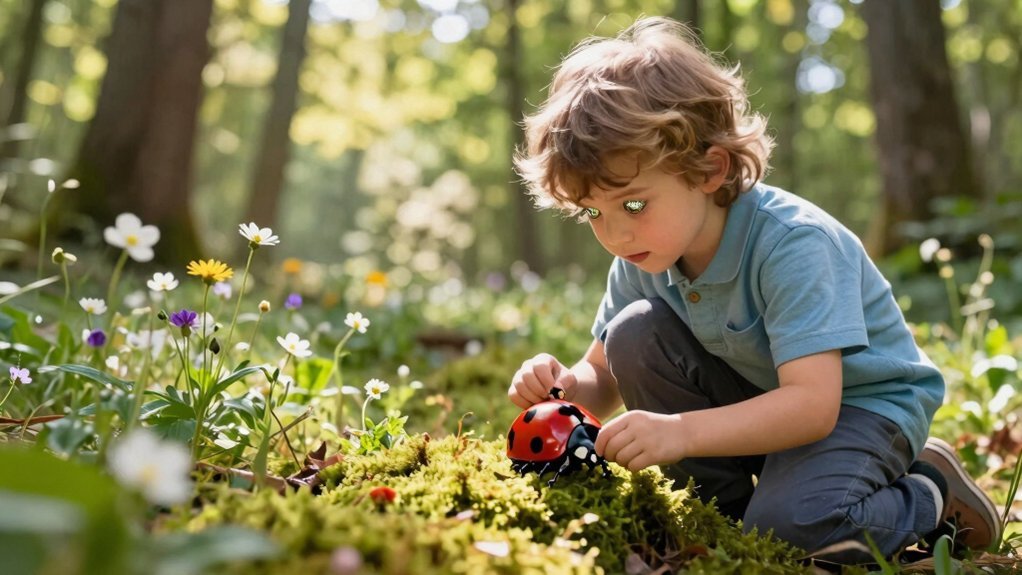
As your child’s self-awareness blossoms, you’ll notice a parallel shift in how they engage with the world around them—through questions, exploration, and wonder. Your child’s curiosity about nature signals crucial cognitive development. When they ask about insects, plants, or weather patterns, they’re exercising critical thinking and problem-solving skills. Nature’s complexity strengthens their attention span and creativity as they navigate unpredictable environments. By 4 years old, children naturally gravitate toward novel experiences that challenge them appropriately—neither too easy nor too difficult. This selective exploration reveals their brain’s optimization of learning. When you encourage nature-based inquiry, you’re nurturing cognitive flexibility and resilience. These early experiences with outdoor wonders build the foundation for lifelong learning and adaptive thinking. Sensory and social experiences in natural settings shape your child’s perception, attention, and memory development in profound ways.
Back-and-Forth Moments Build Your Child’s Self-Regulation
Why do simple exchanges between you and your child matter so much? Back-and-forth interactions teach your child to regulate emotions and behavior through your responsive presence. When you respond to your child’s cues—whether babbling, gestures, or cries—you’re building neural pathways essential for self-regulation.
These serve-and-return moments work through co-regulation:
- Your calm voice down-regulates overstimulation, building emotional flexibility
- Reciprocal exchanges strengthen connections for communication and social skills
- Early responsive interactions predict faster self-regulation gains across preschool transitions
Your meaningful turns at specific moments create lasting brain architecture. Children who experience more conversational exchanges develop better behavioral control from ages three through seven. Research shows that conversational turns correlate with increased activation in Broca’s area, the brain region responsible for language processing and production. You’re not just talking—you’re literally teaching your child’s brain how to manage itself.
Developmental Readiness: When Your Child Is Ready to Move Forward

How do you know when your child’s ready for the next developmental step? Look for comprehensive positive development across physical well-being, motor skills, social-emotional abilities, and cognition. Your child demonstrates writing readiness through pencil grasp, drawings, and invented spellings. Math readiness appears as numeral recognition and interest in quantities. Self-care independence—dressing, eating, toileting—signals maturation. Notice your child’s rate and style of learning across different contexts. Preschoolers showing strong math skills often display prosocial behavior and positive approaches to learning. When literacy interest emerges alongside parental engagement, developmental momentum accelerates. Research shows that school readiness serves as a comprehensive lens for monitoring early development across multiple domains to predict later health and academic success. Diagnostic testing over time reveals true patterns. If concerns arise, comprehensive evaluation—assessing family background, health, language, hearing, and vision—identifies whether intervention supports further progress.
What Your Toddler’s Tantrums Are Actually Telling You
While developmental readiness signals progress across multiple domains, tantrums represent another critical form of communication—one that reveals your child’s emotional state, unmet needs, and emerging capabilities.
Your toddler’s tantrums aren’t random outbursts; they’re developmental milestones expressing frustration and independence. Between ages 2 and 3, tantrums peak as your child navigates conflicting desires for autonomy and parental connection. You’ll notice they occur daily, lasting approximately three minutes on average. The amygdala’s emotional responses are fully active during these early years, while the prefrontal cortex responsible for logic and self-control is still under construction.
Understanding what triggers your child’s tantrums helps you decode their underlying messages:
- Physiological needs – fatigue, hunger, or illness demand attention
- Frustration from language gaps – limited communication abilities increase outbursts
- Overstimulation or routine disruption – environmental changes overwhelm developing regulation skills
Recognizing these patterns allows you to anticipate, prevent, and respond appropriately to your child’s emerging emotional needs.
Nature Play: Essential Development Booster, Not Just Fun
You’ll discover that nature play isn’t simply entertainment—it’s a vital catalyst for your child’s cognitive and emotional development.
When your toddler explores outdoors, they’re actively building neural pathways through creative problem-solving, sensory engagement, and natural risk-taking that indoor settings can’t replicate.
Through direct contact with natural environments, your child cultivates emotional resilience, confidence, and a foundational sense of wellbeing that supports their growth across all developmental domains. Research demonstrates that loose parts and movable elements in nature-based play settings significantly increase social interaction and collaborative play among young children.
Creativity Blooms Through Natural Exploration
Why do children’s imaginations flourish outdoors in ways that indoor environments rarely spark? Natural settings unlock creative potential through unrestricted exploration and sensory richness. You’ll notice your child’s play becomes more complex and inventive when surrounded by biodiversity and greenery.
When you observe nature play, you’re witnessing cognitive development in action. Children engage multiple pathways simultaneously through multi-sensory experiences that indoor settings can’t replicate. They solve real problems, manipulate natural materials, and create increasingly sophisticated games. These benefits extend across different types of nature contact, from direct engagement with natural elements to broader outdoor exposure.
Here’s what blooms through natural exploration:
- Extended, complex play episodes with greater diversity in actions
- Enhanced problem-solving and creative thinking through environmental challenges
- Stronger decision-making skills developed via independent exploration
Your child’s expanding imagination signals healthy cognitive growth. Natural environments don’t just entertain—they fundamentally reshape how your child thinks, creates, and learns. Early experiences with nature during the critical 0-5 years can foster ongoing nature connections that support wellbeing throughout childhood and beyond.
Brain Development in Outdoor Settings
How does your child’s brain actually change when they’re playing outside? Physical activity during outdoor play increases the size of their basal ganglia, a key brain region that aids attention and executive control. Nature exposure enhances both gray and white matter development, directly strengthening cognitive skills, working memory, and attention capacity.
When your child engages in hands-on outdoor activities, their brain encodes physical experiences into motor systems, creating deeper neural pathways than passive observation alone. Time spent in nature replenishes their voluntary focus and restores mental fatigue, resulting in better concentration. These neurological changes translate into measurable improvements: your child develops stronger intuitions about science and mathematical concepts while building essential brain connections that support lifelong learning. Unstructured nature play positively influences cognitive development across multiple domains, allowing children to direct their own learning through exploration and discovery.
Emotional Growth From Nature Contact
While outdoor physical activity rewires your child’s brain for better focus and learning, nature contact simultaneously shapes their emotional landscape in equally profound ways.
Nature contact builds your child’s emotional resilience by reducing stress and teaching them to recognize and regulate their feelings. You’ll notice they develop stronger coping strategies when they experience natural environments regularly.
Here’s what happens during nature contact:
- Stress reduction – Natural settings lower cortisol levels, buffering your child against anxiety and building lifelong resilience.
- Emotion recognition – Nature-based encounters help your child identify feelings and internalize healthy regulation techniques.
- Enhanced attachment – Shared outdoor activities strengthen your parent-child bond while elevating mood and emotional security.
These emotional gains don’t happen through passive exposure alone—your child needs genuine psychological connection to nature. Research shows that children with stronger connection to nature demonstrate significantly higher social-emotional learning skills across self-awareness, self-management, and relationship competencies.
When Stress Is Slowing Your Child’s Brain Development
When your child’s body stays in a constant state of alert, their developing brain can’t function as it should. Toxic stress—the kind without supportive adults present—triggers prolonged cortisol elevation that damages critical brain regions. Your child’s hippocampus shrinks, impairing learning and memory. Their amygdala becomes hyperreactive to emotional stimuli, while their prefrontal cortex struggles to regulate responses.
This chronic activation rewires their stress response system, making it harder to calm down. You’ll notice increased anxiety, poor emotional control, and difficulty concentrating. Their body remains stuck in survival mode, unable to access the neural pathways needed for growth. These structural and functional brain changes occur because stress hormones persistently alter how neurons develop and communicate during this critical window.
The timing matters enormously—early childhood stress creates the deepest, longest-lasting changes. But support from you can buffer these effects, helping their brain recover and build resilience.
Red Flags That Warrant a Professional Developmental Evaluation
You’ll want to watch for developmental delays and regression, which can signal that your child isn’t progressing as expected or is losing skills they’ve already gained.
Keep an eye out for behavioral and communication concerns—like limited eye contact, resistance to interaction, or speech that isn’t developing on track—as these often warrant professional evaluation. Early identification and intervention can dramatically improve outcomes for children facing developmental challenges.
When you notice patterns that don’t align with typical milestones for your child’s age, reaching out to a developmental specialist can help you understand what’s happening and what support might help.
Developmental Delays And Regression
Recognizing developmental red flags early can make a significant difference in your child’s outcomes. Developmental delays and regression represent two distinct concerns you shouldn’t overlook.
Delays involve slower-than-typical skill acquisition across gross motor, fine motor, or cognitive domains. You’ll notice persistent challenges like inability to sit unsupported by 10 months or difficulty following multi-step directions. These patterns at 9 months predict 91% sensitivity for delays at 24 months.
Regression, however, signals loss of previously acquired skills—a more serious indicator requiring immediate investigation. Watch for:
- Skills disappearing after developing normally
- Abnormal neurological signs emerging
- Abilities stalling despite time passing
Early intervention influences overall development, particularly when sensory integration challenges are present, as sensory-infant-focused interventions can enhance sensory functioning and daily participation. Consider that only 2.8% of eligible toddlers receive early intervention services. If your child shows these warning signs, seek professional evaluation promptly.
Behavioral And Communication Concerns
Beyond developmental delays, behavioral and communication difficulties can signal that your child needs professional support. Watch for extreme resistance to routine changes, unexplained aggression, or excessive clinginess with adults. If your child can’t engage in self-directed play or rarely settles from tantrums within 5-10 minutes, these patterns warrant attention.
Communication concerns include unclear speech beyond 24-36 months, persistent drooling, or inappropriate answers to simple questions by age 4-5. Your child might struggle following age-appropriate instructions, seem not to understand when spoken to, or ignore behavioral directions like “no.” Early identification of these communication challenges through standardized assessments can help determine if professional intervention is needed.
Additionally, sensory sensitivities matter—overreactivity or underresponsiveness to sound or touch can indicate underlying issues. Absent pretend play by 30 months or failure to point at objects to share with others by 18 months also suggest developmental concerns.
Frequently Asked Questions
How Do Piaget’s Cognitive Stages Relate to Freud’s Psychosexual Stages in Child Development?
You’ll find Piaget’s cognitive stages and Freud’s psychosexual stages develop concurrently, with sensorimotor/oral emphasizing sensory foundations, preoperational/anal-phallic linking symbolic thought to autonomy conflicts, and concrete operational/latency supporting logical emergence during sexual dormancy.
What Specific Parenting Strategies Support Serve-And-Return Interactions for Brain Development?
You’ll strengthen serve-and-return by noticing your child’s cues, responding promptly with words or gestures, waiting patiently for their next move, and labeling what they’re experiencing. You’re building neural pathways through these reciprocal exchanges.
How Does Epigenetics Explain Why Identical Twins Develop Differently Over Time?
You’ll find that identical twins develop differently because environmental factors—like lifestyle choices, stress, nutrition, and toxins—accumulate epigenetic changes over time, silencing or activating genes differently despite sharing identical DNA.
At What Age Should Children Begin Experiencing Nature to Maximize Developmental Benefits?
You’ll maximize your child’s developmental benefits by introducing nature from birth. Exposing your infant immediately establishes emotional regulation, sensorial development, and active lifestyle habits that sustain lifelong mental health advantages through preschool years.
How Can Parents Distinguish Between Normal Developmental Stress and Concerning Chronic Stress?
You’ll distinguish normal stress from chronic stress by monitoring frequency, duration, and resolution. Normal stress resolves quickly with support; chronic stress persists for weeks, worsens over time, and resists caregiver comfort.
In Summary
You’ve learned to recognize your child’s developmental signals—from their body language and milestone achievements to their behavioral cycles and stress responses. By staying attuned to these natural cues, you’re equipping yourself to support their growth effectively. Trust your observations, celebrate their progress, and don’t hesitate to seek professional guidance when something feels off. You’re giving your child the foundation they need to thrive.




Leave a Reply