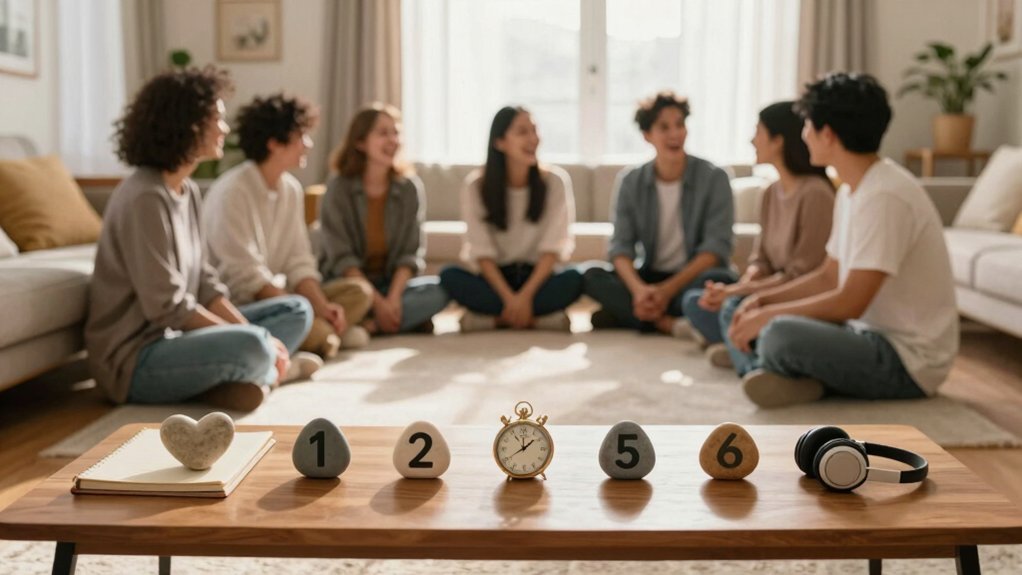

You can calm a sibling fight fast by using a steady voice, inviting each child to breathe, and modeling I‑statements like “I feel upset when my toys disappear.” Let them share perspectives without interruption, then guide a fair turn‑taking exercise and praise the cooperation. Enforce simple ground rules—no hitting, no name‑calling, equal turns—on a visible chart and reinforce them instantly. If you keep going, you’ll discover deeper strategies for lasting harmony.
Our Recommended Product on Amazon

As an Amazon Associate we earn from qualifying purchases.
Quick‑Start Guide: 5 Steps to Peaceful Sibling Conflict Resolution

Ever wondered how to calm a sibling spat in seconds?
Ever wondered how to calm a sibling spat in seconds?
You start with a quick de‑escalation cue: ask each child to take a breath and use an I‑statement, setting the ground rule of no hitting or name‑calling.
Next, you invite the siblings to share their perspectives without interruption, actively listening to regulate the family nervous system.
Then, you guide them through a fair turn‑taking exercise, prompting collaborative questions that lead to mutually workable solutions.
After they agree, praise the successful enactment and have the other child restate what was said and felt.
Finally, reinforce the plan with a brief recap and schedule one‑on‑one time to strengthen the relationship, completing the five‑step conflict resolution process.
Using tools designed with sustainable materials can also teach children valuable lessons about care and responsibility in everyday life.
Model Conflict Calmly for Peaceful Sibling Conflict
When you model calmness during a sibling dispute—using a steady voice, measured pace, and non‑punitive responses—you set the emotional tone that guides both children toward resolution. Your conflict calmness shows them how to stay grounded, while neutral mediation avoids taking sides and teaches fairness. After a pause, ask each child to restate the other’s feelings, then move into collaborative problem‑solving scripts that let them craft joint solutions. Consistently enforce ground rules—no hitting, no name‑calling, turn‑taking—to keep the environment safe and respectful. By practicing these steps daily, you empower the kids to resolve future clashes without escalating tension. Incorporating comfortable and supportive reading corner cushions can create a calm environment that encourages peaceful dialogue.
| Step | Action | Goal |
|---|---|---|
| 1 | Speak slowly, neutral tone | Set conflict calmness |
| 2 | Listen without bias | Ensure neutral mediation |
| 3 | Guide joint solution | Foster collaborative problem‑solving |
Explain Developmental Differences That Shape Sibling Disputes

Why do sibling fights feel so intense? Because you’re witnessing sibling development in real time. Younger children lack fully formed emotional regulation and impulse control, so “mine” moments erupt quickly over toys or attention. As each child matures, their brain’s ability to manage feelings improves, but the gap between siblings can be wide. One may already be negotiating resource sharing calmly, while the other still reacts with raw frustration. Birth‑order traits and personality add another layer, shaping who leans toward aggression, withdrawal, or cooperation. When teens seek autonomy, they clash with the same walls they once shared, amplifying disputes. Understanding these developmental differences lets you anticipate triggers, set realistic expectations, and guide each child toward healthier conflict resolution. Creating an environment with safe-handling designs that support learning can also foster positive interaction and reduce conflict.
Identify Common Triggers of Sibling Fights
You’ll notice that fights often spark when you compete for parental attention, especially if one of you feels overlooked.
Sharing toys, screens, or space can quickly turn into a resource dispute if boundaries aren’t clear.
And when you each try to assert autonomy, mismatched maturity levels make those boundary tests erupt into conflict.
Using self-regulation tools can help manage the emotions that arise during these conflicts.
Attention Competition
Ever wondered why sibling fights flare up over the same things? You notice them scrambling for attention, each demanding the spotlight when a parent walks in. This attention competition fuels conflict because the younger child’s egocentrism and underdeveloped prefrontal cortex push them to claim “mine” moments impulsively, while the older sibling feels overlooked.
When parents unintentionally favor one child, perceived unfairness intensifies the rivalry. Even close‑in‑age siblings, who act as peers, amplify the battle for validation. You can break the cycle with mediation: set clear expectations, rotate one‑on‑one time, and teach both kids how to ask for help without resorting to shouting. Structured guidance turns the tug‑of‑war into cooperative problem‑solving. Incorporating Montessori-inspired musical instruments can support social development and cooperative play, reducing sibling tension.
Shared Resource Disputes
A handful of everyday moments can spark shared‑resource disputes: a favorite toy left within reach, a coveted seat on the couch, or a limited‑time video‑game session. You’ll notice sibling rivalry flares when kids feel they’re missing out on attention or when developmental stages clash, turning “mine” moments into full‑blown arguments. To keep things calm, set clear ground rules—no hitting, no name‑calling—and intervene early with neutral mediation. Encourage them to brainstorm solutions together, such as turn‑taking schedules or shared‑item calendars. Incorporating age-appropriate tools can also promote cooperation and reduce conflict among siblings.
- Identify the trigger (e.g., limited time, space).
- Agree on a fair turn‑taking rule.
- Praise cooperative behavior instantly.
Positive reinforcement cements durable agreements and reduces future fights over shared resources.
Autonomy and Boundaries
When a shared‑resource spat settles, the next challenge is respecting each child’s need for autonomy and clear boundaries. You’ll notice that competition for parental attention spikes when one sibling feels their autonomy is threatened by a larger sibling’s size advantage or by mismatched developmental stages.
Close‑in‑age kids often clash because overlapping roles blur boundaries, making perceived unfairness erupt into conflict. To keep things constructive, avoid side‑taking and instead model calm, neutral mediation.
Encourage each child to use I‑statements and restate the other’s perspective, reinforcing personal autonomy while defining respectful boundaries. This approach not only defuses the immediate flare‑up but also equips them with lasting conflict‑resolution skills.
Incorporating interactive, hands-on learning experiences can further support children in developing empathy and communication skills, fostering peaceful resolution tactics.
Apply Neutral Mediation Techniques
If you stay neutral while mediating, you help kids feel heard and keep the tension from escalating. Neutral mediation lets each child share their view without fear of bias, shaping healthier sibling dynamics and stronger conflict resolution skills. You model calm, non‑punitive responses, showing that fairness beats favoritism.
- Listen fully – let each sibling speak uninterrupted, then summarize their points to confirm understanding.
- Guide brainstorming – ask both children to suggest solutions, steering away from blame and toward compromise.
- Set follow‑up – agree on a concrete plan, schedule a quick check‑in, and reinforce the cooperative outcome.
Teach I‑Statements and Active Listening

You’ll notice that when you guide kids to say “I feel…” they own their emotions and avoid blame, which eases tension. Then you have them repeat back what the other sibling said, showing they’re truly listening and understanding. By pairing these I‑statements with turn‑taking and praise, you turn conflict into a constructive conversation.
I‑Statements
I‑Statements let kids voice their feelings without pointing fingers, turning “You always take my toys” into “I feel upset when my toys disappear.” Pairing this with active listening—where the listener repeats back what was said and how it felt—creates a safe back for both children to be heard.
- Teach the formula “I feel [emotion] when [behavior]” and practice it in role‑plays.
- Prompt the listener to paraphrase the speaker’s words and emotions, confirming understanding.
- Guide them to brainstorm a concrete solution together, then praise the successful use of I‑statements for conflict resolution.
Active Listening Techniques
How can you turn a heated sibling spat into a calm conversation? Start by teaching I‑statements, then model active listening. When one child says, “I feel upset when you take my toy because I want to finish my game,” the other paraphrases, “So you’re frustrated because you need to finish your game.” This back‑and‑forth builds empathy and sharpens conflict resolution. Pair each paraphrase with validation—“I hear you.”—before moving to problem‑solving. Use a simple script during jealous moments, reinforcing respectful turn‑taking. Sprinkle regular touch‑routines into calm times to cement safety and openness.
| Step | Example |
|---|---|
| I‑Statement | “I feel ___ when ___ because ___.” |
| Paraphrase | “So you’re ___ because ___.” |
| Validation | “I hear you.” |
Establish Predictable Ground Rules
Ground rules set the stage for calm, fair play, so start by stating clear limits—no hitting, no name‑calling, and equal speaking turns—before any disagreement erupts. You’ll notice how these simple boundaries boost conflict resolution and make mediation smoother. By modeling neutral, calm communication you avoid bias and give each child a safe space to speak.
Ground rules create calm, fair play, fostering empathy and cooperative problem‑solving.
- Define limits – write “no hitting, no name‑calling, equal turns” on a visible chart.
- Enforce immediately – step in the first sign of aggression, then guide them to brainstorm solutions.
- Reinforce success – praise when they follow the plan, like using turn‑taking signals or shared‑item schedules.
These steps create predictability, teach empathy, and turn disputes into cooperative problem‑solving.
De‑Escalate Aggression Safely
Aggression spikes the moment you intervene, so act fast: separate the kids, keep your tone neutral, and state the zero‑tolerance rule clearly. You recognize aggression as an emergency, then enforce a calm, consistent consequence plan that protects both bodies and feelings. Use neutral mediation to avoid taking sides; ask each child what happened, repeat their words, and guide them toward a shared solution. Model a composed, non‑punitive response, and praise any cooperative behavior you see. If the aggression persists or you sense resistance, don’t hesitate to seek extra help—family therapy or resources like Kinder Mind can deepen your de‑escalation toolkit. This approach builds safety habits while teaching lasting conflict‑resolution skills.
Leverage Long‑Term Benefits of Constructive Conflict
After you’ve de‑escalated the heat of an argument, you can turn the moment into a growth opportunity. By framing the discussion as constructive conflict, you give both siblings a rehearsal space for negotiation tactics that later pay off in school, work, and friendships. The long‑term benefits surface when they learn to listen, empathize, and view problems from multiple perspectives. Peaceful mediation, like a shared‑item schedule or turn‑taking plan, cements these habits and boosts resilience.
- Practice role‑playing different conflict styles in low‑stakes scenarios.
- Use a simple mediation script to agree on solutions and revisit them later.
- Celebrate each successful resolution to reinforce prosocial behavior.
These steps turn everyday squabbles into lasting social‑emotional skills.
Frequently Asked Questions
What Is the 7 7 7 Rule for Parents?
You give each child seven minutes of one‑on‑one time daily, seven days a week, and seven chances each week to practice positive interactions or receive guidance, fostering connection and reducing rivalry.
Which Sibling Has the Highest IQ?
You can’t tell which sibling has the highest IQ from the material you provided; it contains no IQ data or assessments, so you’ll need separate, reliable testing to determine that.
What Are the 3 C’s of Conflict Resolution?
You’ll recognize the 3 C’s as Calm, Cooperation, and Constructive problem‑solving. Stay calm, listen and collaborate, then guide children to brainstorm and implement solutions together.
Does Sibling Rivalry Ever Go Away?
You’ll never see rivalry vanish completely, but you’ll watch it shrink as you teach empathy, set clear boundaries, and model calm problem‑solving; over time it transforms into healthier, collaborative interactions.