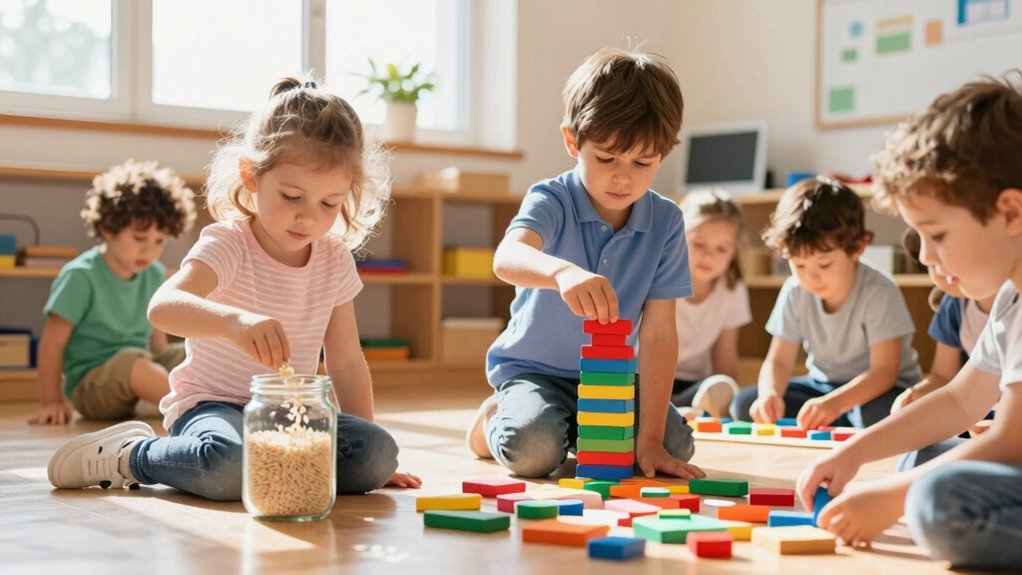
Child-led Montessori activities put your child’s curiosity in the driver’s seat, transforming learning from something done to them into something they actively direct and own. You’ll set up accessible materials on low shelves—sandpaper letters, practical life tasks, sensory bins, and building blocks—then step back as your child chooses what engages them. This freedom cultivates intrinsic motivation, deepens concentration, and builds real confidence through self-directed exploration. Your role shifts to observation and gentle guidance, supporting their natural developmental unfolding. Discover how these simple shifts unlock remarkable growth across language, independence, and problem-solving skills.
Why Montessori Puts Your Child in Control

How does giving children agency in their learning transform their development? When you place your child in control of their learning, you’re fostering self-determination that directly enhances their well-being and competence. Montessori classrooms operate within teacher-set parameters, allowing your child to explore individual interests at their own pace. This freedom cultivates intrinsic motivation—your child learns because they’re genuinely curious, not because they’re chasing external rewards.
You’ll notice your child develops concentration, confidence, and independence through self-directed work. They become active participants deciding their learning focus, which drives internal satisfaction and joyful engagement. Studies demonstrate that Montessori students show sustained improvements in reading, memory, and executive function that continue strengthening through kindergarten rather than fading over time. Research shows adults who spent at least two years in Montessori environments score higher across all psychological well-being measures, including self-confidence and social trust. By empowering your child with meaningful choices, you’re building foundations for lifelong learning and flourishing.
How Sensory Exploration Builds Independence and Curiosity
Why do children thrive when they’re free to explore through their senses? Because sensory activities naturally build both independence and curiosity simultaneously.
When you let your child manipulate materials like sand, rice, or textured objects without constant supervision, they develop autonomy and self-confidence. They learn to trust their own judgments and complete tasks at their own pace, fostering genuine self-dependency.
This hands-on exploration also sparks curiosity. Your child discovers how objects feel, sound, and look, refining their perceptions and deepening their connection with the world. Open-ended activities—balancing pebbles, mixing colors, sorting by texture—encourage problem-solving and creative thinking naturally. Through repetitive sensory tasks, children build concentration and focus that strengthens their ability to engage deeply with learning materials.
As your child gains control over their learning through sensory discovery, they experience genuine achievement. This sense of ownership transforms learning from passive consumption into active, joyful exploration.
Self-Directed Practical Life Skills for Real-World Confidence

When your child pours their own juice, buttons their own shirt, or wipes up a spill they’ve made, they’re doing far more than completing a household task—they’re building the foundation for genuine confidence.
Self-directed practical life skills empower children to master their environment and develop real-world competence. Through purposeful work, your child cultivates essential qualities:
Self-directed practical life skills empower children to master their environment and develop genuine real-world competence.
- Independence through decision-making when preparing simple snacks or managing personal routines
- Concentration by engaging in sequential processes like dishwashing and organizing
- Motor skill refinement via spooning, sweeping, and folding activities
- Self-esteem through visible impact on their surroundings
When you allow your child to contribute meaningfully to family life, they internalize that their actions matter. This hands-on engagement transforms everyday activities into powerful learning opportunities, fostering autonomy and lasting confidence. These exercises of practical life create a foundation that supports all future learning and skill development in your child’s educational journey.
Language Development Through Child-Paced Discovery
You’ll discover that self-directed letter exploration lets your child trace sandpaper letters and moveable alphabet pieces at their own rhythm, building both tactile memory and phonemic confidence.
Picture matching activities strengthen recognition skills as your child connects images to words they’re learning, transforming abstract symbols into concrete meaning.
Through storytelling with toy characters, you’ll watch your child naturally practice vocabulary, sentence construction, and narrative sequencing while enjoying complete creative freedom. These concrete materials provide the sensory foundation that transforms language learning from abstract instruction into tangible, hands-on exploration that respects each child’s individual pace and readiness.
Self-Directed Letter Exploration
Self-directed letter exploration places your child’s natural curiosity at the center of language learning, allowing them to discover sounds and symbols through tactile engagement rather than formal instruction.
You’ll observe your child progressing through meaningful stages:
- Phonemic awareness — Your child hears, distinguishes, and reproduces language sounds through sensory activities
- Sandpaper letter tracing — They trace textured letters while pronouncing sounds, building pre-writing skills and sound-symbol associations
- Moveable alphabet experimentation — Your child arranges color-coded letters to form words independently, fostering phonics comprehension
- Self-paced advancement — They progress naturally to sentence creation and grammar exploration without pressure
You’ll facilitate this process by providing materials at eye level, reading daily, and asking open-ended questions. Your role involves observation and gentle suggestion rather than directing learning. This approach respects your child’s readiness while building confident, independent learners. Materials tailored to your child’s learning needs and interests should be organized with designated shelves or cupboards for easy access and independent exploration.
Picture Matching For Recognition
Picture matching builds naturally from your child’s sound-symbol discoveries, offering a concrete way to strengthen visual discrimination and vocabulary simultaneously. You’ll start with identical objects, then progress to realistic images, gradually introducing complexity through backgrounds and abstract forms.
| Stage | Materials | Skills Developed |
|---|---|---|
| Object-to-Object | Concrete items, baskets | Visual discrimination |
| Object-to-Picture | Figurines, photos | One-to-one correspondence |
| Picture-to-Picture | Identical cards, trays | Classification ability |
You observe your child pairing images independently, resisting the urge to name objects prematurely. This self-directed exploration builds concentration and short-term memory naturally. Once mastery occurs, you introduce memory games or word cards, connecting visual recognition to phonemic awareness. Your role remains supportive, allowing successful matches to boost confidence while preparing your child for reading’s transition from concrete to abstract symbols. Early experiences with picture matching provide real opportunities to practice language in a supportive environment where visual and sensory play make learning natural and engaging.
Storytelling With Toy Characters
Three foundational elements—words, actions, and imagination—converge when your child narrates stories with toy characters, transforming play into powerful language development. This interactive approach builds narrative skills while fostering genuine community connection through shared storytelling experiences.
As your child manipulates characters and creates dialogue, they’re strengthening comprehension and recall abilities that surpass traditional read-aloud activities. You’ll notice their vocabulary expanding naturally as they experiment with descriptive language and varied sentence structures. The multi-sensory engagement of physically moving characters while speaking dialogue enhances retention of language concepts more effectively than passive listening alone.
Consider these benefits:
- Children develop phonemic awareness through character dialogue and sound exploration
- Narrative skills flourish as they sequence events and create plot coherence
- Vocabulary expands through contextual, imaginative language use
- Confidence in self-expression grows without pressure or correction
Your role involves asking open-ended questions that challenge thinking while allowing ample space for your child’s authentic voice to emerge.
Cognitive Matching Games That Strengthen Problem-Solving
How can children develop confidence in tackling challenges without adult intervention? Cognitive matching games provide the perfect opportunity. When you introduce self-correcting Montessori materials, your child learns through trial and error, building resilience as they work independently.
These games strengthen problem-solving by encouraging logical thinking and analytical reasoning. Your child identifies patterns, compares characteristics, and develops memory skills through repeated exposure to objects and their relationships. As they manipulate various textured and shaped materials, they’re also refining fine motor skills and hand-eye coordination simultaneously. Self-correcting materials enable children to recognize and correct their own mistakes, fostering independence and self-directed discovery.
You’ll notice your child progressing from simple object-to-object matching toward more abstract connections. This gradual advancement fosters patience and perseverance while building the confidence needed to tackle future challenges without seeking external guidance.
Building and Construction for Spatial Reasoning and Patience

When you place wooden blocks in your child’s hands, you’re offering more than a simple toy—you’re providing a gateway to spatial understanding and mathematical thinking.
Through open-ended construction, your child develops critical reasoning by experimenting with balance and structure. When towers topple or blocks don’t stack evenly, they’re learning cause-and-effect relationships firsthand. This trial-and-error process builds persistence and adaptive thinking. These hands-on materials create the sensorial engagement that enhances cognitive development through multisensory exploration.
When blocks topple, children learn cause-and-effect, building persistence and adaptive thinking through trial-and-error construction.
Consider these building approaches:
- Magnetic tiles and wooden blocks for exploring 3D shapes and spatial relationships
- Cardboard boxes and tubes for creative problem-solving
- Obstacle courses using household items for motor planning
- Geometric solids for visual discrimination and spatial visualization
You’ll notice your child’s fine motor control improving alongside their patience. Each adjustment they make strengthens both their hands and their ability to persist through challenges.
What Your Child’s Creative Play Reveals About Development
Your child’s creative play serves as a window into their cognitive development, revealing how they’re building symbolic thinking, flexible problem-solving, and planning abilities through imaginative scenarios. When you observe them engaging in dramatic play or cooperative building projects, you’re watching emotional competencies emerge—their capacity to regulate themselves within game rules, express feelings through role-adoption, and develop empathy by stepping into different perspectives. These creative moments aren’t just entertainment; they’re concrete evidence of your child’s growing ability to think abstractly, organize complex ideas, and navigate social relationships with increasing sophistication. Through exposure to diverse communities and varied perspectives during creative play, children develop respect for different cultures and choices that shape their worldview. By providing a stimulating environment with novelty and variety, you actively support the creativity and problem-solving skills emerging through your child’s imaginative exploration.
Cognitive Growth Through Play
Ever watched a child lose themselves in imaginative play and wondered what’s actually happening in their brain?
When your child engages in pretend play, they’re activating critical neural pathways that fuel cognitive development. Here’s what’s actually occurring:
- Neural connection formation – Creative play strengthens synaptic transmissions across multiple developmental domains, enhancing memory and concentration.
- Prefrontal cortex activation – Imaginative scenarios stimulate higher-order thinking and problem-solving abilities essential for academic success.
- Language expansion – Role-playing adventures build vocabulary and storytelling skills through natural experimentation.
- Flexible thinking development – Navigating make-believe obstacles teaches your child to adapt strategies and approach challenges creatively.
This cognitive growth isn’t coincidental. Research confirms that play-based learning directly correlates with future literacy and mathematical achievements, making pretend play one of the most powerful tools for intellectual development. Studies show that divergent thinking enhancements from creative play support children’s ability to generate multiple solutions and innovate across different contexts.
Emotional Expression In Creation
A child’s drawing, song, or imaginary story isn’t just entertainment—it’s a window into their emotional world. When you observe your child creating, you’re witnessing their emotional development unfold. Through art and music, they explore feelings they can’t yet verbalize, building resilience and self-understanding. Dramatic play with costumes and props lets them experiment with different emotions safely. Open-ended activities with manipulable materials reveal their creative freedom and imagination. The way they problem-solve during collaborative projects shows their social-emotional adaptation. Notice how they expand their play scenarios—these spontaneous developments signal their emotional growth and flexibility. When children engage in multisensory creative exploration, they develop stronger neural pathways that support both emotional processing and cognitive growth.
In a prepared Montessori environment, your child has the safety and freedom to express themselves authentically. This creative expression directly translates to better emotion management and social skills in real-world situations.
Setting Up a Prepared Environment for Self-Directed Learning

How does a child learn to make independent choices when materials sit out of reach or spaces feel chaotic? You’ll create a prepared environment by implementing these essentials:
- Position materials at child eye-level on low, open shelves for easy access and visibility
- Organize by activity areas—practical life, sensory, language, math—in clearly labeled boxes or baskets
- Provide child-sized furniture including tables, chairs, and counters that children can move freely
- Maintain a clutter-free atmosphere with designated spots for every material and neutral wall colors
You’ll use natural light, add plants and wood elements, and rotate materials based on your child’s interests. This intentional setup removes barriers to independence, allowing children to select activities confidently, work autonomously, and develop decision-making skills naturally. Regular observation of your child’s developmental stage and interests will help you adjust materials to match their evolving needs and sustain engagement over time.
Frequently Asked Questions
At What Age Can Children Start Child-Led Montessori Learning Activities?
You can start child-led Montessori learning activities from infancy. Your infant engages with high-contrast mobiles and tactile exploration. As your toddler approaches 12 months, you’ll introduce choice-based activities, fostering their emerging autonomy and self-directed play naturally.
How Do I Know if My Child Is Making Progress in Self-Directed Learning?
You’ll notice your child initiating tasks independently, sustaining focus without prompting, and managing materials responsibly. Document these moments through photos and notes. You’re observing genuine progress when they’re problem-solving without constantly seeking adult help.
What Should I Do if My Child Refuses to Engage With Prepared Activities?
You should model the activity yourself consistently in your child’s view, observe their interests closely, and offer limited choices between two acceptable options to empower their decision-making and reduce resistance naturally.
Can Child-Led Montessori Activities Be Done at Home Without Formal Training?
You can absolutely implement child-led Montessori activities at home without formal training. You’ll observe your child’s interests, prepare accessible materials, and create uninterrupted work periods that foster independence and deep learning naturally.
How Much Time Should Children Spend on Self-Directed Activities Daily?
You should provide your child 2-3 hours daily of uninterrupted self-directed work time. You’ll want to ensure they’re choosing activities freely while you observe and guide minimally, supporting their natural concentration development.
In Summary
You’re witnessing your child’s natural drive to learn when you embrace Montessori’s child-led approach. By setting up a prepared environment and letting your child choose activities, you’re fostering independence, curiosity, and confidence. You’ll notice how sensory exploration, practical skills, and creative play reveal their unique developmental journey. You’re not just teaching—you’re empowering your child to become a self-directed learner who loves discovery.


Leave a Reply