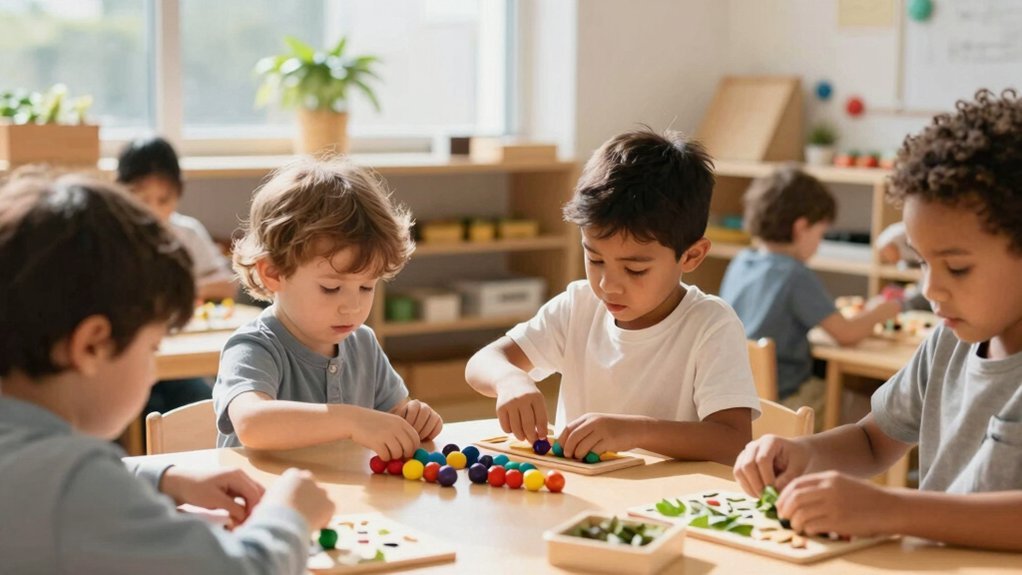
You’ll find that a Montessori child stays self‑motivated because the prepared environment offers easy, purposeful materials that spark curiosity, lets them pick tasks that interest them, and provides self‑correcting tools that turn mistakes into learning moments. Mixed‑age peers model skills and give subtle guidance, reinforcing autonomy and responsibility. Real‑world connections and hands‑on activities turn concrete experiences into abstract mastery, while process‑focused feedback builds resilience. Keep exploring to discover how to nurture this intrinsic drive at home and school.
Prepared Environment Sparks Intrinsic Curiosity
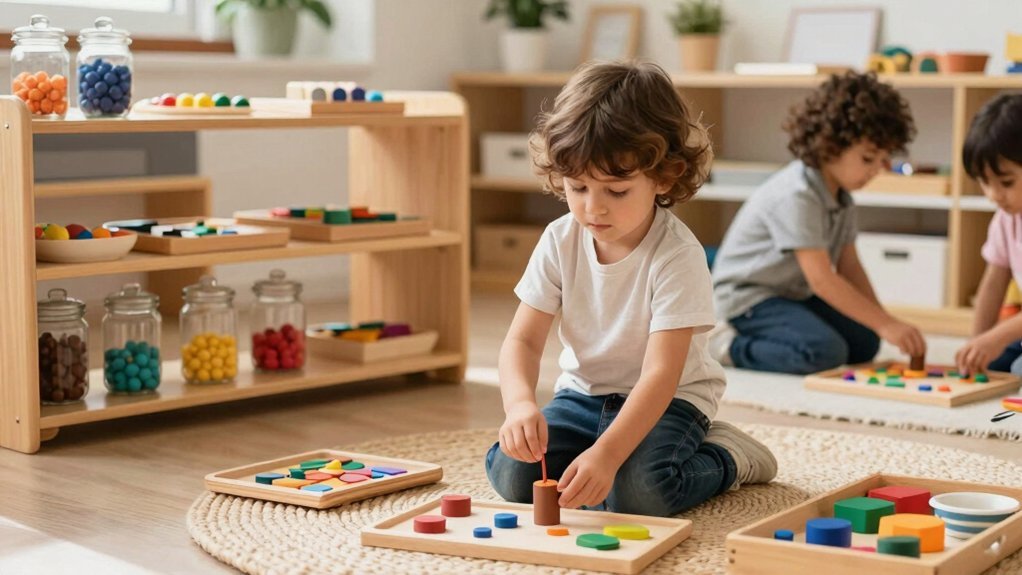
Why does a prepared environment spark curiosity? You step into a room where every shelf, tool, and activity is sized for your hands, inviting you to explore without adult prompting. The layout lets you pick a material, work with it, and return it independently, reinforcing a sense of competence. Safety rails and clear boundaries keep risk low, so you feel free to experiment and build confidence. Tasks progress from simple to complex, so each success fuels the next, sustaining your interest. This design nurtures intrinsic motivation, turning learning into a self‑driven adventure. You become responsible for your own pace, and the environment’s purposeful organization keeps you engaged, curious, and eager to discover more.
Freedom of Choice Fuels Autonomy and Motivation
When you let kids pick the activities they’ll work on, you hand them the reins of their own learning, sparking genuine autonomy. That self‑directed exploration fuels intrinsic motivation because they’re chasing interests that matter to them.
At the same time, choosing when and where to engage teaches personal responsibility and time‑management skills. Providing children with tools like a Montessori step stool encourages independence by allowing them to safely participate in everyday tasks.
Choosing Activities Builds Autonomy
Ever notice how a child lights up the moment they can pick their own activity? You’ll see autonomy blossom as they scan the shelf, weigh options, and decide what feels right. By offering a curated set of materials, you give them enough freedom to feel empowered without drowning in choices.
When they choose a puzzle, a bead string, or a reading corner, they practice decision‑making and time‑management, starting and finishing on their own terms. This self‑direction nurtures independence; they learn to organize space, gather tools, and track progress. The intrinsic joy of working on something they love fuels sustained engagement, sharpening self‑regulation and deepening their motivation to explore further. Incorporating sensory materials like All-Inclusive Calm-Down Sensory Bottles can enhance emotional regulation and mindfulness during independent activities.
Self‑Directed Exploration Enhances Motivation
Choosing an activity is just the first step; the real spark happens when children take ownership of the exploration that follows. In a Montessori setting you watch a child pick a puzzle, then see them experiment, adjust, and persist without prompting. This self‑directed learning fuels intrinsic motivation, because every success feels earned. The prepared environment supplies just the right materials, while the teacher quietly observes, ready to intervene only when readiness shows. Peer interaction in mixed‑age rooms adds subtle guidance, reinforcing confidence and curiosity. Using materials such as Montessori command cards paired with real objects encourages hands-on engagement and deepens comprehension through tactile experience, further supporting self-motivated learning with real object matching.
| Benefit | How it appears |
|---|---|
| Autonomy | Child selects task |
| Persistence | Continues despite difficulty |
| Mastery | Self‑correcting tools give feedback |
| Confidence | Peer mentors validate effort |
Freedom Encourages Personal Responsibility
Because children can pick the tasks, tools, and even the spot where they work, they instantly feel a sense of ownership that turns simple activity into a personal commitment. You’ll notice how freedom fuels autonomy: when a child decides which material to use, they practice time‑management and self‑directed engagement.
By setting clear limits, you guide them toward safe, manageable choices, preventing overwhelm. This independence lets them determine when to start and finish, reinforcing accountability and personal responsibility.
A child‑centered environment that honors individual interests keeps motivation intrinsic, encouraging sustained exploration. As they experience the direct link between choice and outcome, they internalize responsibility, building confidence and a lifelong love of learning.
Self‑Correcting Materials Foster Responsibility
Often you’ll notice that self‑correcting materials let children spot mistakes right within the activity, so they can fix errors on their own without a teacher’s prompt. This self‑correction invites them to own their learning, turning every slip into a chance to act responsibly. The built‑in cues guide them toward the right answer, reinforcing persistence and pride. When they solve problems independently, intrinsic motivation spikes, because mastery feels personal, not awarded. You’ll see them pause, assess, and choose the next step—an empowering loop that nurtures accountability.
- Immediate visual feedback sparks confidence.
- Children learn to monitor progress without adult oversight.
- Errors become learning moments, not failures.
- Mastery emerges from personal effort, not praise.
- Responsibility grows as they decide how to correct themselves.
Montessori life cycle materials, such as 3D figurines representing stages of plant and animal growth, provide tactile and visual cues that enhance self-directed learning.
How Mixed‑Age Classrooms Boost Peer Learning and Confidence

You’ll see older kids modeling skills that you can copy, which naturally sparks leadership in you and your peers. When they tackle problems together, you’re encouraged to collaborate and learn from each other’s strengths. This mix of ages creates a supportive cycle where confidence and competence grow hand in hand. Montessori classrooms often use progressive texture gradation to scaffold tactile learning effectively.
Peer Modeling Enhances Skills
How does a mixed‑age classroom spark self‑motivation? You watch older peers tackle a puzzle, then you try the same steps, feeling the surge of confidence that comes from peer modeling. Their focused effort becomes your blueprint, and you internalize strategies for independence without waiting for adult direction. This dynamic fuels collaboration, social responsibility, and a genuine desire to master tasks.
- You see a senior student calmly solve a math problem, and you mimic the method.
- You receive quick, informal feedback from a classmate who just mastered the skill.
- You feel pride when you replicate a peer’s concentration and succeed.
- You develop persistence by observing peers finish tasks alone.
- You gain intrinsic motivation from relatable role models across ages.
Toys like Montessori-inspired wooden spinning tops can further support this environment by fostering hands-on learning and fine motor skills development in mixed-age groups.
Natural Leadership Opportunities
Seeing a senior student guide a younger peer through a new activity instantly creates a natural leadership moment. In a mixed‑age Montessori classroom, you’ll notice older children stepping into helper roles, modeling tasks while younger ones watch and imitate. This peer collaboration builds social responsibility; you see kids asking for advice, offering support, and feeling proud when they succeed.
As you observe the older child explain a concept, the younger learner gains confidence, and the mentor reinforces mastery. Voluntary group work across ages sparks autonomy and initiative, turning each interaction into a chance to lead or follow.
The result is a self‑sustaining cycle of motivation, where leadership emerges naturally and confidence grows for every student. Incorporating real-life role play, such as with dress-up costumes, further enhances cooperative imaginative play and leadership skills among children in this environment.
Collaborative Problem Solving
When older children mentor younger peers in a mixed‑age classroom, they reinforce their own understanding while boosting confidence through leadership. You’ll see collaborative problem solving happen naturally: a 7‑year‑old explains a puzzle to a 4‑year‑old, then both experiment with solutions, learning from each other’s questions and successes. This dynamic builds social responsibility, encourages initiative, and lets you negotiate, listen, and co‑create outcomes. Peer feedback fuels autonomy, and the shared projects keep interest high, making learning feel like play rather than a chore.
- You feel proud when a younger child finally “gets it” because you helped.
- You gain confidence as your explanations become clearer.
- You enjoy the buzz of teamwork during shared tasks.
- You discover new strategies from peers’ fresh perspectives.
- You celebrate collective victories that reinforce self‑motivation.
Hands‑On Activities as Tangible Paths to Abstract Mastery

From the moment you let a child handle a set of Montessori beads, the concrete material becomes a bridge to abstract ideas. You watch them count, group, and compare, then notice the same logic appear when they later manipulate symbols. Self‑correcting tools let errors surface without adult interference, so they develop independent problem‑solving habits. As the beads give way to tiles and rods, the same tactile patterns reinforce numerical fluency before any notation appears. Multisensory materials sharpen pattern recognition, sequencing, and prediction, laying a solid foundation for abstract mathematical thinking.
| Material | Concrete Skill | Abstract Transition |
|---|---|---|
| Beads | Counting | Numeracy concepts |
| Tiles | Grouping | Set theory basics |
| Rods | Length comparison | Geometry intuition |
| Puzzle boards | Sequencing | Algorithmic thinking |
Concentration Through Repetition Builds Mastery and Pride
Repetition sharpens your child’s concentration, turning a single activity into a focused, sustained effort. Each time they work with a Montessori material, they reinforce attention, move from concrete to abstract, and see progress unfold. The self‑correcting nature lets them solve problems independently, so every success builds confidence and pride. Mastery isn’t handed down; it emerges from persistent practice that fuels intrinsic motivation.
- They notice patterns, so each step feels predictable and rewarding.
- Small corrections become visible victories, boosting self‑esteem.
- Repeated drills turn mistakes into learning moments, deepening focus.
- Consistent routines nurture perseverance, reducing frustration.
- Mastery experiences replace external praise, fostering lasting confidence.
Guiding Children at Home Without External Rewards
How can you nurture a child’s inner drive at home without relying on stickers, points, or praise? You become a guide, watching for readiness and stepping in only when the child truly needs support. Offer choices of activities and work spaces so autonomy blossoms, and let self‑correcting materials reveal errors on their own. Emphasize effort and growth rather than the finished product, and model calm problem‑solving. Mixed‑age interactions let older siblings mentor younger ones, reinforcing social responsibility and self‑regulation.
| Strategy | Why it works |
|---|---|
| Offer choices | Builds autonomy |
| Use self‑correcting tools | Encourages internal feedback |
| Focus on process | Shifts attention from external rewards |
| Encourage peer mentoring | Strengthens intrinsic motivation and social‑regulation |
Montessori’s Real‑World Connections Strengthen Meaningful Learning
You’ll notice how everyday objects turn abstract ideas into hands‑on experiences, making learning feel relevant and useful. When children practice real‑life skills—like measuring ingredients or arranging schedules—they see the purpose behind each activity, which fuels their intrinsic drive.
This concrete‑to‑abstract progression lets them solve problems independently, reinforcing that their learning truly matters.
Real‑World Contextual Learning
- Measuring ingredients feels like a science experiment.
- Sorting coins teaches budgeting and math.
- Planting seeds links biology to responsibility.
- Using a calendar reinforces time management.
- Analyzing weather data sparks data‑literacy.
Practical Skill Application
When children engage with real‑world materials—like measuring cups, sewing needles, or garden tools—they instantly see how classroom concepts translate into everyday tasks, turning abstract ideas into concrete, usable skills. You watch them choose a task, measure flour, then compare the result to a recipe, reinforcing self‑directed learning. The tactile feedback of cutting, threading, or planting shows cause‑and‑effect, so persistence feels rewarding. Independent problem‑solving with self‑correcting tools builds confidence that effort yields real improvements, not just grades. Observing mastery in authentic contexts fuels intrinsic motivation, linking school knowledge to life you value.
| Material | Real‑World Use | Skill Gained |
|---|---|---|
| Measuring cups | Cooking | Volume estimation |
| Sewing needles | Clothing repair | Fine‑motor precision |
| Garden tools | Planting | Observation & care |
| Bead frames | Math sequencing | Pattern recognition |
| Tile puzzles | Spatial reasoning | Problem solving |
How Parents and Teachers Provide Feedback That Builds Intrinsic Motivation
Ever wonder how a simple comment can spark a child’s inner drive? You can nurture intrinsic motivation by focusing on effort, curiosity, and self‑reflection. When you notice a child persisting on a hands‑on task, pause and say, “I see you’re trying different ways to solve that—what’s working for you?” This process‑focused feedback replaces praise for the product with pride in the journey, reinforcing autonomy and mastery.
- Highlight specific strategies they used, not just the outcome.
- Ask open‑ended questions that invite self‑assessment.
- Celebrate persistence when challenges arise.
- Connect their work to personal interests they chose.
- Encourage peer sharing, letting older classmates model growth mindsets.
These moments turn everyday interactions into powerful motivators, keeping the child’s inner drive alive.
Long‑Term Outcomes: Lifelong Curiosity & Self‑Direction
Often, Montessori’s emphasis on self‑directed, hands‑on learning plants a seed of lifelong curiosity that keeps growing long after the classroom doors close. You’ll notice that autonomy becomes the engine of future achievement: the habit of choosing tasks, persisting through challenges, and reflecting on progress carries into college, careers, and personal projects. Mixed‑age settings teach you to mentor peers and learn from them, while self‑correcting materials let you diagnose errors without external pressure. This blend of choice, purposeful pacing, and guided discovery builds durable reasoning skills and a resilient mindset, so you stay engaged long after formal schooling ends.
| Aspect | Montessori Mechanism | Long‑Term Effect |
|---|---|---|
| Autonomy | Choice of work | Sustained self‑direction |
| Collaboration | Mixed‑age interaction | Social competence |
| Mastery | Process focus | Deep expertise |
| Resilience | Self‑correction | Persistent curiosity |
Frequently Asked Questions
Is Montessori Good for Dyslexia?
Yes, you’ll find Montessori works well for dyslexia because its hands‑on, self‑directed activities let you explore concepts at your own pace, reducing pressure and building confidence through concrete, multisensory experiences.
What Motivates Children in a Montessori Classroom?
You’re driven by the freedom to choose activities, the tactile, self‑correcting materials that let you see progress, and the mixed‑age community that offers real‑time feedback and peer mentorship.
What Is the Biggest Criticism of Montessori?
You’ll find the biggest criticism is that outcomes hinge on teacher training and fidelity, causing inconsistent quality, uneven academic rigor, and mixed‑age assessments that can delay foundational literacy and numeracy mastery.
What Are the 4 C’s of Montessori?
You’ll find the four C’s are Confidence, Concentration, Coordination, and Compassion—each nurtured through hands‑on, self‑directed work, mixed‑age collaboration, and respectful, supportive classroom interactions.