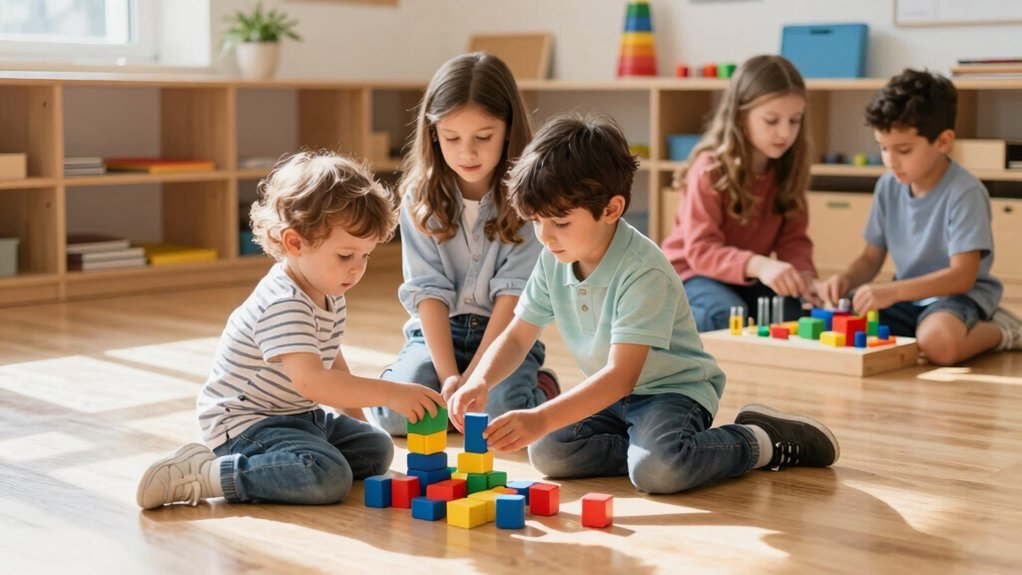
You’ll find that mixed-age Montessori classrooms transform how kids develop socially and academically. Older students naturally become mentors, building leadership and empathy while reinforcing their own learning. Younger peers observe role models solving problems at relatable paces, boosting confidence without anxiety. You’ll see measurable gains in reading, memory, and executive function—advantages that actually compound over time, unlike traditional preschool benefits that fade. The collaborative, non-competitive structure mirrors real workplaces while building lasting friendships. There’s much more to discover about how these dynamics reshape childhood development.
Natural Social Skills Emerge From Age-Mixed Interaction

How do children develop genuine social competence? In mixed-age Montessori classrooms, you’ll find they acquire it naturally through daily interactions with peers of varying abilities and maturity levels.
In mixed-age Montessori classrooms, children develop genuine social competence naturally through daily interactions with peers of varying abilities and maturity levels.
You’ll observe younger students gaining familiarity with classroom routines by watching older classmates, which reduces their anxiety and builds confidence.
Meanwhile, older children develop empathy by helping younger peers with tasks, learning patience as they allow independent problem-solving before intervening.
These diverse interactions create authentic opportunities for negotiation and conflict resolution without direct competition. You’ll notice children learn to share, empathize, and adapt to different communication styles. The low student-to-teacher ratios ensure that teachers can facilitate these meaningful peer interactions and provide personalized guidance when social challenges arise.
Research demonstrates that mixed-age settings produce a remarkable 40% improvement in collaborative skills compared to same-age environments, fostering the social understanding children genuinely need.
How Older Kids Become Leaders by Teaching Younger Ones
Within the mixed-age Montessori classroom, leadership doesn’t emerge from arbitrary designation—it develops organically as older students take on mentoring roles. You’ll notice third-year students naturally step into positions where they give lessons, assist with materials, and offer comfort to younger classmates. This transition happens gradually over multiple years, allowing confidence to build steadily.
As you teach younger peers specific concepts, you reinforce your own mastery while developing crucial communication skills. You learn to explain ideas clearly, listen actively, and respond with patience. Your younger classmates look up to you, which strengthens your sense of responsibility and self-esteem.
These leadership experiences extend beyond the classroom. You’re practicing real-world skills—cooperation, adaptability, and empathy—that’ll serve you throughout life. The respect you build through mentorship creates lasting relationships built on genuine understanding. Teachers staying with groups for the full three-year cycle enables deeper recognition of each student’s individual needs and learning style.
Measurable Academic Gains: Reading, Memory, and Executive Function
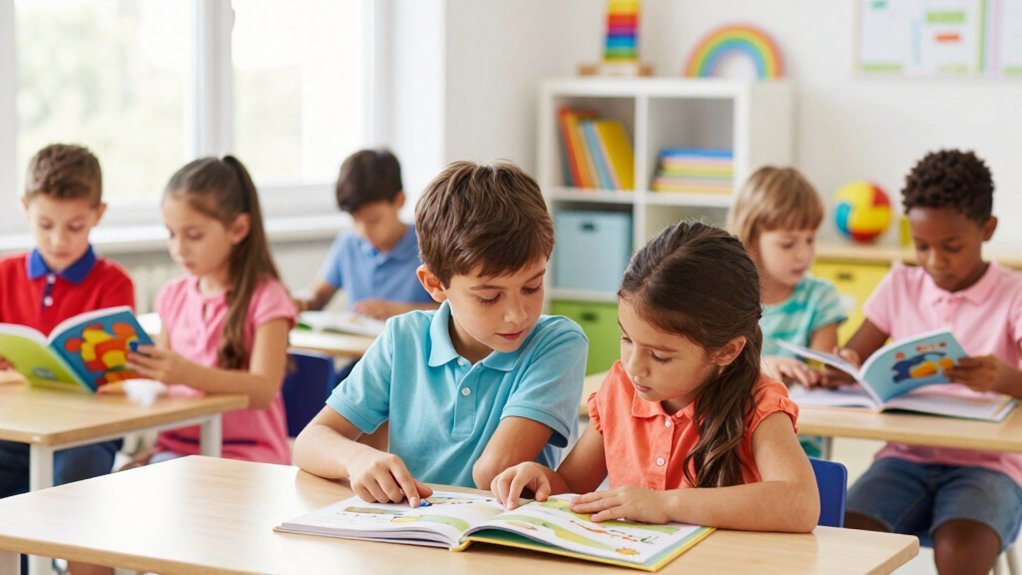
While mentorship builds character and social skills, the Montessori model delivers concrete academic results that matter. You’ll see your child’s reading skills outpace peers in traditional programs—a nationwide randomized trial showed disadvantaged kindergarteners gained an effect size of d=0.68 in reading outcomes. Memory improvements emerge too, with Montessori students demonstrating superior short-term memory performance by kindergarten’s end across 24 national programs.
Executive function advances round out the cognitive gains you can expect. Your child develops stronger self-regulation and planning abilities compared to conventional preschool attendees. Remarkably, these benefits don’t fade like many preschool programs; they sustain through kindergarten. These gains continue to grow over time, meaning the advantages compound as your child progresses through school. You’re investing in lasting improvements, not temporary advantages—all while paying approximately $13,000 less per child than traditional options.
Learn by Watching: Why Younger Kids Pick Up Skills From Older Peers
You’ll notice that younger children absorb skills most effectively when they’re watching older peers tackle real tasks, not sitting through formal instruction. This observational learning builds your child’s confidence because they’re seeing age-appropriate role models solve problems at a relatable pace, making new abilities feel achievable. When younger children observe older peers explaining concepts in their own words, peer explanations reinforce comprehension and critical thinking in ways formal instruction cannot replicate.
As you observe this dynamic in a mixed-age classroom, you’re witnessing how exposure to varied competencies naturally prepares your child for the flexible thinking they’ll need beyond school.
Observational Learning In Action
How do younger children acquire advanced skills without direct instruction? You’ll find the answer in everyday Montessori classrooms where observation becomes your child’s most powerful teacher.
When you watch your child observe older peers stacking blocks or completing complex projects, you’re witnessing real-time skill acquisition. They absorb techniques through careful observation, then replicate them during hands-on activities. This imitative learning accelerates cognitive development, exposing your child to concepts beyond their current stage.
You’ll notice your child gains advanced vocabulary and comprehension by observing peer interactions and eavesdropping on lessons meant for older students. Mixed-age dynamics create natural learning opportunities that mirror family settings, where younger siblings learn from older ones daily. The prepared environment in Montessori classrooms intentionally supports this observational process by arranging materials and activities where younger children can naturally witness older peers engaged in complex work.
This reciprocal cycle benefits everyone—younger children gain skills, while older peers reinforce mastery through demonstration and teaching.
Building Confidence Through Exposure
What transforms a shy five-year-old into a capable learner? Exposure to older peers who model competence and independence. When you watch an older child tackle a challenging task, you see it’s achievable. You observe their problem-solving strategies, their persistence, and their success—all without the pressure of immediate competition.
In mixed-age classrooms, you develop confidence by witnessing diverse capabilities around you. Older children naturally mentor younger ones, demonstrating skills like reading or mathematical reasoning. You don’t feel rushed to perform at their level; instead, you work at your own pace while absorbing their approach. Through these mentoring roles, older students reinforce their own knowledge while younger learners gain practical insight into how concepts are applied.
This exposure reduces jealousy and builds reciprocal worth. You understand that everyone progresses differently. Seeing older children succeed shows you what’s possible, while teaching younger peers reveals your own growth. You develop genuine confidence grounded in realistic capability and mutual respect.
Reduced Competition Creates Space for Genuine Collaboration

When children learn alongside peers at different developmental stages, they’re freed from the constant comparison that defines traditional classrooms. You’ll notice they naturally gravitate toward collaboration rather than competition. Without ranking systems or direct peer comparisons, children focus on solving problems together and exploring ideas collectively.
In mixed-age environments, you observe genuine teamwork flourishing. Younger students learn from older mentors, while older children reinforce their own understanding through teaching. Hands-on materials encourage group engagement where everyone contributes meaningfully. This reciprocal interaction builds responsibility and leadership organically. The protégé effect enhances older students’ concept mastery when they explain ideas to younger learners, deepening their own cognitive development.
The absence of competitive hierarchies transforms how children relate to one another. You’ll see them supporting peers authentically, motivated by shared learning goals rather than individual achievement. This collaborative framework reflects real-world dynamics where people of varying ages work cooperatively toward common purposes.
Empathy Across Age Differences: The Mentoring Effect
Why do older children develop remarkable patience and empathy when guiding younger peers? When you mentor younger students, you naturally step into their shoes, understanding their struggles and perspectives. You recognize that learning unfolds differently for each child, cultivating genuine compassion rather than judgment.
This mentoring dynamic strengthens your emotional intelligence significantly. You’ll experience hands-on caregiving—answering questions, demonstrating tasks, offering encouragement—all of which deepen your empathy muscles. You’re not just teaching academic concepts; you’re developing crucial emotional awareness. Peer-assisted learning occurs naturally as you help classmates navigate their own educational journeys.
Meanwhile, younger students observe your patience and modeling, which boosts their confidence and reduces anxiety. You create a reciprocal relationship where mutual respect flourishes. Through these age-spanning interactions, you’ll build authentic connections that foster belonging and resilience for everyone involved.
Building Lasting Friendships Beyond Single-Grade Isolation
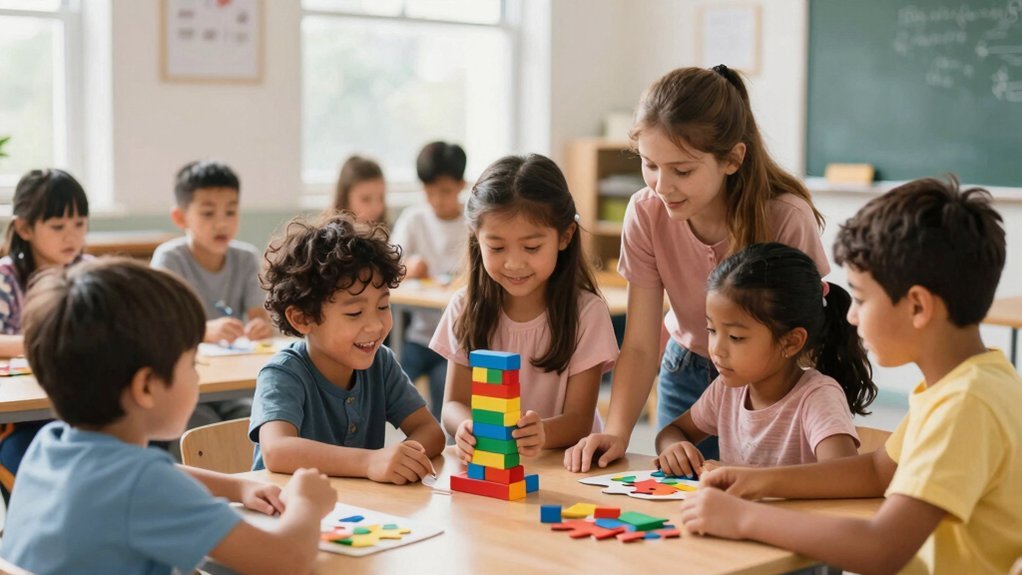
You’ll discover that mixed-age classrooms naturally break down age barriers, allowing friendships to flourish based on shared interests rather than arbitrary grade assignments. Within these communities, you’re exposed to peer support networks that emerge organically through daily collaboration, where older and younger students learn from one another’s strengths. The continuity you experience across multiple years creates deeper bonds than single-grade isolation ever could, fostering connections that often extend far beyond the classroom. Older students mentor younger peers, reinforcing their own leadership abilities while building confidence in both age groups through consistent interaction and guidance.
Breaking Down Age Barriers
How do children break free from the isolation of single-grade classrooms? In mixed-age Montessori environments, you’ll find that age barriers naturally dissolve through daily interaction across multiple years. Your child experiences genuine friendships with peers spanning wider age ranges, creating opportunities that single-grade settings simply can’t offer. These extended relationships sustain deeper connections because children interact frequently over extended periods, moving beyond superficial peer dynamics.
You’ll notice your child viewing themselves as part of a supportive community rather than competing within a narrow cohort. Multi-year grouping breaks traditional grade-level isolation, allowing sympathetic bonds to develop organically. Older and younger children collaborate regularly, fostering mutual respect and understanding. Through peer teaching, older students reinforce and expand their own knowledge while supporting younger learners’ cognitive development. Your child develops the interpersonal skills necessary for human solidarity, carrying these authentic friendships and collaborative abilities into adulthood.
Natural Peer Support Networks
Because children spend multiple years together in Montessori classrooms, they develop genuine peer support networks that transcend typical single-grade friendships. You’ll notice your child builds stronger bonds through sustained collaboration and extended peer interactions that single-age settings simply can’t replicate.
These lasting relationships prepare your child for real-world diverse interactions, building resilience and adaptability. Your child experiences frequent peer-to-peer talk that boosts both language development and social connection. The natural peer networks that emerge extend far beyond classroom walls, creating friendships rooted in genuine understanding rather than arbitrary age grouping. In this environment, older students reinforce knowledge by guiding younger peers, creating mutual roles that strengthen the entire community.
Your child benefits from reciprocal help-giving and receiving, strengthening their sense of belonging within a community that values sustained support. These relationships become foundational to your child’s social confidence and emotional wellbeing.
Continuity Creates Deeper Bonds
When your child stays with the same peer group for two to three years, something remarkable happens—friendships deepen in ways that annual classroom rotations simply can’t facilitate. Your child builds genuine familiarity with classmates’ strengths, quirks, and character, moving beyond surface-level interactions.
This continuity eliminates the disruption of yearly transitions. Instead of restarting social dynamics annually, your child develops reciprocal relationships rooted in sustained contact. Repeated interactions cement bonds that grow increasingly resilient over time. Disagreements and conflict resolution experiences within this stable group actually strengthen relationships by teaching children how to navigate differences with peers they genuinely care about.
Multi-year grouping also creates natural mentorship opportunities. Older students guide younger peers, while younger children observe and admire role models they’ve known for years. These relationships foster mutual reliance and empathy.
The result? Your child forms enduring friendships grounded in shared experiences, known strengths, and genuine community—connections that extend well beyond single-grade isolation.
Why Mixed-Age Models Cost Less: The Efficiency Factor
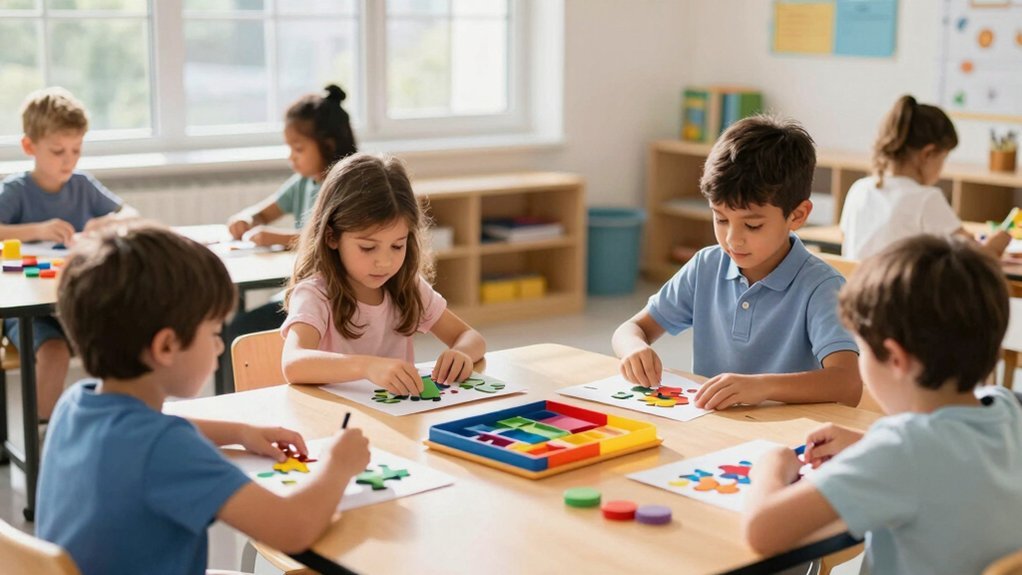
Why does Montessori education deliver substantial cost savings despite higher upfront investments? You’ll find the answer in operational efficiency. Mixed-age classrooms enable you to maintain higher student-to-teacher ratios—up to 13:1 for three- and four-year-olds—without sacrificing quality. Older children naturally mentor younger peers, reducing direct instruction demands on teachers. This peer-learning dynamic cuts your supervision requirements significantly.
Teacher salaries represent your largest expense. By optimizing staffing through efficient classroom structures, you’ll save $13,000–$13,127 per child over three years. When you amortize specialized Montessori materials across their 25-year lifespan, initial equipment costs become negligible. Additionally, you’ll benefit from improved teacher retention, which eliminates costly hiring and onboarding cycles. These interconnected efficiencies transform Montessori’s design into genuine financial advantage. Research from a national randomized controlled trial demonstrates that public Montessori programs consistently outperform traditional alternatives in reading and executive function outcomes while maintaining these cost advantages.
Three-Year Teaching Cycles: Why Continuity Strengthens Development
While operational efficiency creates the financial foundation for Montessori programs, the real competitive advantage lies in how children develop within stable, continuous learning environments. You’ll see your child progress through distinct phases over three years: exploration and observation initially, then confidence-building through repetition, and finally leadership as a mentor to younger peers.
This continuity allows teachers to deeply understand your child’s learning style and developmental needs. Rather than restarting each year, educators build seamlessly on prior knowledge, letting your child master skills at their own pace without rushed timelines. Your child gains the security to take intellectual risks, knowing consistent guides support their growth. Within the mixed-age setting, older children naturally develop empathy and communication skills by assisting younger peers, enriching the entire classroom dynamic. By year three, you’ll witness exponential development as your child fully blossoms into their potential.
Personalized Pacing Eliminates the Stigma of Academic Struggle
You move through material at your own rhythm, freed from the arbitrary timeline that labels slower learners as struggling. Your confidence builds when you master skills on your schedule rather than someone else’s, allowing genuine understanding to precede advancement. Self-directed progress means you’re not racing against classmates—you’re advancing because you’ve actually internalized what you’ve learned.
Individual Learning Timelines
How do children thrive when they’re allowed to learn at their own pace? In mixed-age Montessori classrooms, you’ll notice students progressing through individual learning timelines rather than rigid grade-level schedules. Your child isn’t pressured to master skills on a predetermined timeline or compared against age-matched peers. This flexibility acknowledges that learning isn’t linear—your student experiences periods of rapid growth, plateaus, and occasional regression, all perfectly normal.
You’re freed from the anxiety of keeping up or falling behind. Teachers observe your child’s unique developmental pace over three-year cycles, tailoring instruction to their specific needs. This responsive approach means your student builds confidence through authentic progress, not artificial benchmarks. They develop resilience by understanding that different timelines reflect different learning styles, not deficiencies. With peers across skill levels available in the same classroom, your child avoids the isolation of feeling left behind or understimulated by unnecessary repetition.
Confidence Through Self-Directed Progress
What happens when children aren’t measured against a standardized timeline? You’ll find that academic struggle loses its sting.
In a mixed-age Montessori environment, your child progresses at their own pace without labels like “behind” or “slow.” There’s no rigid deadline creating anxiety or shame around learning speed.
This self-directed approach lets you pursue interests naturally, building confidence through genuine accomplishment rather than external pressure. When you’re free from comparison, you focus on personal growth. The prepared environment supports your independent choices, allowing steady progress that feels authentic. Mixed-age classrooms enable peer learning and mentorship, creating additional opportunities for growth beyond individual pacing.
You sustain motivation through your own rhythm, avoiding the frustration of being held back or rushed. Progress becomes your story, not a standardized ranking. This flexibility transforms how you view yourself as a learner—capable, valued, and secure.
How Classroom Communities Build Lasting Belonging
Why do children thrive in mixed-age classrooms? You’ll find they develop genuine belonging through stable, family-like communities. Long-term peer relationships across three-year cycles create trust and affection that persist throughout their education. You witness children naturally protecting and supporting each other, fostering inclusion for younger peers while building leadership in older students.
| Aspect | Benefit | Outcome |
|---|---|---|
| Long-term relationships | Deep peer connections | Peaceful collaboration |
| Teacher continuity | Personalized understanding | Tailored instruction |
| Reciprocal care | Shared responsibility | Community unity |
| Multi-year stability | Reduced disruption | Emotional security |
| Family atmosphere | Sense of belonging | Lifelong bonds |
Your classroom becomes a small society where contributions matter. Children develop reciprocal feelings for each other’s worth, creating stability that reduces anxiety and strengthens their confidence in social settings.
Confidence Through Exposure: Why Younger Kids Rise to Advanced Work
Beyond the emotional security of stable communities, children in mixed-age classrooms gain something equally powerful: confidence born from constant exposure to advanced work. You’ll notice younger learners naturally attempt challenging tasks they’ve observed older peers complete successfully. This observation-based learning eliminates the intimidation factor that adult-only demonstrations create.
You’re not confined to rigid grade-level pacing, so you progress when ready rather than when schedules dictate. Watching nearby age peers master complex skills normalizes advanced work as achievable, not intimidating. Three-year cycles allow you to transition gradually from novice to expert, building assurance throughout the journey.
When you eventually teach younger classmates, you deepen your own mastery while boosting their confidence. Research confirms this sustained multi-age exposure significantly improves reading scores through confidence gains alone. The protégé effect—where teaching others reinforces the teacher’s own understanding—creates a powerful cycle of learning that benefits both mentor and learner simultaneously.
Real-World Skills: Why Mixed-Age Teamwork Mirrors Workplace Dynamics
How do you prepare for a workplace you’ve never experienced? Mixed-age Montessori classrooms offer authentic training grounds. You’ll navigate diverse teams, negotiate with peers of varying abilities, and solve problems collaboratively—exactly what workplaces demand.
| Skill | Classroom Practice | Workplace Application |
|---|---|---|
| Communication | Explaining concepts to younger students | Presenting ideas to mixed-level teams |
| Adaptability | Adjusting approaches for different ages | Responding to varied colleague needs |
| Problem-solving | Collaborating across ability groups | Contributing to cross-functional projects |
| Leadership | Mentoring peers naturally | Managing diverse team dynamics |
These interactions build genuine competencies organically. You’ll develop patience, flexibility, and perspective-taking without artificial exercises. By experiencing real collaboration across ages and abilities, you’ll enter workplaces equipped with authentic interpersonal skills and confidence in diverse environments.
Long-Term Durability: Why These Gains Don’t Fade Like Traditional Preschool Advantages
You’ve likely noticed how traditional preschool gains evaporate once children enter kindergarten, but Montessori’s mixed-age structure sustains cognitive growth because children build intrinsic motivation through genuine collaboration rather than external rewards. When you’re working alongside older and younger peers across multiple years, you’re naturally driven to master skills at your own pace—not racing to meet arbitrary benchmarks that fade once the pressure lifts. This collaborative foundation transforms learning into something you’re genuinely invested in, making the cognitive and social gains remarkably durable. In multi-age environments, older children develop leadership through mentoring younger peers, which reinforces their own mastery while creating a cycle of peer learning that extends far beyond single-grade classrooms.
Building Sustained Cognitive Growth
Why do Montessori advantages persist while traditional preschool gains often fade? You’ll find the answer lies in how mixed-age environments continuously reinforce learning through multiple mechanisms.
In mixed-age classrooms, you benefit from:
- Peer modeling effects – Observing older students’ work accelerates your cognitive fluency without requiring direct instruction
- Individualized pacing – You progress at your own speed, preventing the cognitive regression common in conventional settings
- Multi-year stability – Remaining in the same environment with consistent peer groups strengthens neural pathways over time
- Imitative learning cycles – You absorb advanced concepts by watching future lessons, embedding knowledge deeper into memory
This sustained exposure prevents the typical fade-out effect. You’re not passively receiving information; you’re actively constructing knowledge through continuous peer interaction and environmental consistency that traditional classrooms simply can’t replicate. The deeper teacher-student connections formed over multiple years in the same classroom enhance the effectiveness of personalized instruction tailored to your developmental needs.
Intrinsic Motivation Through Collaboration
While mixed-age environments strengthen cognitive pathways through peer observation and environmental consistency, they’re equally powerful in cultivating something deeper: the internal drive to learn for its own sake. You’ll notice that when children collaborate across age groups, intrinsic motivation flourishes naturally. Older students mentoring younger peers reinforce their own understanding while building empathy and leadership capacity. Younger children gain confidence and motivation from these relationships. This collaborative structure eliminates the competitive stress that undermines genuine curiosity in traditional classrooms. Children experience flow—that heightened engagement where learning becomes inherently rewarding. Research demonstrates that mastery-based learning sustains these motivational gains far beyond the typical preschool period, creating durable developmental advantages.
The autonomy you provide within thoughtful boundaries enables self-directed exploration aligned with personal interests. These experiences establish neural pathways supporting lifelong curiosity, ensuring the motivation you cultivate doesn’t fade as typical preschool advantages do.
Frequently Asked Questions
At What Specific Ages Should Children Enter a Mixed-Age Montessori Classroom for Optimal Benefits?
You’ll achieve ideal benefits by enrolling your child at age 3, positioning them as an observer during their first year. You’ll then see peak advantages when your child enters the middle years around age 4-5.
How Do Teachers Manage Behavioral Issues When Children Span Multiple Developmental Stages?
You redirect behavior through close observation and purposeful work placement, use peer mentorship to model appropriate conduct, create prepared environments with clear expectations, and address issues via role-playing and storytelling rather than punishment.
Do Advanced Younger Students Become Bored or Unchallenged in Mixed-Age Classroom Settings?
You won’t see advanced younger students getting bored in mixed-age classrooms. They’re naturally exposed to higher-level activities through observing older peers, and individualized pacing lets them progress without artificial constraints holding them back.
What Happens When a Child Significantly Lags Behind Peers in Mixed-Age Groups?
You’ll benefit from observation-based planning that tailors lessons to your unique pace. Teachers remain with you through developmental planes, identifying your learning style and providing flexibility within three-year cycles to achieve mastery without stigma.
How Do Mixed-Age Classrooms Prepare Children for Traditional Single-Grade Elementary School Transitions?
You’ll cultivate advanced social understanding and personal growth that endures when you shift to single-grade classrooms. You’re already perceiving yourself as a supportive community member, easing your shift to grade-level expectations.
In Summary
You’ll discover that mixed-age classrooms give your child genuine advantages that stick around long after preschool ends. You’re not just getting academic boosts in reading and memory—you’re building a confident learner who collaborates naturally, leads thoughtfully, and develops real-world skills. Your child won’t compete unnecessarily or feel confined by age-based expectations. Instead, you’re fostering lasting confidence and belonging that transforms how they approach learning forever.



Leave a Reply