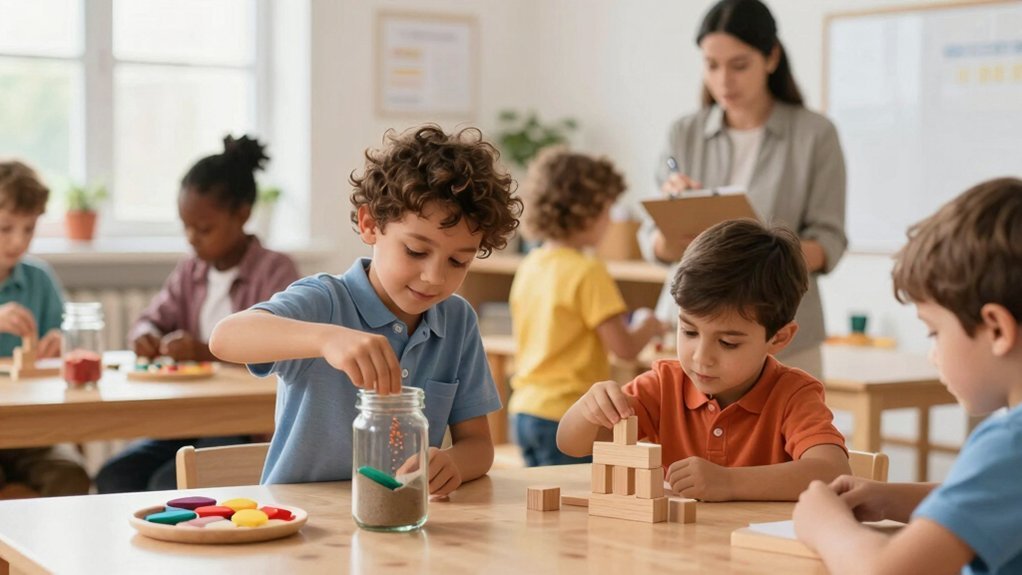
You can transform your Montessori classroom by mastering seven observation techniques. Start with daily logs every 15 minutes, then watch without judgment using neutral, fact-based recording. You’ll read the room indirectly while remaining objectively tuned in, leaving your biases aside to capture true behaviors. Go deeper with contemplative practice, building running records that reveal the whole child across all developmental domains. Finally, you’ll turn your observations into personalized lessons by identifying patterns and timing material introductions. The framework becomes clearer when you discover how these techniques interconnect.
Start With Daily Observation Logs
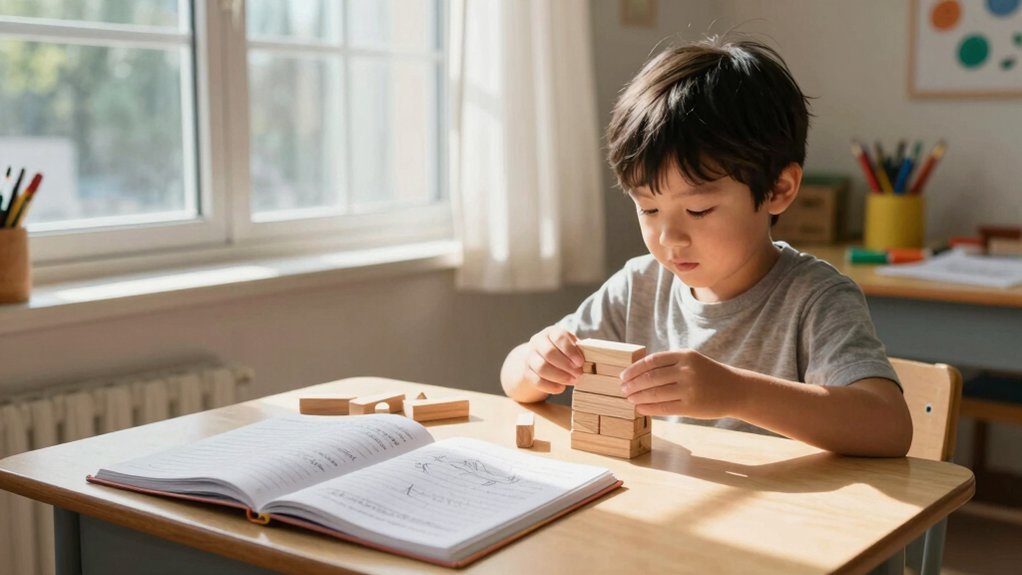
You’ll establish the foundation of Montessori observation by maintaining daily logs that capture each child’s activities, interactions, and developmental patterns throughout the work cycle.
Keep a clipboard in your classroom and record observations every 15 minutes, noting the duration and purpose of each activity. Document how many children participate, the adult’s role, and individual concentration levels.
Use either handwritten notes or digital assessment platforms to track work attitudes, discipline, and obedience. Review these logs weekly with co-teachers to identify data gaps and emerging patterns.
Your daily observations inform formative assessments that guide your next lesson planning. Over time, these logs reveal which activities children enjoy and which they avoid, enabling you to create meaningful learning experiences tailored to each child’s natural development. Maintain humility and openness when reviewing your records, remaining willing to admit when initial interpretations require refinement as you gather additional observational data.
Watch Without Judgment: Master Direct Observation
You’ll adopt the scientific observer approach by setting aside personal expectations and recording only what you actually see unfold before you. As you master direct observation, you’ll recognize behavioral patterns objectively—distinguishing between a child’s genuine needs and your interpretations of their actions. This systematic method transforms you into a neutral documenter of reality, revealing the child’s true developmental trajectory. Cultivating a quiet, bias-free mindset enables you to remain fully present, both mentally and physically, allowing the child’s authentic behaviors and capabilities to emerge without the filter of your own assumptions or judgments.
The Scientific Observer Approach
When you observe a child without the filter of judgment, you’re engaging in an art form that Maria Montessori herself spent years perfecting—one that requires active attention rather than passive watching. You’ll detach from emotions and biases, resisting the urge to name, categorize, or interpret in the moment.
Instead, you ground yourself in respect and awareness, maintaining a silent mind free of distractions. You focus solely on facts: specific actions and words, nothing more. This scientific approach demands meticulous detailing over extended periods until you become nearly invisible to the child. Through careful observation of patterns, you develop attention to detail that reveals how children naturally progress through developmental stages.
Your written records capture these objective observations, which you later reflect upon to reveal developmental needs, strengths, and interests—the foundation for supporting natural growth.
Recognizing Behavioral Patterns Objectively
The foundation of recognizing behavioral patterns rests on your ability to observe without filtering what you see through interpretation or expectation. You’ll record only what the child actually does—their actions, interactions, and reactions—without layering your assumptions onto their behavior.
Develop deep inner awareness to recognize when judgment creeps in. When you notice yourself jumping to conclusions, pause and refocus on observable facts. A child repeatedly choosing puzzles tells you about their cognitive preference; labeling them “smart” clouds that objective observation. Daily observation forms the basis for understanding each child’s true developmental patterns.
Use fresh eyes by stepping back from constant intervention. This distance lets you see patterns you’d otherwise miss. Watch their social interactions with peers, track emotional cues, and monitor language development. You’re understanding the child, not evaluating them.
Read the Room: Indirect Observation Explained
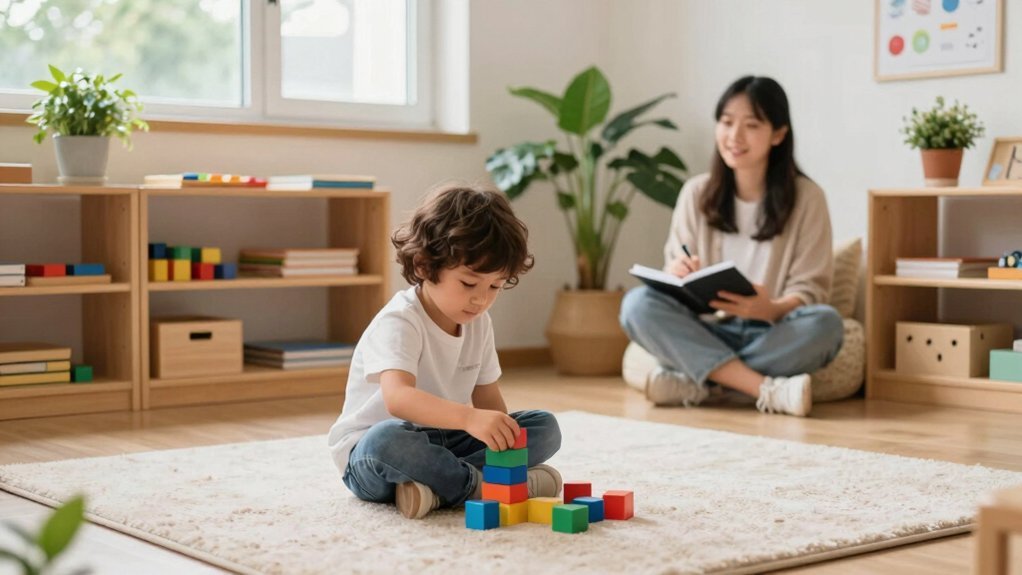
When you’re actively engaged with children, you’ll notice how classroom atmosphere shifts with group dynamics, revealing which activities capture their attention most. You can spot sensitive periods emerging through their sustained focus and repeated choices, while simultaneously observing how peers influence each other’s learning and behavior. By maintaining this dual awareness—participating while you’re genuinely tuned in—you’ll decode the room’s natural rhythms and understand what your students truly need. Unlike direct observation, indirect observation requires you to remain objective about personal biases while actively engaging, making it a more challenging but equally valuable method for gathering insights into the child’s authentic behavior and preferences.
Scanning Classroom Atmosphere Dynamics
How do you truly understand what’s happening in your classroom without constant direct intervention? You master the art of scanning—alternating between wide-angled views of your entire space and focused observations of individual students.
Listen carefully to noise levels rising and falling, identifying their sources. You’ll notice which groups generate activity and distinguish meaningful work from mere movement. This dual awareness reveals the classroom’s emotional landscape. When you separate objective observation from your personal reactions and assumptions, you gain clarity about what is actually occurring rather than what you expect to see.
Develop your scanning skills by monitoring these dynamics:
- Child engagement levels across interconnected, unique tasks
- Material usage patterns and shelf accessibility
- Independence displayed versus peer support needed
- Spontaneous, concentrated work indicating normalization
You’ll strengthen your connection with students while gathering crucial data for environmental adjustments and individual progress tracking.
Detecting Sensitive Period Interests
Observation becomes your most powerful tool when you’re watching for sensitive periods—those fleeting windows when children possess an almost magnetic draw toward specific skills or knowledge. You’ll recognize these phases through unmistakable signs: intense focus, repetitive engagement, and emotional responses when interrupted. A child absorbed in sorting objects or practicing sounds demonstrates heightened developmental readiness.
To detect these interests effectively, position yourself nearby without intervening. Record observable behaviors objectively, noting patterns in their play and exploration. Use photos to document repeated tasks you might otherwise miss. Watch for sensory cravings—touching textures, listening intently to sounds, or manipulating small objects compulsively. The five main sensitive periods—Order, Language, Sensory Skills, Movement, and Social Skills—each reveal distinct behavioral markers that signal when children are developmentally primed for specific learning.
These cues guide your next steps. When you identify a sensitive period, introduce matching materials that support their natural inclination, whether Sound Cylinders for auditory development or Sandpaper Letters for language exploration.
Observing Peer Modeling Patterns
A younger child watches intently as her older classmate traces Sandpaper Letters, absorbing not just the letter formation but the deliberate hand movements, the focused posture, the quiet concentration that makes mastery visible.
You’re witnessing peer modeling in action. In multi-age classrooms, younger children naturally learn by observing older peers and “eavesdropping” on advanced lessons. Teachers deliberately present lessons so interested younger children can watch, listen, and internalize knowledge without direct instruction.
Key patterns you’ll observe:
- Younger children spontaneously engage in imitative activities, playing “school” and repeating peer behaviors
- Three-year age groupings expose children to both older and younger peers simultaneously
- Direct peer instruction combines with indirect observation for comprehensive learning
- Every child becomes both learner and teacher, developing leadership through natural opportunities
- Observational learning accelerates development as younger students internalize the behaviors and problem-solving strategies they witness daily
This dynamic creates powerful, sustained engagement through authentic modeling.
Leave Your Bias at the Door: Objective Observation Techniques

When you observe a child in a Montessori environment, you’re engaging in a scientific process that demands you set aside your emotions, preconceptions, and personal preferences. You’ll eliminate labels and judgments, recording only what you actually see—not what you expect to see.
| What You Might Think | What You Should Record |
|---|---|
| “She’s shy” | “She watched peers for 8 minutes before joining” |
| “He’s difficult” | “He repeated the task 12 times, adjusting grip” |
| “They’re not ready” | “They explored materials independently for 20 minutes” |
| “She’s advanced” | “She counted to 15 spontaneously during snack” |
Develop inner awareness to truly look rather than merely see. Resist rushing to conclusions. Maintain curiosity and acceptance, viewing each child with fresh eyes. Your honest observations reveal authentic development patterns, informing meaningful individualized support. Documentation of these neutral, objective records allows adults to shape guidance and environmental preparation based on what children actually demonstrate rather than adult assumptions.
Go Deeper: Contemplative Observation for Montessori Teachers
Once you’ve mastered the discipline of objective observation—recording only what you see without judgment—you’re ready to move beyond the surface. Contemplative observation invites you into deeper work, requiring you to quiet your mind and approach each child as if meeting them for the first time.
This practice demands:
- A meditative state: Release preconceived notions and mental chatter to achieve full presence
- Extended focus: Dedicate 20+ uninterrupted minutes observing one child across all dimensions simultaneously
- Wonder and patience: Look beyond obvious behaviors to discover the child’s hidden gifts and inner life
- Spiritual grounding: Ground your observation in compassion, respect, and genuine interest
When you observe contemplatively, you’re not just discovering the child’s secrets—you’re transforming yourself through this sacred practice. This contemplative work is closely aligned with Montessori philosophy, as it aims to observe the inner life and life acts of the child beyond measurable behaviors alone.
Build Running Records That Show the Whole Child

Your running record—a sequential documentation of a child’s behaviors across all developmental domains—becomes the cornerstone of authentic assessment in Montessori environments. You’ll capture literacy skills alongside physical, emotional, and social progress, revealing how these elements interconnect during daily work cycles.
Record objective observations without judgment: note repetition counts, movement patterns, and language use. You’re building a comprehensive portrait that moves beyond academic metrics alone. Include fine and gross motor development, practical life competencies, and peer interactions alongside reading miscues. Consult with the child’s teacher to understand observations and assessments and ensure your running records align with school-based documentation.
Conduct observations regularly—every 1-2 weeks for struggling learners, every 3-4 weeks for emerging or proficient children. Write during sessions to maintain accuracy and create reliable documentation. You’ll use this data to guide instruction, individualize work assignments, and share meaningful progress narratives with families.
Turn Observations Into Personalized Lesson Plans
The running records you’ve built become the raw material for designing lessons that actually match each child’s learning trajectory. Your observations reveal sensitive periods and readiness levels that guide intentional instruction.
Transform your data into action by:
Transform observation data into purposeful lessons by identifying patterns, timing introductions strategically, and adjusting pacing based on demonstrated readiness and interest.
- Identifying patterns in what captures each child’s attention and where they struggle
- Timing introductions of new materials when observations show genuine readiness, not arbitrary schedules
- Planning small-group lessons using hands-on Montessori materials tailored to specific needs you’ve documented
- Adjusting pacing based on how quickly children master concepts during independent work
You’ll present lessons after children’ve explored freely, building on their demonstrated interests. Document your observation look-fors systematically to capture concrete evidence of each child’s developmental progress and readiness markers. This approach ensures every lesson serves a real purpose grounded in actual child development rather than generic curriculum sequences.
Frequently Asked Questions
How Often Should I Update Observation Logs to Maintain Accurate Child Development Records?
You should update observation logs daily, consolidating them weekly and reviewing monthly. This cadence helps you capture patterns, track development accurately, and tailor your environment to each child’s needs effectively.
What Specific Tools and Materials Work Best for Recording Running Records Efficiently?
You’ll record running records efficiently using digital platforms like Transparent Classroom or Brightwheel, which auto-save observations with photos. Alternatively, you’ll maintain simple paper grids or lesson tracking sheets organized by child for quick daily logging.
How Can I Balance Observation Time With Actual Teaching Responsibilities and Classroom Management?
You’ll balance observation with teaching by stepping back periodically while your prepared environment and multi-age peers handle routines. Schedule dedicated observation times separate from direct instruction, and record brief notes during natural classroom moments without interrupting children’s work.
What Are Red Flags in Observations That Require Immediate Intervention or Parent Communication?
You’ll intervene immediately when you observe safety threats, destructive behavior, or physical aggression. You’ll communicate with parents about persistent developmental delays, social difficulties, or concerning behavioral patterns you’re documenting through focused observation.
How Do I Transition Observations Into Concrete, Measurable Learning Objectives for Individual Children?
You’ll translate observations into measurable objectives by documenting specific behaviors you’ve witnessed, identifying skill gaps, and establishing clear, child-centered goals that reflect their demonstrated interests and developmental readiness.
In Summary
You’ve learned how to observe children authentically, setting aside your biases while capturing their true development. By maintaining daily logs and running records, you’re building a thorough picture of each child’s growth. You’re transforming these observations into meaningful, personalized learning experiences that honor their natural pace and interests. This commitment to mindful observation becomes the foundation for genuine, responsive Montessori practice.


Leave a Reply