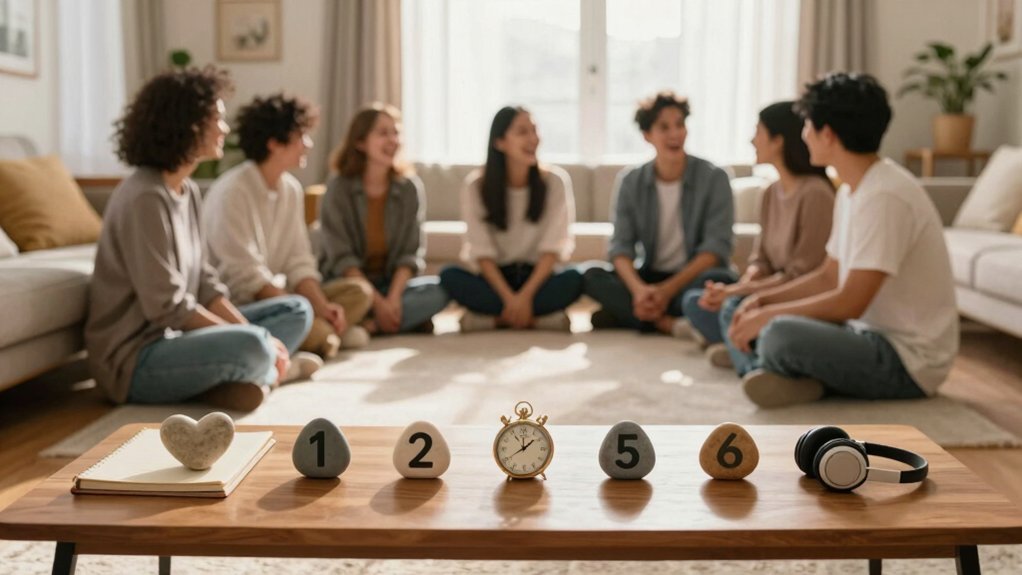

When you teach peace education at home, you give everyone tools to name feelings, listen actively, and respond non‑judgmentally, which cuts down misunderstandings and calm emotional spikes. Structured “peace tables” turn heated moments into brief, collaborative problem‑solving sessions, while daily grace and courtesy routines reinforce respectful communication before conflicts arise. Role‑plays build empathy and negotiation skills, and family journaling tracks progress, turning disagreements into learning opportunities. Keep exploring these habits to see deeper results.
Teach Foundational Peace Principles at Home
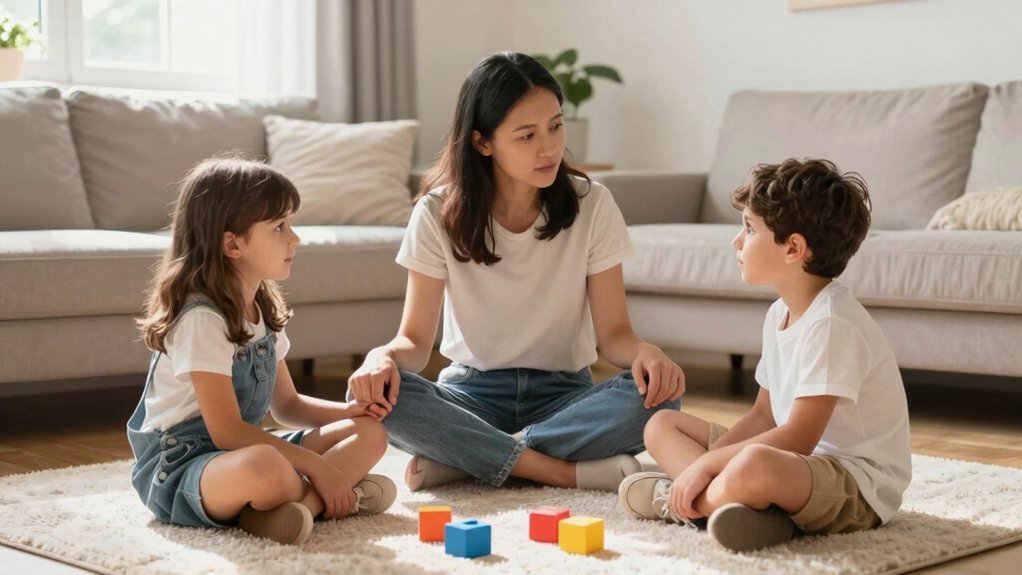
Can you imagine a home where peace isn’t just a lesson at school but a lived habit? You start by modeling self‑respect and teaching emotional intelligence, so each family member learns to name feelings and listen actively. When tensions rise, you gather for restorative circles, giving everyone a safe space to share perspectives and practice non‑violent communication. These circles reinforce family resilience by turning conflicts into collaborative problem‑solving moments. You embed consistent language—“I feel,” “I need”—into daily chatter, so children internalize respectful dialogue. Over time, the household becomes a training ground for justice, empathy, and social responsibility, reducing aggression and preparing kids to lead peaceful resolution beyond the front door. Incorporating age-appropriate safety standards into everyday routines supports a secure environment that nurtures emotional growth and peaceful interactions.
Start Daily “Grace & Courtesy” Routines to Prevent Escalation
Ever wonder how a simple daily habit can stop arguments before they spark? You can start a grace & courtesy routine that turns calm greeting into a conflict‑resolution tool. Each morning, greet every family member, make polite requests, and set a brief shared problem‑solving talk.
In the evening, repeat the pattern, reinforcing emotional regulation and listening skills. These home routines embed peace education’s proactive approach, giving kids predictable cues that lower escalation risk. By normalizing respectful exchange, you cultivate empathy and mutual respect, which research shows cuts aggressive behavior.
Over time, the family climate shifts toward constructive responses, turning potential disputes into opportunities for growth. Incorporating Montessori principles like safety, respect, and independence into daily life routines further supports peaceful conflict resolution.
Use Peace Tables for Real‑Time Conflict Resolution
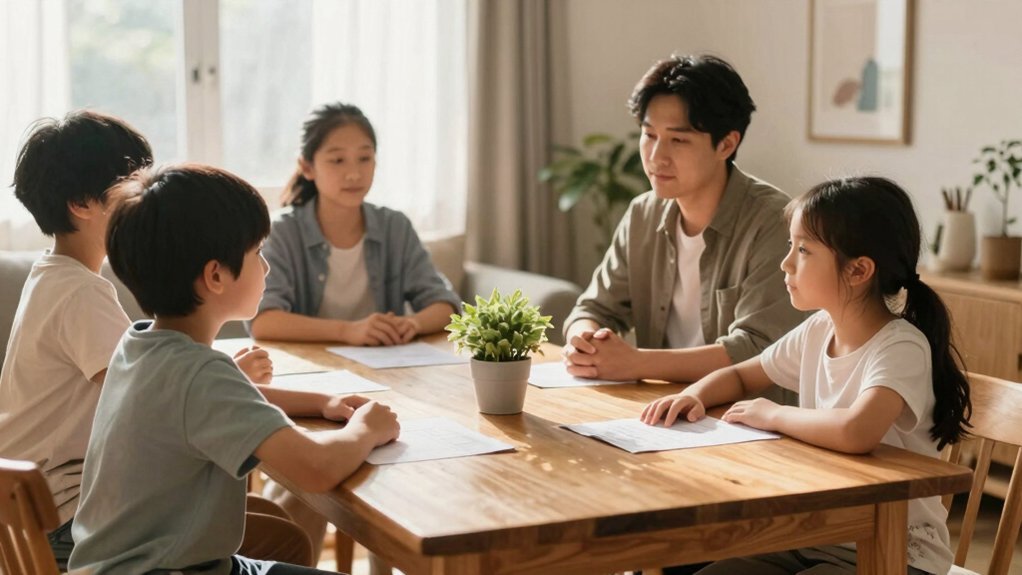
After establishing daily “Grace & Courtesy” habits, you can take the next step by introducing a peace table whenever tension spikes. A peace table creates a structured, real‑time space where each family member pauses, hears, and contributes to a shared solution. You chair the session, set clear ground rules, and limit the dialogue to a few minutes, ensuring active listening and nonviolent communication dominate the exchange. This restorative practice models calm conflict resolution, preventing escalation and fostering mutual respect. By using the table, you transform arguments into collaborative problem‑solving moments, which lowers recurring disputes and strengthens cohesion. The time‑bound process guarantees everyone feels heard, reinforcing the habit of peaceful, constructive dialogue at home.
Guide Role‑Play Scenarios That Build Empathy and Negotiation Skills
You can start by creating empathy‑building role‑plays that let each family member experience the other’s viewpoint, turning tension into understanding. Then design negotiation‑focused scenarios—like sharing chores or screen time—that require collaborative problem‑solving and non‑violent bargaining. Finally, debrief each session to highlight feelings, biases, and peaceful alternatives, reinforcing the skills for real‑world use.
Empathy‑Building Role‑Play
How can a simple role‑play turn everyday household tension into a practice of empathy? You start with an empathy‑building role‑play that mirrors a common home dispute—like a sibling arguing over screen time. Assign one child the “mediator” role and the other the “concerned party.” Use structured prompts: “What do you think the other feels?” and “What need lies behind that feeling?” As you guide them, they practice active listening, perspective‑taking, and emotional regulation. The peace education framework frames each exchange as a step toward conflict resolution, not a win‑lose battle. After the scene, encourage reflective journaling and a brief restorative dialogue. Repeating this process boosts empathy scores, reduces aggression, and equips families with a reusable, non‑violent toolkit. Integrating tools such as emotion flash cards can further support emotional identification during these activities.
Negotiation‑Focused Scenario Design
When you design a negotiation‑focused role‑play, start by picking a familiar household dispute—like bedtime routines, chore assignments, or privacy boundaries—and map it onto a three‑phase structure: define the problem, surface each person’s underlying needs, and co‑create a win‑win solution. You then script a short scenario that lets a child and a parent swap roles, prompting perspective‑taking and active listening. Throughout the negotiation, embed peace education language that names interests and encourages respectful dialogue. After the role‑play, lead a restorative practices debrief where participants summarize what they learned about communication, rights, and mutual respect. This concise scenario design turns everyday home conflict into a rehearsal for collaborative problem‑solving. Incorporating interactive features such as movable clock hands can similarly enhance hands-on learning and cooperative engagement during role-play exercises.
Start a Family Journaling Habit for Reflection
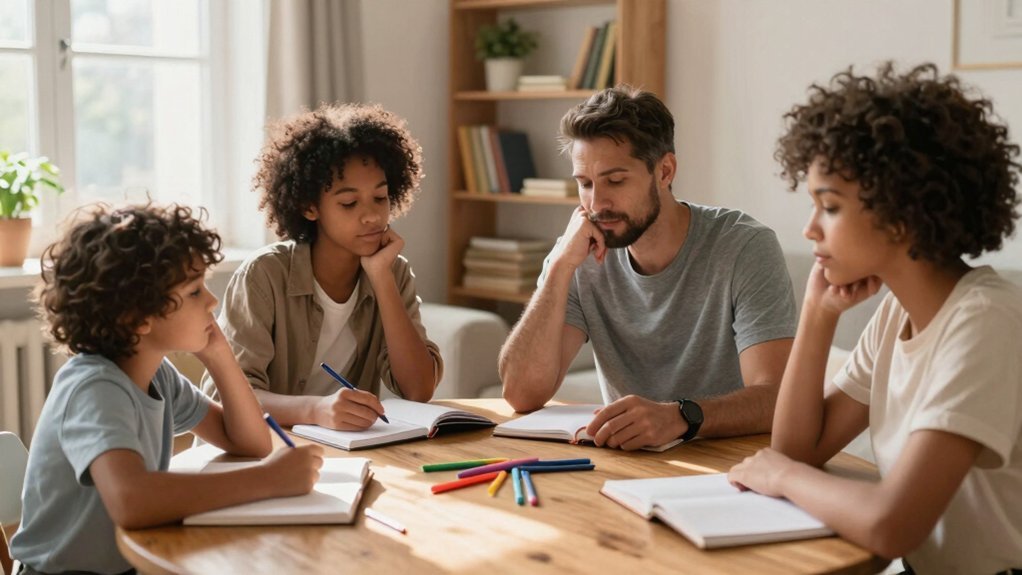
Often the simplest way to embed peace‑education principles at home is by establishing a family journaling habit. You’ll start each day with a brief session where every member writes about feelings, triggers, and any conflict resolution attempts. This reflection sharpens emotional regulation, so you respond instead of react.
As you read each other’s entries, you practice peaceful communication, noticing patterns and offering empathetic feedback. The journal becomes a concrete record, letting you track progress and spot recurring issues. Collaborative entries build trust, model constructive feedback, and reinforce non‑violent problem‑solving.
Over weeks, the habit turns abstract classroom lessons into lived family skills, making disagreements easier to navigate and relationships stronger. Complementing this practice with activities that enhance fine motor skills and spatial awareness can further support focus and emotional regulation in children.
Turn Family Disagreements Into Collaborative Learning
When a disagreement sparks, you can model active listening by echoing each other’s feelings before proposing solutions.
Invite everyone to co‑create a plan, turning the conflict into a shared decision‑making moment.
This collaborative approach reshapes tension into a learning experience for the whole family.
Active Listening Skills
How can you turn a heated family argument into a shared learning moment? Use active listening to create a calm home environment where every voice feels heard. When you fully attend, acknowledge feelings, and paraphrase, you cut misinterpretations and model nonjudgmental feedback. This habit strengthens emotional regulation and builds a foundation for lasting conflict resolution. Try a simple routine: one person speaks, others nod, then the listener repeats the core message before responding. The practice embeds empathy, reduces anxiety, and turns disputes into collaborative problem‑solving.
Research shows that maintaining a low center of gravity in physical environments, like organized home storage, can enhance a sense of stability that supports emotional calm during family interactions.
| Step | What to Do |
|---|---|
| 1 | Pause, maintain eye contact, and silence distractions |
| 2 | Reflect back the speaker’s feeling and content |
| 3 | Offer nonjudgmental feedback and ask clarifying questions |
Shared Decision‑Making
Shared decision‑making turns family disagreements into collaborative learning by letting parents and children co‑create solutions instead of imposing top‑down rules. You’ll notice that shared decision‑making, as a core of peace education, lets everyone voice concerns, explore options, and settle on a plan that respects each person’s needs. This approach balances power, nurtures mutual respect, and strengthens home conflict resolution. When you practice active listening and compromise together, you boost emotional regulation and empathy, turning heated moments into teachable opportunities.
Schools reinforce this by sending conversation starters and joint projects that echo classroom mediation. Over time, the collaborative habits you build at home ripple outward, shaping how children resolve conflicts in peer groups and the wider community.
Track Peace‑Education Success With Simple Home Indicators
Ever wondered how you can see peace‑education’s impact without a lab? You can track simple home indicators that reveal real change. Start by noting a 20‑30 % drop in parent‑child clashes after 8‑12 weeks of joint peace‑education activities and restorative practices. Keep a weekly reflection log; you’ll spot fewer emotional outbursts and more constructive problem‑solving, showing stronger emotional regulation.
Count peer‑mediated resolutions during family circles—each successful instance signals growing skill. Schedule brief parent‑teacher check‑ins to align peace‑language at school and home, boosting consistency across contexts. Add daily breathing exercises and reflective journaling; these boost family cohesion and perceived safety. Over time, these metrics give you clear, actionable proof that your peace‑education efforts are reshaping home conflict resolution.
Frequently Asked Questions
How Is Peace Education a Strategy for Conflict Resolution?
You use peace education as a conflict‑resolution strategy by learning active listening, nonviolent communication, and mediation techniques, then applying those skills to de‑escalate disagreements and foster collaborative solutions at home.
What Are the 5 C’s of Conflict Resolution?
You use the five C’s: cooling down, calm communication, consideration of others, cooperation toward a solution, and commitment to follow through, each guiding you toward healthier, lasting conflict resolution.
What Is the Significance of Conflict Transformation in the Study of Peace Building?
You’ll see conflict transformation reshapes peace‑building studies by turning disputes into learning opportunities, fostering equitable power relations, and embedding restorative practices that sustain long‑term harmony and social justice.
What Is the Main Goal of Peace Education as Transformative Education?
You aim to empower people, fostering empathy, critical thinking, and collaborative problem‑solving so they resolve disputes peacefully, nurture mutual respect, and build resilient, non‑violent communities.