
When you set up spacious zones, flexible seating, and clear pathways, you instantly raise attention and cut off‑task behavior. The room’s layout lets students move freely, which boosts oxygen flow, dopamine, and hippocampal activity—key drivers of memory. Kinesthetic gestures and movement‑aligned drawings reinforce concepts, lowering cognitive load and improving recall by up to 20 % for focused‑struggling learners. Keep exploring to discover how specific classroom designs and timed brain breaks can further amplify these gains.
Understand How Movement Improves Learning
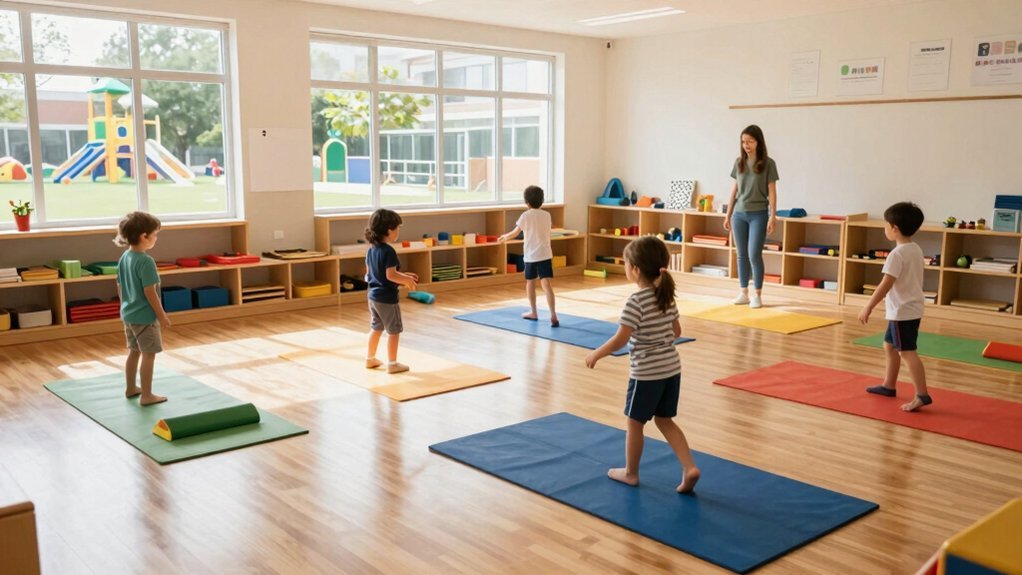
Why does moving your body help you learn? You boost movement while studying, and your brain gets more oxygen and blood flow, flooding it with dopamine, norepinephrine, and serotonin. Those chemicals sharpen focus, lift mood, and boost memory.
Movement fuels learning by boosting oxygen, blood flow, and dopamine, sharpening focus, mood, and memory.
Short breaks—just ten minutes of light activity—reset attention, lower stress, and improve retention, even in demanding college courses.
Embodiment ties gestures and actions to concepts, engaging multiple brain regions and strengthening problem‑solving pathways. When you gesture while explaining, you reveal how well you understand, letting teachers adjust instruction instantly.
This synergy of movement, breaks, and embodied practice translates into higher working‑memory scores, fluid intelligence, and creativity, turning ordinary learning into a dynamic, high‑performance experience.
Using tools designed for safety and durability, such as child-safe stainless steel whisks, can also encourage hands‑on movement and enhance motor skills in young learners.
Discover the Science Behind Movement‑Based Memory Boosts
What happens in your brain when you move while learning? You boost oxygen, blood flow, and brain stimulation, especially in the hippocampus, so memory sharpens. Dopamine, norepinephrine, and serotonin surge, sharpening attention and mood. Gestures act as embodied cognition cues, encoding concepts physically and revealing understanding. Regular movement breaks cut off‑task behavior by roughly 8 % and lift focus for attention‑challenged learners by about 20 %. Using toys like wooden rainbow stackers helps develop fine motor skills and coordinated movement, reinforcing these cognitive benefits.
| Effect | Mechanism | |
|---|---|---|
| Enhanced memory | Hippocampal blood flow | |
| Better attention | Neurotransmitter release | |
| Faster brain stimulation | Increased oxygenation | |
| Stronger encoding | Sensorimotor integration | |
| Reduced off‑task behavior | Brief movement bursts | By linking Movement to memory through these pathways, you turn learning into an active, embodied experience that sticks. |
Plan Effective Active Brain Breaks for Movement‑Based Learning

Ever wondered how a quick, 2‑minute stretch can reset your brain’s focus? You can plan active brain breaks that fit movement‑based learning by timing them after dense content. Choose age‑appropriate moves—wiggle breaks for younger kids, whole‑body stretches for older ones—so distractions stay low. Align each break with cognitive load: a brief stretch or a shared rhythm activity clears mental clutter and primes memory encoding. Embed social gestures to boost classroom engagement without derailing instructional design. After each session, note on‑task behavior and immediate recall; this data lets you fine‑tune routines. By keeping breaks short, frequent, and purposeful, you sustain attention, spark creativity, and keep learning momentum high. Incorporating play environments designed to promote independence and social interaction can further enhance these active learning breaks.
Apply Movement Strategies to Math for Deeper Understanding
After a quick stretch, you can channel that refreshed focus straight into math by pairing concepts with purposeful movement. You might line up desks to form a giant number line, letting students step forward for each addition or backward for subtraction, turning abstract symbols into kinesthetic strategies. In a classroom design that includes chalk‑grid floors, learners hop between “rise” and “run” zones to visualize slope, while gesture‑based tangents reinforce geometry. Short, frequent movement breaks—ten minutes of standing or gentle shuffling—reset attention and boost retention, as research shows a 6 % mastery lift and a 16 % motivation surge among Copenhagen elementary pupils. By embedding whole‑body tasks, you activate multiple brain regions, sharpen procedural memory, and sustain student engagement without sacrificing instructional time. Incorporating a Montessori step stool can further encourage independence and active participation in learning environments.
Use Body Experiments to Teach Science Concepts
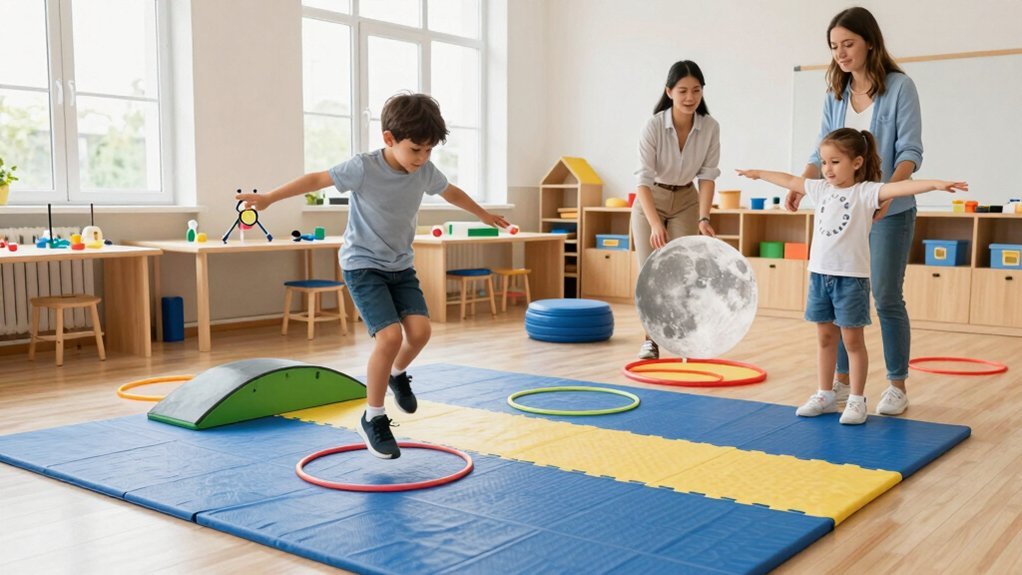
You’ll see how modeling solids, liquids, and gases with your body makes abstract matter concepts tangible.
By exaggerating arm waves or gestures, you’ll demonstrate energy transfer and let students feel the difference between low‑ and high‑energy states.
These kinesthetic cues boost retention and give you immediate insight into each learner’s grasp of the science.
Incorporating auditory materials like wooden sound cylinders can further enhance sensory learning and aid in concept reinforcement.
Body Modeling of Matter
When you turn your body into a model of matter, you instantly make abstract particle behavior concrete. In a “Becoming a Liquid” drill, you stretch, sway, and flow together, turning movement into a visual of diffusion and viscosity. By arranging classmates in tight clusters for solids, loose circles for liquids, and scattered bursts for gases, you demonstrate particle arrangement, compressibility, and shape retention. Physical activity anchors matter concepts, so learners feel rather and volume rather than just hearing definitions.
The kinetic gestures boost learning retention, turning fleeting explanations into durable mental models. Formative assessments show higher scores after these body‑modeling sessions, confirming that embodied practice creates transferable understanding of states of matter.
Energy Transfer Gestures
How can a simple arm wave make the invisible flow of energy tangible? You’ll notice that energy transfer gestures turn abstract rates into visible motion. When you amplify the wave, you signal a higher transfer rate, letting kinesthetic demonstrations anchor conduction, convection, and radiation in the body. In “Becoming a Liquid” drills, your gestures align with verbal explanations, strengthening embodied cognition. Misaligned movements flag partial grasp, so you can intervene instantly. Short, body‑based demos keep the classroom dynamic and make abstract concepts concrete. Utilizing tools designed with safety features and design principles can enhance hands-on learning experiences and encourage creativity in movement-based lessons.
| Gesture | Concept |
|---|---|
| Small wave | Low energy transfer |
| Large wave | High energy transfer |
| Circular sweep | Convection flow |
| Rapid tap | Radiation burst |
Combine Drama and Role‑Play for Movement‑Based Language Arts
Ever wondered why a simple skit can make a vocabulary list stick? You’ll see that movement‑based learning thrives when drama and role‑play intersect with language arts. By acting out definitions, you turn abstract words into concrete actions, boosting memory retention up to 73 %. When students embody historical figures or literary characters, they synchronize speech with gestures, deepening comprehension and listening rhythm. You can stage quick role‑play rounds where each student portrays a term’s meaning, then swaps roles to reinforce connections. The kinetic component anchors semantics, while the narrative context supplies cues for later recall. This blend of drama, role‑play, and purposeful movement creates a durable, transferable grasp of language content. Using carefully tuned instruments with note accuracy and tuning enhances auditory discrimination skills simultaneously.
Pair Drawing With Kinesthetic Activities to Reduce Cognitive Load
When you pair drawing with movement, you turn abstract ideas into concrete, gesture‑linked sketches that lighten cognitive load. This multisensory integration lets you encode and retrieve information more effectively than passive listening alone. By physically drawing while acting out concepts, you reinforce understanding and boost retention for future problem‑solving.
Kinesthetic Sketching Reduces Load
Pairing drawing with kinesthetic activities cuts cognitive load by spreading processing across visual and motor pathways, which eases extraneous strain. You’ll notice that kinesthetic sketching lets you encode concepts through multimodal encoding, so your brain stores both image and motion together. In prepared environments, the low‑distraction setup lets you focus on the movement‑based learning task without competing stimuli. The result is a smoother flow of ideas and a lighter cognitive load, letting you retain more while expending less mental effort.
- Sketch a quick diagram while tapping your fingers in rhythm with each label.
- Draw a concept map while swaying side‑to‑side, matching each branch to a step.
- Outline a process flow while mimicking the actions described, linking gestures to symbols.
Multisensory Integration Enhances Retention
Building on the reduced cognitive load from kinesthetic sketching, you’ll find that pairing drawing with movement creates a multisensory experience that locks information in both visual and motor memory. When you integrate drawing with kinesthetic activities, you engage visual, motor, and semantic networks simultaneously, strengthening memory traces. This multisensory integration means each concept is encoded twice—once as a sketch, once as a gesture—boosting retention without extra effort. You can have students act out a process while sketching key steps, turning abstract ideas into concrete images and motions. The result is deeper processing, faster recall, and smoother transfer to new problems, all while keeping the classroom dynamic and focused on movement‑based learning.
Physical Drawing Reinforces Concepts
A sketch on paper becomes a bridge to the body when you pair it with a kinesthetic activity, letting visual and motor pathways reinforce each other and lower cognitive load. By integrating physical drawing into movement‑based learning, you create a multi‑channel encoding system that ties symbols to actions. This kinesthetic learning approach frees working memory, because the brain stores the concept both visually and physically. When you doodle relevant shapes while stepping, stretching, or manipulating objects, you reinforce the idea and cut unnecessary cognitive load. Misaligned gestures, however, signal gaps, so keep the drawing and movement tightly linked.
- Draw a diagram while walking a set path, feeling each step align with a component.
- Sketch a process flow while passing a ball, using the throw to mark transitions.
- Trace a map on paper while rotating a chair, matching turns to directional arrows.
Balance Multitasking & Fidgeting: Classroom Accommodations
Can you keep students focused while letting them move? You can, by designing movement‑friendly classroom accommodations that let light fidgeting and flexible seating coexist with clear focus goals. Offer low‑distraction movement breaks every 20‑30 minutes; they channel excess energy without derailing content.
When you notice a student’s gestures, read them as cognitive cues and adjust instruction, not as mere disruption. Calibrate the amount of fidgeting—allow a fidget toy or a footrest, but avoid loud or sprawling activities that interfere with semantic processing. Pair brief, purposeful movement with concise objectives, so learners stay on task while their bodies stay engaged. This balance preserves memory retention and maximizes learning efficiency.
Create a Flexible Movement‑Friendly Classroom Layout
Some teachers start by mapping out zones that naturally flow into one another, so movement feels purposeful rather than chaotic. You’ll see a flexible environment where a shared standing area holds tablets, and roles rotate—navigator, clue‑tracker, builder—keeping students engaged in movement‑based learning while staying on task. Low‑distraction options like standing desks, wobble stools, and simple hand gestures let kids shift posture without losing focus. Arrange stations so transitions are seamless, and embed short brain breaks that feel like natural pauses, not extra time blocks. Using AR sandbox modes, you align physical space with concept scale, reducing spatial confusion and reinforcing understanding.
- Standing area with tablets for role rotation
- Low-distraction desks and stools for quick posture changes
- Integrated 3‑5 minute brain‑break stations throughout the room
Explore TimePod Adventures to Amplify Movement‑Based Learning
You’ll step into immersive narratives that turn your classroom into a 3‑D adventure zone, where every clue you chase forces you to move and look around.
The spatial problem‑solving tasks compel you to collaborate, think critically, and physically engage with the story.
With TimePod Adventures on iPad or iPhone, you get a ready‑to‑use, movement‑rich experience that deepens comprehension and memory.
Immersive Narrative Exploration
Ever wondered how a story can turn a classroom into a kinetic playground? You step into a TimePod adventure, become the protagonist, and let movement drive comprehension. The AR world wraps around you, so you walk, turn, and reach while clues unfold, turning passive listening into active learning. Your body becomes the compass for spatial navigation, and each gesture cements concepts, delivering true experiential education.
- Navigator role – you scan the room, mapping virtual landmarks to real‑world positions.
- Clue‑tracker role – you stride to hidden objects, linking physical steps to narrative hints.
- Builder role – you collaborate, arranging virtual pieces that reflect your collective movement.
Post‑session reflections let you articulate how walking revealed information, reinforcing memory and understanding.
Spatial Problem‑Solving Activities
Creativity sparks when students step into TimePod Adventures, turning a classroom into a 3‑D AR playground where every stride uncovers a clue. You guide learners through spatial problem‑solving activities that demand movement in classroom and real‑time decision making. By assigning rotating roles—navigator, clue‑tracker, builder—you amplify collaborative learning while each child manipulates virtual objects and charts physical pathways. The immersive education platform pushes them to test hypotheses, adjust angles, and communicate findings, turning abstract concepts into tangible challenges. As they sprint, duck, and pivot, movement‑based learning fuels higher‑order reasoning and reinforces spatial awareness. The result is a dynamic, shared‑space experience where every step deepens understanding and strengthens teamwork.
Build Concepts With Sandbox AR and Physical Interaction
How can you turn abstract ideas into tactile experiences? With Sandbox AR you let students walk into a virtual world on their iPad, grab 3‑D objects, and reshape concepts through physical interaction. The movement‑based learning cycle deepens understanding as learners become navigators, clue‑trackers, and builders, turning static lessons into dynamic, shared experiences that boost classroom engagement.
- Table‑scale mode – students stand in a circle, each holding a tablet, and move around a shared AR landscape that mirrors the classroom size.
- Life‑scale mode – the environment expands to life‑size objects, letting learners walk through a giant molecule or a scaled‑up ecosystem.
- Role rotation – one student guides, another records observations, a third modifies the scene, reinforcing concepts through collaboration and physical interaction.
Measure Impact and Scale Movement‑Based Learning Success
What if you could prove that every step your students take translates into measurable gains? You can start by logging steps, duration, and activity type during each lesson, then link those data points to pre‑ and post‑tests of working memory and fluid intelligence. Use quick surveys or classroom observation tools to capture on‑task behavior before and after brief brain breaks—10‑minute intervals are enough to show concentration spikes. Apply statistical effect measurement to compare test scores, retention rates, and off‑task reductions, which average 8% overall and 20% for focus‑challenged learners. By embedding movement across math, literacy, and science, you create a scalable education model where each activity becomes a data‑rich, repeatable unit for continuous impact tracking.
Reflect and Iterate: Continuous Improvement of Movement Practices
Ever wondered how a quick post‑activity debrief can turn fleeting gestures into lasting learning gains? You’ll notice that a brief reflection after each movement‑based learning session surfaces the gestures, routes, or AR cues that truly stick. By logging those insights, you feed an iterative design loop that sharpens classroom management and prevents semantic drift. Data‑informed adjustments—like rotating navigator roles or tweaking shared‑space layouts—keep energy high without overloading cognition. Over weeks, those notes become a playbook for scalable improvements across subjects.
- Capture standout gestures and student reactions on a shared board.
- Map observations to specific data points from formative assessments.
- Revise roles, space, and timing for the next cycle, then repeat.
Frequently Asked Questions
How Can Movement‑Based Learning Support Students With Sensory Processing Challenges?
You can help students with sensory processing challenges by integrating gentle, structured movements that calm nervous systems, offering tactile tools, and allowing flexible pacing, which boosts focus, engagement, and learning retention.
What Budget‑Friendly Materials Create Effective Movement Zones in Small Classrooms?
You can use cheap yoga mats, foam cushions, floor‑tape pathways, cardboard balance beams, bean‑bags, and portable bins. These items define zones, encourage movement, and fit easily into tight classroom spaces.
How Do I Train Teachers to Monitor Safety During Spontaneous Movement Activities?
You train teachers by modeling safety checks, role‑playing scenarios, giving quick‑reference checklists, and holding debriefs after each spontaneous activity, reinforcing vigilance and immediate corrective actions.
Can Movement Strategies Be Adapted for Virtual or Hybrid Learning Environments?
You can adapt movement strategies for virtual or hybrid settings by using short, guided videos, interactive breakout activities, and real‑time feedback tools, ensuring learners stay engaged, safe, and physically active throughout sessions.
What Are the Legal Considerations for Incorporating Movement Equipment in Schools?
You must check liability insurance, guarantee equipment meets safety standards, obtain parental consent, comply with ADA accessibility rules, verify local building codes, and follow district procurement policies before installing movement gear.




Leave a Reply