
You’ll love the Pink Tower, Brown Stair, Red Rods, Knobbed Cylinders, and Geometric Cabinet for three‑period lessons because each sparks visual, tactile, and spatial discrimination. Warm‑up prompts you predict the next block or rod, the main phase lets you compare sizes, patterns, or shapes, and cool‑down encourages you to describe textures or colors. These five materials scale from preschool to early elementary, and rotating them weekly keeps curiosity high while you track observations and safety checks for deeper mastery.
Best Sensory Materials for Three‑Period Lessons: Top 5 Montessori Picks
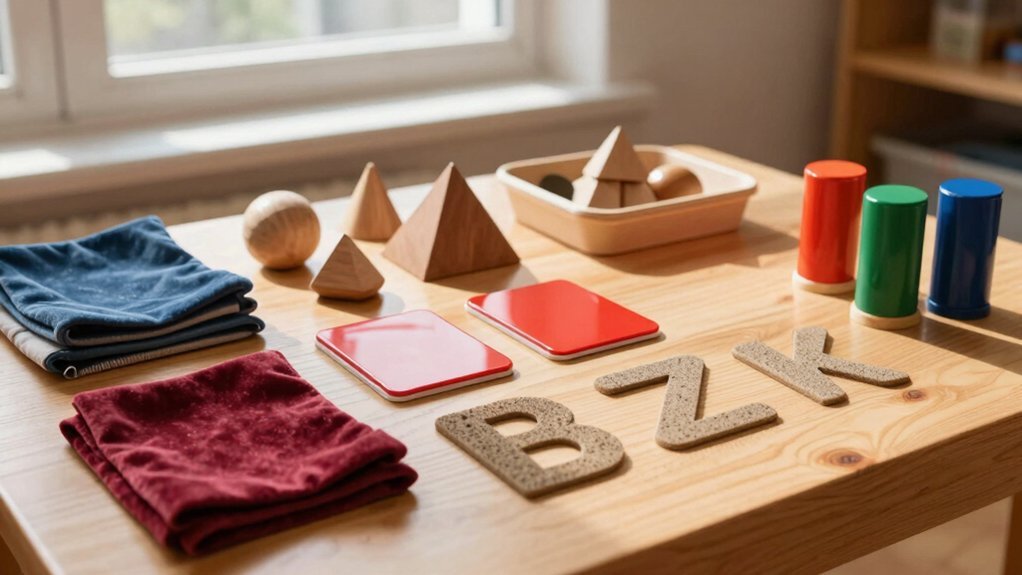
The Pink Tower, Brown Stair, Red Rods, Knobbed Cylinders, and Knobless Cylinders are the five Montessori materials that most effectively support three‑period lessons, each sharpening a child’s visual and tactile discrimination of size, dimension, and pattern.
You’ll notice that these sensory materials invite hands‑on discovery while you guide a child through naming, matching, and recalling attributes.
The Pink Tower’s ten cubes teach three‑dimensional scaling; the Brown Stair and Red Rods reinforce length and unit measurement.
Knobbed Cylinders develop fine‑motor strength as kids fit varying widths, while Knobless Cylinders challenge pattern recognition without slots.
Knobbed Cylinders sharpen fine‑motor strength; Knobless Cylinders hone pattern recognition without slots.
Adding a geometric cabinet and geometry blocks expands shape awareness, turning sensory play activities into a solid foundation for later geometry.
For enhanced learning independence, consider integrating tools like the Kitchen Step Stool for Kids with Safety Rail, which promotes safe access and Montessori principles in practical home settings.
How to Align Each Material With Warm‑Up, Main, and Cool‑Down Phases
Where can you best weave a three‑period lesson into a seamless flow? Start with a warm‑up activity that sparks visual discrimination—show the Pink Tower and ask learners to predict which block fits next. Then move to the main phase, letting them manipulate the Knobbed Cylinders or Geometric Cabinet to compare sizes and patterns, deepening tactile discrimination and multi‑sensory analysis. Finish with a cool‑down reflection: have children describe the texture of Color Tablets, reinforcing vocabulary and abstract reasoning. Apply this structure to each sensory material, ensuring the warm‑up primes attention, the main phase builds concrete skills, and the cool‑down consolidates understanding. This rhythm supports early childhood education and maximizes learning impact. Additionally, incorporating tools made from sustainable bamboo enhances engagement through eco-friendly materials.
Adapt the Best Materials for Different Ages and Skill Levels

After priming learners with a warm‑up, main, and cool‑down rhythm, you can tailor each sensory material to the developmental stage of your class. For preschoolers, the Pink Tower and Knobbed Cylinders give concrete size and dimension discrimination, supporting age‑appropriate differentiation through tactile feedback. As children grow, replace knobbed with knobless cylinders to increase self‑correction and pattern‑detection challenges. The Geometric Cabinet introduces shape vocabulary; older students can extend it with Geometry Blocks, Constructive Triangles, and Practical Geometry tasks that bridge to early algebraic concepts. Use the same set across skill levels by varying the number of pieces, the complexity of the pattern, and the abstraction of the question, ensuring each student experiences a meaningful, progressive sensory lesson. Incorporating natural wood materials in sensory tools enhances tactile engagement and supports safe, multisensory exploration.
Maintain a Rotation Schedule to Keep Materials Fresh
Why let sensory materials become stale when a simple rotation schedule can keep each Three Period Lesson fresh and engaging? You’ll set a sensory rotation that aligns with your cycle schedule, swapping out at least one visual, tactile, and auditory item each week. Use observation notes to decide which sensory bin contents to retire and which new pieces to add, ensuring age‑appropriate variety and safety monitoring. Record every change in a rotation log, noting dates, outcomes, and any hazards. This systematic materials refresh preserves novelty, supports the introduce‑recognize‑apply flow, and keeps kids eager to explore. Incorporating tools with ergonomic handles can further enhance children’s tactile experiences and safety during sensory activities.
| Period | Focus | Example Swap |
|---|---|---|
| Introduce | New stimulus | Replace plain sand with scented rice |
| Recognize | Compare | Add textured fabric alongside smooth beads |
| Apply | Integrate | Swap single‑tone chimes for multi‑tone set |
| Review | Reflect | Log child comments and safety checks |
Quick‑Start Set‑Ups for Every Lesson Period
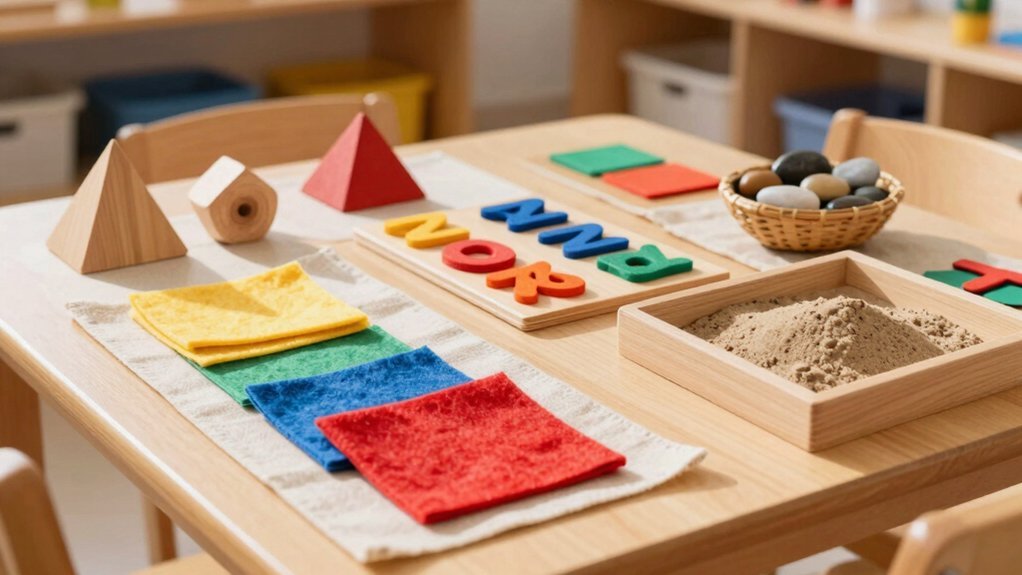
Ever wondered how to launch each Three Period Lesson without missing a beat? You’ll start with a quick‑start presentation of the sensory materials, then run a control of error check, and finish with guided comparison. Use Montessori sensorial items—knobbed cylinders, brown stairs, red rods, geometric cabinets—to move from concrete to abstract. Set out labeling trays labeled “Size,” “Weight,” and “Color,” each holding exact‑control pieces. In the first period, isolate one dimension, name it, and let students explore independently. In the second, repeat the isolation, emphasize the control of error, and prompt a brief naming exercise. The third period calls for a final guided comparison, reinforcing perceptual distinctions and encouraging independent exploration. Incorporating tools with Montessori-inspired learning encourages safe, hands-on experiences that enhance skill development during these lessons.
Frequently Asked Questions
What Materials Are Best for Sensory Play?
You’ll love mixing dry beans, lentils, rice, and colorful pasta with wet shaving cream, water beads, kinetic sand, and oobleck; add scoops, funnels, ribbons, and leaves for varied texture and visual cues.
What Is the 20 Toy Rule for Kids?
You limit a child’s selection to about twenty toys, rotating them regularly. This keeps the set manageable, encourages focused play, and lets you observe which items foster independent concentration and learning.
What Are the 7 Sensory Needs?
You need visual, tactile, auditory, olfactory, gustatory, vestibular, and proprioceptive experiences. Each modality supports specific perception and movement skills, so you should provide activities that engage all seven to foster balanced development.
What Are the 6 Sensitive Periods in Montessori?
You’ll recognize six sensitive periods: language, order, movement, refinement of the senses, social manners, and mathematical mind—each emerging at a specific developmental window where children naturally absorb those skills.