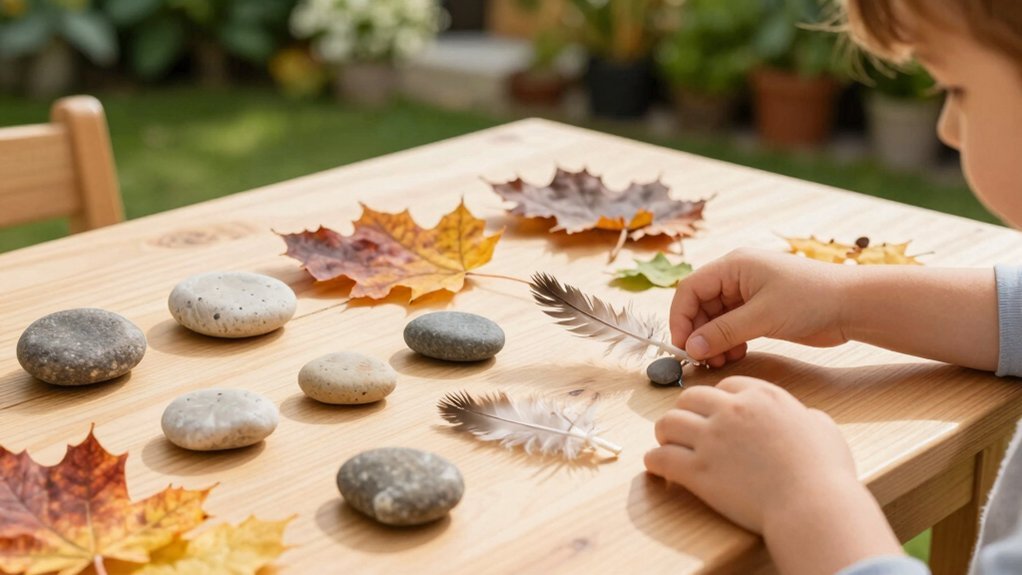
You’ll foster independent learning by organizing natural loose parts—rocks, sticks, shells, and branches—in clear, low containers arranged by texture. Display 8-10 items at eye level so your child can self-select materials without asking permission. Pair these items with simple tools like magnifiers and tweezers to deepen exploration. Rotate your collection monthly to sustain curiosity and skill development. This setup builds autonomy, problem-solving, and confidence through hands-on discovery. Understanding how to maximize these materials opens doors to deeper engagement.
Start With Loose Parts: the Foundation of Open-Ended Play

Loose parts—ordinary, everyday materials like branches, crates, stones, and fabric scraps—form the cornerstone of open-ended play because they’re infinitely manipulable and offer no single “correct” outcome. You control how you combine, redesign, and repurpose these materials, creating unique structures and scenarios limited only by imagination.
Unlike toys with predetermined functions, loose parts invite divergent thinking. You might transform a crate into a boat, a fortress, or a shop—each iteration different. This flexibility stimulates neural networks, sharpens focus, and develops critical thinking skills. Materials like these also encourage reuse and recycling, extending their value beyond single-purpose use.
You’ll discover that these materials empower independence. You make decisions, test theories, and solve problems without external directions. This autonomy builds self-efficacy and confidence as you recognize your ideas matter and produce tangible results through your own effort and creativity.
Build Your Initial Collection: Rocks, Sticks, Shells, and More
Building your collection of natural materials doesn’t require buying anything—you’ll find rocks, sticks, shells, and more in your own backyard, local park, or neighborhood beach.
Natural materials for learning are free and waiting in your backyard, park, or local beach.
Start gathering these essentials:
- Rocks for counting, measurement, and sensory exploration across math and science stations
- Sticks to replace plastic blocks and enable outdoor construction play
- Shells that support complex, extended play through natural variety
- Pinecones functioning as informal measurement tools with intricate patterns for observation
- Additional items like acorns, leaves, seed pods, feathers, and bark for rotating seasonal collections
These materials connect children to their communities while minimizing environmental impact. Collecting locally transforms spontaneous playground discoveries into authentic learning experiences. Your rotating collections keep exploration fresh and spark genuine curiosity about natural relationships, patterns, and problem-solving possibilities. Natural materials replace commercially produced items to foster creativity and support future play value across learning environments.
Arrange by Feel: Rough, Smooth, Soft, and Hard

Once you’ve gathered your collection of natural materials, organizing them by tactile qualities opens up rich sensory learning opportunities. You can create four distinct categories: rough, smooth, soft, and hard.
To distinguish textures, run your fingertips laterally across surfaces to identify bumpy or prickly qualities. Apply pressure through poking and squeezing to reveal firmness levels. Rocks, pine cones, and tree bark exemplify rough textures, while polished stones and glass demonstrate smoothness. Feathers, foam, and fabric represent softness, and wooden items with ceramic dishes showcase hardness.
Arrange your sorted materials into separate bins or display boards. Pairing objects with descriptive language—”rough like pebbles” or “soft like feathers”—reinforces learning. This tactile organization develops sensory discrimination skills while encouraging independent exploration and classification practice.
Create Low Shelves for Easy Access
Why do children learn best when they can access materials independently? When you position shelves at eye level, you’re removing barriers between your child and learning. Low shelves transform passive observation into active engagement, allowing kids to make meaningful choices without waiting for adult help.
You’ll foster independence by creating accessible storage that matches your child’s height and capabilities. Here’s how to set up your shelves effectively:
- Position materials within arm’s reach of your standing child
- Use sturdy construction that supports cruising and movement
- Display 8-10 purposeful items to prevent overwhelm
- Arrange items front-facing for easy visibility
- Define spots with trays or baskets for organization
This setup builds confidence, responsibility, and self-motivation while keeping your learning space organized and inviting. Rotating materials regularly through your shelves keeps children engaged and prevents boredom as they master new skills.
Use Clear Containers So Kids Can See Everything

When you fill clear containers with natural materials, you’re inviting your kids to see exactly what’s available without opening anything first. That visibility sparks curiosity and encourages them to explore independently, knowing they don’t need permission or help to discover what catches their interest.
Organized materials in transparent storage remove barriers to engagement, letting children make their own choices and build confidence in their learning. Clear labeling and step-by-step instructions help guide independent work while maintaining the self-directed nature of exploration.
Transparent Containers Spark Curiosity
How do you build your child’s awareness of what they’re eating? Transparent containers offer a powerful solution by making food visibility central to independent learning.
When you use clear storage, you’re inviting your child to explore and discover:
- Visual inventory tracking helps them see what’s available without asking you
- Freshness observation teaches them to recognize when food’s condition changes
- Portion awareness develops naturally as they visually assess quantities before eating
- Mindful consumption emerges when snacking patterns become observable and intentional
- Storage mastery grows through understanding how containers preserve food quality
Your child engages more deeply with food choices when they can see everything at once. This transparency transforms passive eating into active learning, where curiosity drives discovery and independence flourishes through visual exploration of their food environment. Clear containers with airtight, leak-proof lids also help preserve freshness, teaching children that proper storage directly impacts the quality and longevity of their food choices.
Organized Materials Encourage Exploration
Beyond what your child can see lies another dimension of independence: what they can easily reach and use. When you organize materials in clear containers, you’re creating visual pathways that invite exploration without requiring adult prompts.
Your child spots the buttons in the nested boxes and naturally begins sorting. They notice the magnets on the tray and experiment with magnetic properties. This visibility transforms storage into suggestion—the container itself communicates what’s possible.
Natural material bins on accessible shelves eliminate search frustration. Your child develops autonomy by independently selecting activities, assuming responsibility for their learning process. They spend focused time engaging with materials like threading colanders with pipe cleaners, sustaining attention for extended periods. Labeled containers help your child quickly identify which materials they need and return items to their designated spaces when finished.
Organized, visible storage doesn’t just reduce clutter; it empowers your child to direct their own discovery.
Rotate Your Loose Parts Collection Monthly
Ever wonder why your child loses interest in the same toys within weeks? Rotating your loose parts collection monthly reignites engagement and deepens play experiences.
When you rotate materials strategically, you’ll notice remarkable benefits:
- Reduces overstimulation by limiting choices, allowing your child to engage more meaningfully with fewer items
- Boosts creativity as your child discovers fresh ways to use familiar materials
- Minimizes toy fatigue so previously abandoned items feel brand new
- Simplifies cleanup with manageable quantities accessible at any time
- Encourages independence through self-directed exploration and storage management
Rotate weekly, fortnightly, or monthly based on your child’s interests. Store rotated collections in clear containers out of sight. Maintain a small set of permanent toys alongside your rotating loose parts to provide consistent anchor points for exploration. This approach sustains curiosity while supporting creativity, problem-solving, and fine motor development across all ages.
Mix Loose Parts With Simple Tools
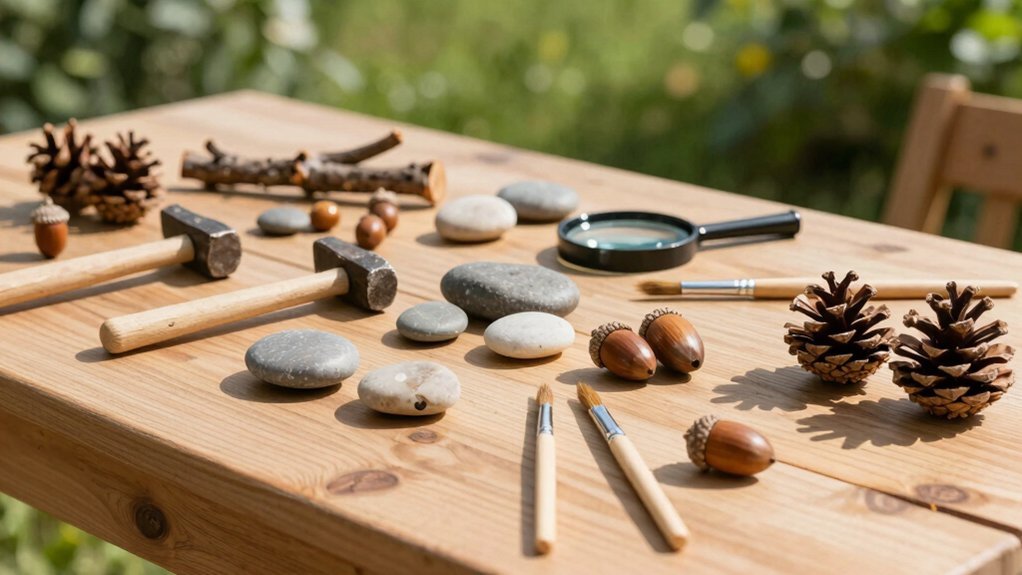
You’ll discover that pairing rocks and sticks with simple tools like tweezers, magnifiers, and baskets transforms basic exploration into purposeful investigation.
When you combine natural materials with these implements, you’re not just playing—you’re building fine motor control while examining textures and structures up close.
This hands-on mixing encourages you to ask questions, make decisions, and test different ways materials can work together. As children engage with open-ended materials, they develop problem-solving skills and critical thinking through trial-and-error exploration of what works and what doesn’t.
Combining Rocks And Sticks
When children mix rocks and sticks with simple tools, they’re unsealing a playground of learning that spans cognitive, physical, and social development.
You’ll observe remarkable growth as kids engage with these combined materials:
- Problem-solving flourishes through trial-and-error experimentation, building perseverance and decision-making skills
- Motor development accelerates via lifting, stacking, and balancing varied sizes and weights
- Scientific thinking emerges as children explore cause-and-effect, texture, weight, and balance concepts
- Collaboration strengthens when peers divide materials, negotiate roles, and construct shared structures
- Creativity expands through dramatic play, where rocks become characters and sticks transform into tools
This non-standardized combination encourages divergent thinking and adaptability. Children compare, contrast, and predict outcomes while handling diverse natural materials. Sticks serve as building materials, props, tools, extending the range of structures and scenarios children can create with rocks alone. You’re facilitating independent learning that builds both competence and confidence in young learners.
Open-Ended Tool Exploration
What happens when you place a collection of loose parts—pebbles, twigs, shells, cloth scraps—alongside simple tools like spoons, containers, and wooden blocks? You’ve created an environment where children’s problem-solving abilities flourish.
When you introduce basic tools with open-ended materials, you’re encouraging active manipulation and experimentation. Children discover cause-and-effect relationships as they scoop, sort, stack, and construct. They develop engineering thinking by redesigning structures and testing different approaches. Through conversations about object properties like sound, weight, and texture, you can extend their learning and deepen their inquiry.
Your role involves observing which tools children select and how they transform materials. This observation reveals their learning interests and current skill levels. You respond by gradually introducing new tools or materials that extend their thinking.
This combination fosters spatial reasoning, planning skills, and creative reasoning—all essential foundations for independent learning and academic success.
Document What Kids Choose to Play With
Observation becomes your most powerful teaching tool when you pay attention to which natural materials children gravitate toward during outdoor play.
Documenting your students’ choices reveals authentic learning patterns and individual interests. You’ll notice:
- Concentration peaks when kids engage with materials they’ve selected themselves
- Problem-solving emerges naturally as they manipulate rocks, sticks, and leaves
- Self-directed curiosity drives deeper exploration than teacher-assigned tasks
- Confidence builds through risk-taking with real-world materials
- Academic ownership increases when children pursue self-chosen investigations
When children select their own materials rather than relying on teacher-directed choices, frequency-dependent fitness dynamics emerge, where individual learners thrive by adapting to their immediate environment while social learners benefit from observing peers’ successful material choices.
Frequently Asked Questions
How Do Natural Materials Support Academic Performance and Critical Thinking Skills?
You’ll enhance your academic performance when you engage with natural materials because they reduce stress, restore your attention, and spark critical thinking through direct exploration and investigation of authentic ecosystems.
What Age Groups Benefit Most From Nature-Based Learning With Loose Parts?
You’ll find that children ages 3-9 benefit most from nature-based learning with loose parts. They’re engaging in dramatic play, construction, and collaborative activities that sustain longer play episodes and enhance critical thinking skills through exploration and creativity.
How Can Loose Parts Be Integrated Into Literacy and Math Instruction?
You’ll integrate loose parts into literacy by using them as storytelling props that prompt vocabulary expansion and symbolic play. For math, you’ll classify, measure, and stack materials to develop spatial awareness, equivalency, and logical thinking skills through hands-on experimentation.
Where Should I Source Natural Materials Sustainably and Safely for Classrooms?
You’ll source natural materials locally by foraging fallen items on school grounds, requesting community donations, shopping secondhand stores, and partnering with sustainable suppliers offering recycled or biodegradable products.
How Do Loose Parts Foster Creativity and Intrinsic Motivation in Children?
You’ll foster creativity when you provide loose parts without prescribed uses, letting children explore “what if” scenarios freely. You’ll build intrinsic motivation as they set personal goals, take risks, and experience ownership of their discoveries.
In Summary
You’ve now got everything you need to transform natural materials into a powerful learning tool. By organizing loose parts thoughtfully and rotating them regularly, you’re creating endless opportunities for your child’s independent exploration. You’ll watch them develop creativity, problem-solving skills, and confidence as they direct their own play. These simple, natural materials become the foundation for deep, meaningful learning that costs you nothing but pays dividends.

Leave a Reply