
You’ll nurture your child’s gross motor development by creating challenging outdoor environments, prioritizing active play over screens, and recognizing that movement skills directly build social confidence and peer relationships. Start prenatal support through proper nutrition—iron, folic acid, and iodine—which lay the neurological foundation for motor abilities. Watch for red flags like persistent head lag beyond four months, and don’t hesitate to seek early intervention. Understanding the full picture of milestones, environmental design, and sibling influences reveals how profoundly movement shapes your child’s entire development.
Gross Motor Delays: Red Flags by Age
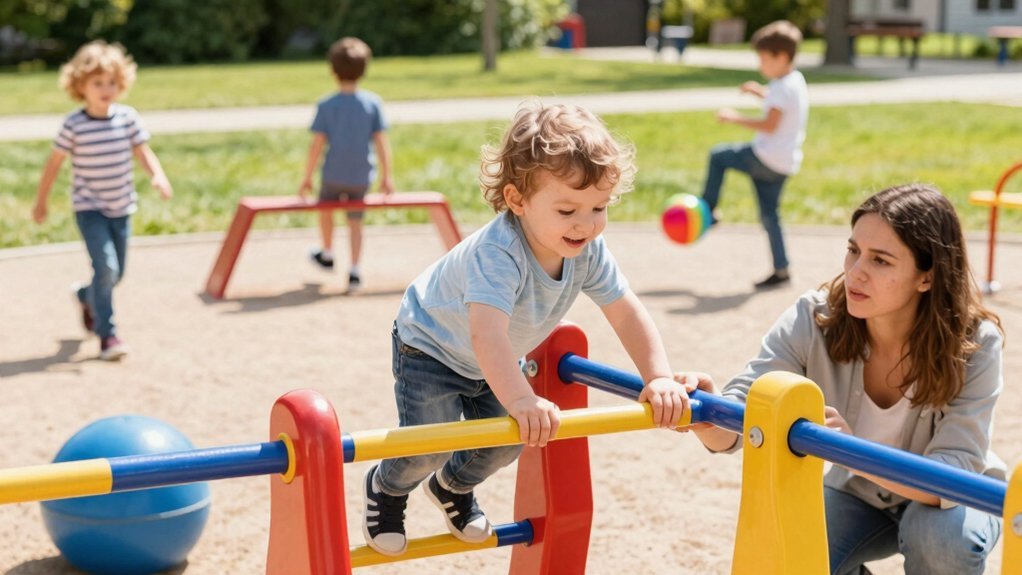
When should you start noticing your child’s physical milestones? Early identification of gross motor delays allows you to intervene promptly and support your child’s development.
Between birth and six months, watch for head control and weight-bearing on legs. By seven to twelve months, your child should roll independently, crawl, and pull to stand. Between twelve and eighteen months, you’ll see unsupported steps and independent walking emerge across various surfaces.
From eighteen to thirty-six months, your child should walk confidently, jump in place, and navigate stairs. After age three, expect running, single-leg standing, and coordination matching their peers. Persistent head lag beyond four months may indicate low muscle tone requiring professional evaluation.
If your child misses these benchmarks, consult your pediatrician. Early intervention services can address developmental concerns before they impact school readiness and peer interaction.
What Your Child Should Be Doing: Milestones by Month
You’ll notice your child’s gross motor abilities transform dramatically during the first eighteen months of life. From newborn reflexes through six months, your baby progresses from basic head control to rolling and sitting independently.
Between six and eighteen months, you’ll watch your child advance from crawling to walking and climbing stairs with support. These large muscle developments form the foundation for more complex movements and activities your child will master in the years ahead.
Newborn To Six Months
During these first six months, your baby’s gross motor abilities expand dramatically as they shift from reflexive movements to purposeful control.
| Age | Key Milestones |
|---|---|
| Newborn–1 Month | Head turning, brief lifts, equal limb movement |
| 2–3 Months | 45-degree head raise, forearm propping |
| 4 Months | Head alignment with trunk, belly-to-back rolling, midline hand play |
| 5–6 Months | Back-to-belly rolling, independent sitting, weight-bearing on legs |
Your newborn begins with reflexive head control, progressing to deliberate movements by month three. At four months, you’ll notice your baby rolling and sitting with hand support. By six months, your child achieves independent sitting and supports full weight on legs when held upright. These progressions reflect strengthening neck, trunk, and limb muscles. Each milestone builds upon previous skills, establishing the foundation for crawling and walking. Gross motor skills enable your child to move through space and interact with their environment in increasingly coordinated ways.
Six To Eighteen Months
How quickly your child transforms from a sitting infant to a running toddler! Between six and eighteen months, you’ll witness remarkable physical changes as your child masters increasingly complex movements.
Around six to eight months, your child sits independently and crawls on their belly. By nine to eleven months, they’re crawling on hands and knees, pulling to stand, and cruising along furniture. At twelve to fifteen months, they’re standing and walking alone while developing fine motor skills.
Between fifteen and eighteen months, your child climbs stairs with support, runs with developing balance, and kicks a ball intentionally. Each milestone builds on the previous one, creating a foundation for confident movement. You’ll notice your child’s coordination and strength improving dramatically throughout this crucial period of physical development. To support these advances, encourage your child to practice jumping and hopping movements that further strengthen their developing legs and balance.
Prenatal Nutrition: The Motor Skill Foundation

You’ll want to prioritize iron and folic acid during pregnancy, as studies show these micronutrients markedly improve your child’s fine motor control and overall motor function by school age. Iodine plays an equally critical role in supporting your baby’s developing brain and nervous system, which directly influences gross motor coordination. Your thyroid health during pregnancy fundamentally affects how your child’s motor pathways develop, making prenatal nutrition far more than just general wellness—it’s the foundation for lifelong movement capabilities. Research indicates that fish consumption during pregnancy is particularly beneficial, as it provides omega-3 fatty acids essential for fetal brain development and has been linked to better fine and gross motor skills in children.
Iron And Folic Acid
You’ll find that prenatal iron and folic acid supplementation directly supports your child’s brain architecture. Starting at 14 weeks gestation, these nutrients work together to enhance intellectual functioning and fine motor skills, with documented improvements of 2.38 points on standardized tests.
Here’s what happens when you maintain adequate iron and folate levels:
- Iron facilitates neurogenesis, myelination, and synaptic plasticity essential for motor circuits
- Folic acid supports neurotransmitter metabolism and cognitive pathways
- Deficient maternal iron correlates with reduced gross and fine motor scores in offspring
- The severity of motor impairment directly ties to deficiency timing and duration during pregnancy
Adequate supplementation establishes the neurological groundwork your child needs for optimal motor development. While multivitamin-containing folic acid supplementation during pregnancy has shown limited mental performance benefits in randomized controlled trials, the neurological support for motor pathways remains clinically significant.
Iodine’s Critical Role Early
While iron and folic acid build the structural foundation for your child’s nervous system, iodine serves as the biochemical key that opens optimal motor development from conception onward. Your adequate iodine intake during pregnancy directly influences your child’s fine and gross motor skills at age three and beyond. Research shows that when you consume below 160 µg daily, your child faces increased risks of language delays, behavioral problems, and reduced motor coordination. However, excessive iodine supplementation beyond recommended levels may paradoxically impair maternal thyroxine concentrations and has not been shown to improve developmental outcomes in mildly iodine-deficient populations. Dairy products offer your strongest iodine source, correlating powerfully with intake levels. Two-thirds of pregnant UK women fall short of optimal iodine consumption, making dietary awareness essential. Your consistent prenatal iodine status supports neurodevelopmental trajectories that extend into childhood, affecting everything from coordination to academic performance.
Thyroid Health During Pregnancy
How profoundly does maternal thyroid function shape your child’s motor development? Your thyroid health during pregnancy directly influences your child’s neurological foundation, affecting motor skills that emerge throughout early childhood.
- Untreated hypothyroidism reduces your child’s IQ scores and impairs psychomotor development, creating lasting deficits in motor function.
- Hypothyroxinemia (low thyroid hormone) increases ADHD symptom scores by 7% at eight years and delays language development and motor skills in toddlers.
- Thyroid autoimmunity decreases your child’s perceptual and motor abilities at four years, reducing motor speed by six years.
- Treatment with thyroid hormone replacement therapy normalizes your child’s developmental outcomes, matching non-exposed children when you begin prenatal screening and maintain consistent dosing throughout pregnancy. Early detection and treatment of maternal hypothyroidism through verbal screening at prenatal visits may prevent fetal harm and optimize your child’s neurological development.
Designing Spaces for Gross Motor Growth

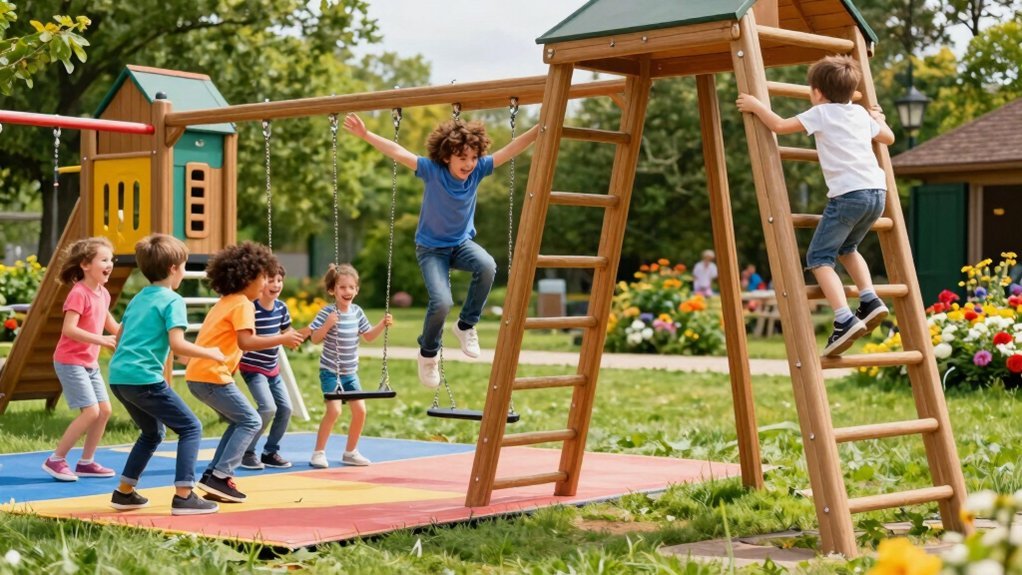
Consider why your child’s play environment matters so much: thoughtfully designed spaces directly shape how children develop strength, coordination, and confidence through movement. You’ll want to spread features across large areas, ensuring adequate space per child and stimulating diverse locomotor skills. Include varied, complex equipment like climbing walls, swings, monkey bars, and balance beams that target stability, coordination, and object control. Layer in padded flooring and foam pits for safe exploration, while rounded edges and accessible platforms reduce injury risks. Smart design transforms even small rooms into effective play zones. Natural settings alongside manufactured elements create optimal conditions for gross motor development. This brain development support means movement in these spaces directly enhances focus and learning alongside physical competence. You’re essentially building environments where children naturally develop physical competence while fostering cognitive growth and social-emotional skills through play.
Why Playtime Beats Screen Time for Motor Skills
You’ve built the physical spaces where children can thrive—now comes a critical reality: the time your child spends in those environments directly competes with screen time.
Every additional 30 minutes of moderate-vigorous active play predicts higher motor skill scores. Meanwhile, children exceeding two hours daily screen time show significantly lower locomotor and object-control abilities. Screens keep kids sedentary, eliminating the running, jumping, and climbing that build strength and coordination. Research shows that strong foundational motor skills are linked to later social, emotional, and academic abilities, making early active play investment critical for long-term development.
Consider what screens can’t provide:
- Tactile learning through hands-on manipulation of real objects
- Vestibular system activation essential for balance and spatial awareness
- Core muscle development from climbing, balancing, and dynamic movement
- Sensorimotor stimulation that educational apps simply can’t replicate
Your child needs genuine play—not passive consumption. Active experiences build the motor foundation no touchscreen ever will.
How Siblings Affect Milestone Timing

While you’re creating the perfect play environment, a variable you can’t control—your family structure—quietly shapes your child’s motor development timeline. Having older siblings accelerates your child’s milestones, as they provide living role models for imitation and motivation. Your child with older siblings typically crawls and walks earlier, demonstrating superior balance, coordination, and jumping skills compared to only children.
Conversely, younger siblings face delays. Second-born children consistently achieve gross motor milestones later than their firstborns, with larger age gaps correlating to slower development. However, benefits from sibling presence emerge strongly after age two, particularly in locomotion and object manipulation.
The mechanism is straightforward: older siblings inspire imitation and create shared play opportunities that naturally accelerate motor competence in younger children.
Getting Your Child Outside: Why Nature Play Works Best
Why does your child’s development accelerate outdoors in ways that manicured playgrounds simply can’t replicate?
Natural environments challenge your child’s body and mind simultaneously. Uneven terrain activates stabilizing muscles, building postural control that flat surfaces never demand. Your child develops confidence navigating unpredictable landscapes while strengthening their core.
- Varied ground surfaces enhance balance and proprioception through constant adaptation
- Climbing trees and rocks engages entire-body strength with problem-solving demands
- Natural jumping obstacles like streams develop precision and explosive power
- Rich sensory input from nature promotes regulation and emotional resilience
Running through grass and hills strengthens muscles more effectively than pavement. Jumping over stumps and logs boosts coordination and timing. Your child’s body builds endurance meeting CDC activity recommendations while absorbing vital vitamin D. Outdoor play involving group activities and cooperative games also provides opportunities to practice social skills and communication. Nature play works because it demands everything manicured playgrounds don’t.
Early Intervention: When and Where to Seek Help
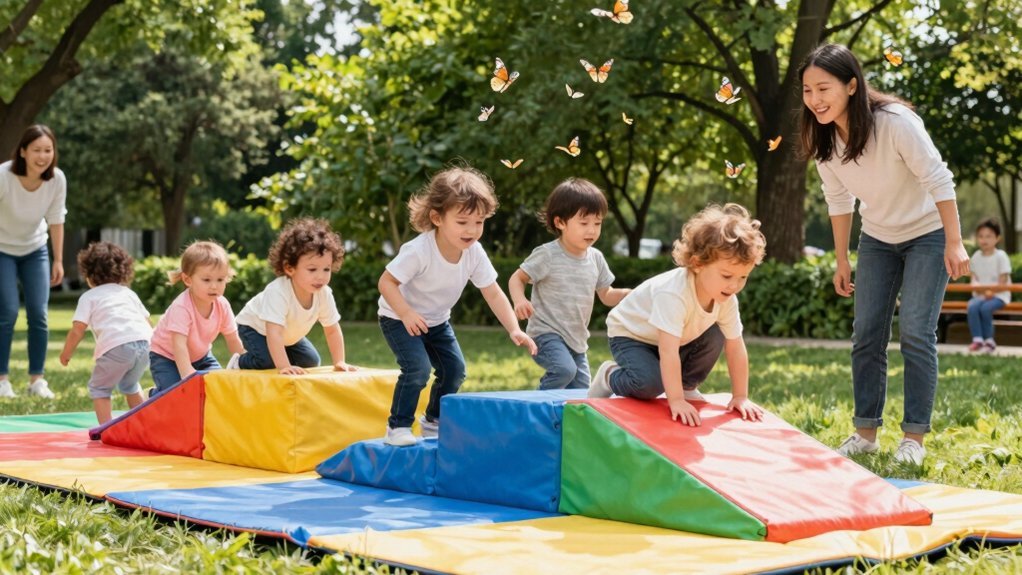
When should you start worrying about your child’s gross motor development? If you’ve noticed delays by 18–35 months, don’t delay seeking help. Early interventions prove most effective when started in your child’s first year, particularly for gross and locomotor skills.
You’ll find the best support through early childhood settings, where trained professionals implement standardized programs. Physical therapy options include treadmill training, tummy time, and Bobath approaches. Many childcare centers now screen children systematically, knowing roughly 10% of the general population needs evaluation. Research using decision tree modeling has identified age as a primary factor influencing gross motor delay risk, with supplementary food provision and interactive time with other children also serving as key predictive variables.
Diagnostic tools like the ASQ-C offer 87.50% sensitivity, catching delays accurately. Video-based assessments and developmental screening tests validate your concerns. Act quickly—timely identification enables referrals that mitigate cascading impacts on physical, cognitive, and social skill development.
Why Kids Who Move Well Also Play Better With Others
Have you noticed that children who run faster, jump higher, and catch better seem to navigate friendships more smoothly? There’s a direct connection between gross motor competence and social success that you shouldn’t overlook.
When kids develop strong motor skills, they naturally participate more in peer interactions and group play. Here’s why this matters:
- Motor abilities enable children to join playground games and organized activities where friendships form
- Physical competence builds confidence, reducing shyness and social withdrawal during playtime
- Coordinated movement skills like running and catching become tools for collaborative play and bonding
- Early motor development predicts later social-emotional adjustment and peer relationships
Children with below-average motor skills exhibit less frequent social interaction. Research demonstrates that organized physical activities significantly enhance social development outcomes in children with learning disabilities. You can support natural development through active play opportunities that strengthen both physical and social abilities simultaneously.
Frequently Asked Questions
How Does Birth Order in Large Families Specifically Impact Gross Motor Milestone Achievement?
You’ll find that younger children in large families consistently achieve gross motor milestones—turning over, sitting, crawling, standing, walking—later than their older siblings, with birth order functioning as a hindering factor.
What Specific Prenatal Supplements Beyond Iron and Folic Acid Optimize Motor Development?
You’ll optimize motor development by combining multivitamins with fish oil and n-3 fatty acids, though you should note that fish oil’s long-term benefits aren’t conclusive. B12 shows inconsistent results, so multivitamin-mineral supplements offer your most reliable protection.
Can Gender Differences in Motor Skills Be Addressed Through Targeted Physical Activities?
Yes, you can address gender differences through targeted activities. You’ll want to focus on girls’ object control skills from age 3 and tailor parental play to counter socialization biases that amplify biological differences.
How Much Daily Interaction Time Is Needed to Prevent Gross Motor Delays?
You’ll need to provide at least 30 minutes of daily interaction time, though extending it beyond 120 minutes further enhances your child’s gross motor development. You’re supporting physical, cognitive, and social growth simultaneously.
What Environmental Factors Account for the Fifty Percent Motor Skill Variance Beyond Genetics?
You’ll find that home physical space, toy availability, prenatal nutrition, postnatal health, play environments, toxin exposure, and socioeconomic conditions account for approximately fifty percent of motor skill variance beyond genetics.
In Summary
You’ll find that supporting your child’s gross motor development requires intentional choices—prioritizing outdoor play, designing movement-friendly spaces, and recognizing when professional help’s needed. You’re not just building physical strength; you’re fostering social confidence and emotional resilience. By staying attuned to developmental milestones and responding promptly to delays, you’re setting your child up for lifelong success both on and off the playground.


Leave a Reply