
When you place children in mixed-age classrooms, they’re constantly observing older peers calmly solving problems and patiently mentoring younger classmates. You’ll see younger students naturally internalize patience through this real-time modeling rather than abstract lessons. Older kids develop tolerance by taking responsibility for others’ learning, experiencing genuine struggle during cognitive conflicts, and navigating different paces collaboratively. The environment mirrors natural social development, normalizing varied progress while reducing comparison and shame. You’re essentially building patience through authentic relationships and shared responsibility—something that unfolds gradually over time.
How Cognitive Disequilibrium Builds Genuine Patience in Multiage Settings

How do children develop real patience rather than merely waiting without complaint? In multiage classrooms, you’ll notice cognitive disequilibrium—that mental discomfort when new information conflicts with existing understanding—naturally fosters genuine patience.
When you encounter peers at different developmental stages, you’re constantly confronted with ideas that don’t fit your current schemas. This cognitive conflict demands you engage in effortful problem-solving rather than passive acceptance. You’re not simply waiting; you’re actively wrestling with uncertainty and reorganizing your thinking through repeated cycles of conflict and resolution. This iterative process builds adaptability and tolerance for confusion. Because equilibration is self-regulated, learners must develop their own strategies to restore coherence rather than relying on external instruction alone. As you navigate these challenges alongside diverse learners, you develop authentic patience grounded in the struggle to understand, not merely the ability to sit still.
When Uneven Abilities Spark Learning and Patience
What happens when you’re grouped with peers who possess skills you haven’t yet mastered? You’re forced to navigate uneven abilities daily, which builds genuine patience.
In multiage classrooms, you don’t simply observe capable peers—you interact with them, learning through their modeling and explanations. This constant exposure to different skill levels teaches you tolerance and adaptability. You discover that struggling with math doesn’t diminish your strengths in art or communication.
Meanwhile, older students solidify their own learning by teaching you, creating mutual growth. These mixed-ability interactions reveal hidden talents you might’ve overlooked in single-age settings. You develop responsibility for your own progress while supporting classmates at different stages, ultimately fostering the patience that emerges from understanding everyone’s unique learning journey.
Research shows that social/emotional outcomes in pedagogic multiage classrooms demonstrate small positive effects on attitudes and social adjustment, though these benefits are most pronounced in well-designed classroom environments with strong teacher support and diagnostic practices.
Teaching Younger Kids: How Responsibility Develops Tolerance
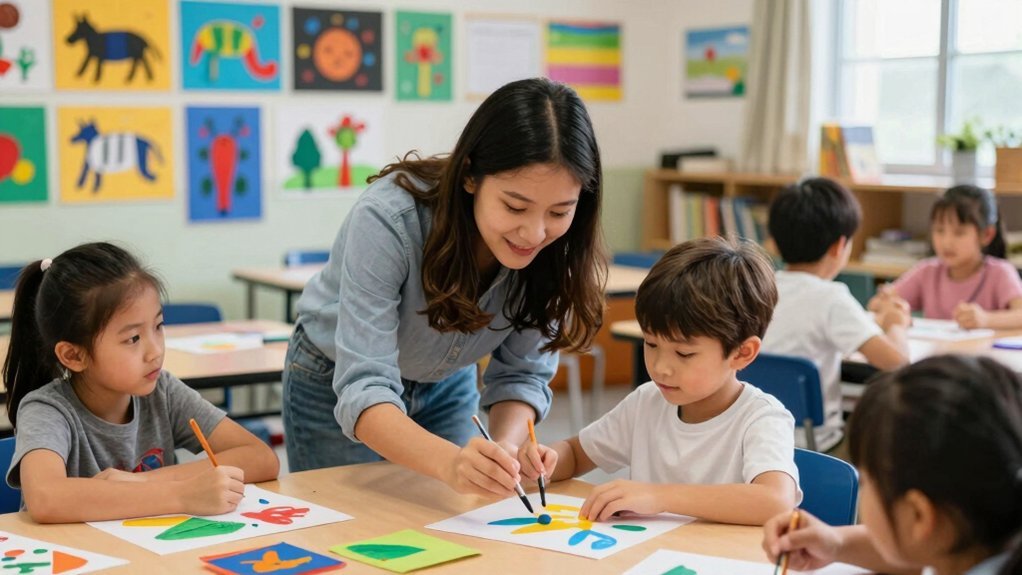
When you mentor younger students, you’ll naturally model patient, supportive behaviors that demonstrate how to adapt explanations for different learning paces. As you take on leadership roles guiding these peers through challenging concepts, you’re building the tolerance that comes from understanding how others learn differently than you do. This responsibility doesn’t just develop your mentoring skills—it cultivates genuine patience as you recognize that your younger classmates’ varied progress reflects their unique needs, not a lack of effort. Research shows that older students reinforcing their learning through teaching younger peers creates a reciprocal benefit where both age groups develop stronger academic and social competencies.
Modeling Patient, Supportive Behaviors
Why do older students become more patient when they’re responsible for teaching younger peers? When you’re tasked with guiding someone through learning, you naturally develop patience as a core skill. You can’t rush the process; you must slow down, explain concepts clearly, and repeat information without frustration.
This responsibility transforms how you interact with others:
- You model calm responses to mistakes, showing younger students that errors are learning opportunities rather than failures
- You demonstrate active listening and encouragement, creating a supportive environment where questions feel welcome
- You practice breaking complex ideas into manageable steps, teaching yourself perseverance alongside your mentee
These behaviors ripple through your classroom community. When younger students witness your patient approach, they internalize these supportive values, gradually becoming more tolerant themselves. Looping with the same teacher deepens these relationships, allowing mentors and mentees to build trust over multiple years. You’re not just teaching content—you’re cultivating empathy through consistent, purposeful modeling.
Managing Varied Learning Paces
Your patience deepens further when you’re working alongside peers who learn at different speeds. In multi-age classrooms, you don’t experience the pressure of rigid grade-level timelines. Instead, you progress through three years of curriculum at your own readiness level, focusing on mastery rather than comparison.
Flexible grouping reassembles around skill levels and learning objectives, not age. When you finish a concept, your group shifts to new challenges while others continue. This dynamic teaches you that everyone’s learning journey differs—a profound lesson in tolerance. Peer interactions across ages foster perspective-taking and empathy through daily practice.
You witness firsthand that slower paces don’t signal failure; they reflect individual developmental timelines. Teacher-managed transitions between groups further normalize varied speeds. This continuous exposure to diverse learners transforms patience from an abstract virtue into lived experience, embedded in your daily classroom reality.
Building Leadership Through Mentorship
In multi-age classrooms, you’ll discover that teaching younger students transforms you into a leader. As you guide peers through concepts and skills, you naturally develop confidence and responsibility. This mentoring experience strengthens your own knowledge while fostering genuine leadership qualities.
Your teaching role creates meaningful opportunities for growth:
- You gain self-assurance by taking expert positions and directing peer learning
- You build empathy and patience by addressing varied skill levels and developmental needs
- You develop caregiving skills that reduce academic stress and enhance social dynamics
Through these interactions, you recognize your personal growth and competencies. You learn tolerance by explaining concepts multiple ways, adjusting to different learning styles. The transition from observer to leader occurs in each child’s own timing, creating moments where you naturally step into mentoring roles when developmentally ready. Mentoring younger peers isn’t just about helping them—it’s about you becoming a more patient, capable leader.
Modeling Patience: What Younger Children Learn From Older Peers
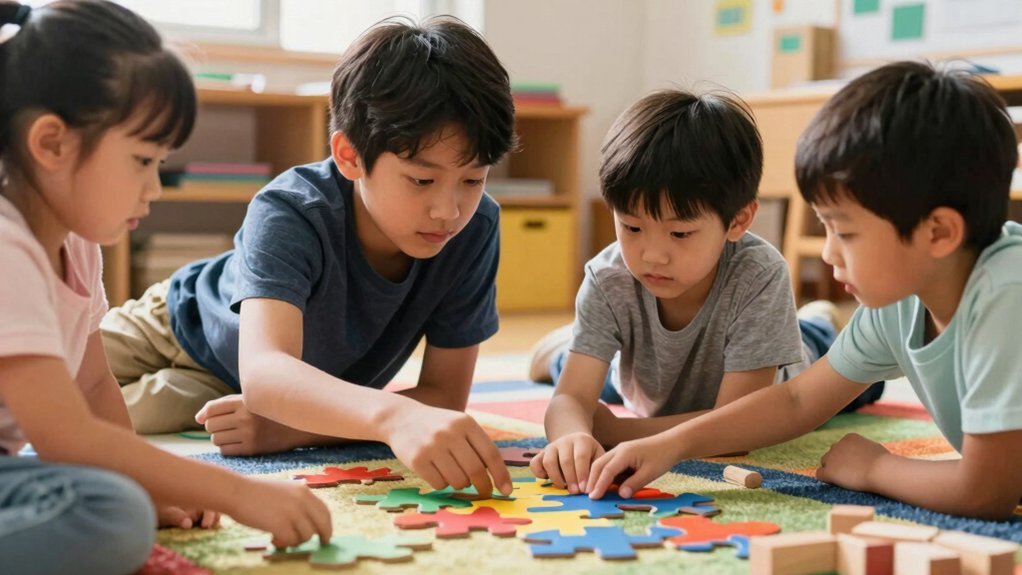
When you observe older students working through problems methodically rather than rushing to solutions, you’re witnessing patience in action—a behavior younger children naturally absorb and replicate in their own struggles. You’ll notice how older peers explain concepts with deliberate care, modeling the supportive communication style that teaches younger classmates listening matters as much as speaking. Through this real-time demonstration, you develop an understanding that solving problems thoughtfully and explaining ideas clearly aren’t just academic skills but essential ways of relating to others. This continuous exposure to mixed-age interactions creates peer mentorship opportunities where younger students internalize the value of patience through consistent observation and guided practice.
Observing Calm Problem-Solving
How do younger children learn patience if nobody explicitly teaches it to them? You observe it happening naturally in multi-age classrooms through daily demonstrations of calm problem-solving.
When you watch older peers navigate frustration during challenging tasks, you absorb their composure without instruction. These concrete examples prove far more powerful than abstract lessons about patience. You’re witnessing:
- Multiple models demonstrating varied but calm approaches to obstacles
- Real-time strategies for managing setbacks with composure
- The confidence that accompanies successful task completion after persistence
This exposure builds your own coping repertoire. You internalize not just what patience looks like, but *how* it actually works in practice. You see that frustration doesn’t require panic—problems yield to methodical effort and composed thinking. Over time, peer interactions provide empathy and practical strategies for managing stress or failure, reinforcing that patience develops through community support rather than isolation.
Adopting Supportive Communication Styles
Beyond observing calm problem-solving, you’re also absorbing the actual language and communication patterns that older students use when they encounter difficulty. You notice how they articulate frustration without hostility, ask clarifying questions thoughtfully, and break down complex ideas into digestible pieces.
| Communication Element | Older Student Approach | What You Learn |
|---|---|---|
| Pacing | Deliberate, unhurried | Rushing creates mistakes |
| Tone | Encouraging, non-judgmental | Support matters more than speed |
| Questions | Probing, open-ended | Understanding requires inquiry |
| Explanations | Step-by-step breakdown | Complexity needs scaffolding |
These mentors demonstrate that patience isn’t passivity—it’s an active choice. You internalize that listening without interrupting, responding thoughtfully rather than reactively, and tailoring your language to others’ needs constitute genuine strength. You’re developing communication skills rooted in respect.
Collaborative Play: Where Multiage Patience Actually Develops
Why does patience flourish when children of different ages play together? Collaborative play creates natural opportunities for you to develop this essential skill through real-world challenges.
When you engage in multi-age play, you’re navigating:
- Differing abilities – You adapt your expectations and communication, learning to meet peers where they’re rather than where you’d prefer them to be
- Shared problem-solving – You work through conflicts peacefully, discovering that compromise and understanding produce better outcomes than frustration
- Teaching moments – You explain concepts to younger peers, which requires slowing down, clarifying your thinking, and practicing genuine patience
These interactions mirror real-world dynamics you’ll encounter throughout life. You’re not just playing; you’re building the emotional resilience and interpersonal skills that transform impatience into genuine understanding. Through peer modeling, younger learners absorb social cues and routines from older children, while older children reinforce their own knowledge by guiding their younger companions.
Navigating Skill Gaps Without Frustration or Stigma
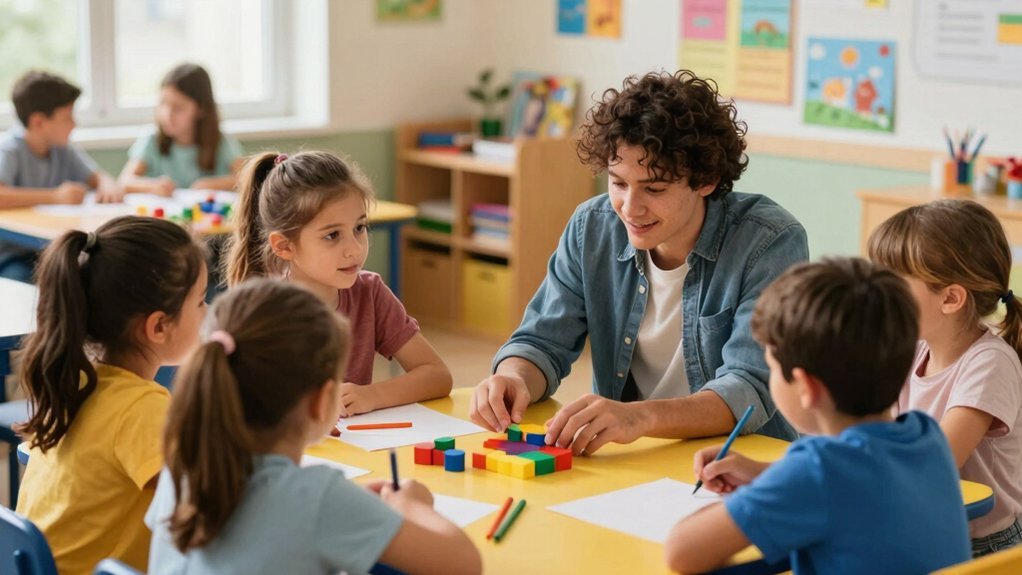
You’ll notice that when children learn at their own pace within a multiage classroom, they naturally observe how peers tackle challenges differently without judgment or comparison. By watching older students support younger classmates through struggles, you’re modeling the patience and encouragement that becomes your child’s default response to setbacks.
You’re also normalizing developmental differences as simply part of growing, which shifts your child’s perspective from viewing skill gaps as personal failures to seeing them as natural stages everyone moves through.
Learning At Individual Pace
Most children don’t learn at the same speed, yet traditional single-grade classrooms often force them to. Multi-age classrooms recognize this reality and let you progress based on your actual readiness, not your birthday.
You’ll experience meaningful benefits when learning at your own pace:
- Spiraled curriculum exposure – You encounter concepts multiple times across years, mastering them when you’re developmentally ready
- Reduced pressure and frustration – You navigate skill gaps through peer learning without the single-grade performance anxiety
- Personalized engagement – Teachers match instruction to your needs, keeping you motivated whether you’re advancing quickly or needing extra time
This individualized approach means you’re never rushed or held back artificially. You develop patience naturally as you see peers progressing at different rates, normalizing varied learning timelines. Teachers working in content teams across grade levels can access more resources to support your differentiated needs.
Modeling Supportive Peer Behavior
When older students explain concepts to younger classmates, they’re not just helping—they’re strengthening their own understanding while developing patience.
You’ll notice younger children naturally observe and emulate the supportive behaviors they witness daily. This continuous exposure to prosocial interactions makes helping feel intuitive rather than forced.
In mixed-age classrooms, older students demonstrate kindness more consistently when assigned mentoring roles, reducing aggressive responses. They provide scaffolding during challenging tasks, normalizing help-seeking behavior for everyone. The classroom functions as a family unit where nurturance becomes expected. Research shows that social competence in early years predicts later academic and social success, making these formative interactions particularly valuable for long-term development.
Your children internalize these supportive interactions through naturalistic settings. When peers model patience and encouragement rather than judgment, younger students learn that struggles are normal and asking for help is acceptable. This creates a foundation for lifelong patience and collaborative problem-solving.
Normalizing Different Development Stages
Beyond the mentoring relationships that foster patience, multi-age classrooms create an environment where developmental differences aren’t obstacles to hide but natural variations children witness and accept every day.
You’ll observe how this normalization happens through direct experience:
- Visible progression: You watch older classmates master skills gradually, reinforcing that competence develops over time through effort rather than appearing overnight
- Flexible pacing: You work at your own developmental level without age-based pressure, understanding that learning timelines vary naturally among peers
- Collaborative struggle: You tackle tasks alongside students with different abilities, recognizing that diverse capability levels coexist healthily in your classroom community
When you see peers progressing at different rates without shame or comparison, you internalize that individual development is expected. This mixed-age environment mirrors the natural social development that occurs when children of varying maturity levels interact daily. You become patient with yourself and others, accepting that mastery unfolds uniquely for everyone.
Looping Teachers, Patient Relationships Over Years

How does a child develop patience? When you stay with the same teacher for multiple years, you’re building something powerful: secure attachment. Your teacher knows your learning style, strengths, and challenges deeply. She’s not starting from scratch each year, so she can recognize your progress in ways new teachers can’t.
This consistency reduces your anxiety about transitions. You’re not learning new classroom rules or adapting to different expectations annually. Instead, you’re gaining an extra month of actual teaching time and engagement. Research from the National Bureau of Economic Research found that looping raised test scores by 10% compared to traditional classroom settings.
Your teacher’s patience grows too. She understands your pace and individual needs without grade-level pressure. She collaborates with your family as a true partner, reinforcing goals at home. This sustained relationship teaches you that growth takes time—and that’s okay.
Advanced Learners Stay Engaged Through Peer Mentoring
While your looping teacher builds patience through sustained support, the multi-age classroom itself creates another powerful dynamic: advanced learners don’t plateau or disengage while waiting for peers to catch up.
Instead, you’ll find them naturally stepping into mentoring roles that deepen their own understanding. When you mentor younger students, you’re not just helping them—you’re developing critical leadership and communication skills. Research shows that peer mentors achieve greater learning gains while building self-confidence and resilience.
Your advanced learners experience tangible benefits:
- Solidify subject mastery by explaining concepts to others
- Develop leadership and problem-solving abilities through teaching
- Gain interpersonal skills while increasing personal purpose and engagement
This reciprocal relationship keeps everyone progressing, transforming potential boredom into meaningful contribution and sustained academic growth. Structured mentor training on active listening and communication ensures these peer relationships remain focused and productive, creating a foundation for trust and effective guidance.
Why Mixed-Age Classrooms Reduce Behavioral Conflict
What transforms a classroom into a place where conflicts dissolve rather than escalate? Mixed-age settings do. You’ll notice fewer aggressive behaviors when older children model constructive problem-solving and younger peers observe and adopt these strategies. This creates a culture of shared responsibility that reduces conflict naturally.
| Setting Type | Physical Aggression | Verbal Aggression | Teacher Intervention |
|---|---|---|---|
| Same-age classrooms | Higher levels | Higher levels | Frequent |
| Mixed-age classrooms | Significantly lower | Significantly lower | Minimal |
| Post-transition outcomes | Sustained reduction | Sustained reduction | Child-led resolution |
| Toddler/preschool groups | Elevated incidents | Elevated incidents | Constant management |
| Montessori mixed-age | Lowest recorded | Lowest recorded | Rare |
When older children enforce rules, they improve their own behavior while younger children develop sophisticated verbal communication skills. You’re witnessing children resolving disputes independently, with teacher involvement nearly disappearing. This shift builds patience and emotional regulation naturally.
Research Evidence: Patience Growth in Multiage Settings
Behavioral improvements in mixed-age classrooms reveal only part of the story—they’re actually symptoms of something deeper developing in these environments. Research substantiates that you’re witnessing genuine patience growth, not merely surface-level compliance.
Studies document measurable outcomes when you place children in multiage settings:
- Children demonstrate higher emotional intelligence scores and advanced patience behaviors after three years of multiage instruction
- Consensus-building processes among 7-11 year olds show significantly enhanced patience compared to single-age peers
- Mixed-age groupings produce superior social skills development per established research protocols
You’re observing neurological and emotional shifts. When you adjust expectations across developmental stages, you create conditions where patience becomes intrinsic rather than imposed. This evidence-based framework explains why multiage environments cultivate patient learners more effectively than traditional classroom structures. The theme-driven instruction across multiple subject areas reinforces consistent opportunities for children to practice patience within authentic, contextualized learning experiences.
Frequently Asked Questions
How Do Multiage Classrooms Compare to Traditional Single-Age Settings Academically?
You’ll find multiage classrooms yield mixed academic results compared to single-age settings. While you’ll gain advantages in language, mathematics, and problem-solving skills, research shows you’ll experience no significant differences on standardized tests overall.
What Age Ranges Work Best Together in a Multiage Classroom Environment?
You’ll find that three-year age spans work best together in multiage classrooms. You’re creating optimal heterogeneous groupings when you combine ages like 3-6, 6-9, or 9-12, which you’ll discover supports both academic and social-emotional development effectively.
How Do Teachers Manage Curriculum Standards Across Multiple Grade Levels Simultaneously?
You’ll use curriculum mapping frameworks that define clear learning pathways and progression levels. You’ll implement flexible grouping based on developmental readiness, differentiated instruction across grade levels, and robust assessment systems tracking individual student progress toward national standards.
Are There Disadvantages or Challenges Specific to Multiage Classroom Structures?
You’ll face significant challenges managing expanded curriculum preparation, scheduling conflicts with traditional school structures, parent skepticism about instructional quality, and student confidence issues when mixing age groups.
How Do Parents Support Multiage Learning at Home With Mixed-Age Siblings?
You’ll strengthen multiage learning by creating open-ended spaces, facilitating peer mentoring between siblings, maintaining consistent routines, and communicating regularly with teachers about your children’s development and classroom dynamics.
In Summary
You’ll discover that multiage classrooms cultivate genuine patience by placing you in situations where you can’t rush learning. You’re forced to collaborate with peers at different developmental stages, which builds your tolerance naturally. When you mentor younger students, you develop responsibility and empathy. You’re also exposed to diverse learning styles and paces, teaching you that growth doesn’t follow a single timeline. These experiences transform patience from an abstract concept into a lived skill.



Leave a Reply