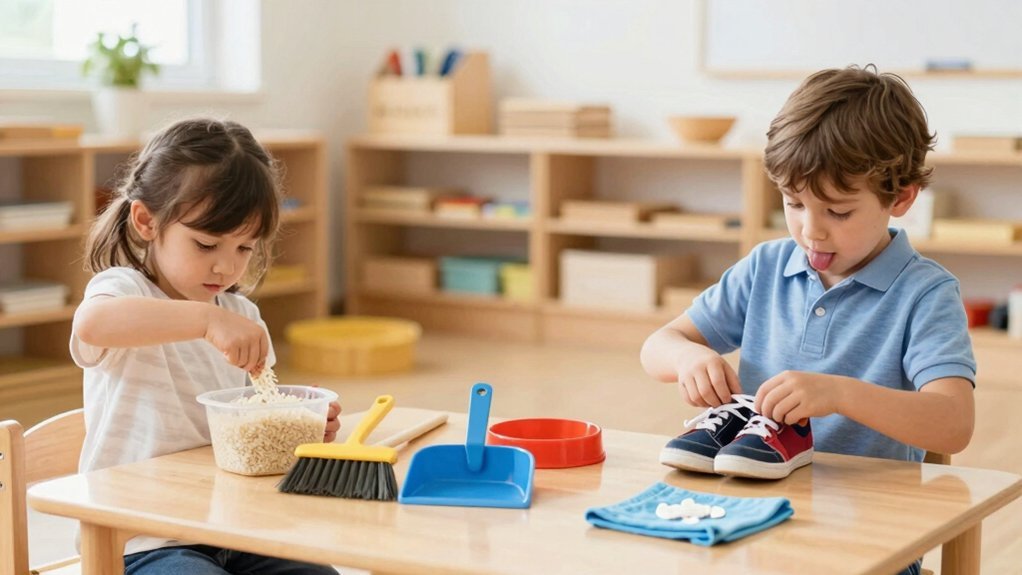
You’ll build your child’s independence through seven core Montessori activities that transform everyday tasks into meaningful learning opportunities. Start with self-care skills like dressing and feeding to develop confidence. Progress through fine motor exercises using pouring and threading to strengthen coordination. Layer in household chores that build concentration naturally. Master kitchen skills together, then organize your home environment intentionally. Problem-solving activities with real tools deepen critical thinking. Finally, establish safety routines that empower your child. Each activity interconnects, creating a foundation that extends far beyond the home.
Self-Care Skills: Dressing, Hygiene, and Feeding Independence
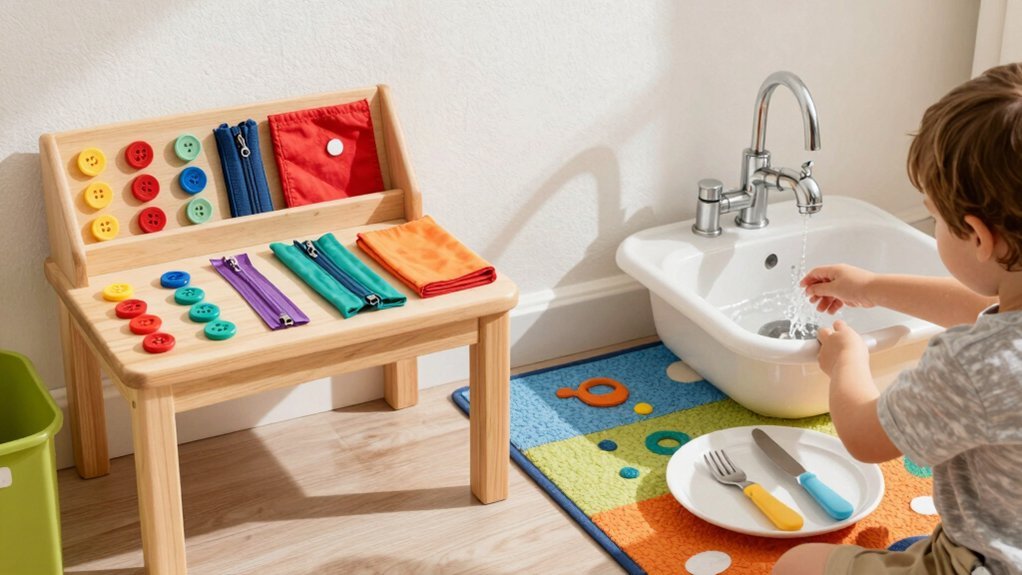
How do children develop the confidence to care for themselves? You’ll find the answer in practical life activities that build independence through repetitive movements. As young as 12 to 18 months, your child can learn dressing skills and clothing organization by observing older peers in multi-age classrooms. These hands-on exercises develop the muscle control and eye-hand coordination necessary for managing fasteners and completing dressing tasks.
Hygiene routines integrated into daily living exercises activate your child’s brain, creating lasting neural pathways for habit formation. You’ll notice they develop self-awareness and healthy habits through meaningful activities. Research on Montessori graduates shows that self-directed learning and intrinsic motivation contribute to higher levels of adult well-being. When you provide uninterrupted work periods during feeding tasks, your child engages at their own pace, building concentration and time-management skills. Self-directed participation in these routines enhances overall well-being significantly.
Build Fine Motor Control Through Pouring, Threading, and Practical Tasks
While self-care routines establish healthy habits, fine motor skills form the physical foundation that makes independent living possible. You’ll develop precision and hand-eye coordination through targeted Montessori activities that transform everyday movements into skill-building exercises.
Pouring activities teach you to control liquid flow while building intentional actions. Threading beads strengthens your pincer grip, essential for utensil use and writing. Tweezers transfer tasks refine sustained grip and concentration through repeated practice. The Montessori approach integrates these practical life exercises into a structured curriculum that connects fine motor development to broader physical, cognitive, and emotional growth.
These practical life exercises address a critical gap—77% of educators report declining pencil and scissors handling in young learners. Research confirms that Montessori’s hands-on approach significantly improves fine motor control better than traditional methods. By engaging in these activities regularly, you’ll build the dexterity necessary for complex tasks and genuine independence.
Develop Concentration With Real-World Household Responsibilities
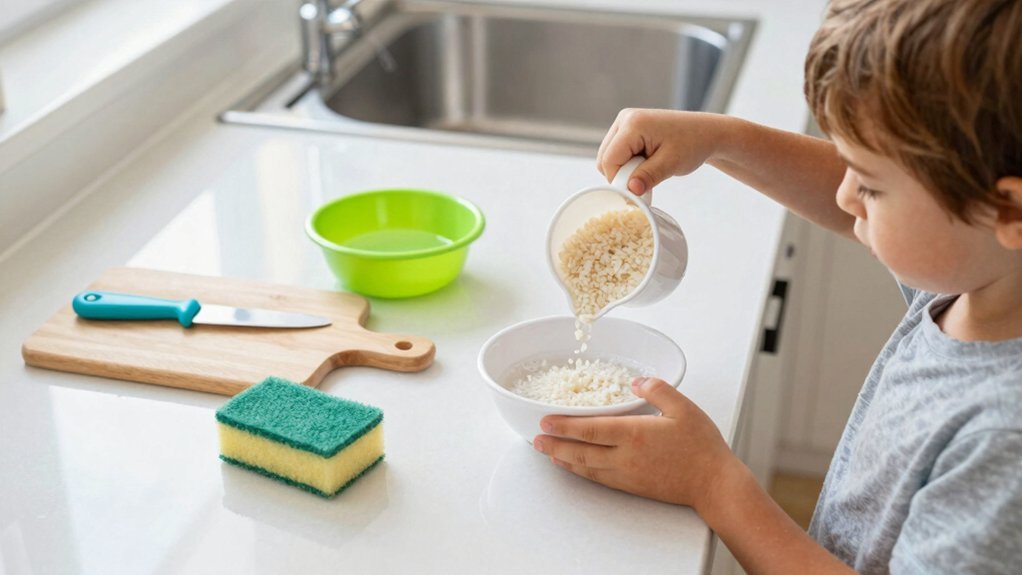
Where does genuine concentration develop? Through real-world household responsibilities that matter. When you assign age-appropriate chores, you’re building focus naturally.
Toddlers start small—wiping spills and organizing toys—developing awareness of their environment. As children progress to ages 3-6, you can introduce tasks like making beds and folding washcloths, which require sustained attention.
By ages 6-9, children tackle more complex responsibilities: emptying dishwashers, vacuuming floors, and weeding gardens. These tasks demand concentration and follow-through. When viewed as meaningful work, children become capable and engaged rather than resistant to household duties.
To maximize concentration development, you’ll establish consistent 3-hour morning work periods and maintain daily routines. Model each task using exact materials, so children understand expectations clearly. Visual chore cards reinforce independence while practice with the Silence Game heightens awareness. This combination transforms household chores into powerful concentration-building activities.
Master Kitchen Skills for Meal Preparation and Nutrition
The same concentration you’ve cultivated through household chores naturally extends into the kitchen, where children transform food preparation into purposeful learning. You’ll find that child-sized tools—small knives, peelers, and measuring spoons—enable genuine independence rather than supervision.
| Age Group | Key Tasks |
|---|---|
| 1-2 years | Spreading, peeling bananas, mixing ingredients |
| 2-3 years | Squeezing juice, grating cheese, spinning salad |
| Preschool | Peeling eggs, slicing bananas, measuring flour |
| Primary | Washing produce, safe slicing, food prep sequencing |
| All Ages | Cleanup, wiping spills, developing responsibility |
You’ll witness fine motor development, vocabulary expansion, and nutrition awareness flourish simultaneously. A prepared environment with low-access shelves, labeled storage, and dedicated snack stations removes barriers to independent work. Your child builds confidence handling real tools while developing healthy eating habits through hands-on exploration. Through step-by-step task following, children enhance their executive functioning by remembering procedures and paying attention to detail as they progress through each stage of meal preparation.
Teach Independence Through Environmental Care and Organization
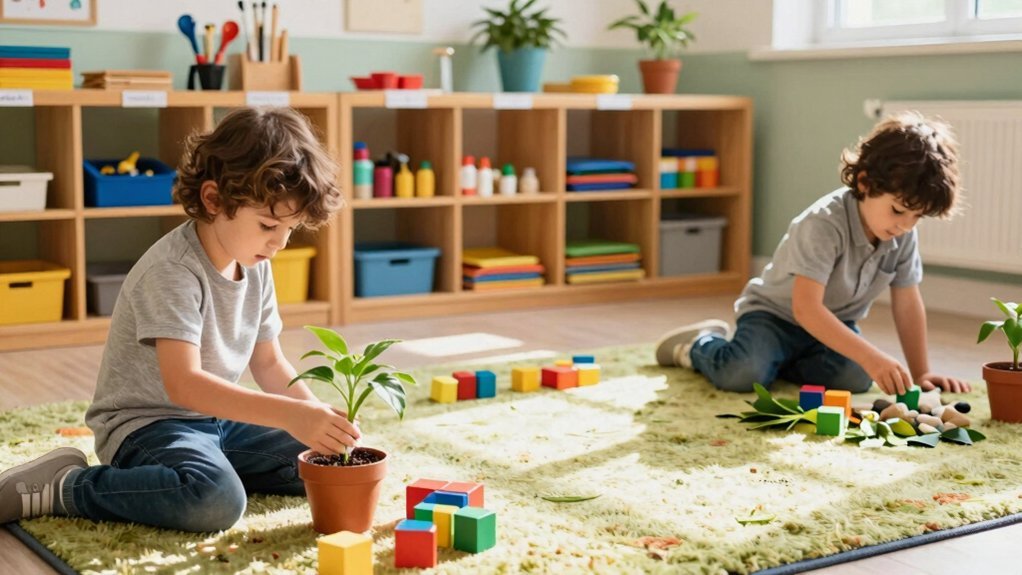
You’ll discover that organizing spaces with purpose teaches children how environments support independence and function. When you guide them to care for living things—from plants to small animals—you’re cultivating genuine empathy and responsibility that extends beyond themselves. Through these environmental stewardship tasks, you’re helping children understand that their actions directly impact the world around them. Observing their interactions with outdoor materials allows you to continuously adapt the space to match their evolving interests and developmental needs.
Organizing Spaces With Purpose
Creating purposeful outdoor environments teaches children that organization isn’t arbitrary—it’s a foundation for independence and care. You’ll design distinct zones for specific activities: observation stations with accessible nature journals and magnifying glasses, garden areas with labeled plots, and composting stations integrated into play spaces. When you arrange materials by purpose and accessibility, children develop executive function skills naturally. Research on classroom curricula demonstrates that Montessori approaches meet more criteria for executive function development across broader age groups than other interventions.
Shaded seating zones encourage reflection, while weather tools positioned strategically support systematic monitoring. You’re not just organizing physical space—you’re teaching children that thoughtful arrangement enables them to complete tasks independently. By maintaining consistent, intentional layouts, you model how orderly environments foster responsibility, reduce confusion, and empower children to manage their own exploration and environmental stewardship.
Caring For Living Things
How do children develop genuine responsibility? By caring for living things. You’ll discover that plant care teaches accountability through real consequences—overwatering drowns roots while neglect wilts leaves, demonstrating how actions impact living organisms.
Start with simple watering techniques. You’ll fill containers from low spouts for controlled pours, moistening soil without flooding. Mist leaves gently to hydrate and clean them. Before watering, you’ll observe soil dryness, building observation skills naturally. Consistent watering schedules help children understand daily plant care routines and develop time management habits.
You’ll expand care through cleaning activities using child-safe tools like cotton balls and Q-tips to gently wipe leaves. During transplanting, you’ll examine roots, fill pots with moistened soil, and discuss how roots absorb nutrition and provide stability.
Group gardening tasks encourage turn-taking and tool sharing. You’ll maintain nature journals documenting observations, engaging multiple senses while fostering stewardship toward delicate plant parts.
Developing Stewardship Through Tasks
When children take ownership of their outdoor environment through regular care tasks, they develop genuine responsibility that extends far beyond the classroom. You’ll notice how hands-on stewardship transforms their relationship with nature.
| Task | Environmental Benefit | Child Development |
|---|---|---|
| Gardening | Connects to natural cycles | Observes cause-and-effect |
| Composting | Reduces waste sustainably | Understands interconnectedness |
| Bird feeder maintenance | Supports wildlife | Develops accountability |
| Water collection | Conserves resources | Learns long-term planning |
| Space organization | Prevents clutter and loss | Builds systematic thinking |
Through composting, rainwater collection, and garden care, you create meaningful contexts where children apply ecological knowledge. They maintain observation stations, record findings, and manage materials—actions that cultivate lifelong environmental advocacy. These purposeful tasks embed responsibility into daily routines, demonstrating that individual actions matter.
Unlock Problem-Solving: Tools, Locks, and Real Objects
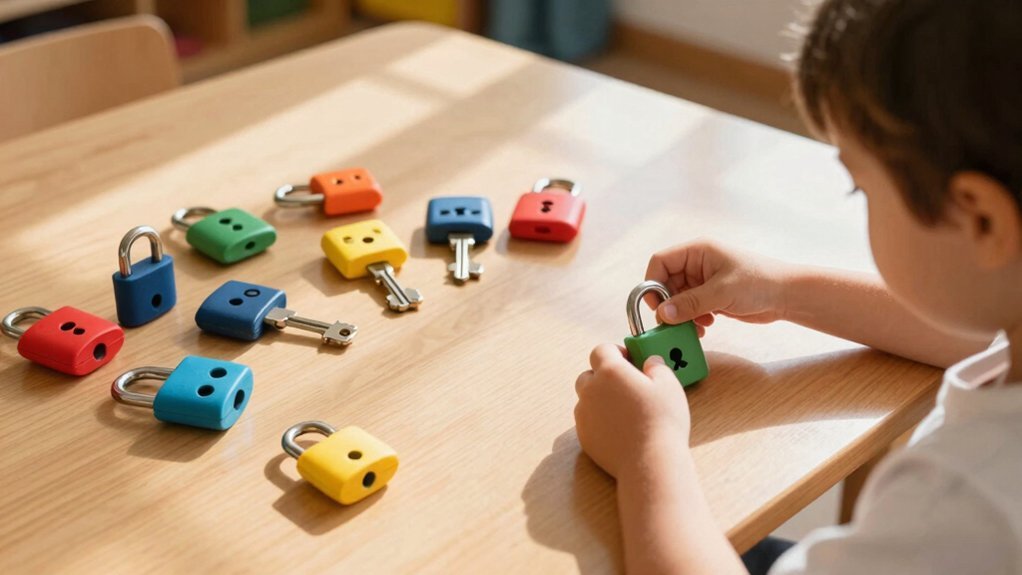
Why do children unleash their potential through hands-on engagement with real tools and locks? Because you’re providing immediate, tangible feedback that builds confidence and autonomy.
Lock and key activities develop your child’s fine motor skills, hand-eye coordination, and concentration through trial-and-error learning. When they match the correct key to a padlock, success arrives instantly—no ambiguity. The matching task emphasizes careful pairing of each key to its corresponding padlock, reinforcing orderly and purposeful practice.
You’ll strengthen problem-solving by introducing busy boards with latches, zippers, and buttons. These self-correcting tools teach cause-and-effect while building patience and resilience.
Real objects matter. Natural materials like wood, metal, and fabric provide sensory feedback that plastic substitutes can’t match. Start simple with lid-matching tasks for two-year-olds, then progress to complex mechanisms.
You’re not rushing solutions. Instead, ask guiding questions that encourage persistence and independent thinking, transforming frustration into mastery.
Prepare for Emergencies: Safety Basics and Advanced Independence
Building true independence means equipping your child with emergency preparedness skills that foster confidence rather than fear. Through regular drills, you reinforce essential protocols like STOP–DROP–ROLL for fire safety and DUCK–COVER–HOLD during earthquakes. Your child practices these responses until they become instinctive, reducing panic in actual emergencies.
You’ll involve your child in preparing Personal Comfort Kits and understanding evacuation routes. Teaching lockdown procedures and discussing “what if” scenarios builds their ability to respond appropriately under stress. Staff training ensures consistent messaging across all adults in your child’s life. Monthly evacuation drills help children develop muscle memory for safe responses in real emergencies.
This preparation transforms abstract danger into manageable knowledge. Your child learns they can handle uncertainty by following established procedures, developing genuine self-reliance rather than anxiety. Emergency preparedness becomes another life skill supporting their independence.
Frequently Asked Questions
At What Age Should Children Begin Participating in Montessori Practical Life Activities?
You can start introducing practical life activities from birth through sensory stimulation, but you’ll find they’re most effective when your child begins walking. You’ll foster independence most successfully between 18 months and age six.
How Can Parents Implement Montessori Activities at Home Without Specialized Classroom Materials?
You’ll use real household items—dishes, vegetables, cleaning supplies—for practical tasks. You can arrange low shelves, create sorting activities, and model routines like tidying. You’re building independence through everyday materials you’ve already got at home.
What Is the Role of Adult Supervision During Independent Practical Life Activities?
You observe quietly, stepping back after demonstrating. You supervise without directing perfection, allowing your child to make mistakes and learn. You’re present to assure safety while fostering their independence and self-confidence.
How Do Montessori Practical Life Activities Differ From Traditional Chore Systems for Children?
You’ll find Montessori activities emphasize child-chosen, intrinsically motivated engagement rather than assigned obligations. You’re developing independence and confidence through real-world skill mastery, not completing tasks for results or compliance.
Can Montessori Life Skills Activities Be Adapted for Children With Developmental Delays?
You can absolutely adapt Montessori life skills activities for children with developmental delays. You’ll adjust complexity levels, break tasks into smaller steps, and use multi-sensory materials while integrating therapy support seamlessly into daily routines.
In Summary
You’ll discover that Montessori activities aren’t just educational—they’re transformative. By incorporating these seven skill-building exercises into your child’s routine, you’re fostering genuine independence and confidence. You’re not simply teaching tasks; you’re empowering your child to navigate life’s challenges with capability and self-assurance. You’re creating a foundation for lifelong success and resilience.


Leave a Reply