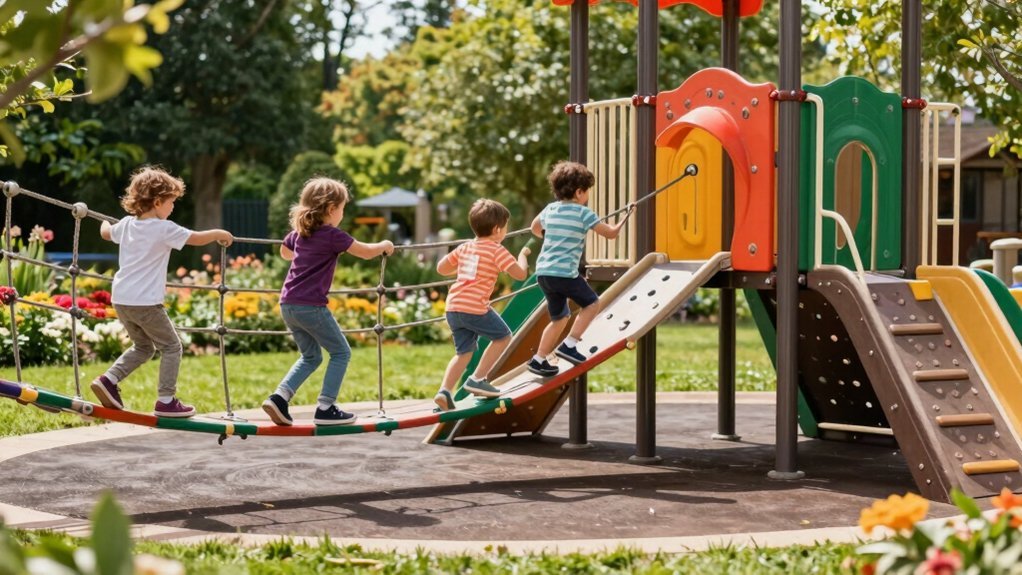
You’re building your child’s coordination the moment you design spaces that force their body to adapt constantly—varied terrain, unpredictable surfaces, and strategic obstacles act like a coordination gym, where every step on grass, sand, or an incline rewires their balance system and strengthens the neural pathways that control skilled movement. Safe yet challenging environments keep them engaged, building resilience through repeated sensory experiences. Discover how specific design choices unlock even greater coordination gains.
How Does Physical Space Layout Improve Balance and Control?

Why do children who play on varied terrain develop better coordination than those confined to flat surfaces? When you expose kids to diverse textures—grass, woodchip, sand, and mud—you challenge their proprioceptive systems constantly. These surfaces demand postural adjustments that strengthen balance control naturally.
Inclined surfaces and gradients amplify this benefit. You’re essentially training their bodies to adapt continuously, building advanced equilibrium skills progressively. Stair access with visible signage encourages climbing and descending, which activates the vestibular sense crucial for spatial awareness.
Winding sensory paths combining jumping, running, and kicking pathways integrate multiple movement types simultaneously. This configurational approach yields superior results compared to single-activity zones. Research using Y Balance Test measurements demonstrates that structured movement education significantly improves reach distances in all directions for young children. By designing spaces that transition from flat to uneven levels, you develop sophisticated motor control that translates to better coordination across all physical activities.
Why Do Different Equipment Types Strengthen Motor Skills?
Each type of playground equipment you select serves a distinct purpose in strengthening your child’s motor skills. Climbing structures develop pulling strength and coordination as your child navigates multiple movement patterns simultaneously.
Climbing structures develop pulling strength and coordination as children navigate multiple movement patterns simultaneously.
Balance-specific toys like beams and boards target the vestibular system, enhancing spatial awareness and core stability with each deliberate step.
Obstacle course equipment builds motor planning abilities through structured sequences that demand problem-solving and directional awareness.
Soft play structures enable safe experimentation, allowing your child to practice jumping, landing, and complex movements without injury risk. These safe, stimulating environments strengthen core and limb muscles through frequent and varied play opportunities.
Multi-functional equipment maximizes learning opportunities by addressing different coordination aspects within single structures. By thoughtfully combining these varied equipment types, you create comprehensive environments where your child progressively masters balance, strength, and movement control.
What Child-Sized Structures Teach About Coordination?
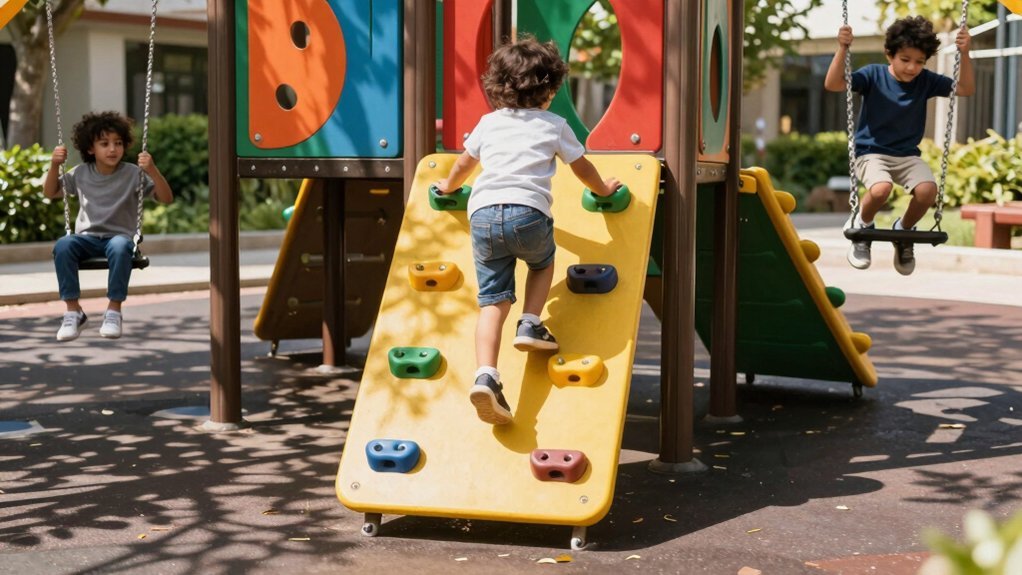
When you design child-sized structures, you’re creating spaces where children build competence through appropriate physical proportions that match their developmental stage. You’ll notice that these scaled environments allow kids to assess and manage risk more effectively, as they can navigate challenges that feel manageable yet still push their coordination boundaries. Through complex play on structures built to their scale, children develop motor processing skills that transfer to real-world coordination challenges they’ll encounter. Early intervention during preschool years is critical because developmental coordination disorder affects 5-6% of children and, without intervention, up to 75% may experience difficulties into adulthood.
Scale-Reduced Structures Build Competence
How do child-sized environments fundamentally transform coordination development? You’ll discover that scale-reduced structures directly address the postural control deficits children with DCD exhibit. When you interact with appropriately-sized equipment, you naturally reduce the compensatory movements that typically increase oscillations and sway.
Consider these key benefits:
- Proprioceptive compensation – Child-sized structures help you manage balance by providing optimal reach distances, reducing the need for excessive postural adjustments in medio-lateral directions
- Task self-organization – You develop better stability through functional engagement with proportionate equipment
- Visual-motor integration – Properly-scaled environments enhance your visual focus during manipulation tasks, decreasing oscillation velocity
- Neuromuscular efficiency – You prevent improper movement patterns by maintaining appropriate posture during developmentally-matched activities
Scale-reduced environments create the foundation for successful motor milestone achievement and sustainable competence building. Research demonstrates that children with DCD show earlier muscle activation patterns when task difficulty increases, suggesting that appropriately-scaled environments can help calibrate these anticipatory responses more precisely.
Risk Assessment Through Appropriate Challenge
Beyond building foundational stability through scale-reduced equipment, you’re now ready to understand how these same child-sized structures function as sophisticated tools for learning risk assessment. When you engage with graduated challenges in controlled environments, you’re naturally calibrating your personal limits through trial and safe failure. Child-sized structures prompt organic motor learning by allowing you to physically grasp, push, and pull against appropriately scaled resistance. This self-regulated growth teaches you to gauge which challenges match your current abilities and which ones stretch beyond your comfort zone. By repeatedly testing boundaries without injury, you develop sophisticated risk judgment skills that extend far beyond the playground, establishing lifelong patterns of confident, calculated decision-making. These proprioceptive experiences from navigating scaled equipment build body awareness that deepens your understanding of how your muscles respond to different movements and surfaces.
Motor Processing In Complex Play
Why do you instinctively pump your legs when swinging, or naturally sequence your hands and feet while climbing? These aren’t random movements—they’re complex motor processing at work. Child-sized structures teach your body to coordinate multiple systems simultaneously through:
- Vestibular integration – Spinning and swinging input helps your brain process balance and spatial orientation
- Proprioceptive feedback – Hanging and climbing strengthen awareness of where your body exists in space
- Cross-lateral coordination – Crawling tunnels and ladders require synchronized opposite limbs
- Motor sequencing – Repeated climbing patterns train your nervous system to execute precise hand-foot progressions
When you navigate these structures, you’re not simply playing. You’re building neural pathways that enhance coordination, refine timing, and develop the body control necessary for complex physical tasks. The back-and-forth movement of swinging provides visual, vestibular, and proprioceptive stimulation that reinforces your awareness of effort to modulate speed.
How Clear Pathways Prevent Kids From Losing Balance?

When you organize space spatially, you’re removing the obstacles that force your child’s body to make constant compensatory adjustments, which drains their focus from actual movement control.
You’ll notice that open movement zones activate their proprioceptive system—the internal feedback that tells them where their body sits in space—allowing them to build authentic balance rather than fighting environmental chaos.
You’re essentially scaffolding their confidence through predictable routes, so they can concentrate on the motor skills that’ll stick with them long-term.
Spatial Organization Reduces Obstacles
How do clear pathways protect children from losing their balance? When you organize your space thoughtfully, you’re directly reducing collision risks that destabilize young movers. Children with poor spatial awareness often stand too close to objects or misjudge their body’s impact on surroundings, leading to falls and roughhousing incidents.
Strategic spatial organization creates safer movement zones:
- Arrange furniture to maintain open walkways, preventing unexpected obstacles
- Store toys systematically so children locate items without tripping hazards
- Use vertical storage to keep floor space clear and accessible
- Establish consistent placement of daily-use items to support predictable navigation
When you minimize clutter and design intentional pathways, you’re supporting your child’s visual-spatial processing. This environmental consistency allows them to move confidently without constantly recalculating their position relative to surroundings, strengthening both coordination and balance skills naturally. Research shows that spatial language development during these formative years directly correlates with improved navigation abilities and geometric reasoning in later childhood.
Open Movement Enhances Proprioception
Clear pathways do more than just prevent trips—they’re essential for developing your child’s proprioceptive system, which is their body’s ability to sense where it’s in space and how it’s moving. When you remove obstacles from movement spaces, your child can focus entirely on coordinating their body rather than navigating hazards. This uninterrupted movement allows proprioceptive feedback to flow naturally during spontaneous whole-body activities.
As your child moves freely without environmental constraints, their sensorimotor interactions self-organize, strengthening neural connections between brain regions. Regular engagement in open-space movement directly improves balance function and motor control. Cross-lateral movements across clear areas particularly foster these brain connections, supporting the proprioceptive processing necessary for coordinated behavior and enhanced body awareness. The fronto-parietal network continues developing throughout childhood, meaning sustained exposure to coordinated bimanual activities in unobstructed spaces accelerates the maturation of executive motor control.
Flow Design Builds Confidence
Why do some children move through spaces with assured steps while others hesitate and stumble? The answer lies in how you design their environment. Clear pathways build the confidence children need to navigate confidently and maintain balance.
When you structure spaces thoughtfully, you’re directly supporting your child’s motor development. Consider these key elements:
- Visual clarity through high-contrast lines that highlight terrain changes and prevent perceptual misjudgments
- Defined boundaries using marked edges that guide foot placement and reduce veering by 20-30%
- Unobstructed routes eliminating trip hazards and lowering collision risks by 40%
- Consistent designs reinforcing muscle memory and increasing coordination confidence by 25%
You’re not just organizing space—you’re creating predictable environments where children practice balance repeatedly. This familiarity transforms hesitation into assurance.
Does Nature-Based Design Build Better Coordination Than Traditional Playgrounds?
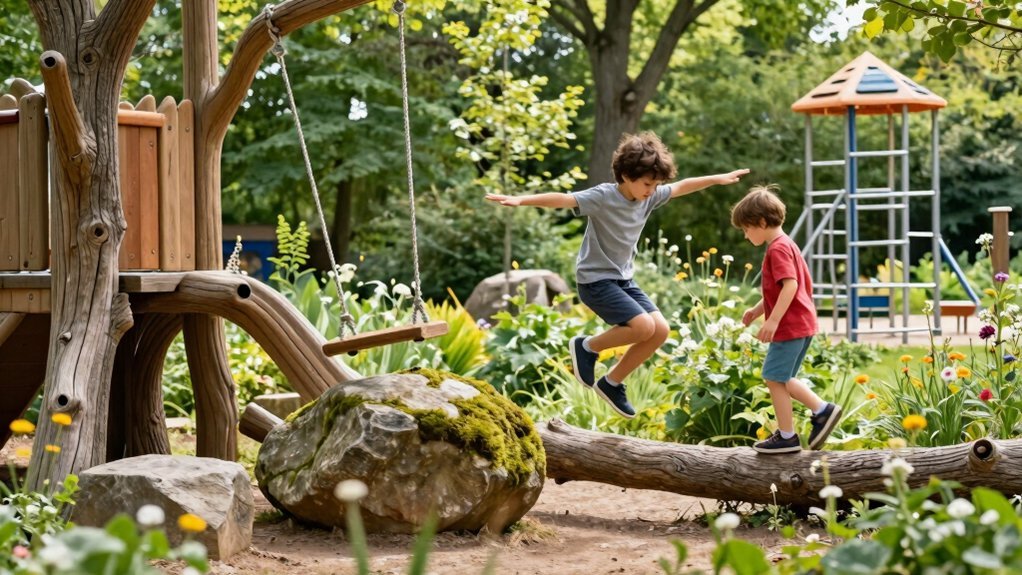
When you place a child on a boulder-strewn landscape versus a manufactured playground, you’re fundamentally changing what their body must do to move through space. Natural playgrounds demand full-body engagement through climbing, balancing, and crawling over varied terrain—activities that build strength and agility in ways artificial equipment can’t replicate.
Meanwhile, traditional playgrounds support only predictable, functional movements that quickly become tedious.
Research shows children engage in more vigorous, sustained physical activity in natural settings, directly supporting cardiovascular health. The diverse environmental features—logs, open fields, loose parts—prompt varied movement patterns that develop coordination through multiple challenges. Natural environments provide multisensory experiences that strengthen the brain pathways essential for coordinated movement. You’re not just offering play; you’re providing the complex sensory and motor experiences your child’s developing brain needs to master coordinated movement.
How Should Designers Make Playgrounds Work for All Coordination Levels?
To create playgrounds where every child can thrive, you’ve got to move beyond one-size-fits-all design and build spaces that actively accommodate diverse abilities, ages, and confidence levels.
You should implement these key strategies:
- Tiered challenge options – Provide multiple entry points for each activity so children progress at their own pace without feeling excluded or overwhelmed.
- Sensory variety – Integrate both stimulating and calming elements, allowing kids to self-regulate their engagement based on individual needs. Research demonstrates that nature provides stress reduction, happiness, and positive physiological responses that enhance children’s overall well-being and coordination development.
- Collaborative equipment – Select freestanding activities like see-saws and tire swings that naturally encourage teamwork across different ability levels.
- Accessible pathways – Ensure 60-inch minimum widths and rubberized surfaces so all children navigate independently or with caregivers.
This inclusive approach builds confidence while supporting genuine coordination development.
Why Are Risk and Challenge Essential for Coordination Development?

children develop stronger coordination skills when you expose them to manageable discomfort rather than protect them from all challenges. Environmental stress—when not traumatic—enables adaptive learning and refines motor coordination. Natural outdoor settings with unpredictable surfaces demand greater motor adaptation than standardized equipment, forcing your child’s body to constantly adjust posture and balance. This progressive difficulty builds essential muscle strength and trunk stability.
When you design spaces with graduated complexity, you prevent skill plateaus. Varied terrain, different textures, and novel obstacles present continuous motor challenges that strengthen vestibular and proprioceptive systems. Your child’s problem-solving abilities directly enhance motor performance under pressure. Without these manageable risks, coordination development stalls. These environmental demands particularly benefit children with motor coordination difficulties, as primary reflex integration through varied sensory experiences supports the postural development necessary for skilled movement. The key’s creating environments challenging enough to build resilience while remaining safe enough to encourage participation and persistence.
Frequently Asked Questions
Can Quiet Indoor Environments Help Children With Coordination Difficulties Learn Better?
You’ll enhance coordination learning in quiet indoor spaces because reduced noise supports your self-regulation and attention focus. You can concentrate on motor tasks without auditory distractions disrupting your development.
How Do Wider Streets and Seating Areas Encourage More Physical Activity Games?
You’ll find that wider streets and seating areas reduce perceived danger, encouraging you to allow unsupervised play. These spaces also create natural gathering spots where you’re more likely to organize group games and physical activities.
What Role Does Imaginative Play With Natural Materials Play in Coordination Development?
When you transform sticks into wands or balance rocks, you’re actively engaging your body’s coordination systems. You’ll develop balance, fine motor control, and spatial awareness as you manipulate natural loose parts through sustained imaginative play scenarios.
How Can Playgrounds Be Designed to Reduce Sensory Stress for Sensitive Children?
You’ll reduce sensory stress by creating distinct zones—calm retreats with natural materials, shaded spaces, and enclosed hideaways alongside stimulating areas. You’re strategically spacing sensory components to prevent overstimulation while offering quiet observation points for overwhelmed children.
Why Do Modular Furniture Spaces Support Children With Changing Coordination Needs?
You can reconfigure modular furniture as your child’s strength and balance improve, preventing outgrowth. Pieces adapt to your developing coordination skills, supporting healthy postural development while you practice motor abilities through intuitive, enjoyable play.
In Summary
You’ll find that thoughtfully designed environments directly enhance your child’s coordination development. When you create spaces with varied equipment, clear pathways, and age-appropriate challenges, you’re actively building their balance and motor control. You shouldn’t overlook nature-based elements or inclusive design principles—they’re vital. By you providing strategic risk opportunities tailored to different skill levels, you’re fostering confident, coordinated movers who’ll develop skills that transfer beyond the playground.



Leave a Reply