
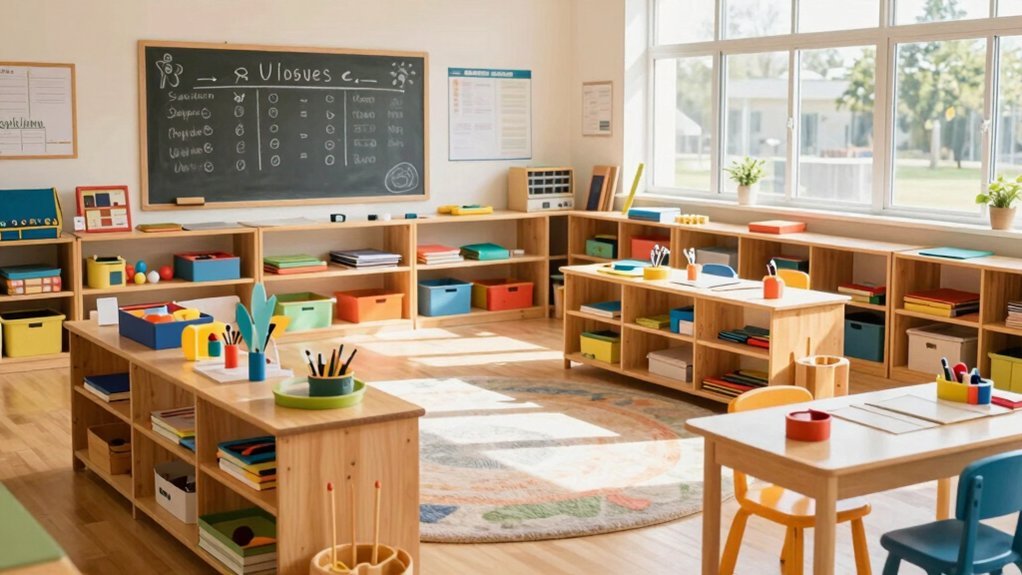
You’ll create an effective prepared environment rotation schedule by matching material cycles to your child’s developmental readiness rather than following a rigid calendar. Observe what they’re actually engaging with, rotate every two to three weeks based on interest signals—not just time—and limit active options to five or six materials. You’ll reduce cognitive overload while encouraging deeper focus and meaningful learning. Understanding how to track those engagement patterns and adapt seasonally takes your system from functional to truly transformative.
Why Material Rotation Matters for Your Child’s Learning
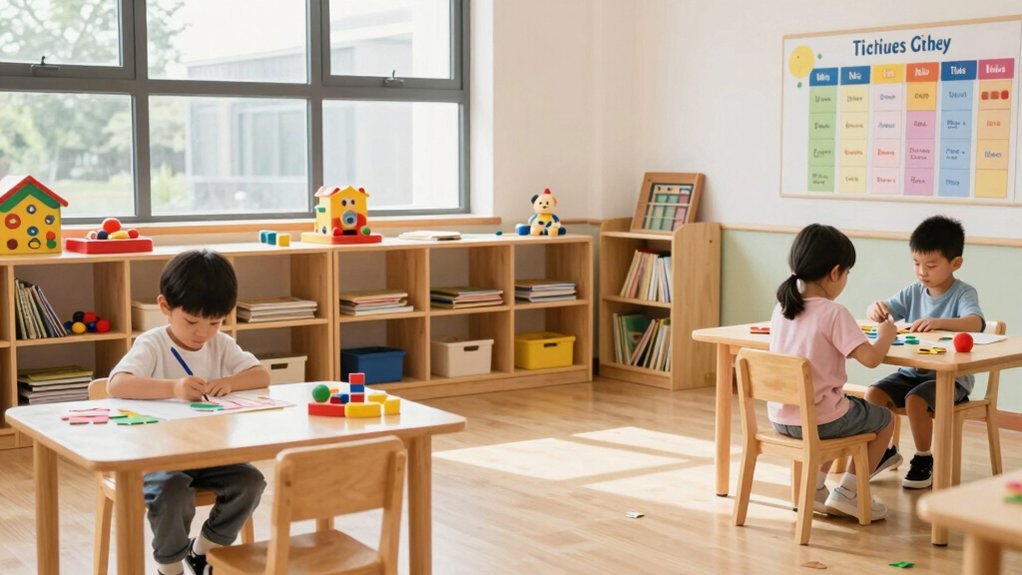
A cluttered playroom can feel overwhelming, but rotating materials transforms your child’s learning environment into a focused space where they’ll naturally concentrate deeper and longer. When you limit visible toys, you reduce cognitive overload and anxiety, allowing your child to engage meaningfully with fewer items.
Rotation establishes predictable routines that enhance sustained attention and memory retention. Your child spends more time mastering skills through repeated exploration of purposefully selected materials rather than bouncing between endless options. Research shows that fewer toys lead to longer, more exploratory play experiences that deepen learning outcomes.
This approach aligns with Montessori principles: decluttered environments promote extended engagement periods, and children develop stronger concentration abilities. By strategically rotating materials every two weeks or upon skill mastery, you’ll notice your child demonstrates improved focus, better problem-solving capabilities, and genuine enthusiasm for learning.
Start Here: Assessing What Your Child Actually Needs
Now that you understand how rotation supports your child’s learning, you’ll need to determine which materials truly matter for their development stage and interests.
Start by observing your child during independent work and recording what captures their attention. Document which materials they choose repeatedly and where they demonstrate mastery versus struggle. Review your notes weekly to identify patterns in their concentration and skill development. The prepared environment quality directly impacts how effectively your child can engage in self-directed learning and skill acquisition.
| What to Observe | Why It Matters | Action to Take |
|---|---|---|
| Material choices | Reveals intrinsic interests | Prioritize those areas |
| Error patterns | Shows readiness gaps | Adjust difficulty level |
| Mastery indicators | Confirms progress | Introduce advanced work |
| Engagement duration | Measures focus development | Track concentration growth |
This assessment informs your rotation strategy, ensuring you introduce materials matching your child’s current needs rather than guessing what they’re ready for.
When to Rotate: Spotting the Signs of Lost Interest

How do you know when it’s time to swap out materials? Watch for clear behavioral shifts that signal disengagement. If your child avoids the prepared environment, complains of boredom, or shows declining motivation, these are red flags. You’ll notice inattentiveness, difficulty concentrating, or excessive time spent without progress on activities.
Watch for behavioral shifts: avoidance, boredom complaints, and declining motivation signal it’s time to refresh materials.
Pay attention to emotional cues too. Frustration, low self-esteem, or reluctance to participate suggest the current materials aren’t meeting their needs. Misbehavior or quick irritability often masks understanding difficulties rather than defiance. These internalising and externalising responses can indicate that the child’s emotional wellbeing is affected by misalignment with available materials.
Academic performance matters as well. Repeating mistakes, falling grades, or loss of interest in learning indicate misalignment between your child’s current abilities and available materials.
When you spot these patterns consistently, it’s time to rotate. Fresh, appropriately challenging materials reignite engagement and learning momentum.
Designing Your Rotation Cycle: A Practical Weekly Framework
Once you’ve identified that materials need refreshing, you’ll want to structure your rotation around your child’s natural learning rhythms.
Your weekly framework should align with your daily schedule, rotating materials during transition periods rather than mid-concentration.
Start by designating specific rotation days—perhaps Monday mornings or Friday afternoons—when you swap stored items with active ones.
This consistency helps your child anticipate changes and maintain independence.
Keep your rotation cycles brief, typically two to three weeks per set.
This frequency prevents boredom while allowing sufficient mastery time.
Coordinate rotations with your work periods: introduce new materials after deep-focus cycles when your child’s ready for fresh engagement.
Store rotated items accessibly so you can swap them efficiently without disrupting your established routines or flow.
Limiting active options through toy rotation ensures your child can focus deeply on fewer materials without overwhelming the prepared environment.
Which Materials Rotate, Which Stay: Curating Your Collection
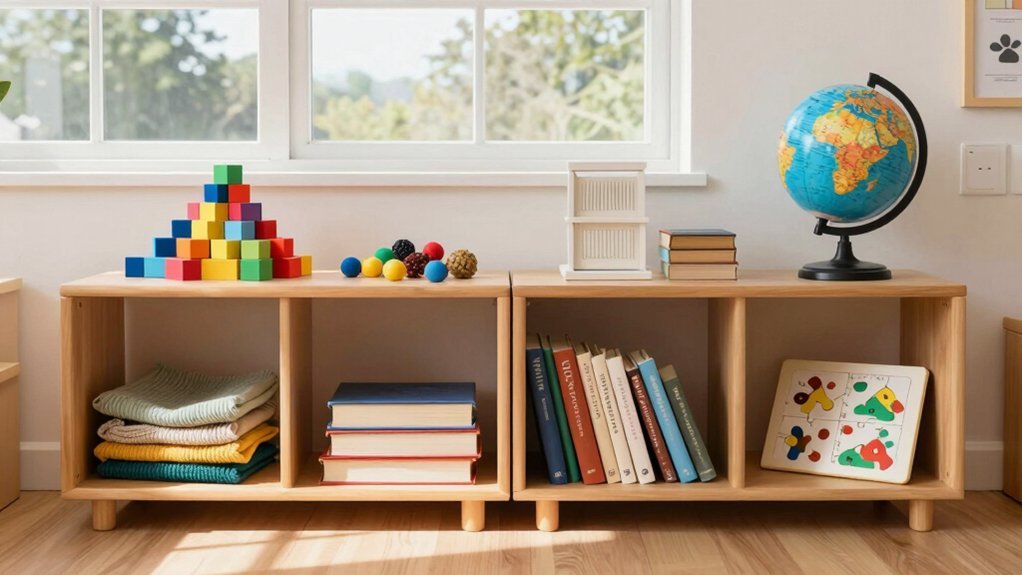
What distinguishes a thriving Montessori environment from an overwhelming one? You’ll find the answer in strategic curation. Your core materials—pink tower, red rods, sound cylinders—remain permanently fixed, providing the stability children need. These foundational items anchor learning and build competence through familiarity.
Meanwhile, you’ll rotate supplementary materials based on observed interests and developmental readiness. Practical life activities, art supplies, and open-ended blocks cycle in and out purposefully, keeping the environment fresh without creating chaos. The left to right progression of rotated materials guides children naturally through increasingly complex activities, supporting their self-directed learning journey.
| Category | Stays Fixed | Rotates |
|---|---|---|
| Sensorial | Sound cylinders, color boxes | Supplementary exploration items |
| Practical Life | Core activities | Interest-based extensions |
| Open-Ended | Basic blocks | Seasonal variations |
This balance between stability and novelty creates an engaging, orderly space where children thrive.
Pairing Activities by Difficulty to Prevent Frustration
Why do some children abandon activities after moments while others work with intense concentration? The answer lies in difficulty calibration. You’ll want to pair activities strategically so each child experiences appropriate challenge without frustration.
Difficulty calibration is key: strategically pair activities so each child experiences appropriate challenge without frustration or abandonment.
When you notice toy hopping, throwing pieces, or ignoring materials for days, rotation is needed. Conversely, when you observe careful engagement—children so focused they’re unaware of surroundings—you’ve matched difficulty perfectly. Anchor activities like beloved favorites should remain consistently on the shelf to provide emotional security while you rotate other materials based on behavioral cues.
Structure your environment by limiting initial offerings to 5-6 activities. Arrange them from simple to complex on shelves, reflecting developmental progression. For children aged 2-3, start with sorting and grading. Ages 3-4 progress toward language work and classification games.
Monitor hand size and attention span when scaling difficulty. Each tray should contain one clear goal with self-correction built in, allowing successful completion and confidence for advancing toward more complex work.
How Observation Guides Your Rotation Decisions

How do you know when it’s truly time to rotate materials? Systematic observation provides the answer. You’ll track which materials children consistently bypass, indicating developmental mismatch or fatigue. Record concentration levels during focused work to determine optimal rotation intervals for your specific group.
Monitor emerging interests through free-choice periods—children’s spontaneous material selections reveal genuine engagement versus imposed activities. Notice when social dynamics shift during group interactions, signaling when collaborative materials need rotation. Rotation and limitation of materials support will, patience, and observational skills as children develop deeper engagement with fewer options.
Document patterns across multiple days rather than making arbitrary decisions. This objective data collection reveals natural rotation windows aligned with developmental readiness. You’re not guessing; you’re responding to what children actually demonstrate through their engagement patterns, ensuring rotations maintain relevance and prevent stagnation.
Forward Rotations: Why the Direction Matters for Independence
When you rotate toys forward on a predictable schedule, you’re aligning your child’s natural rhythms with environmental changes, which reduces the adaptation stress that comes with unpredictable shifts.
Your child thrives on knowing what to expect—whether that’s a new material appearing every two weeks or monthly—because this consistency builds the confidence needed for independent exploration and decision-making. Limiting the environment to no more than five toys at a time helps children focus more deeply and engage more meaningfully with each item available to them.
Circadian Rhythm Alignment Benefits
The direction you rotate through your work schedule—forward or backward—fundamentally shapes your body’s ability to adapt and thrive. When you progress clockwise through shifts, you’re aligning with your natural circadian rhythm’s tendency to advance more easily than delay. This forward momentum reduces adaptation time and minimizes the phase disruptions that backward rotations create.
Your body responds to this alignment by maintaining stable relationships between your internal clock and sleep-wake cycle. You’ll experience better daytime alertness, improved sleep consolidation, and enhanced cognitive performance. Forward rotations also support your autonomy by reducing reliance on external sleep aids or stimulants to compensate for misalignment. Environments that respect natural rhythms further amplify these benefits by supporting your overall well-being during schedule transitions.
Adaptation Stress Reduction Mechanisms
Forward rotations eliminate the compounding stress your body experiences when fighting against its natural circadian tendency. When you rotate materials from top left to bottom right, you’re synchronizing your schedule with your children’s developmental readiness and energy patterns throughout the day.
This alignment prevents the cognitive friction that occurs when you introduce challenging activities during low-energy periods. You’re not forcing adaptation; you’re supporting it. By matching material complexity to circadian peaks, you reduce the neural effort required for transitions. This left-to-right progression mirrors the natural developmental sequencing that prepares children for reading and mathematical thinking.
Your children navigate materials intuitively, without constant reorientation. They develop confidence through predictable progression rather than random challenge. This systematic approach transforms rotation from a logistical task into a stress-reduction mechanism that nurtures both independence and neurological efficiency.
Independence Through Predictable Scheduling
While reducing adaptation stress matters profoundly, you’ll discover that predictability itself becomes the gateway to genuine independence. When you rotate materials forward consistently, you’re creating the external structure young children need to thrive autonomously.
Here’s how forward rotations cultivate self-reliance:
- Limited choices prevent overwhelm, allowing deeper engagement with fewer items
- Sequential introduction matches your child’s developmental rhythm, building confidence progressively
- Consistent timing reduces decision fatigue, freeing mental energy for exploration
- Ordered environments enable mastery without adult intervention, fostering self-discipline
You’re not just organizing materials—you’re architecting conditions where children manage their own learning cycles. Predictable rotations every two weeks or at skill mastery points honor your child’s natural rhythm. This framework transforms preparation into independence, shifting responsibility gradually from you to your child through uninterrupted, purposeful work. Displaying 6-8 toys on accessible shelves ensures your child can independently select engaging materials without feeling overwhelmed by excessive options.
Spacing Out Materials: Preventing Decision Fatigue
You’ll find that managing Material Rotation Timing Strategies prevents your learners from facing overwhelming choices that drain their mental resources. By spacing materials strategically, you’re implementing Cognitive Load Management Systems that allow focused attention on one concept before introducing the next. This deliberate sequencing keeps your environment supportive rather than cognitively demanding, enabling genuine independence rather than decision paralysis. Similar to how rotating shift patterns distribute work fairly among staff members, thoughtfully spacing materials ensures that equitable cognitive distribution occurs throughout your learning environment.
Material Rotation Timing Strategies
How can you prevent students from becoming overwhelmed by too many choices at once? Strategic material rotation timing creates predictable patterns that support focus and reduce decision fatigue.
- Announce rotations clearly – Use consistent clock-based signals or teacher cues so students know when transitions occur
- Cycle materials systematically – Introduce fresh stations weekly while removing less-engaging options temporarily
- Sequence progressively – Build skills by rotating stations that increase in complexity, helping students master foundational concepts first. Fixed-time intervals of 10-15 minutes per station work well for maintaining structure while allowing adequate time for skill development.
- Adjust timing by age – Allocate 10-15 minutes per station, extending or shortening based on your students’ developmental needs
This approach maintains novelty without creating choice paralysis. You’ll notice students engage more deeply when they understand the rotation schedule and can anticipate what’s coming next.
Cognitive Load Management Systems
Even with predictable rotation schedules in place, students still face cognitive overload when too many materials compete for their attention simultaneously. You can manage this by strategically spacing out available materials, reducing the decision burden on learners.
When you limit choices per rotation period, you decrease extraneous load and prevent decision fatigue. Scaffold the learning environment by introducing new materials gradually while removing mastered items. This approach aligns with cognitive load theory by optimizing working memory capacity. Well-designed spacing supports schema development by allowing students to integrate new information with existing mental frameworks without overwhelming their processing capacity.
You should monitor how many materials students access at once. Granular diagnostic assessments help you identify which items truly support current learning goals. Remove distracting elements that don’t contribute to core concepts. By thoughtfully spacing rotations, you create focused environments where students concentrate on germane load—the cognitive resources directly supporting knowledge transfer.
Common Rotation Mistakes That Kill Engagement
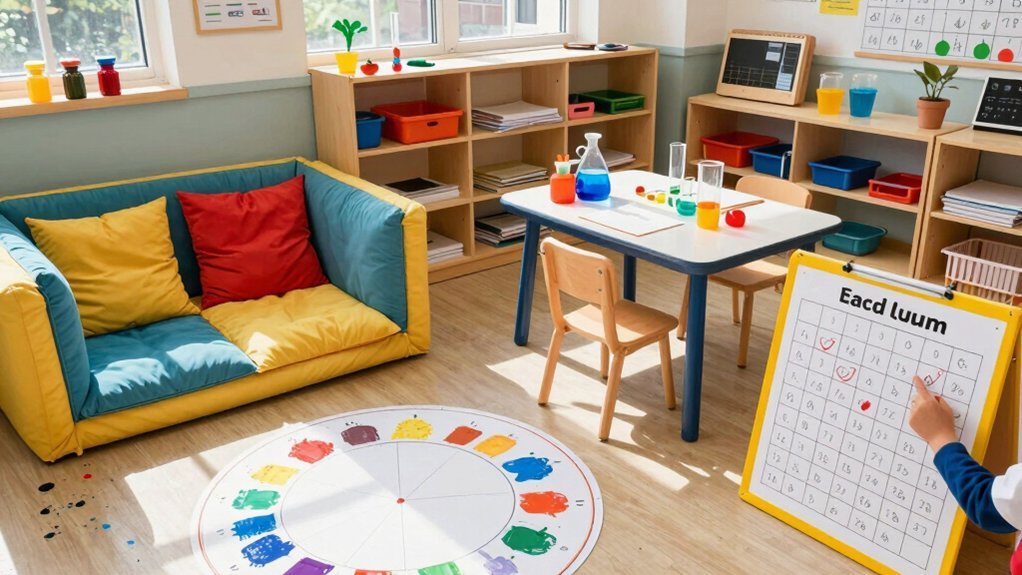
Why do some prepared environments lose their spark despite thoughtful planning? You’re likely making common rotation mistakes that undermine engagement.
- Overcontrolling choices – Micromanaging toy selections and activity sequences disrupts your child’s autonomy and reduces intrinsic motivation for learning. Facilitating rather than dictating empowers children to make meaningful choices that sustain their engagement with materials.
- Ignoring behavioral cues – Rotating on calendar schedules rather than observing your child’s interest patterns wastes preparation time and reduces genuine engagement.
- Adding complexity too quickly – Placing advanced materials before foundational skills are mastered creates frustration instead of progress and diminishes problem-solving confidence.
- Neglecting material completeness – Rotating incomplete sets without control of error mechanisms prevents your child from self-correcting independently.
These mistakes transform your environment from a catalyst for learning into a source of confusion. You’ll restore engagement by respecting your child’s developmental pace and observing their actual behavioral signals rather than external schedules.
Visual Trackers and Systems That Actually Work
Once you’ve identified the rotation mistakes undermining your environment, you’re ready to build a system that actually tracks engagement. Bullet journals work exceptionally well for logging weekly observations and noting which toys capture your child’s attention.
Wipeable monthly calendars mark rotation frequencies, giving you a visual reference that adapts as needed. Photograph each shelf’s current setup—you’ll spot patterns in what sustains interest versus what collects dust. When selecting which materials to photograph and track, prioritize open-ended toys that align with Montessori principles, as these tend to generate the most meaningful engagement data.
Document gradual introductions to track how quickly your child adapts to new materials. These trackers serve dual purposes: they guide your rotation decisions and reveal developmental progress. Your system needn’t be complicated; simple, consistent documentation reveals exactly what your environment needs.
Adapting Your Schedule as Your Child Grows
How do you know when your rotation schedule has stopped serving your child? Your child’s developmental needs constantly evolve, requiring you to adjust your approach accordingly.
Consider these key adaptations:
- Monitor skill progression – When your child masters activities independently, introduce slightly more challenging materials that stretch their emerging abilities.
- Observe interest shifts – Track which categories engage them most and rotate more frequently within those areas while phasing out lost interests.
- Adjust frequency based on age – Younger toddlers benefit from bi-weekly rotations, while older preschoolers thrive with monthly schedules allowing deeper exploration.
- Expand or contract your collection – As capabilities grow, you’ll naturally need more complex puzzles, building materials, and problem-solving activities while removing simpler infant toys.
Regular observation ensures your rotation schedule grows with your child. This practice of uninterrupted work cycles with appropriately challenging materials supports the deep concentration and mastery that foster genuine love of learning in your home environment.
Seasonal and Interest-Based Adjustments: Staying Responsive
Your prepared environment thrives when you actively respond to the seasons and your child’s evolving interests rather than maintaining a static rotation schedule. Pay close attention during work cycles—observe which materials your child gravitates toward and what captures their focus. When you notice sustained interest, allow deeper engagement through repetition rather than rotating those items away prematurely.
Simultaneously, align your environment with seasonal changes. Swap materials daily to reflect current weather and natural cycles. Update your nature table, rotate continent folders, and adjust outdoor activities to match environmental shifts. This responsiveness prevents overwhelm while building predictability. Consider using magnetic wooden dolls with seasonal outfits to help children internalize the connection between clothing choices and environmental conditions.
Track materials receiving insufficient attention, then strategically introduce them when your child shows readiness. Small, purposeful rotations based on genuine observation and seasonal relevance create coherence between your child’s interests and their learning environment.
Frequently Asked Questions
How Do I Manage Rotation Schedules Across Multiple Children With Different Developmental Stages?
You’ll create separate rotation schedules for each child based on their developmental stage. Observe their skills, limit activities to 5-6 per child, rotate weekly or bi-monthly, and involve them in choosing what’s next.
What Technology or Tools Best Automate Tracking Rotations and Send Reminders?
You’ll benefit from scheduling apps that create individual student schedules and send automatic transition reminders. Digital tools track which stations students visit, ensuring you’ve rotated materials every one to two weeks based on their developmental interests.
How Frequently Should I Reassess and Adjust the Rotation Schedule Monthly?
You’ll reassess your rotation schedule weekly through observation, adjusting monthly based on your child’s engagement patterns, skill mastery, and developmental changes you’ve documented in your tracking system.
Can Rotation Schedules Work Effectively With Limited Storage Space in Small Homes?
Yes, you can make rotation schedules work in small homes by implementing space-efficient patterns like 2-2-3 or 4-on/4-off rotations. You’ll minimize concurrent materials and maximize periodic clear-out days for reorganization.
How Do I Balance Child-Led Interests With Structured Rotation Framework Consistency?
You’ll balance child-led interests with structured rotation by observing when your child masters skills or loses interest, then rotating materials accordingly. You’re not forcing schedules—you’re responding to their developmental readiness while maintaining environmental order.
In Summary
You’ll find that effective rotation schedules aren’t rigid—they’re living systems you adapt based on your child’s engagement and growth. By tracking interest levels, respecting seasonal shifts, and staying responsive to what your child actually needs, you’re creating an environment that sustains curiosity. You’re not just rotating materials; you’re actively nurturing a love of learning that evolves with your child.



Leave a Reply