
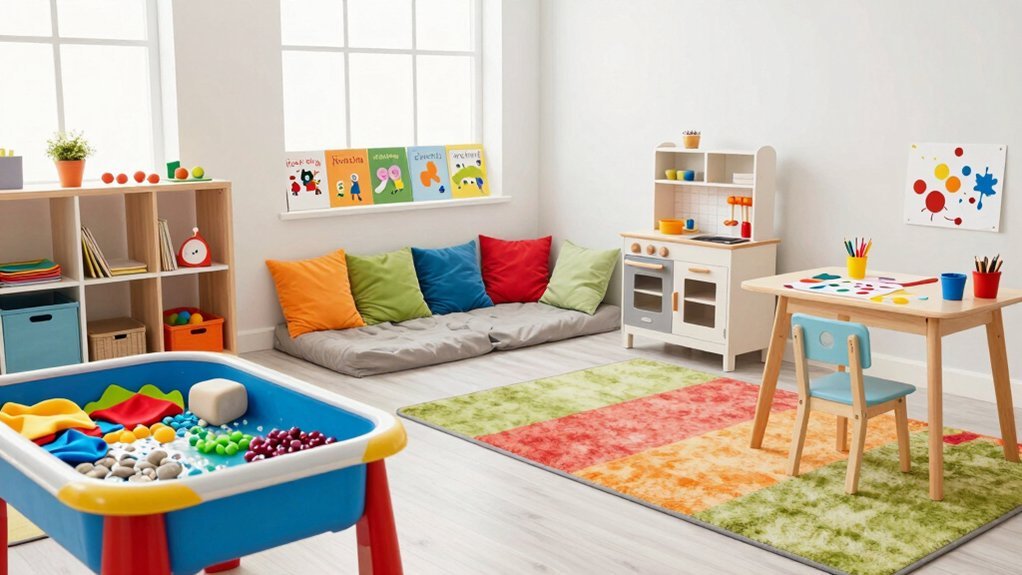
You’ll transform your toddler’s space by arranging low, child-sized shelves with minimal, rotated materials displayed at eye level. Create open zones with natural elements like wood and stone, eliminating visual clutter. Include child-sized tools for real cooking, cleaning, and gardening tasks. Add sensorial materials such as color tablets and sound cylinders for focused exploration. Designate movement spaces with mirrors and open floor areas for gross motor development. Prioritize natural materials over plastic for authentic sensory experiences. Establish predictable routines with visual timers to build security. Each setup compounds the others—discover how they work together below.
How to Organize the Montessori Prepared Environment With Low Shelves

How do you create an environment where toddlers can confidently choose their own activities? Start with low, child-sized shelves positioned at ground level so your toddler can view and reach materials independently. Choose longer shelves with open cubicles over tall, enclosed designs to maximize visibility. Select durable wooden materials like natural birch for both sturdiness and aesthetic appeal.
Arrange materials on trays and baskets, grouping them by developmental skills like practical life or sensory play. Display items front-facing to invite engagement and simplify selection. Limit your offerings to purposeful, minimal choices aligned with your child’s stage, rotating materials every few weeks to maintain interest without overwhelming them. This minimalist approach emphasizes quality over quantity, which reduces clutter while supporting a sense of responsibility in your child.
Label shelves with words or pictures, supporting vocabulary development while building responsibility and independence.
Designing Open Zones Without Visual Clutter
Creating open environments for toddlers requires intentional balance—you’re designing spaces where supervision remains effortless while visual simplicity encourages focused exploration.
Incorporate natural, uncluttered elements like logs, stumps, and boulders instead of manufactured equipment. These materials minimize visual overwhelm while supporting manipulation and discovery. Unmanicured landscapes with wild areas appeal naturally to children without demanding structured interaction.
Arrange soft surfaces—sand, water, grass, and rugs—strategically throughout your space. Separate noisy and quiet activity zones to reduce sensory chaos. Create secluded corners and enclosures where toddlers can retreat without feeling visually dense environments. These hidden curriculum spaces enable discovery and exploration aligned with developmentally appropriate learning opportunities.
Maintain open sightlines so staff easily observe children while they play independently. Individual cubbies and family photos preserve personal connection within your open layout. You’ll notice toddlers engage more deeply when visual clutter disappears and natural elements invite their attention.
Child-Sized Tools for Practical Life Learning
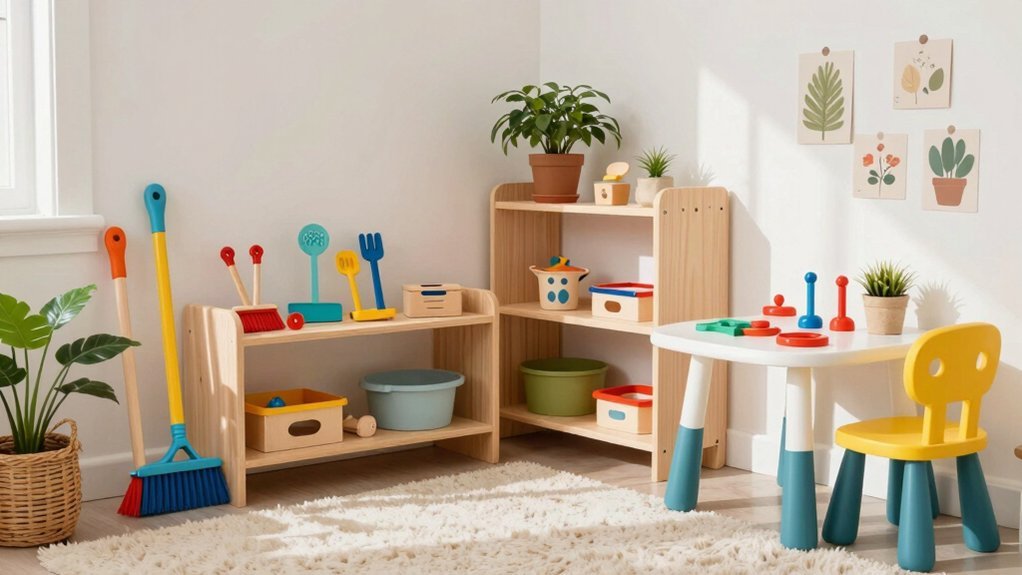
When toddlers handle real tools scaled to their size, they’re not just mimicking adults—they’re developing genuine competence and independence. Child-sized implements let your toddler accomplish tasks without frustration or danger.
Child-sized tools transform toddlers from mimics into competent, independent learners—accomplishing real tasks safely.
In the kitchen, offer child-sized knives, potato peelers, and crinkle cutters so they can prepare food safely. Dressing frames with buttons, laces, hooks, and Velcro teach fine motor skills while building confidence. Cleaning tools—small brooms, mops, and dustpans—encourage responsibility for their environment.
Practical life tools extend beyond daily routines. Woodworking supplies like hammers, saws, and safety glasses introduce problem-solving. Gardening trowels and watering cans connect children to nature. These materials support the development of order, concentration, and coordination that form the foundation for all later learning.
You’re not equipping your toddler with toys; you’re providing real instruments for meaningful work. This approach transforms ordinary activities into powerful learning experiences that build self-reliance.
Sensorial Materials That Build Focus and Perception
Why do toddlers focus so intently on a single color tablet or sound cylinder? You’re witnessing their brains isolating one variable at a time, building neural pathways for refined perception.
When you introduce sensorial materials strategically, you’re creating concrete pathways to abstract thinking. Your toddler’s visual discrimination improves 71% through focused color work, while size comparison activities boost awareness by 67%.
Consider these essential materials:
- Color Tablets – identical except for hue, developing precise color vocabulary and recognition accuracy reaching 72%
- Pink Tower – consistent shape and material highlighting size distinctions through hands-on manipulation
- Sound Cylinders – matching exteriors with varying contents, cultivating auditory discrimination
These materials transform perception into lasting touchstones. Your child progresses from simple sorting to complex exploration, establishing foundations for mathematical and scientific thinking throughout life. Multi-sensory experiences activate multiple brain regions for integrated learning networks that support long-term retention and cognitive flexibility.
Movement Spaces: Mirrors, Floor Play, and Open Freedom

You’ll want to position full-length, shatterproof mirrors at your toddlers’ eye level to foster self-awareness while they explore reaching and turning movements. Create uncluttered floor spaces with soft, non-slip surfaces that invite block building and barefoot play, keeping these zones at least 3 feet away from sleeping areas. Design open layouts with minimal furniture obstacles so your toddlers can move freely without interruption, which naturally boosts their physical activity and refines their developing motor skills. Ensure safe traffic patterns by arranging your furniture and pathways to support positive interactions and minimize congestion during transitions between activity zones.
Mirror Placement For Self-Recognition
How you position mirrors in your toddler’s environment fundamentally shapes their capacity for self-recognition and body awareness. Strategic placement supports developmental progression across different ages and stages.
Consider these key positioning strategies:
- Floor-level mirrors for seated infants around 6 months old, enabling reaching and patting during tactile exploration
- Standing or wall-mounted mirrors for toddlers aged 12-24 months, revealing full-body movement and integrated physical form
- Multiple heights accommodating growth, progressing from isolated facial recognition to comprehensive body awareness
Secure fastening prevents safety hazards during extended play sessions. Accessible placement within natural play zones reduces barriers to spontaneous mirror engagement, allowing your toddler to direct their own discovery. Research shows that self-directed tactile experiences, such as prompted face-touching during mirror play, can accelerate self-recognition development by approximately two months compared to typical onset. This environmental design accelerates self-recognition development while supporting the neurological connections essential for emerging self-awareness.
Floor-Level Freedom And Exploration
While mirrors support your toddler’s self-awareness, the floor itself becomes the canvas for extensive physical and cognitive growth. You create optimal conditions by laying soft foam mats that cushion movements while your child rolls, crawls, and reaches freely.
Arrange toys at varying heights and directions to encourage neck strengthening and spatial exploration. This setup builds gross and fine motor skills simultaneously as your toddler manipulates objects and investigates cause-and-effect relationships.
Rotate activities regularly to maintain engagement and prevent boredom. Supervise fully while respecting your child’s pace—this balance fosters independence and self-confidence. Your consistent presence during these activities creates emotional bonding that deepens your parent-child connection while your toddler explores freely.
Floor play strengthens the foundation for later milestones: standing, walking, and talking. You’re not just facilitating play; you’re building neural pathways that support communication, coordination, and emotional resilience throughout childhood.
Open Spaces Supporting Gross Motor
Why do toddlers thrive in expansive movement spaces? You’ll find that open environments fuel their natural drive to explore and build gross motor skills. When you eliminate barriers, you’re giving toddlers the freedom they need to run, jump, and test their physical capabilities safely.
Consider these key elements:
- Indoor hallways support races via crawling, bear-walking, or hopping, transforming everyday spaces into movement zones
- Outdoor areas with grass or sand challenge balance during dynamic movements and varied terrain
- Short bursts of 5-10 minutes optimize coordination and focus while preventing overstimulation
You’ll notice that mixing open freedom with quieter tasks creates rhythm in your toddler’s day. This balance reduces overwhelm and strengthens their body awareness, coordination, and confidence across all developmental domains. Uneven terrain like natural grass and sand surfaces stimulates tactile feedback during movement, allowing toddlers to adapt to diverse textures and strengthen their gross motor abilities through varied sensory experiences.
Why Natural Materials Outperform Plastic in Montessori Classrooms

Natural materials fundamentally transform how toddlers engage with their learning environment. When you introduce wood, stone, and cotton instead of plastic, you’re providing authentic sensory experiences that develop neural pathways plastic can’t replicate. Your toddlers feel real temperature variations, textures, and weights that sharpen their sensory processing.
Unlike plastic toys that fade and break, natural materials withstand repeated Montessori-style exploration for years. Birchwood blocks survive intensive handling while supporting mathematical concept development through hands-on manipulation.
You’re also modeling environmental stewardship. Natural materials biodegrade or repurpose, reducing landfill waste while teaching responsibility. When your toddlers care for plants and handle fragile items, they develop respect for living ecosystems. These multisensory exploration activities deepen your toddlers’ connection to the earth while cultivating awareness of natural systems.
The serene aesthetic of natural elements—neutral colors, orderly displays, classical simplicity—creates a focused environment that inspires concentration and creativity far beyond plastic’s distracting brightness.
Routines: Building Security Into the Montessori Environment
When you establish predictable daily rhythms, you’re giving your toddler a framework that builds trust and reduces anxiety.
Consistent transition practices—like visual timers or routine charts—help you guide your child through the day without power struggles or confusion. Understanding the day helps toddlers feel in control and capable of time management.
Predictable Daily Rhythms
How do you build a toddler’s confidence and calm? You establish predictable daily rhythms that anchor their sense of security.
When you maintain consistent schedules, your toddler understands what comes next, reducing anxiety and promoting better decision-making. Repetition solidifies routine structure in their developing minds, helping them thrive through stability. A structured day typically includes three main work periods—morning activities from 9:30–11:30 am, midday nap around noon, and afternoon exploration—that naturally align with your child’s developmental readiness and energy levels.
You can enhance this predictability with visual supports:
- Picture cards and charts showing the day’s sequence
- Three main segments: morning work period, nap time, and afternoon work period
- Warnings before transitions to prevent resistance
These tools make routines accessible and help your toddler navigate their day independently. When children feel secure about what’s coming, they develop confidence in their capabilities and maintain better focus throughout their activities.
Consistent Transition Practices
Transitions represent pivotal moments in your toddler’s day—they’re where security either solidifies or fractures. You’ll maintain consistent routines that anchor your child in an otherwise overwhelming world. Collaborate closely with teachers and communicate transition plans with parents beforehand, ensuring everyone supports the same approach.
Design manageable challenges that foster resilience rather than frustration. When shifting to toileting, trust your child’s innate wisdom; this adjustment unfolds over weeks, not days. Offer two simple choices during transitions to prevent power struggles while building autonomy. Routine builds independence, trust, and predictable structure for your child during these moments of change.
After arrival home, allow thirty minutes of downtime for decompression. This buffer helps your toddler process the day’s experiences. By honoring these consistent practices, you create predictability that lets your child thrive during naturally vulnerable moments.
Frequently Asked Questions
How Much Square Footage Should a Toddler Montessori Classroom Actually Have?
You’ll want 40-50 square feet per toddler in your Montessori classroom. For 16 children, you’re looking at approximately 600 square feet of usable floor space. This accommodates their high mobility and gross motor development needs.
What Outdoor Space Design Best Complements an Indoor Prepared Environment?
You’ll design outdoor spaces that mirror your indoor Montessori environment by creating distinct activity zones—quiet areas for observation, active zones for climbing, and creative spaces for art. You’ll connect these with accessible pathways, integrate natural materials like wood and stone, and ensure adequate shade, water, and seating throughout.
How Do I Balance Independent Choices Without Overwhelming Toddlers With Options?
You’ll empower your toddler by offering two or three specific choices—like “red or blue crayon?”—rather than overwhelming them. This balanced approach fosters autonomy while keeping decisions manageable and supporting their developing executive function skills.
When Should I Introduce Mixed-Age Grouping in a Toddler Environment?
You’ll introduce mixed-age grouping when you’ve got toddlers aged one year apart or more. You’re creating a family-like environment that reduces progression, supports continuity from infancy through toddler years, and naturally scaffolds learning.
How Does Soft Surface Flooring Impact Toddler Safety and Development?
You’ll find that soft surface flooring dramatically reduces fall injuries while cushioning your toddler’s knees and feet during crawling and walking. It builds gross motor confidence, encourages active exploration, and supports healthy development through safe, comfortable play.
In Summary
You’ll create a thriving Montessori environment when you combine low shelves, open spaces, and child-sized tools that invite exploration. You’ll notice your toddler’s focus deepening as you introduce sensorial materials and natural textures. You’ll foster independence through movement spaces and consistent routines that build security. You’re not just organizing a room—you’re designing a space where your child naturally develops confidence, concentration, and a lifelong love of learning.


Leave a Reply