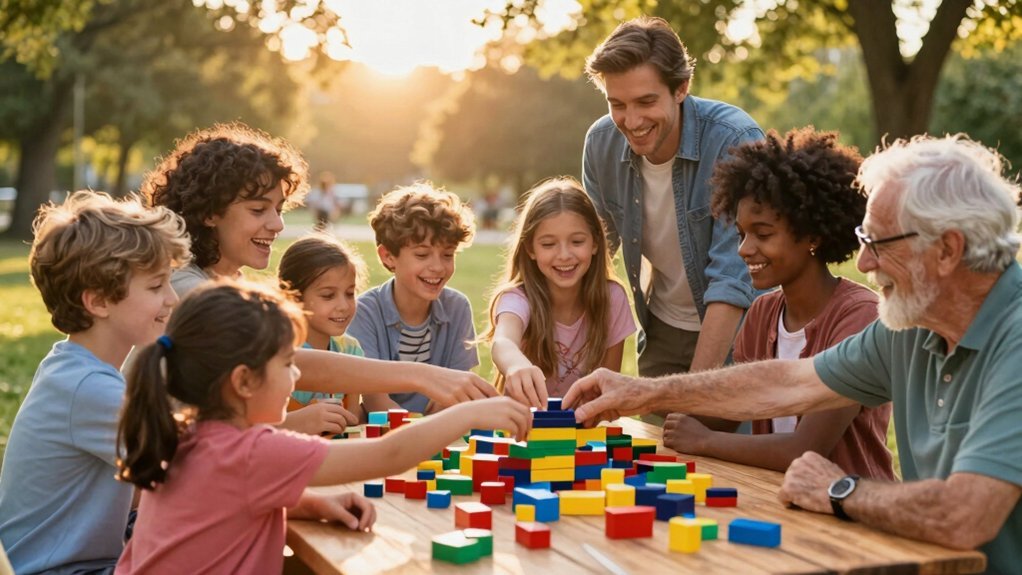
When you place younger children with older peers, you’re activating a cognitive multiplier effect. Younger kids absorb sophisticated strategies through observation, then internalize complex problem-solving approaches as their brains rewire. Older children strengthen their own reasoning by teaching and mentoring, navigating diverse developmental needs that expand cognitive flexibility. Collaborative tasks transition watching into doing, deepening focus on processes over memorization. You’ll discover how strategic classroom design channels these interactions into transformative learning experiences.
Why Does Observation in Mixed-Age Play Build Cognitive Skills?
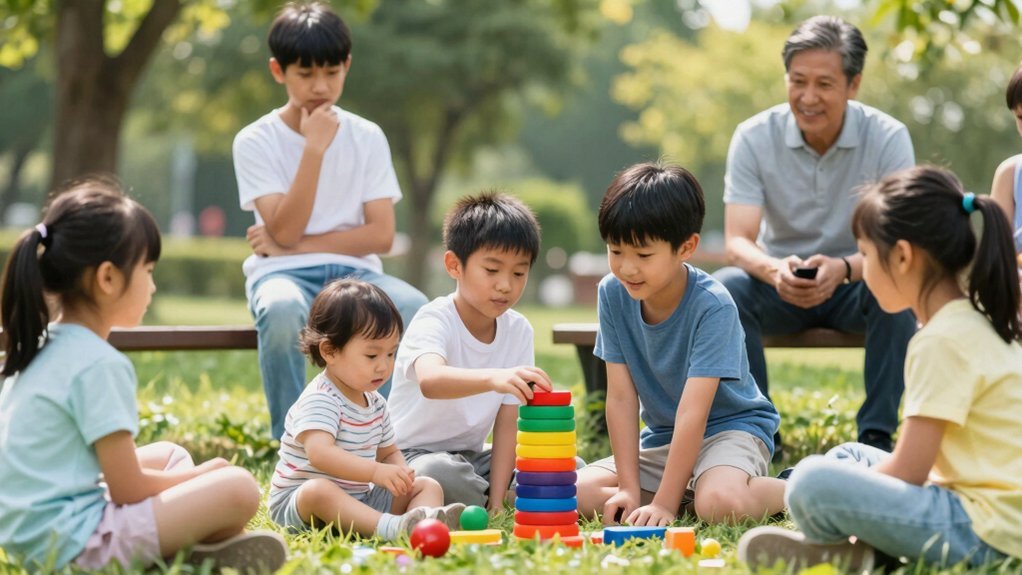
How do younger children develop advanced cognitive abilities so rapidly? When you place younger children in mixed-age settings, they’re exposed to complex ideas and sophisticated play that accelerates their thinking.
You’ll notice they focus longer on challenging tasks when observing older peers modeling advanced strategies. This observation isn’t passive—it actively rewires their brains. As you watch older children navigate intricate problems, you naturally internalize their approaches and attempt similar cognitive challenges. The exposure to mature language and complex reasoning strengthens your neural pathways for problem-solving. Mixed-age play also channels the drive for knowledge into constructive learning experiences that support growth mindset.
Research shows toddlers in age-mixed groups score higher in language and general cognitive development. You’re essentially borrowing the cognitive scaffolding that older children demonstrate, allowing you to tackle problems you’d typically encounter years later.
How Do Younger Children Learn Problem-Solving From Older Peers?
While observation plants the seeds for advanced thinking, direct instruction from older peers accelerates your problem-solving growth. When older children actively teach you, you’re not passively watching—you’re engaging in real dialogue that sharpens your thinking. This instruction prompts you to ask questions, challenge ideas, and participate meaningfully in conversations.
Older peers scaffold problems into manageable steps, revealing strategies you’d struggle to discover alone. Their leadership helps you navigate social hurdles and master complex tasks. Through this dynamic interaction, you build a richer toolkit of problem-solving approaches. This guided peer interaction maintains your agency while directing your exploration toward meaningful learning goals, much like how teachers set the stage with materials and prompts to focus discovery-based learning.
Consensus-building discussions amplify these gains further, as you negotiate solutions collaboratively. Research shows this peer instruction rivals adult-child learning in effectiveness, making your mixed-age partnerships invaluable for developing genuine problem-solving competence.
From Observation to Action: Collaborative Problem-Solving Tasks That Deepen Learning
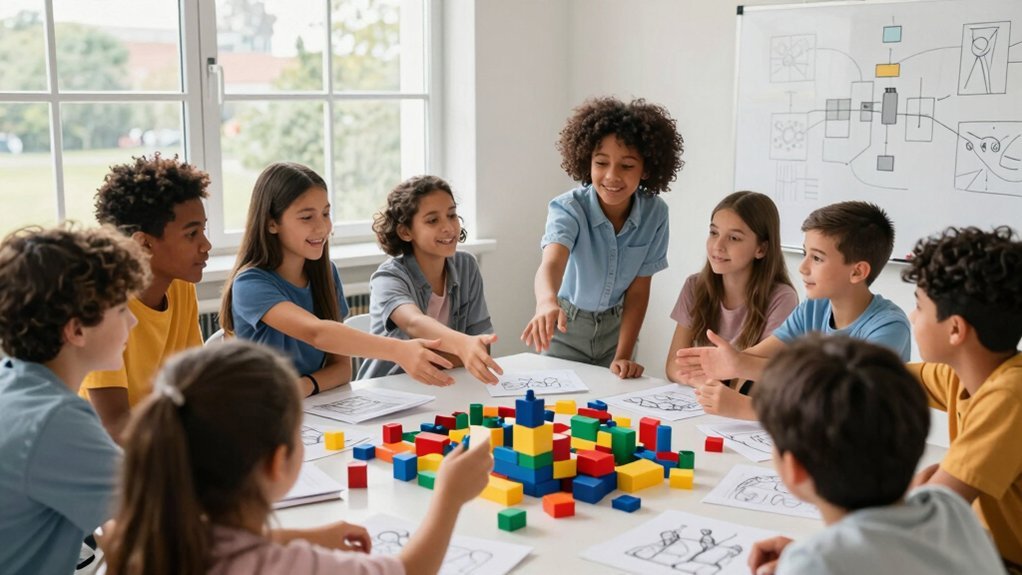
Observation alone won’t transform your problem-solving abilities—you’ve got to move from watching to doing. When you engage in collaborative problem-solving tasks with mixed-age peers, you transition from passive learning to active participation. You’ll discuss strategies more deeply, focusing on processes rather than memorizing facts. This dynamic reduces collaborative inhibition—the tendency to perform worse in groups—because you and your partners communicate distinctly about approaches. Through Plan B’s structured three-step method—empathy, definition, and joint invitation to solve—you’ll build durable problem-solving skills while addressing frustration tolerance and flexibility. These collaborative experiences strengthen your cognitive abilities and boost your accuracy, ensuring you don’t just observe mature problem-solving methods but actually internalize and apply them in real situations. Research demonstrates that social interaction influences cognitive development, meaning your conversations with peers of different ages directly shape how you think and learn.
How Do Leadership Roles Sharpen Older Kids’ Problem-Solving Abilities?
Beyond collaborative tasks, you’ll find that stepping into mentorship roles fundamentally transforms how older children approach problems. When you guide younger peers, you’re forced to articulate implicit knowledge explicitly, sharpening your own understanding in the process.
Leadership positions cultivate advanced problem-solving by requiring you to:
- Demonstrate sophisticated strategies that younger children can observe and replicate, deepening your mastery through teaching
- Navigate diverse developmental needs, which expands your cognitive flexibility and adaptive thinking
- Model decision-making processes in real time, reinforcing your own strategic reasoning
You’ll discover that explaining concepts to less experienced learners reveals gaps in your own knowledge. This metacognitive awareness drives you toward deeper comprehension. Your responsibility as a guide motivates intentional problem-solving rather than passive task completion, ultimately strengthening your reasoning abilities significantly. Through peer mentorship moments, older children internalize that progress and skills develop over time as they witness younger peers’ growth trajectories firsthand.
Setting Up Early Childhood Classrooms for Mixed-Age Problem-Solving
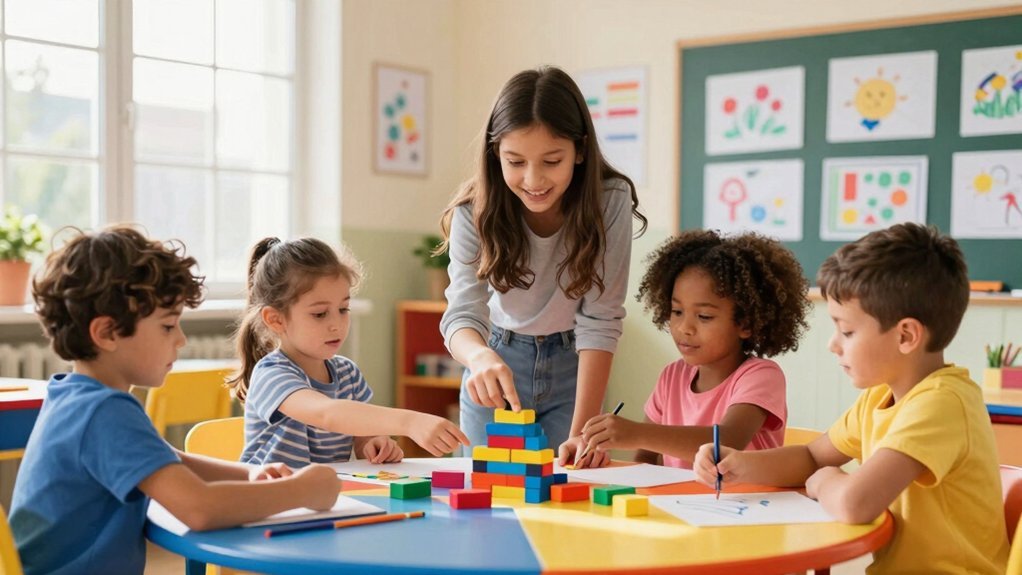
How can you transform an early childhood classroom into an environment where mixed-age problem-solving flourishes? Start by arranging flexible spaces that naturally encourage cross-age interactions. Designate specific zones where older children tackle complex challenges, modeling sophisticated strategies for younger peers to observe and emulate. Create family-like groupings that reflect real-world dynamics, allowing children to experience authentic mentorship and collaboration.
You’ll want to establish choice-time stations where peer-led exploration happens organically. These areas should support differentiated tasks so each developmental level finds appropriate challenges. Include low-ratio supervision spots for individualized guidance when needed. Research shows that peer explanations strengthen comprehension and critical thinking across age groups, making these stations ideal spaces for organic knowledge-building.
Balance your schedule between large mixed groups—ideal for social bonding—and smaller teams focused on targeted problem-solving. This intentional design transforms your classroom into a powerful learning ecosystem where age diversity becomes your greatest instructional asset.
Frequently Asked Questions
What Age Gaps Work Best for Effective Mixed-Age Problem-Solving Partnerships?
You’ll find that one-year age gaps work best for observation and skill emulation, while larger gaps amplify nurturing effects. You’ll benefit most from pairing younger problem-solvers with older peers who prioritize generative, other-focused strategies.
How Do Teachers Assess Individual Progress in Mixed-Age Classroom Settings?
You’ll use embedded tools like GOLD for daily growth tracking, conduct fall and spring observations, maintain learning logs documenting reflections, and form flexible small groups around skills, ensuring you capture individualized progress consistently.
Can Mixed-Age Grouping Reduce Academic Anxiety and Competition Among Children?
Yes, you’ll find that mixed-age grouping significantly reduces your child’s academic anxiety and competition. You’re creating inclusive communities where kids focus on discovery rather than peer comparison, practice pro-social behaviors, and normalize diverse abilities naturally.
What Role Does Conflict Resolution Play in Mixed-Age Problem-Solving Development?
You’ll develop stronger problem-solving skills when you observe older peers resolving conflicts constructively. You’ll learn positive strategies like negotiation and compromise while reducing aggressive responses, building independence and self-discipline in handling disagreements.
How Do Mixed-Age Environments Build Long-Term Confidence and Self-Esteem?
You’ll build lasting confidence when you mentor younger peers, recognize your growing expertise, and experience reduced competition. You’ll develop self-esteem through accomplishment relative to supportive peers rather than jealousy-driven comparison.
In Summary
You’ll discover that mixed-age environments transform how children solve problems. When you combine younger learners with older peers, you’re creating natural mentorship opportunities that sharpen cognitive skills across all ages. You’ll notice older kids developing leadership and deeper understanding, while younger children accelerate their learning through observation and collaboration. You’re building classrooms where problem-solving becomes a shared, dynamic process that benefits every child involved.



Leave a Reply