
You can’t build peaceful focus spaces with visual barriers alone—you’ll need layered acoustic design, ergonomic furniture, and personalized layouts. Deploy soundproof pods for confidential work, add acoustic panels and soft materials, and use IoT sensors to monitor temperature and light in real-time. Design spaces around personality types and neurodiversity needs. Establish clear boundaries between focus and collaborative zones, prevent ghost bookings with smart reservations, and measure actual usage patterns. Understanding how these elements work together reveals the most impactful combination for your unique workspace.
Prioritize Acoustic Privacy Over Visual Separation Alone
Why do you hear your colleague’s phone conversation across the office but barely notice the person sitting five feet away? Visual barriers alone don’t stop sound waves. You need acoustic privacy to truly focus.
When you rely solely on visual separation, noise still travels freely through open spaces, disrupting concentration. Bad speech privacy ranks as the #1 source of employee dissatisfaction in open offices for this exact reason.
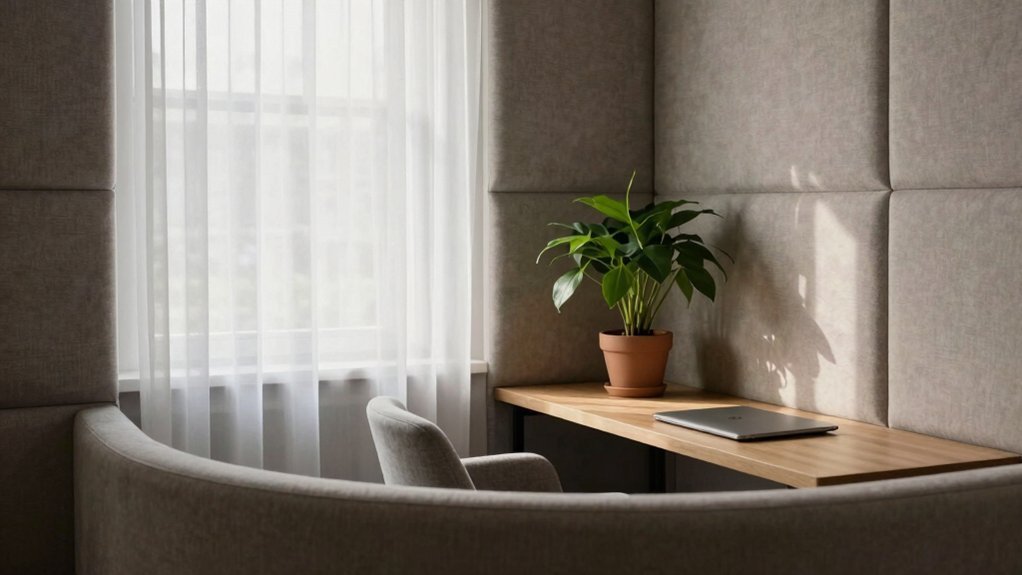
Instead, layer multiple strategies: install partitions at 65 inches or higher, add acoustic panels to absorb sound, and incorporate soft materials like rugs and felt. These elements work together to reduce noise radius and make speakers less intelligible. Sound masking systems further enhance privacy by creating pleasant generative noise that covers irritating sounds. Poor noise conditions also impair employee health and wellness by increasing perceived stress and stress hormones, making acoustic solutions essential for workplace wellbeing.
This multi-layered approach delivers genuine acoustic separation that visual barriers simply can’t achieve alone.
Choose Furniture That Supports Extended Concentration Without Distraction
You’ll find that ergonomic furniture directly impacts your ability to concentrate by eliminating physical distractions that fragment your attention.
Height-adjustable workspace solutions let you maintain the 90-90-90 posture—ankles, knees, and hips at right angles—which reduces muscular fatigue and keeps your mind sharp during extended work sessions.
When your body’s positioned correctly and comfortable, you’re not fighting discomfort or fidgeting, so you can channel all your mental energy into deep focus. Proper posture also improves blood flow and oxygen delivery to your brain, enhancing cognitive performance during sustained concentration periods.
Ergonomic Design For Focus
How much of your concentration actually goes toward managing physical discomfort?
When you’re sitting in an unsupportive chair, your brain diverts mental resources to pain management instead of focusing on work. Ergonomic furniture eliminates this drain, keeping your attention where it belongs.
Consider these key features:
- Lumbar support maintains your spine’s natural S-curve, reducing disc and muscle pressure by up to 30%
- Pressure-distribution design balances your weight across seat and backrest, preventing strain during extended sessions
- Adjustable components allow you to customize support for your body’s unique needs
- Quality materials enhance comfort while promoting proper posture and circulation
Studies show ergonomic seating boosts productivity by 15-20% simply through comfort. You’ll concentrate longer, deliver projects faster, and experience fewer interruptions from physical distractions. Over time, proper ergonomic support prevents chronic pain and musculoskeletal disorders that could otherwise derail your long-term work performance.
Height-Adjustable Workspace Solutions
What if your desk could adapt to your body instead of forcing your body to adapt to it? Height-adjustable desks do exactly that, eliminating the physical strain that disrupts concentration. When you alternate between sitting and standing, you’ll reduce sitting time by 10-21% daily, countering the typical 9.8-hour sedentary average. This movement matters: 47% of users experienced significant declines in upper back, shoulder, and neck discomfort. You’ll feel more alert and energized, naturally supporting sustained focus. The research backs it up—65% of users reported increased productivity within 12 months. Manual or electric options both work effectively, with manual desks preferred for their cost-effectiveness and ease of use. By investing in furniture that supports your body’s needs, you’re removing physical barriers to deep work and creating an environment where your mind can settle into undistracted concentration.
Deploy IoT Sensors to Personalize Environmental Conditions
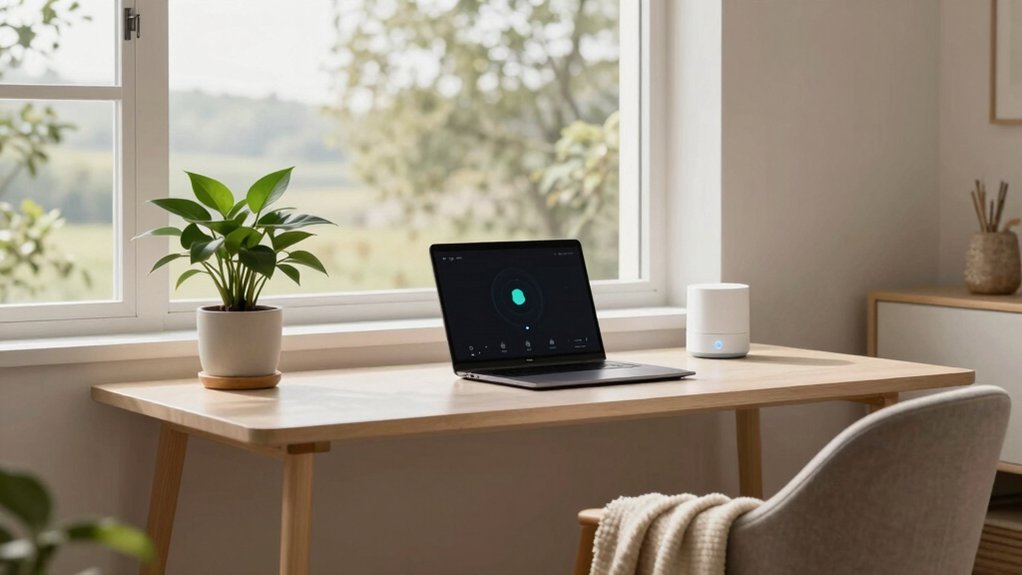
You’ll find that smart sensors optimize your concentration by continuously monitoring temperature, humidity, CO2, and lighting levels in your focus space.
Real-time environmental personalization systems adjust these conditions dynamically based on your occupancy and preferences, eliminating the distractions of uncomfortable hot spots, poor air quality, or inadequate lighting.
This sensor-driven approach transforms your workspace into a responsive environment that supports sustained mental focus without requiring manual adjustments. Cloud-based platforms enable centralized visibility and automated alerts across your focus spaces, ensuring that environmental thresholds trigger notifications to maintain optimal conditions for productivity.
Smart Sensors Optimize Concentration
Why settle for static environmental monitoring when IoT sensors can dynamically adapt to your workspace’s unique needs? Smart sensor placement dramatically improves your focus environment’s effectiveness.
You’ll benefit from:
- Optimized sensor positioning that achieves 100% accuracy with just 30% of available sensors, eliminating unnecessary clutter
- Adaptive sampling rates that reduce power consumption while maintaining real-time environmental detection
- Event-driven activation that monitors only when conditions change, conserving energy and extending device lifespan
- Multi-sensor fusion that guarantees accurate readings regardless of individual sensor placement variations
Strategic placement ensures you’re monitoring what matters most. You’ll eliminate blind spots while minimizing equipment, creating a cleaner workspace that responds intelligently to your needs. This targeted approach means better concentration support without overwhelming complexity. A data-driven optimization approach selects sensor locations by simulating environmental scenarios and assessing detection effectiveness across candidate positions to maximize coverage within your budget constraints.
Real-Time Environmental Personalization Systems
Strategic sensor placement sets the foundation, but intelligent systems that respond to your workspace in real time take focus optimization to the next level. Real-time environmental personalization systems monitor temperature, humidity, air quality, and pressure with sub-minute resolution, delivering ±0.5°C accuracy and ±2% humidity precision. You’ll receive instant alerts via email, SMS, or phone when conditions deviate from your preferences, enabling immediate adjustments. Edge computing processes data rapidly, triggering automatic HVAC optimization and system responses without manual intervention. This continuous monitoring ensures your environment adapts to your needs instantly, eliminating distractions caused by uncomfortable conditions. AI-powered pattern analysis predicts environmental deviations before they escalate, allowing proactive interventions that maintain optimal focus conditions. The result: you maintain peak concentration while the system handles environmental management autonomously, maximizing your productivity and focus capacity.
Design Focus Spaces for Personality Type, Not One-Size-Fits-All Layouts
How different are your focus needs from your coworker’s? One-size-fits-all layouts ignore personality differences that dramatically affect productivity. You’ll find better results when designing spaces tailored to how people actually work.
Consider these personality-driven approaches:
- Introverts and analyticals thrive in private offices or enclosed pods with minimal interruptions for deep thinking
- Extraverts perform better in collaborative zones with modular furniture that encourages social interaction
- Conscientious workers benefit from structured layouts with defined boundaries around 8 square meters per person
- Neurotics and agreeables need quiet, low-stimulation environments with outdoor relaxation areas for rejuvenation
You’ll boost focus and happiness by recognizing that personality type shapes workspace requirements. Research shows that 2-5% performance increases can offset the investment costs of implementing personality-aligned office designs. Personality-driven design replaces frustration with environments where everyone concentrates effectively.
Create Sensory Sanctuaries for Neurodiverse Workers
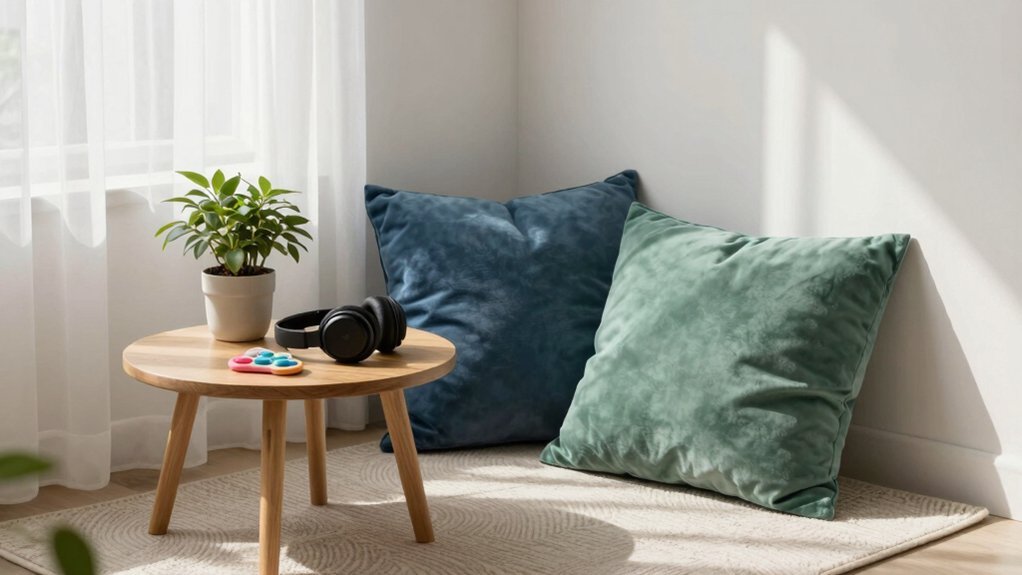
Sensory sensitivities aren’t weaknesses—they’re differences that require tailored environments. You’ll benefit from dedicated sanctuaries designed with your neurological needs in mind.
| Element | Feature | Benefit |
|---|---|---|
| Lighting | Adjustable, dimmed systems | Reduces overstimulation |
| Acoustics | Sound-absorbing panels, white noise | Minimizes distractions |
| Textures | Soft furnishings, weighted cushions | Provides calming input |
| Air | Scent-neutral environment | Prevents sensory triggers |
You can customize your workspace by selecting quiet zones with acoustic panels and carpeting that dampen noise. Incorporate adjustable lighting to avoid harsh fluorescents. Add ergonomic, textured seating like bean bags or rocking chairs for proprioceptive regulation. When you combine these elements thoughtfully, multisensory design reduces stress and enhances your ability to concentrate deeply in your sanctuary space.
These sensory sanctuaries aren’t luxuries—they’re essential accommodations enabling you to focus deeply, manage anxiety, and perform at your best.
Add Biophilic Elements to Protect Focus Without Sterility
You’ll discover that nature’s acoustic benefits—from water features to rustling foliage—mask disruptive office noise while supporting concentration.
Living elements like plants and natural materials actively reduce your stress response, lowering cortisol and heart rate within minutes so you can sustain focus without mental fatigue. Research shows that benefits emerge within 5 to 20 minutes of exposure to these natural elements, making even brief interactions with biophilic design elements an effective strategy for maintaining focus throughout your workday.
Greenery enhances your mental clarity through improved attention and cognitive function, proving that biophilic spaces deliver productivity gains without the cold, sterile feel of minimalist design.
Nature’s Acoustic Benefits
Why do focus spaces often feel sterile despite their quiet? You’re likely missing nature’s acoustic benefits. Biophilic elements transform bland soundscaping into purposeful noise control that supports your concentration.
- Timber panels and natural stone absorb sound while creating warmth through organic textures that dampen ambient noise effectively
- Wave-patterned acoustic tiles with natural motifs diffuse sound without clinical coldness, boosting your perceived cognitive performance
- Water features and birdsong soundscapes mask distractions by layering calming auditory connections that emulate outdoor tranquility
- Gradient blues and greens in ceiling designs connect your indoor acoustics to nature, reducing auditory distractions for sustained attention
You’ll find that organic acoustic elements simultaneously enhance focus and mental well-being. Research demonstrates that exposure to natural elements can positively influence cognitive performance and stress reduction in work environments. Custom modular designs with undulating textures deliver evidence-based sound control while maintaining the visual appeal your space deserves.
Living Elements Reduce Stress
Living plants and natural materials do more than decorate your focus space—they actively lower stress levels while sharpening your cognitive performance. Research demonstrates that biophilic design reduces stress by lowering blood pressure and heart rate, allowing you to concentrate without the mental strain of sterile environments. Natural elements facilitate attention restoration, counteracting focus fatigue that builds during demanding work. Studies on older adults show that biophilic home characteristics correlate with improved mood states and better adaptation to age-related changes, suggesting these environmental benefits extend across the lifespan.
| Element | Stress Reduction | Cognitive Benefit |
|---|---|---|
| Living plants | Lowers cortisol | Enhances attention |
| Natural wood | Calms nervous system | Improves focus clarity |
| Water features | Reduces blood pressure | Restores mental energy |
You’ll experience measurable improvements in mental performance when you integrate these elements strategically. Your workspace transforms into a restorative environment that sustains concentration throughout your workday.
Greenery Enhances Mental Clarity
How does adding plants to your workspace actually change your brain’s performance? Research reveals that biophilic design substantially reduces mental fatigue and enhances cognitive function.
When you incorporate greenery into your focus space, you’re activating genuine neurological changes:
- Lower mental fatigue markers: Beta 2 power reduces in your brain, indicating decreased cognitive strain during complex tasks
- Improved accuracy and speed: You’ll complete work faster with fewer errors compared to sterile environments
- Enhanced working memory: Visual connections to natural elements strengthen concentration and information retention
- Restored attention capacity: Your brain recovers from mental exhaustion, boosting focus duration
Japanese and tropical plants yield the strongest results. You’re not just decorating—you’re rewiring your brain’s stress response and sharpening your mental clarity through parasympathetic activation. Natural light exposure within your workspace further amplifies these benefits by supporting circadian regulation and optimizing cognitive processes through direct biophilic experience.
Establish Clear Boundaries Between Focus Spaces and Collaborative Areas
To create truly productive independent work environments, you’ll need to physically separate your focus zones from collaborative areas. Modern coworking spaces allocate 80% to private offices by 2025, reducing noise intrusion that historically plagued open-plan designs. You’ll benefit from this strategic zoning—77% of users report better work-life balance when clear boundaries minimize collaborative disruptions.
Design your layout intentionally. Larger centers with 100+ desks dedicate 40% to private offices versus 25% open workspaces, enhancing separation. Position focus zones away from high-interaction areas where community managers signal boundaries through recruitment and layout optimization. Leading markets like Los Angeles, Dallas-Fort Worth, and Manhattan are expanding their dedicated desk offerings to accommodate the growing demand for focused work environments.
This deliberate separation works. Remote workers report 84% improved engagement in bounded environments, while private offices boost focus productivity significantly. You’ll notice employees benefit from clear focus-collaborative delineations, averaging 2-3 office days weekly with genuine concentration achieved.
Prevent Overbooking With Smart Reservation Systems
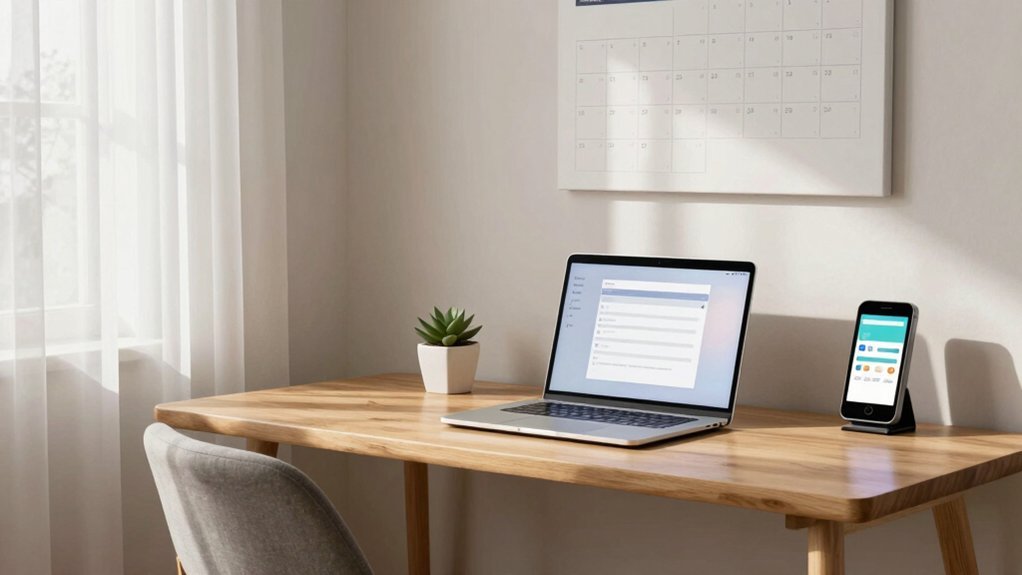
Why do ghost bookings plague so many focus spaces? They waste your real estate and frustrate colleagues seeking quiet work areas. Smart reservation systems eliminate this problem through automation and real-time monitoring.
Ghost bookings waste real estate and frustrate colleagues. Smart reservation systems with real-time monitoring eliminate this costly problem.
You’ll benefit from these key features:
- Auto-release workflows cancel empty reservations 10 minutes after start time, freeing rooms instantly
- Real-time occupancy sensors track actual usage with 95% accuracy, preventing phantom bookings
- Behavioral change incentives discourage no-shows when users know their patterns are monitored
- Data-driven insights reveal booking versus actual usage discrepancies, informing better policies
One tech company reduced ghost meetings from 34% to 9% within three months, raising utilization from 42% to 71%. Smart systems transform your focus spaces into reliably available resources your team can trust. Organizations increasingly recognize that advanced data capabilities are foundational for identifying usage patterns and optimizing space allocation across their portfolios.
Offer Both Soundproof Pods and Acoustic Quiet Zones
Once you’ve eliminated ghost bookings and reclaimed your available real estate, the next challenge is managing how sound travels through those spaces. You’ll want to deploy both soundproof pods and acoustic quiet zones strategically.
| Feature | Pods | Zones |
|---|---|---|
| Enclosure | Fully enclosed | Open panels |
| Noise Reduction | Up to 43 dB | Internal absorption |
| Best For | Solo work, calls | Large areas |
| Installation | Corner placement | Existing layouts |
| Privacy Level | Complete | Moderate |
Pods deliver complete soundproofing for confidential calls and deep focus work, while zones soften echoes in collaborative spaces. You’ll maximize your real estate by combining both approaches—pods handle sensitive tasks requiring privacy, and zones support varied work styles without full renovations. This hybrid strategy creates distraction-free environments that adapt to your team’s diverse needs. Acoustic pods are particularly valuable for underutilized corners of your office that would otherwise remain empty and unproductive.
Measure Utilization and Adjust Based on Actual Work Patterns
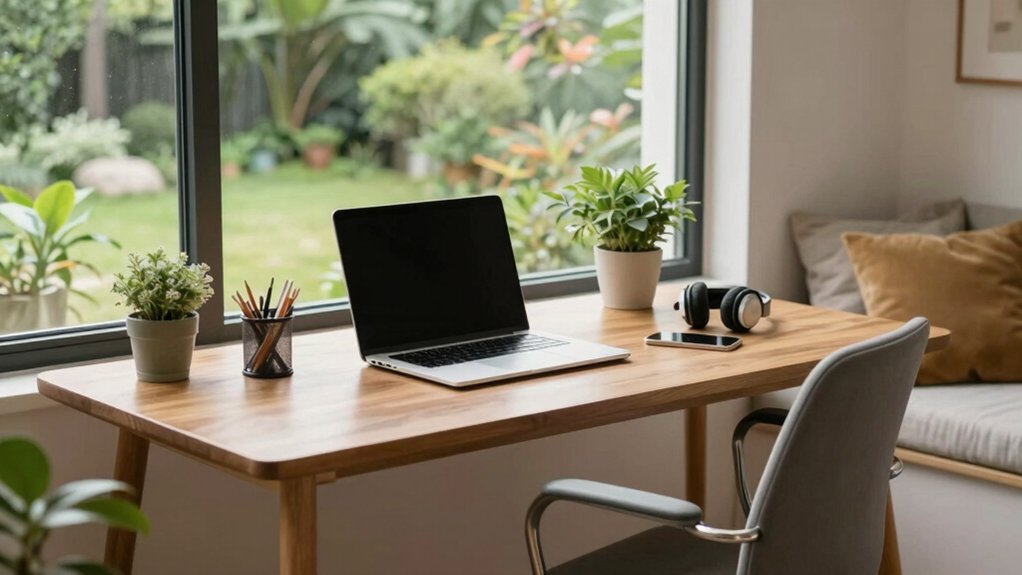
Data’s your most powerful tool for transforming focus spaces from guesswork into a finely tuned operation. You’ll uncover how employees actually work by integrating occupancy sensors, badge data, and booking platforms into a consolidated analytics dashboard.
Data transforms focus spaces from guesswork into finely tuned operations by integrating occupancy sensors, badge data, and booking platforms.
Track these metrics to optimize your spaces:
- Utilization rates comparing actual occupants to pod capacity across different times
- Weekly and monthly patterns revealing when focus spaces see peak demand versus ghost bookings
- Real-time alerts from tools like Cisco Spaces when thresholds shift unexpectedly
- Seasonal fluctuations identifying hybrid work trends that require space reallocation
Review your dashboards regularly to spot gaps between perception and reality. You’ll adjust allocations confidently, eliminating underused pods while expanding high-demand zones. This data-driven approach ensures your focus spaces match genuine work patterns, not assumptions. Occupancy sensors and IoT devices provide continuous measurement to support immediate decision-making and identify opportunities for space optimization.
Frequently Asked Questions
How Much Does It Cost to Implement Soundproof Pods Versus Acoustic Quiet Zones?
You’ll spend $5,000-$15,000 per soundproof pod versus $2,000-$5,000 per 100 sq ft for acoustic zones. Pods cost 3-5 times more upfront but deliver superior noise reduction and use considerably less space.
What Percentage of Employees Actually Use Focus Spaces Versus Collaborative Areas Daily?
You’ll find that employees use collaboration spaces 64% more than individual workpoints daily. Your data shows 4.1 hours spent collaborating versus 3.8 hours at desks, revealing a clear preference for shared environments over solo focus work.
Can Focus Spaces Accommodate Both Introverts and Extraverts Simultaneously Without Compromising Functionality?
You can design focus spaces accommodating both personalities by creating zones within them—quiet corners for introverts’ deep work and semi-open areas where you’ll find extraverts collaborating nearby without disrupting concentration.
How Do I Determine the Ideal Ratio of Focus Spaces to Total Office Square Footage?
You’ll allocate 15-25% of your total office square footage to focus spaces. Calculate this by multiplying your total space by these percentages, then adjust based on your employee personality mix and work requirements.
What Metrics Should I Track to Prove Focus Spaces Improve Employee Productivity and Retention?
You’ll track cycle time, context switching frequency, and developer satisfaction surveys to measure focus space impact. Monitor eNPS scores, bug resolution time, and PTO utilization alongside employee turnover rates for comprehensive productivity and retention proof.
In Summary
You’ve learned that creating peaceful focus spaces requires more than just quiet rooms. By prioritizing acoustic privacy, personalizing environmental controls, and accommodating different work styles, you’ll build spaces where people truly concentrate. Smart reservation systems prevent chaos, while clear boundaries protect focus time. You’re not designing one-size-fits-all solutions—you’re crafting sanctuaries that respect how your team actually works and thinks.



Leave a Reply