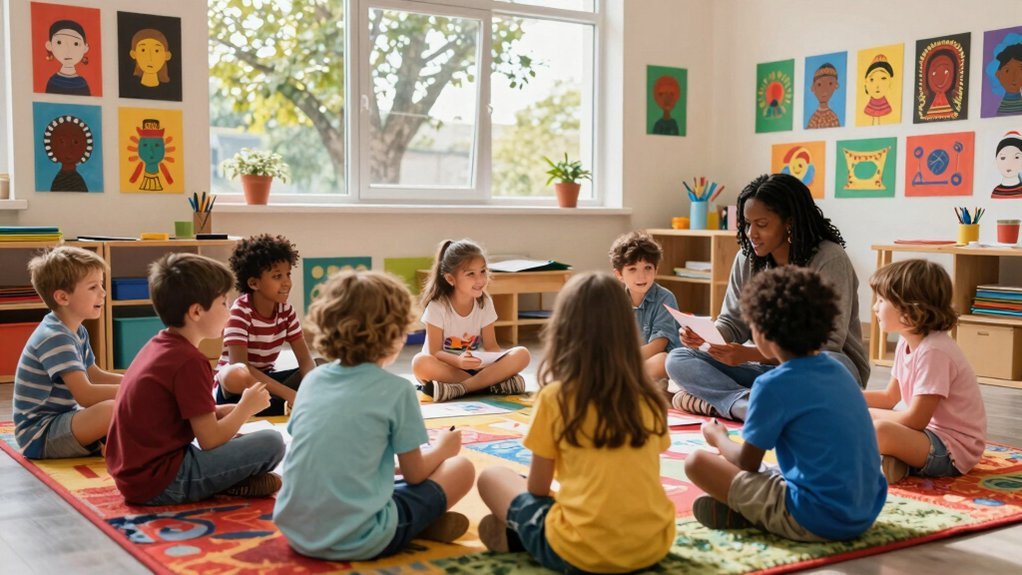
When you mix ages in one classroom, you’re breaking down the artificial hierarchies that fuel disrespect and bullying. Older students naturally become mentors rather than dominators, while younger peers see relatable guides instead of intimidating figures. This diversity shifts focus from comparison to collaboration, where differences become strengths. Kids develop genuine empathy through cross-age interactions and distributed leadership roles. The result? Inclusive communities where everyone belongs. Discover how teachers strategically match these developmental pairs for maximum growth.
Why Age Differences Create Natural Respect in the Classroom?
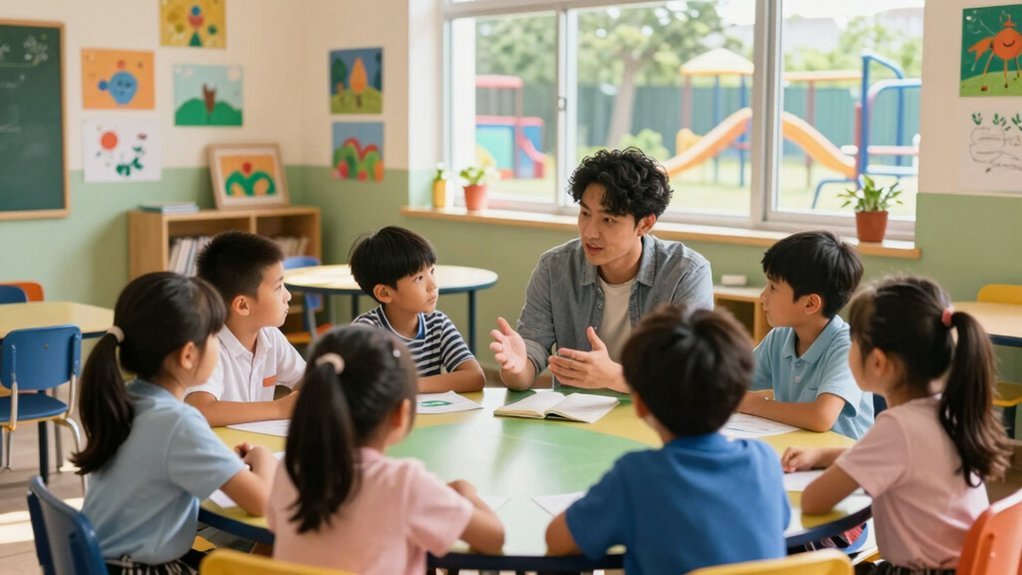
Have you ever noticed how children naturally gravitate toward peers at their developmental level, regardless of age? This phenomenon creates a powerful dynamic in multiage classrooms that fosters genuine respect among students.
When you mix different ages together, you’re not forcing unnatural friendships. Instead, you’re enabling children to connect authentically based on shared interests and maturity levels rather than arbitrary birth dates. Older students naturally emerge as role models, while younger ones find mentors who genuinely understand their capabilities.
This organic structure reduces the hierarchy that often breeds bullying in single-age settings. You’ll observe fewer isolates and more inclusive communities because children relate to one another on their actual developmental plane. The age diversity removes the artificial pressure of conforming to a single peer group, allowing you to build a classroom where respect develops naturally through meaningful interactions and mutual understanding. When students experience peer collaboration as a natural mechanism within these mixed-age environments, they learn to value each other’s unique perspectives and contributions.
How Younger Students Learn From Older Peer Role Models?
You’ll discover that younger students naturally observe and replicate the positive behavioral patterns they see in their older classmates, creating a powerful learning mechanism that doesn’t require formal instruction. When you’re surrounded by older peers who demonstrate persistence, respect, and academic engagement, you unconsciously absorb these habits and integrate them into your own conduct. Language development accelerates through this imitation process as you hear more sophisticated vocabulary and communication styles modeled daily by your advanced peers. Research from early childhood settings shows that asking questions to older peers provides younger children with more effective learning opportunities than adult-led instruction alone, enabling them to develop independence and critical thinking skills through peer interaction.
Observing Positive Behavioral Patterns
In multi-age classrooms, younger students consistently observe and absorb the social and cognitive skills demonstrated by their older peers, creating a natural mentorship dynamic that research has proven to enhance prosocial behavior development. You’ll notice that when younger children interact with older classmates, they’re exposed to more mature problem-solving strategies and advanced social behaviors they can emulate. This exposure stimulates cognitive growth and encourages more complex play patterns than they’d typically engage in with same-age peers. Your younger students don’t just passively watch—they actively internalize these behavioral patterns, gradually adopting the maturity levels they observe. Research shows that social competence in early years predicts later academic and social success, making these formative interactions particularly valuable for long-term development. This natural modeling process occurs without formal instruction, making it an organic and highly effective learning mechanism that strengthens your entire classroom’s social competence.
Language Development Through Imitation
How do younger students acquire advanced language skills they wouldn’t typically develop at their age? In mixed-age classrooms, you’ll observe younger children naturally absorbing linguistic patterns from their older peers through daily interactions. This imitative learning process accelerates vocabulary growth considerably.
Here’s how you can expect this development to unfold:
- Younger students listen to and replicate sophisticated language structures used by older classmates
- Peer-to-peer conversations increase as younger children engage with more advanced communicators
- Repeated exposure to complex vocabulary through collaborative work strengthens language retention
- Children adopt problem-solving discourse and explanatory language modeled by older peers
You’ll notice that children with lower initial language skills benefit most from this arrangement. When you group younger students with cognitively advanced older peers, you create an environment where natural language modeling becomes your most powerful teaching tool. This zone of proximal development enables younger students to tackle linguistic concepts with scaffolding support from their more capable peers.
Building Empathy When Children Work Across Age Groups
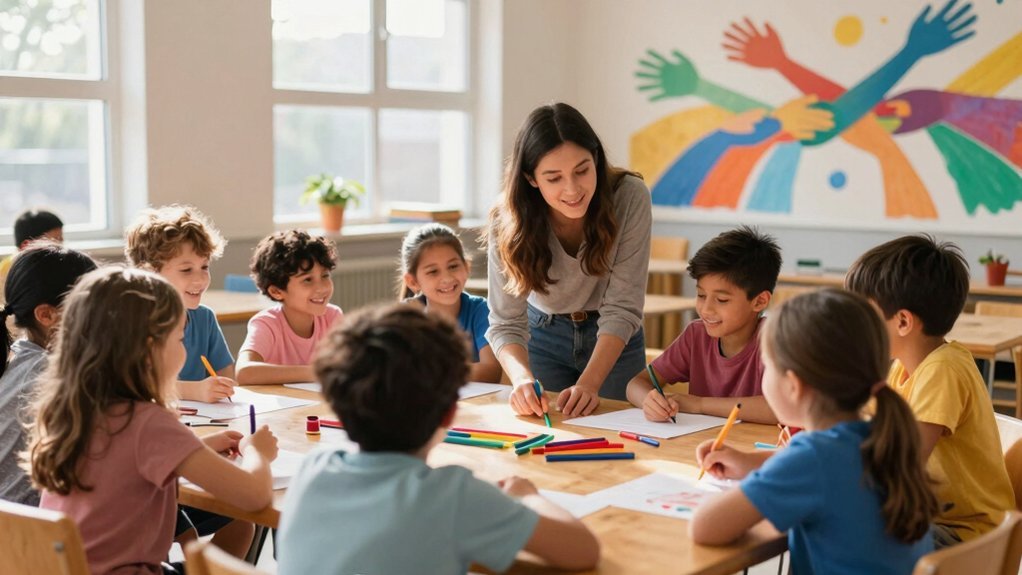
What happens when a younger child watches an older peer navigate a difficult social situation with patience and grace? You’re witnessing empathy in action—the foundation of respect for differences.
When you place children across age groups together, you create natural opportunities for perspective-taking. Younger children observe how older peers handle conflicts and regulate emotions, internalizing these strategies. Simultaneously, older children develop nurturing abilities by supporting less mature companions. Through cross-age friendships, children expand their social networks and learn to appreciate viewpoints beyond their own developmental stage.
| Age Group | Learns From | Develops |
|---|---|---|
| Younger | Emotional regulation | Social cognition |
| Older | Leadership challenges | Empathy and patience |
| Both | Diverse viewpoints | Flexibility |
You’re not simply mixing ages; you’re building genuine relationships where children adjust expectations based on differing competencies. This daily interaction transforms abstract respect into lived experience, where acceptance of differences becomes second nature rather than lesson-based instruction.
How Mentoring Boosts Confidence in Both Age Groups
Mentoring transforms confidence in multi-age classrooms by giving older students meaningful leadership opportunities while providing younger children with relatable role models who demonstrate mastery. You’ll witness profound growth when you implement strategic pairing based on strengths and weaknesses.
Here’s how mentoring boosts confidence in both groups:
- Older students reinforce their own understanding and gain self-assurance by guiding younger peers through tasks
- Younger children internalize mastery by observing older classmates complete complex activities successfully
- Both age groups develop resilience and perspective-taking through genuine mentoring interactions
- Mentors build empathy and patience while mentees experience reduced transition anxiety
Research confirms that children in multiage settings achieve higher cognitive levels faster than same-age peers, with no academic detriment. You’re building self-esteem and verbal skills simultaneously across both groups. When you teach mentors that helping others means guiding, not simply providing answers, you deepen the learning experience for both student and tutor.
Why Mixed-Age Classrooms Reduce Bullying and Social Isolation
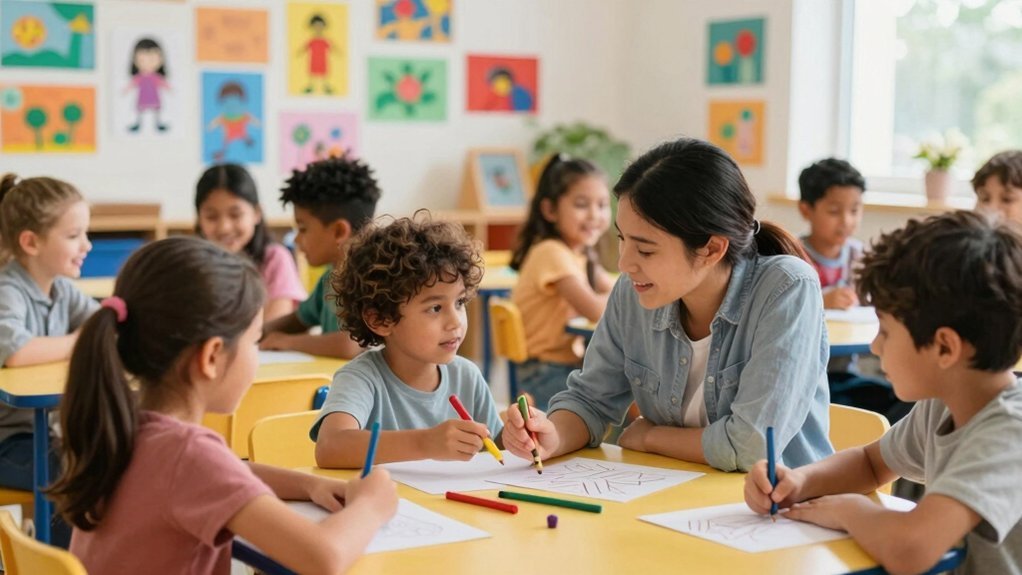
Why do bullying and social isolation persist in same-age classrooms?
Single-grade settings intensify dominance-seeking behavior and aggression, creating hierarchical power dynamics that fuel bullying. You’ll notice mixed-age environments fundamentally disrupt this pattern.
When you place older students alongside younger peers, they naturally adopt caregiving roles that promote compassion and prosocial behavior. This shift extends beyond younger children—older students show reduced aggression toward same-age peers too. The broader friendships that form across age ranges diminish aggressive tendencies and isolation alike. Multi-level, multi-component approaches like structured anti-bullying programs enhance these natural protective effects by establishing clear rules and adult supervision across school, classroom, and individual settings.
Research confirms lower bullying prevalence in mixed-age schools compared to age-segregated classrooms. You’re not just preventing bullying; you’re actively building social integration. By fostering nurturance and cross-age mentoring, mixed-age classrooms create communities where students feel genuinely connected and valued, countering the exclusion that characterizes traditional grade-level settings.
How Multi-Age Classrooms Support Gifted and Struggling Learners Together
How do you accommodate both gifted and struggling learners in a single classroom without compromising either group’s progress? Multi-age classrooms create this balance through intentional differentiation:
- Flexible pacing lets advanced students tackle rigorous material at their own speed while struggling learners receive targeted support without stigma.
- Peer mentoring positions gifted students as teachers, deepening their understanding while helping classmates grasp concepts through relatable explanations.
- Personalized instruction addresses diverse needs simultaneously, with teachers providing real-time differentiation matched to individual abilities.
- Collaborative projects challenge both groups intellectually—gifted students develop leadership skills while struggling learners benefit from proximity to advanced thinking. This distributed leadership based on capability rather than age ensures that each student’s strengths are recognized and utilized within the classroom community.
Research confirms that multi-age settings yield comparable or superior academic outcomes for all students, fostering inclusive environments where diverse abilities thrive together.
Using Mixed Ages to Reteach Concepts Without Stigma
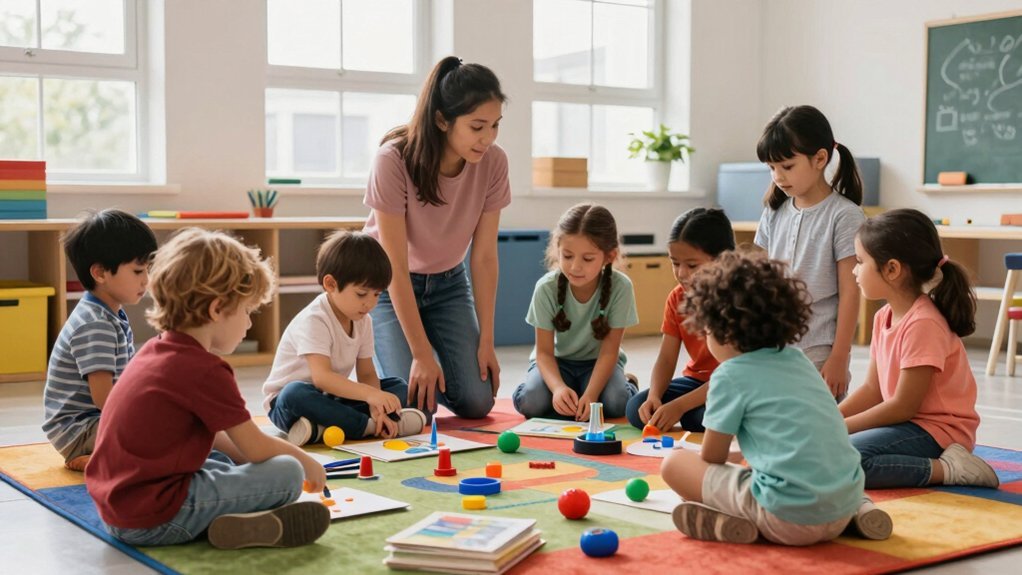
When students need extra support with a concept, traditional classrooms often isolate them in separate remedial groups—a practice that can amplify feelings of inadequacy. In multiage settings, you’ll find a different approach entirely.
You arrange heterogeneous groups where struggling learners work alongside peers of various ages and abilities. This mixed composition removes the stigma associated with grade-level remediation. Students accept differences in learning pace as normal when they’re working with classmates both older and younger than themselves.
You design tasks so each student plays an integral role, regardless of ability level. Older students naturally scaffold learning for younger peers, modeling problem-solving processes. This peer-based instruction allows you to reteach concepts without singling anyone out, creating an environment where needing extra support feels unremarkable and supported. Research on cooperative learning demonstrates that students benefit academically and socially when working in mixed-ability teams on collaborative projects.
Language Development in Multi-Age Peer Conversations
Beyond the structural benefits of mixed-age grouping lies another powerful mechanism for learning: the language itself that students exchange during peer conversations.
When you place students of different ages together, you’re creating natural language-rich environments. Here’s what happens:
- Younger students absorb advanced vocabulary from older peers, expanding their linguistic repertoire without formal instruction.
- Complex sentence structures emerge organically through exposure and imitation during spontaneous conversation.
- Peer talk builds relationships that motivate authentic communication and risk-taking in language use.
- Dual language learners gain accelerated development when exposed to linguistically diverse peers across age groups.
These conversations aren’t scripted lessons—they’re genuine interactions where you scaffold language learning naturally. Your students don’t just hear more words; they experience language in context, making connections that deepen comprehension and fluency simultaneously. Research demonstrates that conversational turns between peers—the back-and-forth exchanges of dialogue—shape developing neural structures more powerfully than simple word exposure alone.
Finding Your Developmental Match in a Mixed-Age Classroom
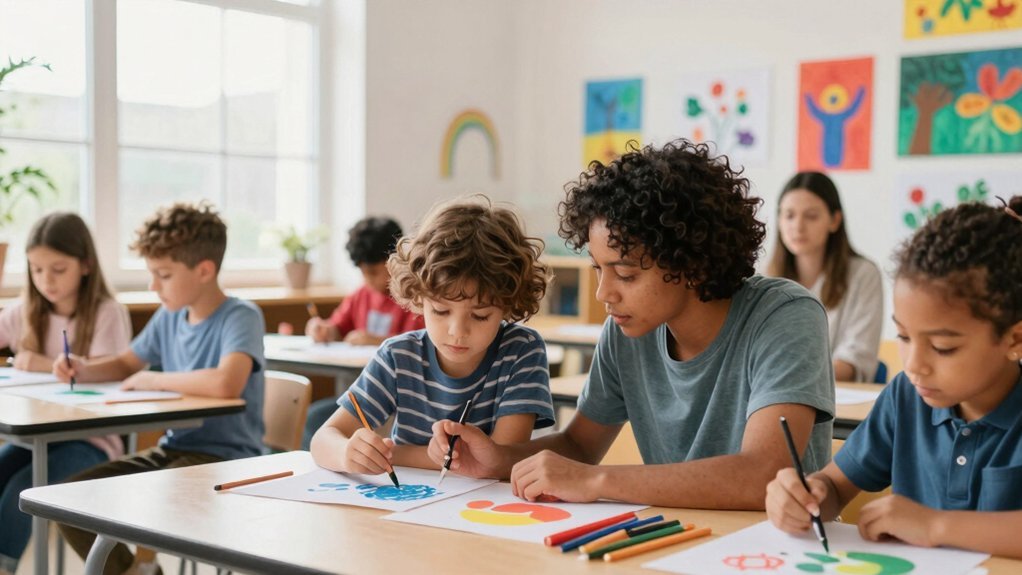
What makes a developmental match work in a mixed-age classroom? You’ll find your ideal peer pairing through careful observation and flexible grouping. Teachers watch your skills, interests, and learning pace—then strategically place you alongside peers who challenge and support your growth simultaneously. This cycle of practice—observe, plan, teach, reflect—ensures each child moves forward at their own pace within a shared community.
| Your Role | Peer’s Role | Outcome |
|---|---|---|
| Novice learner | Expert model | Skill acquisition through observation |
| Collaborator | Contributor | Shared problem-solving and creativity |
| Observer | Advanced peer | Natural scaffolding and vocabulary gains |
You’re not matched by age alone. Instead, you’re grouped with classmates whose abilities complement yours—whether that’s an older student demonstrating complex play or a same-age peer exploring similar interests. This responsive matching reduces isolation, fosters genuine collaboration, and lets you progress at your own developmental rhythm within a supportive community.
Leadership and Responsibility Skills Older Students Gain
How do you grow from being guided to becoming a guide yourself? In multi-age classrooms, you naturally transition into leadership roles after spending your first years as an observer. You’ll develop essential skills through direct responsibility:
- Mentoring younger peers solidifies your own knowledge while building patience and empathy
- Managing group dynamics teaches you problem-solving and interpersonal awareness
- Modeling behavior and learning attitudes stretches your understanding and accountability
- Providing academic support through peer teaching reinforces concepts while boosting your confidence
The three-year cycle allows you to practice these responsibilities at your own pace, transforming you from student to role model. Within this distributed leadership structure, you’ll also gain flexibility to support peers based on their individual strengths rather than rigid grade-level expectations. You’ll remember these leadership experiences long after leaving the classroom, understanding that respect develops through genuine responsibility and guidance.
How Teachers Tailor Instruction Across Different Maturity Levels
While you’re developing leadership skills through mentoring younger classmates, your teachers are simultaneously crafting instruction that honors everyone’s developmental stage. Rather than targeting the class middle, they structure activities around individual needs and readiness levels. Your teacher might use a self-contained approach, beginning with younger students’ lessons before shifting focus to older learners, or employ team-teaching where specialists handle instruction by skill level across ages. They adapt materials—offering varied reading levels, hands-on manipulatives, and thematic units—so spiral curriculum growth happens naturally without grade distinctions. Flexible groupings shift based on your developmental characteristics, ensuring cognitive, social-emotional, and psychomotor needs get met. This personalized learning approach also encourages peer mentorship among students of different ages, reinforcing the collaborative environment. This tailored approach reduces reliance on whole-group instruction, making learning more responsive and effective for everyone’s maturity level.
Why Multi-Age Classrooms Help Every Child Belong
You’ll discover that multi-age classrooms match you with peers at your developmental level, regardless of your chronological age, so you’re never struggling alone or coasting unchallenged.
This natural grouping builds your confidence because you’re accepted for where you actually are in your growth, not where you’re “supposed” to be.
When you find your people—kids progressing at your pace—belonging follows naturally, and you can finally focus on learning instead of measuring yourself against arbitrary age-based expectations.
Teachers in multi-age settings possess deep knowledge across developmental abilities to recognize each student’s unique readiness and tailor instruction accordingly, ensuring that personalized support strengthens both academic growth and your sense of true belonging.
Finding Your Developmental Peer Group
What happens when a child walks into a classroom where age doesn’t determine friendship? You’ll find kids gravitating toward peers who match their developmental level rather than their birth year.
In multiage settings, you’re free to connect authentically:
- You discover social matches regardless of age, reducing isolation that plagues traditional classrooms
- You form stable friendships based on shared capabilities and interests, not arbitrary grade assignments
- You access peer groups without navigating age-based hierarchies that exclude outliers
- You experience belonging through genuine compatibility, creating more inclusive communities
This developmental matching transforms how you experience school. Rather than forcing connections with same-aged classmates, you naturally find your tribe—kids who think, play, and learn at your pace. That alignment builds the foundation for genuine respect and meaningful relationships across all differences
Building Confidence Through Acceptance
Finding your developmental peer group solves the isolation problem, but connection alone doesn’t build lasting confidence—acceptance does. In multiage classrooms, you experience genuine belonging when teachers facilitate cross-age learning opportunities that value your unique contributions.
| Factor | Single-Age Effect | Multiage Benefit |
|---|---|---|
| Self-Esteem | Limited peer comparison | Enhanced through mentoring roles |
| Prosocial Skills | Age-restricted modeling | Cross-age tutoring builds empathy |
| Peer Relationships | Narrow social circles | Broader, more stable connections |
| Acceptance | Conformity-driven | Differences celebrated and respected |
| Confidence | Performance-based | Community-rooted and sustained |
You gain confidence when older students mentor you and younger students respect your leadership. This reciprocal acceptance creates psychological safety where you feel valued regardless of achievement level. Teachers intentionally design interactions celebrating diverse abilities, ensuring every student contributes meaningfully. When teachers differentiate instruction through flexible grouping, they meet each student where they are developmentally, allowing authentic contributions at every level. Your confidence grows authentic and resilient—rooted in genuine community acceptance rather than external validation.
Frequently Asked Questions
What Classroom Size Works Best for Effective Multi-Age Peer Mentoring Relationships?
You’ll find that smaller, heterogeneous groups work best for peer mentoring. You’re creating ideal conditions when you combine flexible sizing with family-like classes spanning three years, enabling meaningful relationships and individualized growth.
How Do Parents Transition Children From Traditional to Multi-Age Classroom Settings?
You’ll find your concerns ease as you observe firsthand classroom experiences. You’ll witness your child’s maturity increase, and you’ll see academic performance remain strong or improve. You’ll notice enhanced peer relationships developing across ages.
What Training Do Teachers Need to Manage Multi-Age Classrooms Successfully?
You’ll need developmental knowledge training, classroom management strategies, peer interaction facilitation skills, and ongoing professional support through monthly sessions. You’ll also require planning time for collaborative team teaching and reflective supervision.
How Are Multi-Age Classrooms Assessed Differently Than Traditional Single-Grade Classrooms?
You’ll use individualized portfolios, learning logs, and observations tracking each student’s personal progress rather than comparing them against grade-level standards. You’ll conduct frequent conferences and spiral evaluations across multiple years instead of single-year assessments.
What Grade Ranges Work Most Effectively in Mixed-Age Classroom Configurations?
You’ll find that grades 1-3 mixed-age configurations work most effectively, though 1-4 spans also show strong results. You should avoid pre-K-kindergarten combinations, which underperform markedly. Wider secondary ranges require careful curriculum design.
In Summary
You’ll find that multi-age classrooms transform how children view differences. When you mix ages together, you’re creating spaces where younger students naturally respect older peers, while older children develop leadership skills through mentoring. You’re building genuine empathy as students work across developmental levels, reducing bullying and isolation. You’re helping every child belong by creating an environment where differences aren’t obstacles—they’re opportunities for growth and understanding.


Leave a Reply