
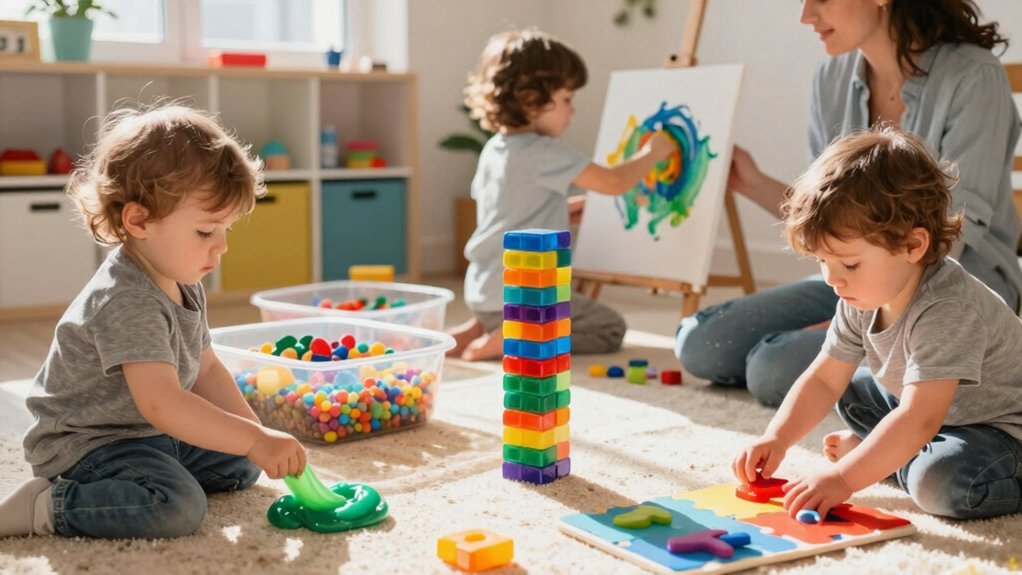
You can turn sensory play into abstract‑thinking lessons by labeling textures, comparing materials, and asking “why?” after each spill or splash. Use simple cause‑and‑effect experiments like egg drops or color mixing to predict outcomes and discuss results. Encourage role‑play with symbolic objects, then have kids write or illustrate stories that capture those patterns. Rotate activities daily, keep observation logs, and prompt “what comes next?” to build flexible reasoning. Keep exploring, and you’ll discover even more strategies.
Play With Textures to Teach Abstract Thinking Classification
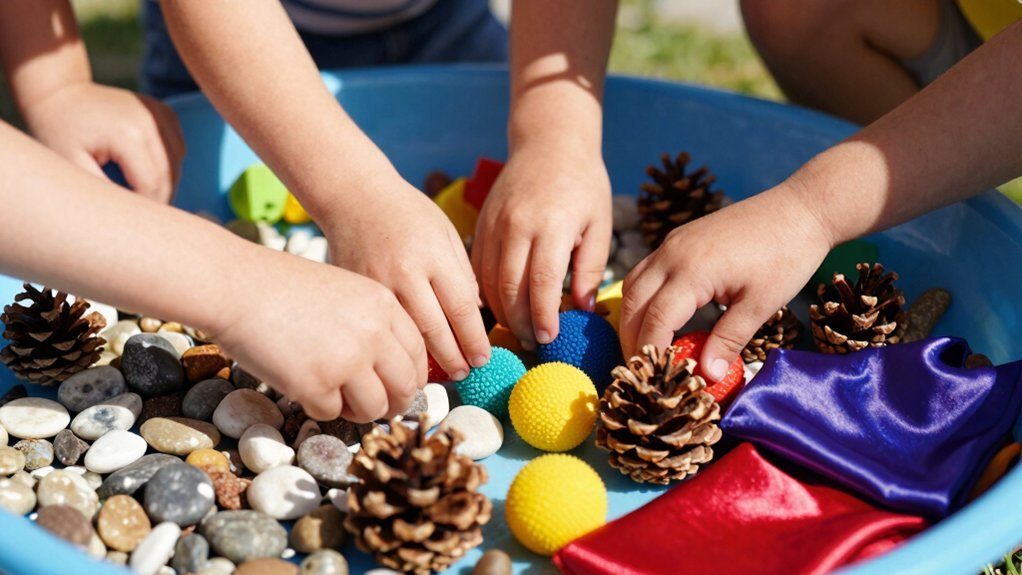
Creativity sparks when you plunge into texture‑rich play, turning smooth, rough, and grainy sensations into learning blocks. You’ll notice that handling pasta necklaces, dough, or a bin of rice lets you sort by feel, a first step toward classification. As you describe each action—“You’re making swirls” or “The beads are bumpy”—you boost language development while reinforcing abstract thinking about patterns.
Threading beads, dyeing pasta, or shaping play‑dough sharpens fine motor skills and invites you to label colors, textures, and sequences.
Comparing rice, beans, and sand highlights similarities and differences, expanding your cognitive flexibility.
Guided questions during sensory play keep you focused on higher‑level concepts, turning tactile experiences into the building blocks of abstract classification.
Using child-size cleaning tools with non-toxic materials during sensory play can enhance motor skills and safety awareness.
Turn Everyday Observations Into “Why?” Questions for Abstract Thinking
Ever wonder how a simple spill can become a lesson in cause and effect? Turn that moment into a “Why?” question and you’re doing sensory play that fuels abstract thinking. Ask yourself, “Why did the water splash farther when the glass tipped faster?” or “What would change if I poured it slower?” These everyday observations spark predictions and explanations, forcing you to link visible outcomes to invisible forces. Use reflection questions like, “Have I seen this pattern before, and how does it differ?” to deepen pattern recognition. By constantly asking why, you transform ordinary events into mini‑experiments, sharpening your ability to reason about cause and effect beyond the surface. Incorporating tools like sensory exploration toys can further enhance this developmental process by engaging multiple senses in cause-and-effect learning.
Use Simple Cause‑and‑Effect Experiments to Build Abstract Reasoning

Instead of just asking “why,” try turning the answer into a quick experiment. In early childhood you can harness sensory play to make cause and effect concrete, then guide the child toward abstract thinking. By letting kids see how a change in one variable reshapes an outcome, you nurture reasoning and set the stage for transfer of learning to everyday situations.
- Egg drop – swap surface types or add a boiled egg; discuss why impact differs.
- Color blending – mix primaries, predict the new hue, and explain why some combos turn brown.
- Water mass illusion – pour equal cups into a tall glass, notice perceived volume, and compare to actual quantity.
These simple experimentation cycles sharpen abstract reasoning and embed cause‑and‑effect language for future problem‑solving. Using Montessori-friendly tools such as a step stool with safety rail can encourage independent exploration in a safe environment.
Link Cause‑and‑Effect Play to Symbolic Role‑Playing
You can turn a simple cause‑and‑effect demo—like using a banana as a telephone—into a symbolic role‑play where the object stands for an idea. By encouraging kids to predict what happens next in these make‑believe scenes, they connect actions with consequences and practice abstract reasoning. Let them draw or write the story afterward, reinforcing the link between language, symbols, and imagined events.
Cause‑and‑Effect Demonstrations
How can a simple egg‑drop experiment become a springboard for symbolic role‑playing? You start with sensory play, letting kids feel the egg, the surface, and the impact. As they observe, you guide them to label cause and effect, then ask “What would happen if we change the variable?” This sparks planning, hypothesis formation, and predictive reasoning. By charting outcomes, they compare trials, turning concrete results into abstract ideas that feed symbolic play and support early development.
- Swap variables – replace a raw egg with a boiled one and note the difference.
- Add a narrative – imagine the egg as a character navigating obstacles.
- Encourage prediction – ask children to forecast the next drop’s result.
Integrating hands-on Montessori materials like the Pink Tower cubes can deepen understanding of spatial relationships and cause-and-effect through physical manipulation.
Symbolic Role‑Playing Connections
Ever wondered how a simple cause‑and‑effect activity morphs into a rich, symbolic adventure? When you hand a child a banana and they turn it into a telephone, you’re witnessing symbolic thinking in action. That pretend play links a concrete object to an imagined function, reinforcing cause and effect while stretching abstract reasoning. By introducing themed playground equipment, you invite role‑playing scenarios that deepen narrative understanding and character motivation. Encourage imaginative play where a knight rescues a dinosaur, and watch the child map real‑world actions onto fantasy outcomes. This bridge between concrete experiences and abstract inference strengthens anticipatory planning, letting them explore why characters act as they do and how imagined events unfold. Incorporating Montessori blue triangles into play supports this cognitive development by fostering spatial reasoning and problem-solving skills through hands-on exploration.
Let Kids Write and Illustrate Their Own Abstract Thinking Stories
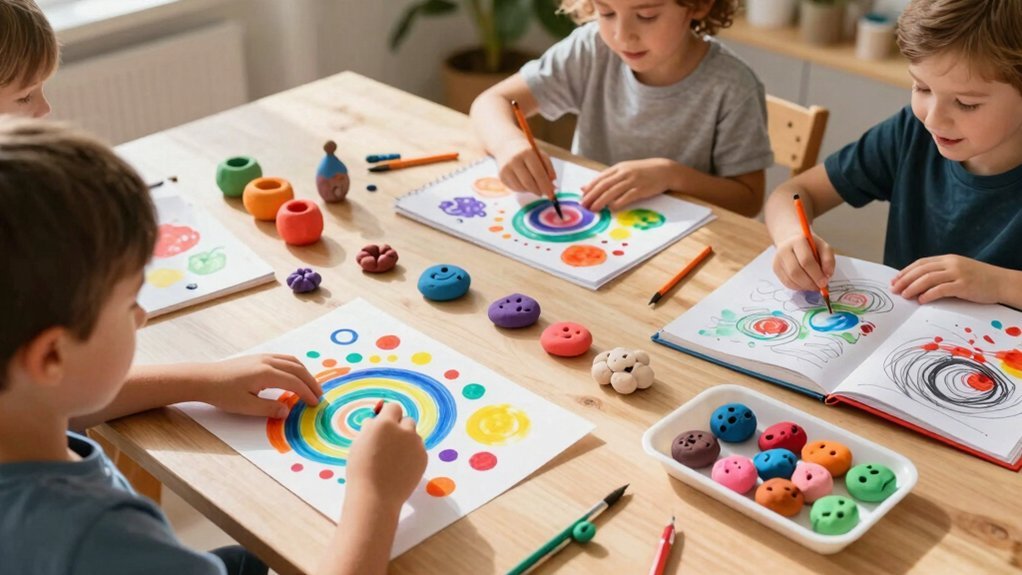
Imagination ignites when kids write and illustrate their own stories, turning fleeting thoughts into concrete symbols. You’ll see how sensory play fuels abstract thinking, letting children turn scribbles into early literacy tools. By encouraging writing and storytelling, you help them link language to symbolism and build imagination muscles.
- Choose a theme – Let them pick a favorite sensory experience (rain, sand, music) and brainstorm symbols that capture its feeling.
- Draft the narrative – Guide them to write a short plot where characters act on those symbols, reinforcing abstract thinking and cause‑and‑effect.
- Illustrate and reflect – Have them draw scenes, then discuss how the pictures represent ideas, strengthening early literacy and confidence in storytelling.
This process transforms fleeting thoughts into concrete symbols, deepening their abstract thinking while making learning joyful. Incorporating educational tools like the TOOKYLAND Kids Daily Calendar Montessori Educational Wooden Toys can further reinforce concepts of time, seasons, and symbols, providing hands-on learning support alongside storytelling.
Encourage Pattern‑Finding Across Materials for Abstract Thinking
When children notice that a pattern they learned with blocks also appears in a song’s rhythm, they start linking ideas across materials and strengthening their abstract thinking. You can boost pattern recognition by setting up cross‑material exploration stations: one with colored beads, another with rhythmic claps, and a third with picture cards. Prompt them with “What repeats here?” and “How does this differ?” to spark imaginative play and sensory play that feeds early learning. As they predict the next beat or bead, they practice abstraction, reinforcing children’s development and building a habit of seeing the bigger picture.
| Material | Pattern Type | Question Prompt |
|---|---|---|
| Blocks | Shape series | “Have I seen this before?” |
| Beats | Rhythm loop | “What comes next?” |
| Beads | Color order | “How is this similar?” |
| Cards | Story sequence | “What changes?” |
Try Simple Science Experiments to Boost Abstract Reasoning
You can start by tweaking an egg‑drop experiment—add a boiled egg, change the landing surface, and watch how cause‑and‑effect shifts.
Next, mix primary colors and predict which combos turn brown, turning observation into hypothesis.
Finally, pour water into a tall, narrow glass and compare its appearance to the actual volume, sharpening your sense of measurement beyond looks.
Incorporating hands-on tools like a wooden abacus can further enhance a child’s understanding of abstract math concepts through tactile learning.
Mix Egg Drop Variations
Ever wondered how tweaking a simple egg‑drop experiment can sharpen abstract reasoning? You’ll notice how sensory play meets abstract thinking when you swap raw for boiled eggs, then observe cause and effect across surfaces. Each trial variation forces you to link material properties with impact outcomes, building causal reasoning skills.
- Change the fall height and record how the egg’s bounce or break differs, noting energy absorption.
- Alter the container’s shape—cushion, cone, or box—and compare friction and protection.
- Use varied materials (foam, cardboard, rubber) to see how stiffness influences the egg’s fate.
Color Mixing Discoveries
Swapping the egg‑drop’s focus on impact for a splash of color lets you see how sensory play fuels abstract reasoning. You grab three equal cups, pour primary hues into a tall glass, then mix them to explore color mixing. As you blend red and blue, you predict a vivid purple; when you add yellow, you hypothesize a brown shift. Ask “What happens next based on prior experience?” to link cause and effect with abstract thinking. Observe the new shade, then reflect: did the result match your prediction? This cycle of hypothesis formation and post‑deduction reinforces color science concepts. Low‑cost, visual experiments sharpen pattern recognition, letting you turn simple sensory play into powerful abstract reasoning.
Water Volume Perception
How does a tall, thin glass trick your brain into thinking it holds more water than a short, wide cup? You start with three identical cups of water, then ask which looks fuller. After you pour the liquid into a taller glass, you’ll notice the same volume appears larger. This sensory play reveals water volume perception and forces abstract thinking about shape versus amount. Repeating the pour sharpens cause and effect reasoning, and predicting outcomes before each transfer builds measurement concepts.
- Set up equal‑volume cups and a tall glass.
- Ask children to predict which container seems fuller.
- Pour, compare, and discuss why the illusion occurs.
Apply Sensory Insights to Abstract Thinking Problem Solving
Creativity sparks when you link concrete sensations to higher‑order ideas, and sensory play gives you the raw material for that connection. You can turn tactile experiments into abstract thinking tools by treating each texture, color, or weight as a concrete anchor that hooks neural pathways. When kids blend colors, they practice pattern recognition; when they compare masses, they sharpen hypothesis generation. These activities boost executive function—working memory, flexible thinking, impulse control—so problem solving becomes systematic rather than random. Design sessions with clear goals and measurable outcomes, then ask children to explain their observations, translate them into verbal reasoning, and predict new scenarios. This loop reinforces cognitive skills, turning sensory play into a powerful engine for abstract problem solving.
Guide Children to Predict Outcomes and Reflect on Abstract Thinking
What happens next when you mix two liquids or turn a page in a story? You spark curiosity, so you ask kids to make predictions and then watch the outcomes. By linking sensory play to cause‑and‑effect language, you turn a simple experiment into a lesson in abstract thinking. Prompt reflection after each result, asking why it happened and how it connects to earlier experiences. Use visual cues like tally marks or tiny graphs to support reasoning and help children see patterns beyond the immediate task.
Encourage predictions, observe outcomes, and reflect—linking sensory play to abstract cause‑and‑effect reasoning.
- Pose a clear “what‑if” question before the activity.
- Describe the cause‑and‑effect after the outcome appears.
- Guide a short reflection on how the result fits prior observations.
Summarize Key Abstract Thinking Strategies and Next Steps
You’ll see how dramatic play, story sharing, inference reading, pattern games, and simple experiments each sharpen abstract thinking.
Next, pick one activity to try this week, set a clear goal, and reflect on how the experience reshapes your reasoning.
Then expand the routine, track progress, and adjust the challenges to keep growing.
Abstract Thinking Strategies
Imagination fuels abstract thinking, and you can nurture it by turning everyday play into symbolic exploration—like letting a banana become a telephone—while also encouraging story‑writing, guided reading, pattern‑spotting questions, and simple science experiments that link concrete outcomes to underlying concepts. You’ll see abstract thinking blossom when sensory play meets symbolic thinking, and when children notice cause‑and‑effect in hands‑on science.
- Symbolic Play – Transform objects into symbols; ask “What could this be?” to spark pattern recognition.
- Guided Reading – Pose inference and prediction questions that highlight cause‑and‑effect and reinforce early learning.
- Hands‑On Experiments – Conduct simple tests, then discuss results, connecting observable facts to underlying concepts.
These strategies weave together abstract thinking, sensory play, and pattern recognition, building a solid foundation for later problem‑solving.
Next Steps for Implementation
How can you turn today’s play into tomorrow’s problem‑solving habit? Start by weaving sensory play into daily routines: let a banana become a telephone, then ask what sound it makes and why. Use play‑based learning to model cause and effect, prompting predictions and explanations. Pair story writing with discussion, linking language and imagination to abstract thinking and executive function. Introduce quick science experiments, guiding kids to hypothesize, observe results, and connect outcomes to prior patterns. Rotate activities each day, reinforcing flexible thinking and pattern recognition. Keep a simple log of observations, noting how each step builds executive function and abstract reasoning. Over weeks, these consistent, low‑cost actions embed problem‑solving habits into everyday life.
Frequently Asked Questions
What Are the Strategies for Abstract Thinking?
You develop abstract thinking by encouraging imaginative play, writing and sharing stories, reading with inference and prediction, focusing on pattern recognition, and doing science experiments that link observations to broader concepts.
Do People With ADHD Struggle With Abstract Thinking?
Yes, you’ll often find ADHD makes abstract thinking tougher because it taxes working memory and flexible attention, but structured sensory activities, visual scaffolds, and repeated concrete‑to‑concept links can noticeably improve your ability to grasp abstract ideas.
What Did Montessori Say About Sensory Play?
You’ll find Montessori says sensory play refines perception, builds independence, and prepares your mind for abstract concepts by letting you explore concrete materials, self‑correct, and internalize ordered patterns through hands‑on experience.
Under What Age Does a Child Have Difficulty With Abstract Thinking?
You’ll usually see difficulty before age five, especially in preschool years, because abstract reasoning hasn’t fully formed yet; as children gain symbolic experiences, the challenge gradually lessens.