

You can teach kids self‑correction by giving them Montessori materials that signal errors through mechanical fits, visual or tactile cues, and gentle social prompts. When a block won’t fit, a bead clicks, or a color mis‑matches, the child notices the mismatch, pauses, and fixes it independently. This process builds concentration, confidence, and a habit of analyzing mistakes. Your adult role is to model observation, stay quiet, and intervene only if the cue is unclear, letting the child lead the learning. Keep exploring to discover practical strategies and long‑term benefits.
What Is Self‑Correction in Montessori?
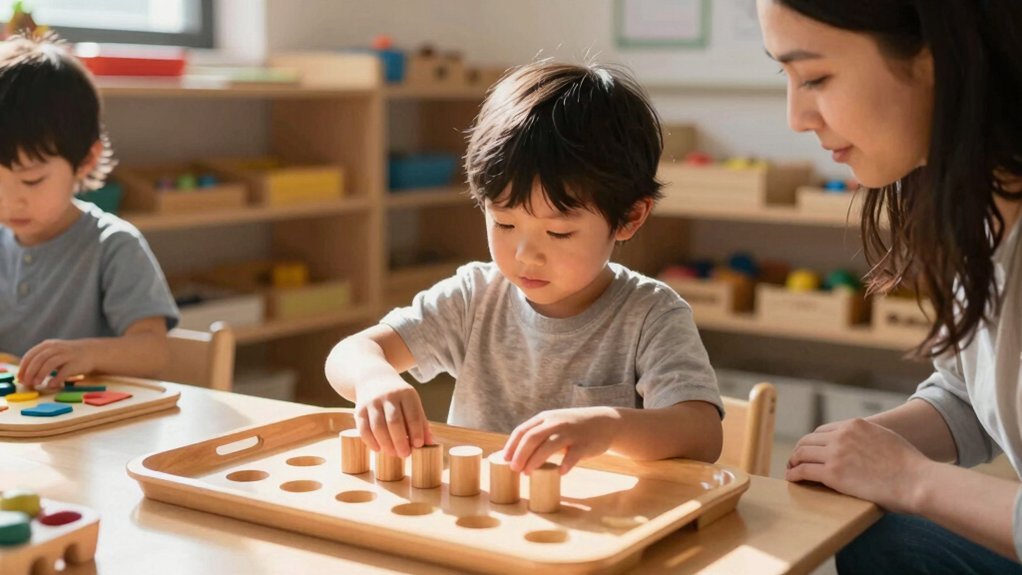
How does a child learn from a mistake without a teacher’s “right you’re wrong”? In Montessori, self‑correction means the child discovers and fixes errors using specially designed materials that signal whether the work is correct—whether a puzzle piece fits, a bead slides into the right slot, or a visual cue aligns. You watch the child manipulate the bead, notice the click that tells them they’re done, and let them repeat until the sound changes. That tactile feedback turns a slip into a clue, prompting investigation rather than reprimand. The adult steps back, only stepping in if the child can’t see the cue, preserving independence. This process builds concentration, confidence, and an inner drive to assess work without external grading. Products like the Kitchen Step Stool for Kids with Safety Rail support this learning by fostering safe independence in daily activities with features like four-sided safety railings.
How Do Mechanical, Perceptual, and Social Error Controls Enable Self‑Correction in Montessori?
Self‑correction thrives when the environment itself signals right and wrong, and Montessori material does just that through three complementary error‑control layers. You’ll notice that mechanical error control forces pieces to fit only in the correct slots, so a misfit instantly tells you something’s off. Perceptual error control adds visual or tactile cues—color contrasts, weight differences, texture changes—so you can sense the mistake without a teacher’s voice. Social error control brings in an adult observer who models the right action or offers a gentle prompt, reinforcing your own discovery process. Together they build trust, independence, and a habit of noticing discrepancies and adjusting on your own. Just like a well-designed plant stand elevates a pot for better airflow and visibility, these error controls raise awareness to promote self-correction.
| Control Type | How It Triggers Self‑Correction |
|---|---|
| Mechanical | Physical fit/no‑fit feedback |
| Perceptual | Visual/tactile cue recognition |
| Social | Adult modeling or subtle prompt |
| Combined | Reinforces internal mastery |
Examples of Self‑Correcting Montessori Materials
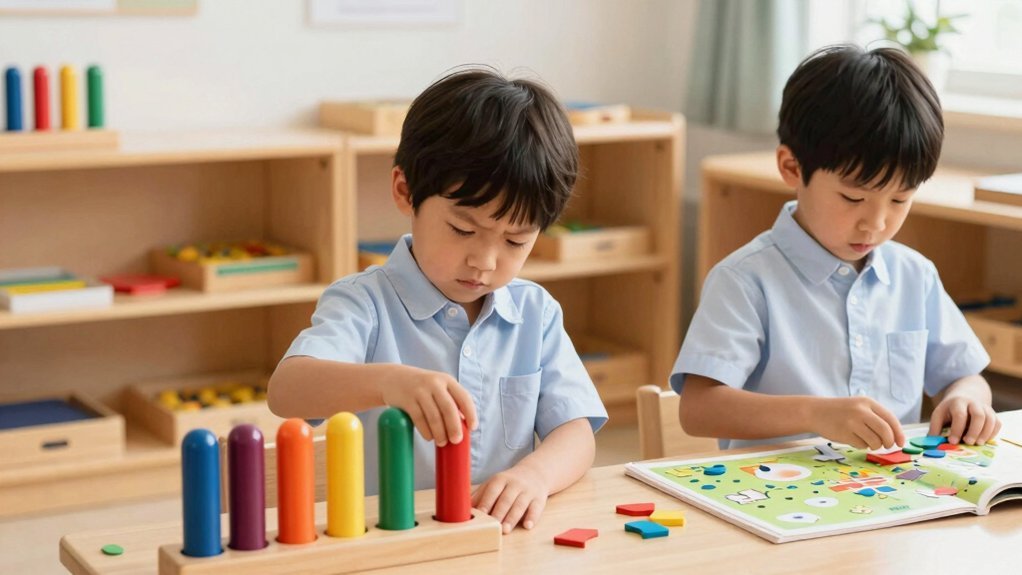
Ever wondered how a simple set of blocks can teach you to spot mistakes on your own? Cylinder blocks are self‑correcting materials that only fit into their matching socket, so you instantly feel when a piece is wrong. The Pink Tower forces you to compare sizes visually; a misplaced block stands out, prompting you to reorder. Moveable alphabet cards and three‑part language cards let you match phonetic words with pictures, and a mismatch signals the error without adult correction. Practical Life tools—pouring trays, buttoning frames—produce real outcomes; spills or loose buttons reveal the mistake, letting you adjust. Each of these self‑correcting materials functions only when used properly, encouraging you to reflect, repeat, and refine your work independently. This focus on stability under load helps maintain a defined work environment essential for effective learning.
Adult Actions That Reinforce Self‑Correction in Montessori
You’ll notice the child’s focus when you observe quietly, letting the activity unfold without stepping in. When a slip occurs, you can offer a brief, guided demonstration that shows the correct use without calling out the mistake. By timing re‑presentations of the material and keeping the environment tidy, you give the child the space to self‑correct and grow independently.
Model Observation, No Interruption
How does an adult stay present yet invisible while a child works? You keep the environment tidy, scaled, and clutter‑free, then you practice Observation without judgment. You watch the child manipulate the material, noting where the task stalls or the child’s face shows confusion. Your gaze signals readiness, not interruption. When the child’s error produces a clear cue—mis‑aligned pieces, a wobbling tower—you hold back, allowing the child to feel the feedback and adjust.
Only if the child repeatedly repeats the same mistake do you step in, re‑demonstrating the next step. This restrained presence preserves autonomy, builds trust, and fuels inner motivation, ensuring the child learns to self‑correct rather than rely on immediate adult fixes. Using tools with ambidextrous handles can support this process by accommodating all children comfortably during hands-on activities.
Guided Demonstration, Timely Re‑Presentation
What happens when you pause, then re‑show the correct way to complete a task? You create a subtle Control of Error that guides without blaming. You watch the child work, note where the process stalls, and later demonstrate the step again—quietly, without pointing out the mistake. This timely re‑presentation lets the child compare their effort to the model, spot the gap, and adjust independently. You keep the demonstration brief, focusing on the intended outcome, not the error.
In individual lessons you can fine‑tune pacing, offering a fresh example exactly when the child needs it. The result is a balance of adult support and child‑initiated problem‑solving, building confidence and internal motivation for self‑correction. Incorporating age-appropriate safety standards ensures that children can explore independently in a secure environment, enhancing their ability to self-correct without risk.
Practical Strategies for Parents to Foster Self‑Correction at Home

Ever wonder how a simple home setup can turn everyday chores into powerful lessons in self‑correction? Create a low‑pressure zone where tasks give clear, physical feedback—like a puzzle that clicks only when pieces fit.
Choose toys or kitchen tools that work correctly when used right, so the child notices a wobble or a leak and adjusts without adult prompting.
Give them ample time; resist the urge to rush or over‑correct.
Observe quietly, step back, and model a calm mindset instead of pointing out errors.
Tie each activity to real‑world relevance, reinforcing concentration and resilience.
Celebrate small fixes, and the child will internalize self‑correction, building intrinsic motivation for future challenges.
How Self‑Correction Builds Confidence, Independence, and Critical Thinking
When you let kids spot and fix their own mistakes, you give them a boost of confidence that comes from real achievement. That independence pushes them to trust their judgment, which naturally sharpens their critical‑thinking skills. As they repeatedly analyze errors and adjust strategies, they become more resilient and self‑reliant learners. Creating a safe and organized environment with low step-in toy storage supports this independent learning process by making tools and materials easily accessible.
Self‑Correction Fuels Confidence
How does noticing and fixing your own mistakes boost confidence? When you catch an error and correct it, self‑correction signals that you control your learning. You feel capable, and that sense of capability builds trust in yourself. Each successful fix reinforces inner motivation, so you start viewing challenges as opportunities rather than threats. You also develop persistence; repeated self‑directed problem‑solving strengthens resilience, keeping you engaged longer. Because you rely less on adult prompts, you gain safety in exploring new tasks without fear of shame. This growing confidence spills over into other areas, encouraging you to take on tougher problems and stay motivated beyond the immediate activity. Incorporating tools like low toy rotation shelving systems can support this process by organizing materials to foster independence and easy access.
Independence Enhances Critical Thinking
A single moment of self‑correction can spark a cascade of independence, sharpening your critical thinking as you learn to spot and fix errors on your own. When you pause to notice a mismatch, you deepen concentration, boost inner motivation, and start trusting your own judgment. Repeated self‑correction builds a safety net of capability, letting you explore problems without adult hand‑holding. You’ll analyze, test, and refine ideas, turning mistakes into stepping stones for critical thinking.
| Skill | What you do | Result |
|---|---|---|
| Observation | Notice discrepancy | Heightened awareness |
| Analysis | Examine cause | Deeper understanding |
| Experiment | Try solutions | Flexible thinking |
| Reflection | Review outcome | Confidence |
| Transfer | Apply elsewhere | Independent mastery |
This rhythm of self‑correction nurtures resilience, ownership, and lasting critical‑thinking growth.
Long‑Term Benefits of Early Self‑Correction Skills
Why does early self‑correction matter? You’ll see that self‑correction builds a lifelong learning foundation, shaping thinking patterns and adaptability far beyond the classroom. By catching and fixing mistakes yourself, you develop confidence, independence, and quiet self‑trust, because you no longer rely on constant adult guidance. Each self‑correcting episode sharpens concentration, fuels curiosity, and drives mastery through intrinsic motivation. Over time, these habits translate into stronger problem‑solving skills and greater resilience when errors arise. You’ll own the learning process, reducing dependence on external correction, and you’ll notice sustained growth in reading, math, and executive function. This early practice creates a durable edge that supports academic and personal success for years to come.
Frequently Asked Questions
How Can Technology Like Vergetab Be Integrated With Montessori Self‑Correction?
You can embed Vergetab’s sensor‑driven prompts into Montessori materials, letting kids receive instant, non‑judgmental feedback that nudges them toward self‑correction while preserving their autonomous learning rhythm.
What Age Range Benefits Most From Error‑Control Activities?
You’ll see the biggest gains with children aged four to eight; at that stage they’re curious, can grasp simple feedback loops, and start internalizing self‑correction habits that stick.
Do Self‑Correction Methods Differ for Children With Learning Disabilities?
Yes, you’ll need to adapt strategies—use clearer prompts, more frequent feedback, and multimodal cues. Those adjustments help children with learning disabilities engage self‑correction effectively and stay motivated.
How Often Should Progress Dashboards Be Reviewed for Optimal Improvement?
You should review progress dashboards at least weekly, adjusting strategies each time you spot trends; this cadence keeps you responsive, reinforces learning, and prevents small setbacks from snowballing into larger gaps.
Can Group Activities Replace One‑On‑One Sessions for Self‑Correction Practice?
You can let group activities replace one‑on‑one sessions, but keep them short, focused, and structured so each child still gets personal feedback and clear error‑control cues.