
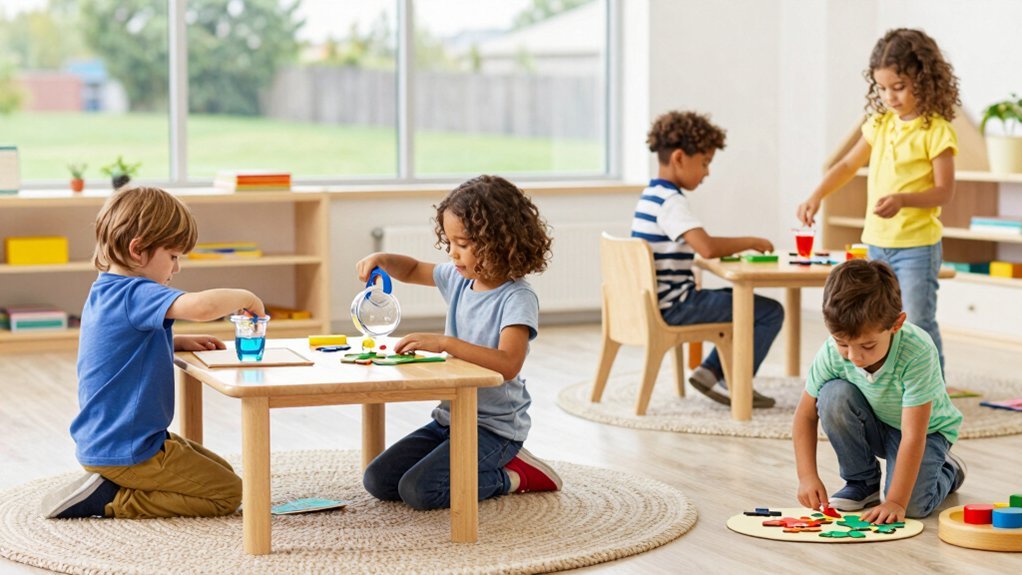
You’ll transform your child’s learning when you protect uninterrupted work cycles. Three-hour blocks build neural pathways that strengthen concentration, memory, and genuine mastery—not just surface completion. Without constant interruptions, children enter flow states where deep engagement flourishes. They develop self-regulation, confidence, and intrinsic motivation independent of external rewards. Their brains rewire for sustained focus while emotional resilience grows through meaningful task completion. The real magic unfolds when you understand exactly how these cycles activate neurological transformation.
How Three-Hour Work Cycles Build Deep Concentration in Children

Have you ever noticed how children can lose themselves in an activity, completely absorbed and unaware of time passing? That’s the flow state you’re witnessing—and it requires uninterrupted time to develop fully.
Three-hour work cycles create the perfect window for this deep engagement. When you allow children to concentrate without interruption, they enter a state where distractions fade and focus intensifies. This sustained attention strengthens their mental capacity, much like exercising a muscle.
During these extended periods, children’s brains form stronger neural pathways. Memory retention improves, comprehension deepens, and problem-solving skills sharpen. The magic happens toward the cycle’s end, when growth peaks and meaningful learning consolidates. After experiencing false fatigue, children who rest briefly often return to their work with renewed energy and enthusiasm, demonstrating the restorative power of these uninterrupted cycles.
What Interruptions Do to Learning and Flow States?
When you interrupt a child’s focused work, you shatter the concentration cycle they’ve carefully built, forcing their brain to abruptly redirect cognitive resources away from the task at hand. This constant shifting between tasks doesn’t just cost them minutes of lost time—it disrupts the flow state entirely, requiring 8 to 25 minutes to rebuild the same depth of engagement they’d achieved. You’re essentially asking their developing mind to repeatedly restart its engine, accumulating invisible losses that compound into measurable deficits in learning and retention. Research from Providence Public School District demonstrates that over 2,000 interruptions annually in typical classrooms translate to 10 to 20 days of lost instructional time per year, underscoring how these disruptions aggregate into substantial educational consequences.
Breaking The Concentration Cycle
Why do interruptions feel so harmless in the moment, yet derail your entire learning session?
Your concentration builds in predictable phases. During the first five minutes, you’re vulnerable to any distraction—a notification, movement, a voice. Once you reach moderate concentration, you can filter noise, but interruptions reset you back to square one. Deep concentration, your learning zone lasting 20-40 minutes, shatters instantly when disturbed. Research shows that transient hypofrontality—the temporary deactivation of your prefrontal cortex during deep focus—makes you especially susceptible to losing momentum once an interruption breaks your state.
| Concentration Phase | Duration | Vulnerability |
|---|---|---|
| Light | 0-5 min | Extremely high |
| Moderate | 5-15 min | Medium |
| Deep | 20-40 min | High impact |
| Recovery | 40-60 min | Critical |
| Cycle Reset | Post-interruption | Requires restart |
You need unbroken 60-minute cycles. Breaking before forty minutes—from interruptions or mind wandering—necessitates longer recovery periods, fragmenting your retention and blocking access to your learning zone.
Cost Of Frequent Disruptions
You’ve seen what happens when concentration breaks—you restart from square one. Each interruption costs you far more than the moment itself. When you’re interrupted, about half the time you’ll go off-task entirely, losing your mental momentum. Small intrusions impair your recall and task performance, making procedural skills harder to practice. Teachers in high-interruption classrooms report that unnecessary intrusions actively undercut sustained focus. You lose three to six minutes of instructional time every hour from these disruptions—that’s 10–20 days of learning annually in a typical classroom. Mathematics suffers most, with computation skills deteriorating particularly during breaks. Your cognitive flow doesn’t simply pause; it shatters, requiring significant effort to rebuild focus and restore academic progress. Research on student absences and closures demonstrates that greater negative effects emerge among students from less-educated homes, where interruptions to learning compound existing resource gaps.
What Happens During Deep Work: The Four Phases

How does uninterrupted focus transform a cognitive task into sustained excellence? You’ll progress through four distinct phases that build upon each other. During Initiation, you concentrate deeply on cognitively demanding work, firing neural circuits repeatedly. Immersion pushes you into flow states where creativity peaks through single-task batching. Acceleration arrives when you schedule intense pulses rather than scattered efforts, stretching your capabilities through time constraints. Finally, Integration solidifies new skills into hard-to-replicate competencies through consistent practice and weekly reviews. Research on deep work philosophies reveals that establishing a predictable schedule makes this progression sustainable by treating deep work as a regular habit rather than an occasional occurrence.
| Phase | Focus Level | Key Action |
|---|---|---|
| Initiation | Single-task concentration | Build mental muscle |
| Immersion | Flow-state intensity | Batch uninterrupted stretches |
| Acceleration | Consolidated pulses | Schedule deep blocks |
| Integration | Skill consolidation | Weekly performance review |
Breaking Through False Fatigue to Reach Peak Focus
When children hit the ten-minute mark before their deepest work phase, they’ll often grow restless and the classroom noise will rise—but don’t mistake this for exhaustion. This false fatigue signals something transition: they’re preparing to tackle challenging work. If you interrupt now, you’ll deny them access to profound cognitive engagement.
Instead, hold space. Let them push through this brief restlessness. Within minutes, they’ll transition into peak concentration, selecting their most challenging tasks. This culminating phase—typically arriving in the final hour of a 2.5 to 3-hour cycle—produces the deepest learning breakthroughs. Modern neuroscience confirms that executive function development accelerates when children remain engaged in purposeful activity without interruption.
Children who complete uninterrupted cycles experience leaps in cognitive development, stronger executive function, and lasting satisfaction that shorter periods can’t provide.
Why Self-Selected Activities Fuel Work Cycle Success?

The magic of Montessori’s uninterrupted work cycles doesn’t lie in time alone—it lives in choice. When you let your child select their own activities, you’re not just keeping them busy—you’re igniting intrinsic motivation that transforms how they learn.
Here’s why self-selected work fuels success:
- You build genuine engagement – Children pursue challenges they’ve chosen, staying focused longer without external rewards or teacher prompts.
- You develop responsibility – Self-direction fosters ownership over learning, encouraging persistence through difficulties without adult intervention.
- You enhance cognitive gains – Choice strengthens executive function, memory, and critical thinking skills that persist long-term.
When your child controls their work selection, they develop not just academic competence but confidence in their own learning capacity. Research shows that this self-determined choice is linked to significantly higher wellbeing scores across multiple dimensions in adulthood, including general wellbeing, engagement, social trust, and self-confidence.
Independence Through Completion
Self-selection ignites motivation, but it’s what happens when your child finishes a chosen task that truly builds independence. When your child completes a work cycle from start to finish, they experience genuine accomplishment—not praise from adults, but the satisfaction of effectiveness itself.
This completion strengthens their confidence and willingness to tackle more challenging tasks.
Your child internalizes a powerful truth: they’re capable of managing their own efforts. Task completion channels this emerging autonomy toward real independence. As they experience repeated success, they develop a view of themselves as capable agents responsible for their learning. This self-perception becomes foundational, extending far beyond the classroom. Through this process, your child cultivates time management and decision-making abilities that support their autonomous growth.
Your child learns that independence isn’t granted—it’s earned through finishing what they’ve started.
Why Montessori Students Outperform: The Work Cycle Advantage?

When you’re given three uninterrupted hours to focus on a single task, your brain builds the neural pathways for sustained attention and executive function that standardized testing measures.
You’ll master skills faster through self-paced repetition, allowing you to work at your own rhythm rather than a teacher’s timeline.
Your natural curiosity drives this engagement—when you choose activities aligned with your interests, you’re far more likely to persist through challenges and achieve deeper learning than when someone else dictates what you study. Research from randomized trials shows this autonomy-driven approach produces equitable gains across socioeconomic backgrounds, with low-income and minority students benefiting as much as or more than their advantaged peers.
Deep Focus Builds Executive Function
How do you build a stronger mind? When you enter deep focus during Montessori’s uninterrupted work cycles, you’re activating your prefrontal cortex—the command center for planning, decision-making, and problem-solving.
- Sustained attention strengthens neural pathways as you maintain concentration without interruptions, transitioning seamlessly into focused states that enhance memory retention and comprehension. Research shows that Montessori students demonstrate greater executive functioning compared to those in conventional schooling environments.
- Emotional regulation develops naturally through the calm satisfaction that emerges during prolonged engagement, helping you manage frustration and build resilience.
- Metacognition flourishes when you follow projects through to completion, allowing you to reflect on your thinking processes and adjust strategies independently.
This neurological transformation isn’t passive. You’re rewiring your brain’s executive function networks, creating the cognitive architecture necessary for complex learning and purposeful achievement.
Self-Paced Mastery Through Repetition
Why do Montessori students consistently outperform their peers? Self-paced repetition builds mastery in ways traditional education can’t replicate. When you work at your own rhythm, you internalize skills deeply rather than surface-level memorization. You’re not rushed to the next lesson; instead, you repeat until concepts become second nature.
Self-correcting materials let you identify and refine mistakes independently, strengthening both technique and confidence. This autonomy transforms how you learn—you develop an internal compass for competency rather than relying on external validation. Through repeated actions, children refine hand-eye coordination, motor control, patience, and sustained focus across multiple developmental domains.
Studies show that extended work cycles boost language and math performance while fostering a growth mindset. You naturally gravitate toward challenging tasks because you’ve experienced genuine mastery, not artificial achievement. This repetition at your pace builds the self-determination that carries into adulthood.
Interest-Driven Engagement Sustains Achievement
The moment you select your own work in a Montessori classroom, something shifts internally—you’re no longer following someone else’s agenda, but pursuing your own curiosity. This autonomy transforms how you engage with learning.
When you choose your activities within the prepared classroom framework, you’re cultivating intrinsic motivation that external rewards can’t replicate. Research shows Montessori students report feeling more active, excited, and happy during academic work compared to traditional peers.
Your sustained engagement directly strengthens measurable outcomes:
- Executive function and problem-solving abilities deepen through self-directed exploration
- Reading and vocabulary gains accelerate when you’re genuinely interested in the material
- Social understanding expands as you collaborate on activities you’ve chosen alongside peers
This interest-driven approach doesn’t just improve immediate academic performance—it establishes lifelong learning patterns rooted in genuine curiosity rather than compliance. Large-scale research comparing Montessori versus traditional preschool programs demonstrates that multiage classroom environments support comparable or enhanced quality outcomes while maintaining cost-effectiveness.
How Work Cycles Protect Individual Learning Pace

Picture a classroom where some children’ve completed three tasks while others’re still engaged with their first—and nobody’s falling behind. Work cycles protect your child’s individual learning pace by removing time pressure entirely. Three-hour uninterrupted blocks let faster learners progress naturally while slower learners develop mastery without rushing.
| Pacing Element | Benefit |
|---|---|
| Flexible duration | Children complete cycles fully |
| Self-chosen tasks | Activities match readiness levels |
| No time constraints | Developmental stages guide progress |
| Teacher observation | Lessons begin when ready |
Your child selects work matching their current abilities, spending necessary time for deep understanding. Multiage groupings reinforce this flexibility—peer exposure shows children diverse learning speeds are normal. Teachers introduce new lessons only when observation reveals readiness, ensuring each child advances confidently through their own developmental timeline. Concentration and uninterrupted work cycles lead to normalization, where children develop self-discipline and joy in their accomplishments.
Mastery Through Repetition
How does your child master a new skill? Through repetition during uninterrupted work cycles, they internalize concepts and develop genuine competency. When you allow your child to repeat activities until perfected, they experience three critical shifts:
Through repetition during uninterrupted work cycles, children internalize concepts and develop genuine competency.
- Neurological connections strengthen through sustained practice, building the concentration required for reading and math readiness
- Internal confidence grows as repetition reinforces feelings of success and self-mastery independent of external rewards
- Mastery orientation develops, helping your child persist on challenging tasks and choose harder puzzles over easier ones
This repetition isn’t random busywork. Your child’s sensitive periods make them naturally hardwired to enjoy tasks until full understanding emerges. Protected work time allows this organic process to unfold, transforming skill acquisition into genuine mastery rooted in intrinsic motivation. When children engage in repeated practice, they strengthen the brain pathways necessary for converting possibility into ability across developmental milestones.
Why Work Cycles Create Calm, Joyful Children?
When your child enters an uninterrupted work cycle, you’ll notice a profound shift: the classroom transforms into a space of genuine calm and joy. Without constant interruptions, children relax into their work, feeling happy and confident as they progress at their own pace. This sustained focus eliminates the stress of external time pressure, allowing them to engage authentically with learning.
Deep concentration naturally produces satisfaction and emotional grounding. Your child manages frustration more effectively, persevering through challenges while building resilience. The predictable rhythm of daily work cycles creates security and order, establishing a respectful community where careful movement and workspace honoring become natural. Over time, repetition strengthens mastery, further cementing their sense of accomplishment.
Children emerge proud of their accomplishments, sociable and content. This environment nurtures intrinsic motivation—they’re driven by genuine interest rather than external rewards, creating lasting joy in learning itself.
From Mischief to Self-Regulation: How Uninterrupted Work Builds Emotional Resilience
You’ve likely noticed how uninterrupted work transforms restless, fidgety children into focused learners who manage their own emotions through deep engagement.
When you remove constant interruptions, children develop genuine internal control rather than relying on external discipline, discovering they can calm themselves through meaningful activity. During this extended focus, children experience a peak of challenging work toward the end of the period, which deepens their sense of accomplishment and emotional resilience.
This self-regulation born from task completion becomes the foundation of authentic confidence that carries far beyond the classroom.
Calm Focus Replaces Restlessness
Why does a child absorbed in purposeful work suddenly abandon the mischief that’s plagued earlier hours? When you protect uninterrupted work time, you witness a remarkable shift—restlessness transforms into calm focus.
Here’s what happens:
- Absorption replaces agitation – Chosen activities capture your child’s full attention, channeling energy away from disruptive behaviors toward meaningful engagement.
- Completion builds confidence – Successfully finishing tasks creates pride and satisfaction, naturally reducing the frustration that triggers acting out.
- Rhythm stabilizes emotions – Predictable, protected work cycles allow your child to settle deeply, establishing patterns that support emotional regulation without external control.
You’re not forcing compliance. Instead, you’re creating conditions where your child naturally gravitates toward purposeful engagement, discovering that sustained focus feels better than restlessness. As concentration skills improve, children develop greater capacity to maintain attention on tasks they’ve chosen, reinforcing their emotional resilience through repeated experiences of deep engagement.
Building Internal Emotional Control
How does a child transform from impulsive and restless into someone who can sit with frustration, persist through challenges, and emerge peaceful?
Uninterrupted work cycles build this internal emotional control systematically.
When you protect three-hour work periods, you’re creating space for genuine self-regulation. Your child learns to manage frustration without escaping the task. They practice persistence through minor obstacles, gradually strengthening impulse control. These extended periods without interruptions allow the prefrontal cortex to engage in the executive functions necessary for sustained emotional management.
Deep concentration naturally activates the prefrontal cortex—the brain region governing emotional regulation. This neural activation reduces stress responses and builds authentic coping strategies. Rather than seeking external validation or adult intervention, your child develops intrinsic emotional management.
As work cycles become routine, your child experiences predictable rhythms that foster security. They recognize their capacity to handle challenges independently. This repeated success transforms restlessness into focused confidence and lasting emotional resilience.
Confidence Through Task Completion
When a child finishes a self-chosen task during an uninterrupted work cycle, something shifts inside them. That “I did it by myself!” moment isn’t just about completing work—it’s about building genuine confidence from within.
This transformation happens through:
- Mastery feelings – Autonomy in task selection lets your child experience real competence, strengthening self-assurance
- Emotional satisfaction – Finishing meaningful work enhances well-being and validates their effort
- Repeated success – Long work cycles allow full immersion, creating competent and self-assured learners
When you respect your child’s effort during these uninterrupted periods, you signal their competence. This recognition fuels emotional growth and self-esteem far more effectively than external praise ever could. During these deep concentration moments, your child’s prefrontal cortex engages fully, enabling executive functions that support both learning and emotional regulation. Your child learns they’re capable, independent, and worthy of trust.
How Uninterrupted Work Deepens Understanding
What happens when a child stays absorbed in a self-chosen activity for hours without interruption? You’ll witness profound shifts in understanding. When you allow uninterrupted focus, your child reaches cognitive depths impossible in fragmented learning environments. They absorb material at their own pace, without rushing or feeling pressured to keep up with peers. Repetition during extended work cycles solidifies comprehension naturally. You’ll notice fewer surface-level learnings—instead, genuine insights emerge as your child explores topics thoroughly. The freedom from constant interruptions removes mental friction, enabling deeper processing. When you respect these extended focus periods, you’re not just teaching content; you’re cultivating the capacity for meaningful understanding. Your child develops a relationship with learning that’s both deeper and more sustainable.
Building Lifelong Productivity Habits
The deeper understanding your child develops through uninterrupted work doesn’t exist in isolation—it builds the foundation for habits they’ll carry throughout life.
When you observe Montessori students in action, you’re witnessing the formation of essential productivity patterns:
- Organizing and managing materials independently teaches your child systematic thinking and responsibility
- Staying focused on single tasks strengthens attention control that translates to academic and professional success
- Completing work without external rewards cultivates intrinsic motivation that sustains effort long-term
These aren’t mere classroom behaviors—they’re lifelong competencies. Your child develops problem-solving skills, cooperation abilities, and creative thinking through consistent, purposeful engagement. Research shows Montessori students outperform peers on standardized tests and demonstrate superior long-term achievement across math, reading, and writing. Studies indicate that fewer discipline incidents among Montessori students correlate with these sustained behavioral improvements, suggesting that uninterrupted work time directly supports better self-regulation and focus. The habits formed during uninterrupted work cycles create self-directed learners who tackle challenges independently throughout their lives.
Frequently Asked Questions
How Do Parents Support Three-Hour Work Cycles at Home Outside Montessori Environments?
You’ll protect three-hour morning cycles by preparing materials beforehand, modeling focused work yourself, ignoring attention bids, limiting distractions, and maintaining consistent daily routines that mirror your child’s school environment.
What Age Should Children Begin Experiencing Uninterrupted Work Cycles?
You can begin introducing uninterrupted work cycles when your child reaches two-and-a-half to three years old. Start with shorter one-to-two-hour periods, gradually extending them as your child’s concentration naturally develops.
How Do Teachers Manage Bathroom Breaks and Other Necessities During Work Cycles?
You’ll manage bathroom breaks by allowing children free access whenever their bodies need it during work cycles. You observe quietly, avoiding interruptions, while students self-regulate through natural concentration rhythms and false fatigue patterns.
Can Children With ADHD or Attention Difficulties Succeed With Work Cycles?
Yes, you can absolutely succeed with work cycles. You’ll benefit from freedom of movement, hands-on materials, and self-paced tasks that reduce anxiety. You’ll develop focus gradually, manage hyperactivity naturally, and build genuine accomplishment.
How Long Does It Take Before Children Develop Deep Concentration Abilities?
You’ll develop deep concentration abilities after 45 minutes to one hour of uninterrupted work. Your prefrontal cortex fully engages only through repeated long cycles, gradually building your attention stamina over time.
In Summary
You’re discovering that uninterrupted work time isn’t just about productivity—it’s transforming how your child learns. You’ll notice deeper focus, stronger emotional regulation, and genuine joy in their activities. You’re building a foundation for lifelong learning habits when you protect these work cycles. Your child’s ability to concentrate, self-regulate, and find meaning in learning grows exponentially. You’re giving them something invaluable: the freedom to think deeply.




Leave a Reply