Create a prepared environment where every material sits at child level, clearly labeled, and within easy reach, using predictable routines to guide transitions and cleanup. Give process‑focused feedback—pause, name the effort or strategy, and link it to intrinsic motivation instead of generic praise. Teach grace and courtesy by modeling polite behaviors and using role‑play prompts during daily activities. Replace stickers with real‑world outcomes and brief reflections on cause and effect. Frame tasks as collaborative puzzles, encouraging teamwork, strategy sharing, and growth‑mindset language, and you’ll discover even more practical ideas.
Replace Reward Charts With a Prepared Montessori Environment
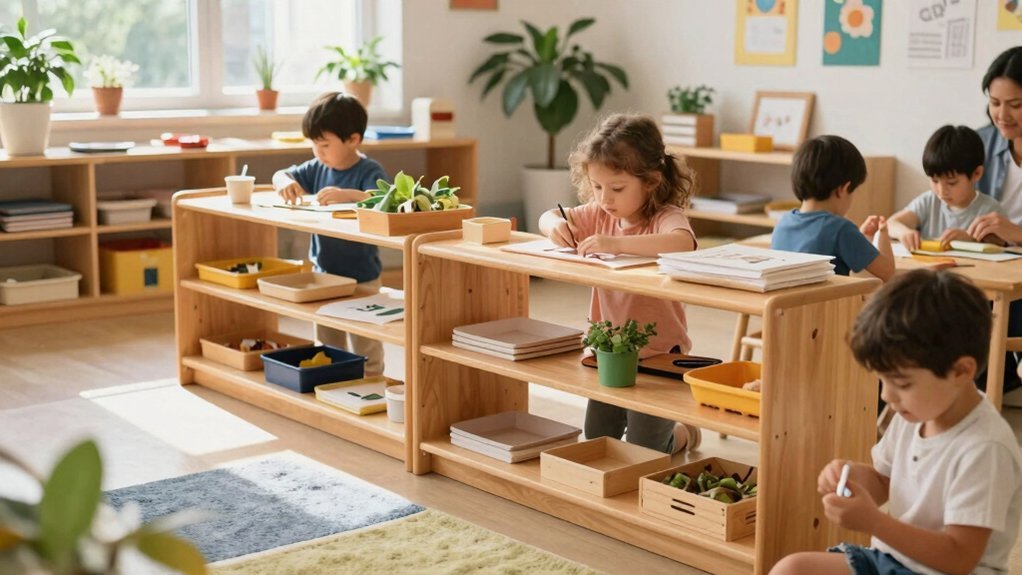
How can you shift from stickers to genuine independence? You start by creating a prepared environment where every material sits at child level, clearly labeled, and within easy reach. This setting reduces frustration and invites self‑directed learning. Predictable routine frames the day, so children know when to transition, clean up, and return items, building competence and intrinsic motivation. By letting them choose what, where, and with whom to work, you nurture autonomy and a sense of ownership. The organized space shows where everything belongs, encouraging habits that reinforce independence. As they engage without extrinsic rewards, they develop confidence, collaborate naturally, and internalize responsibility, turning everyday tasks into meaningful learning experiences. Incorporating Montessori-friendly tools like step stools with safety rails further supports children’s autonomy by enabling safe and independent access to environments.
Give Process-Focused Feedback Instead of Generic Praise
A key shift from generic praise to process‑focused feedback starts with pausing before you speak, letting the child hear the exact action you’re recognizing and its impact—“You put the blocks away in the right place, which helps us find them quickly.” You then name effort, strategy, or reflection, linking it to intrinsic motivation and Montessori methods. This type of behavior guidance replaces empty praise and rewards with language that shows growth and ownership.
| Example | Focus | Effect |
|---|---|---|
| “You tried hard to share the crayons.” | Effort | Builds confidence |
| “Your careful painting shows improving control.” | Process | Encourages self‑assessment |
| “You organized the shelves, making cleanup easier.” | Impact | Reinforces responsibility |
Use this pattern daily, and children will internalize standards without needing charts. Incorporating Montessori color sorting activities can further support development of focus and responsibility during learning.
Teach Grace and Courtesy to Build Social Responsibility

Shifting from process‑focused feedback to everyday interactions, you can teach grace and courtesy by modeling polite behaviors in the prepared environment. In a Montessori environment, you greet peers, say please and thank you, and handle materials gently, turning simple actions into lessons in social responsibility. Use structured language prompts and role‑playing to clarify expectations, then give positive reinforcement that highlights how courteous deeds affect others. By linking these moments to daily routines—serving snacks, cleaning up, or passing tools—you nurture intrinsic motivation, so children act kindly without external rewards. Regular feedback emphasizes the impact of their behavior, reinforcing the connection between personal choices and community well‑being.
Use Real-World Outcomes and Reflection for Natural Consequences
Ever wonder why a child learns best when the result of their action is visible? You can replace stickers with real‑world outcomes that show cause and effect instantly. When a child leaves toys out, the natural consequence is that someone else moves them or they get lost, so you ask, “What happened?” and guide a short reflection: “How did that affect you and others?” This simple dialogue builds intrinsic motivation because the child sees personal responsibility, not external praise.
In a Montessori environment, you observe the cleanup speed or time saved and discuss those outcomes, linking effort to tangible benefit. By consistently pairing real‑world outcomes with reflection, you help the child internalize self‑regulation and understand natural consequences.
Cultivate a Growth Mindset Through Collaborative Problem-Solving

How can you turn everyday challenges into shared learning moments? By framing tasks as puzzles, you nurture a growth mindset and spark intrinsic motivation. When kids collaborate, they practice child autonomy while you give process‑focused feedback that celebrates effort, strategy, and persistence.
Framing everyday challenges as puzzles nurtures growth mindsets, autonomy, and celebrates effort, strategy, and persistence.
- Identify the problem together and ask “What’s the goal?”
- Brainstorm multiple approaches, encouraging each child to voice ideas.
- Test a solution, observe results, and adjust as a team.
- Reflect on what worked, linking effort to future growth.
This collaborative problem‑solving cycle shifts focus from rewards to learning, builds resilience, and reinforces that abilities develop through practice and teamwork. Using tools with convertible training mechanisms can support gradual skill development within this approach.
Frequently Asked Questions
What to Use Instead of Reward Charts?
You should use specific, action‑focused praise, virtues‑based language, and thoughtful pauses that link behavior to growth, plus choices, safe boundaries, and a stimulating environment that nurtures intrinsic motivation.
What Is the Biggest Criticism of Montessori?
You’ll hear that Montessori’s biggest criticism is its perceived lack of structured guidance—parents worry self‑directed work delays core skill mastery, creates inconsistent outcomes, and makes progress harder to assess.
What Are the 3 D’s of Montessori?
You’ll find the three D’s are desk‑free environment, deliberate hands‑on activities, and a daily routine that nurtures independence and concentration, letting kids choose work, explore purposefully, and follow predictable, freedom‑rich schedules.
What Are the 4 C’s of Montessori?
You’ll find the four C’s are Cooperation, Concentration, Confidence, and Compassion—each built through hands‑on activities, mixed‑age collaboration, self‑directed work, and caring, respectful guidance that nurtures growth.