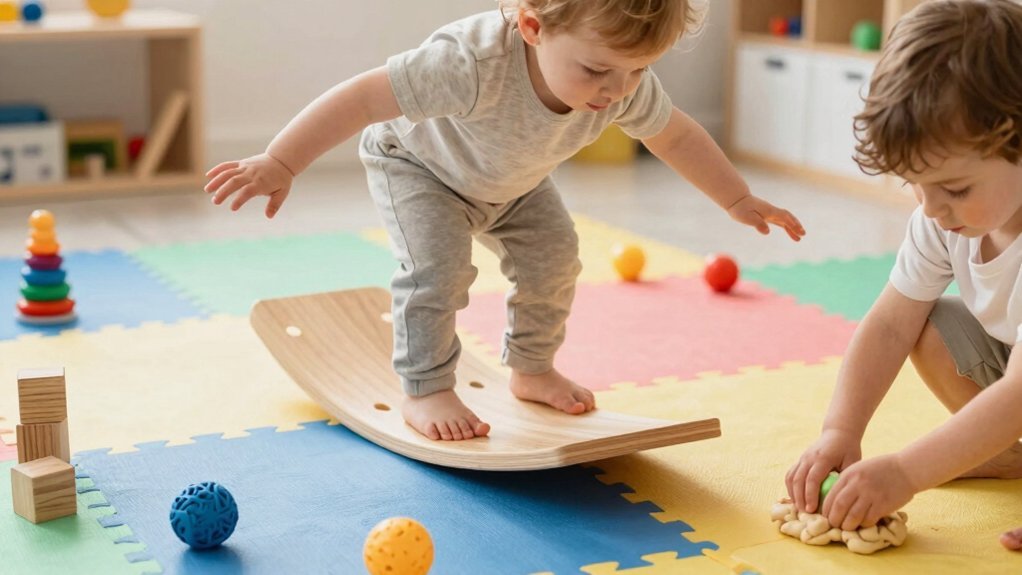
You can boost your child’s brain development with short, multisensory sensorimotor activities like swinging, textured‑toy exploration, and mirror play. These actions fire vestibular, proprioceptive, and visual pathways, strengthening neural connections that improve focus, language readiness, and fine‑motor skills. Simple routines—such as tummy‑time with a baby‑safe mirror, water‑and‑texture stations, or DIY sound bottles—provide varied sensory input, promote posture, and encourage self‑regulation. Keep sessions brief and frequent, and you’ll see progress in attention, coordination, and early learning as you explore more.
What Is Sensorimotor Play and Why It Boosts Brain Development?

When you let a child explore the world through sensorimotor play, you’re wiring their brain with rich, multisensory input while they move, touch, see, hear, and even smell their surroundings. This type of play fuses sensory motor integration with purposeful movement, prompting neural pathways to fire together and strengthen.
As they grasp a block, crawl toward a sound, or scent a flower, the brain registers simultaneous data streams, boosting brain development. Short, frequent bursts—just three to five minutes—enhance focus, memory, and learning readiness by reinforcing connections that underlie language, fine and gross motor skills, and emotional regulation.
Over time, these experiences improve rhythm, timing, bilateral coordination, and adaptive problem‑solving, laying a resilient foundation for future cognition. Using age-appropriate design features in everyday items can further support these developmental gains by encouraging independent and safe exploration.
Vestibular & Proprioceptive Play: How It Shapes Neural Pathways
When you swing, spin, or rock, you’re sending vestibular signals that sharpen your sense of balance and spatial orientation.
Pairing those motions with heavy work or coordinated movements boosts proprioceptive feedback, deepening your core awareness and muscle tone.
Together, these activities forge stronger neural pathways that support postural control and fine‑motor precision.
Incorporating wooden stacking toys into play can further enhance fine motor skills and spatial awareness in toddlers.
Balancing Body Movements
Balancing body movements through vestibular and proprioceptive play strengthens neural pathways by challenging your child’s sense of balance and body awareness. When you let them swing, spin, or climb, the vestibular system receives rapid motion cues that sharpen spatial orientation and postural control.
Pair those actions with proprioception—pushing, pulling, carrying, or resisting movement—to boost muscle tone and refine the internal body map. Short, varied sessions of three to five minutes, two to three times a day, keep the sensory input fresh without overwhelming the nervous system.
This rhythm of movement trains the brain to filter distractions, improves focus, and lays a foundation for later academic tasks. Consistent practice builds a resilient balance network that supports both physical coordination and cognitive readiness. Using engaging tools like the Mbrain Montessori Life Cycle animal figures with flash cards can further enhance cognitive and sensory development through hands-on learning experiences.
Strengthening Core Awareness
Engage your child in dynamic core‑strengthening play—spinning, rocking, crawling, and lifting—to flood the vestibular and proprioceptive systems with rich, varied input. When you mix speeds, directions, and surfaces, you spark neural pathways that sharpen spatial orientation and motor coordination. Short, energetic bursts of swinging or rolling give the vestibular system a workout, boosting postural control and movement planning.
Pair those with pushing, pulling, or carrying heavy objects, and the proprioceptive system reinforces muscle tone and joint position sense, sharpening fine‑motor precision. Consistent, varied experiences help the brain weave cross‑modal connections, improving sensory integration, attention, and executive function. By weaving these activities into daily routines, you lay a solid foundation for balanced, coordinated movement and lifelong cognitive resilience. Incorporating open-ended, hands-on exploration with magnetic science kits can further enhance fine motor skills and independent scientific thinking development.
Sensorimotor Play: Core Montessori Materials That Promote Movement
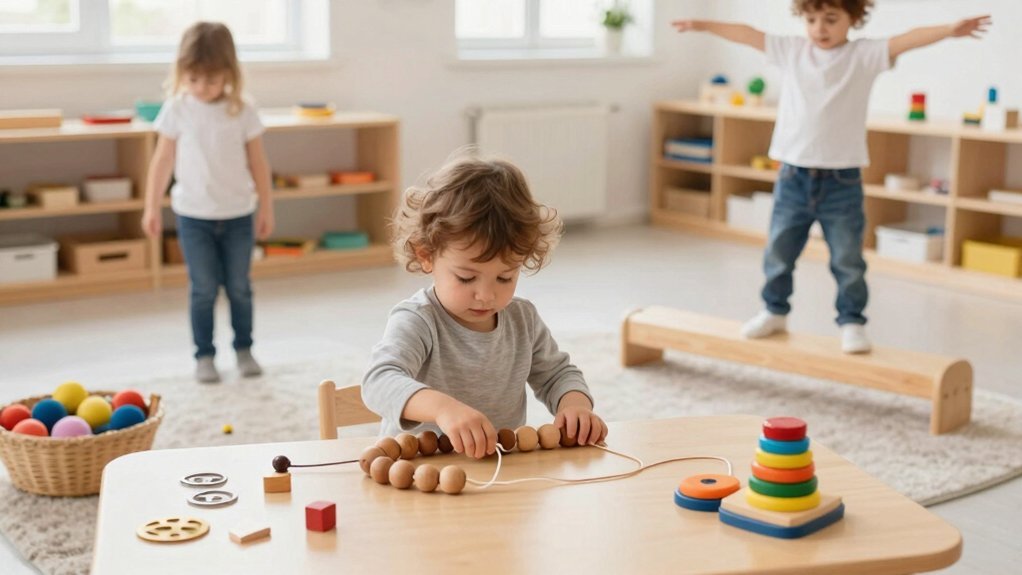
Ever wondered how a simple cylinder can sharpen a child’s focus? You’ll see that sensorimotor play with Montessori materials turns that curiosity into purposeful action. The knobbed cylinder invites a pincer grip, while graded textures teach tactile discrimination. As you guide the child to match sizes, hand‑eye coordination sharpens, and fine motor skills blossom.
Puzzle maps demand precise placement, reinforcing spatial awareness and cause‑and‑effect reasoning. Repeating these isolated sensory experiences builds perceptual discrimination that fuels language and cognitive growth. Because each activity self‑corrects, the child stays motivated, solving problems independently.
The structured yet open‑ended nature of these tools lets you move from passive exploration to intentional manipulation, aligning motor development with executive‑function progress. Incorporating materials like the wooden play food set enhances sensory engagement through tactile variation and auditory feedback, enriching the sensorimotor learning experience.
Sensorimotor Play: Tummy‑Time Activities to Build Core Strength and Focus
You’ll notice that regular tummy‑time builds core strength, giving your baby a solid foundation for later movement.
Adding a baby‑safe mirror encourages visual tracking and facial recognition, sharpening focus as they watch themselves.
Short, varied sessions with gentle pauses help them self‑regulate while learning to shift weight and reach confidently.
Using BPA-free products during playtime ensures a safer environment for your child’s development, highlighting the importance of BPA-free materials.
Core Strength Development
A few minutes of tummy‑time each day give your baby’s neck, shoulder and core muscles the workout they need to build a stable base for head control and upper‑body stability, while a baby‑safe mirror adds visual tracking that encourages longer, purposeful holds. Short, frequent sessions spark motor development without overtaxing the infant, and varied surfaces or a favorite toy keep the experience fresh, prompting the baby to reach, roll, and push up. These micro‑efforts compound, strengthening core strength and laying groundwork for balanced posture as your child grows.
- Place a soft, textured mat to stimulate tactile feedback.
- Use a lightweight, colorful toy just out of reach to motivate reaching.
- Rotate between flat and slightly inclined surfaces to vary muscle activation.
Including age-appropriate tools with safe, ergonomic designs can further enhance developmental skills through hands-on interaction.
Visual Tracking Enhancement
How does a simple mirror turn tummy‑time into a visual‑tracking workout? You place a baby‑safe mirror at eye level and let your little one stare at reflections while lifting their head. The mirror feedback draws attention to moving faces, prompting the infant to follow expressions with their eyes and head. This coordinated effort strengthens neck, shoulder, and core muscles while sharpening visual tracking. Repeated sessions link visual input to caregiver smiles, boosting early social perception and facial recognition.
| Benefit | How it works |
|---|---|
| Eye‑head coordination | Mirror feedback forces the baby to align gaze with head movement |
| Vestibular engagement | Tummy‑time activates balance sensors, supporting gaze‑following |
| Proprioceptive tuning | Core activation refines body awareness during tracking |
| Extended focus | Dynamic reflections keep the infant engaged longer |
| Social‑perception growth | Repeated facial cues enhance recognition skills |
Focus and Self‑Regulation
Ever wonder how a few minutes on their belly can sharpen a baby’s ability to stay calm and focused? Tummy time builds neck, shoulder, and core strength, giving your little one the posture and endurance needed for sustained attention. When you add a baby‑safe mirror, they practice visual tracking, which tightens focus and supports self‑regulation. Short, frequent sessions—three to five minutes, several times a day—let them coordinate movements, while textured toys and lightweight objects invite sensory exploration that fires neural pathways for concentration.
- Place a mirror during tummy time to boost visual tracking and calm focus.
- Rotate soft, textured toys every session to encourage sensory exploration and attention.
- Keep sessions brief but regular, building self‑regulation through consistent, supervised practice.
Water & Texture Exploration for Fine‑Motor and Sensory Integration
Three simple water‑and‑texture stations can instantly boost a baby’s fine‑motor skills and sensory integration. Set up a shallow basin with a few floating toys; as the infant squeezes, pours, and scoops, you’ll see hand‑eye coordination sharpen and fine motor control deepen.
Next, lay a basket of varied textures—soft blankets, crinkly paper, sponges, rubber toys—so the child can reach, grab, and manipulate each surface, building grip strength and tactile discrimination.
Finally, mix wet and dry items under close supervision; the shifting haptics, visual cues, and proprioceptive feedback stimulate sensorimotor pathways and reinforce sensory integration. These multisensory experiences forge neural links that support movement, language, and self‑regulation, laying a strong foundation for later learning.
Safety Checklist for Water, Texture, and Sound Play at Home
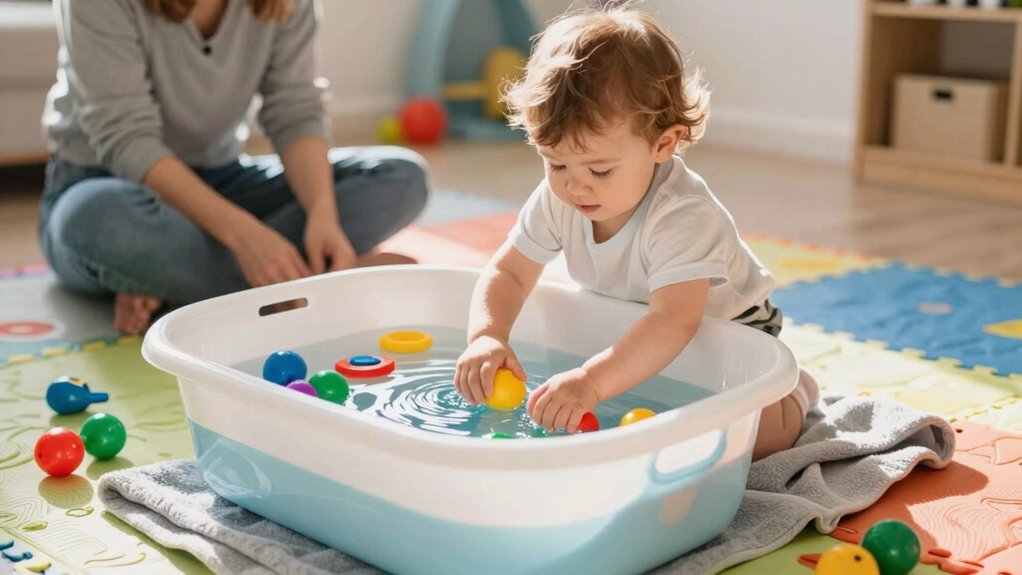
You’ll want to check the water temperature before each session, making sure it’s warm but not hot.
Then, securely close any lids on sensory bottles so nothing can spill or come loose.
Water Temperature Checks
Is the water comfortably warm? You’ll want the water temperature around 37–38 °C (98–100 °F) so your child feels cozy, not burned. Before the splash begins, test the water with your wrist or a bath thermometer; this quick check guarantees safety and lets you adjust instantly. Keep a vigilant eye—supervision is non‑negotiable, even with shallow trays. After play, dry any spills to avoid slips and maintain a tactile‑rich environment.
- Use a reliable thermometer to confirm the temperature stays within the safe range.
- Limit water depth to a shallow bowl or tray, ensuring easy supervision.
- Transition to texture or sound play if the child shows discomfort with moisture.
Secure Lid Closures
Wondering how to keep water, texture, and sound play safe? You’ll want secure lids on every safe container to guarantee spill prevention and protect curious hands. Tighten bottle caps, use child‑proof closures, and pick transparent vessels so you can spot leaks or wear instantly. Before each session, run a quick safety check: confirm lids are sealed, inspect for loose parts, and keep cups out of reach when not in use. This routine lets kids explore pouring, shaking, and rolling without the mess or choking risk.
| Check | Why it matters |
|---|---|
| Lid tightened | Prevents accidental opening |
| Transparent container | Enables visual monitoring |
| No loose inserts | Avoids choking hazards |
| Quick safety routine | Ensures consistent spill prevention |
DIY Sound Bottles and Rhythm Games for Auditory Processing
Exploration through sound invites children to discover rhythm and texture while strengthening auditory processing. You can turn sensory play into a science lab by filling small plastic containers with rice, pasta, beads, or glittery water. Secure lids prevent choking hazards and keep the contents sealed as they shake, roll, and tumble. When you label each noise—“rattle,” “glitter swish”—you boost language and sound differentiation. Vary density with oil or adjust liquid levels to create new timbres, encouraging children to notice subtle changes in pitch and volume. Repeating patterns reinforces auditory processing and builds a foundation for musical awareness.
- Fill bottles with different materials for varied timbres.
- Label each sound and repeat patterns to strengthen auditory processing.
- Adjust density or liquid levels to create distinct auditory cues.
Mirror Play for Visual Tracking, Self‑Recognition, and Postural Control
When you place a baby‑safe mirror in the play area, the infant instantly begins to track their own movements, turning tummy time into a visual workout. Mirror play sparks visual tracking as the baby follows facial twitches across the reflective surface, strengthening eye‑muscle coordination. By six to twelve months, self‑recognition emerges; reaching for the reflected face builds awareness that “I” am distinct from others. The constant visual feedback also refines postural control—head, neck, and upper‑body muscles adjust to keep the image centered while the infant lies prone or sits with support. Repeated sessions boost proprioceptive sense and muscle coordination, laying groundwork for later social cognition and motor skills.
| Benefit | Example |
|---|---|
| Visual tracking | Baby follows smile in mirror |
| Self‑recognition | Reaches for reflected face |
| Postural control | Adjusts head to keep image centered |
| Proprioception | Feels body position via visual cue |
| Social cognition | Differentiates self from others |
Easy Sensorimotor Circuits for Babies (0‑12 mo) & Toddlers (1‑3 yr)
After the mirror’s visual feedback has sparked tracking and self‑awareness, you can expand the baby’s sensorimotor toolbox with simple, tactile‑rich circuits. Use gentle tummy time paired with a baby‑safe mirror to boost visual tracking and upper‑body strength, then introduce soft textures like silk scarves or crinkly paper. Keep each session short—2–5 minutes—but frequent, letting the infant explore rattles, teething rings, and other sensory objects while you label faces and sounds. This routine we sensory play, supports early development, and hones motor skills, laying a sturdy foundation for later milestones.
- Tummy‑time mirror play with soft scarves for proprioception.
- Rattle‑and‑crinkly‑paper exploration while you name colors and sounds.
- Face‑to‑face interaction with language labeling during tactile play.
Tracking Progress: Observing Developmental Milestones Through Play
Even a brief, five‑minute play session can reveal a lot about your child’s development. You watch sensorimotor development unfold as they shift weight during tummy time, grasp slime, and track moving objects. Those moments let you capture developmental milestones: head control improving, hand‑eye coordination sharpening, and the ability to reach for a toy while staying balanced. Use play‑based observation to note when they group blocks by color or size, or when they react faster to new textures and sounds. Short, structured activities—water play, texture exploration, simple puzzles—provide natural windows into attention span, persistence, and problem‑solving. Regularly documenting these actions helps you gauge progress, spot delays early, and decide if screening is needed.
Frequently Asked Questions
What Are Examples of Sensorimotor Activities?
You can try tummy time with a mirror, texture exploration using soft fabrics, water play for fine‑motor control, shaking sound bottles, rolling marbles, sand‑and‑rice bins, and guided loose‑part puzzles.
What Activities Can Increase Brain Growth?
You boost brain growth by doing short, varied sensorimotor drills—balancing on a wobble board, juggling, crawling tunnels, rhythmic clapping, or drawing with textured crayons—each engaging multiple senses and movements.
At What Age Is 90% of the Brain Developed?
By age five you’ve already reached roughly ninety percent of your brain’s adult size, with most growth and synaptic wiring completed during those early years, setting the stage for later cognitive development.
What Activities Boost Brain Development in Toddlers?
You boost your toddler’s brain by offering sand and water play, finger painting, mess‑free sensory bags, textured books, bubble blowing, and obstacle‑course movement, all of which sharpen motor, tactile, and social skills.



Leave a Reply