
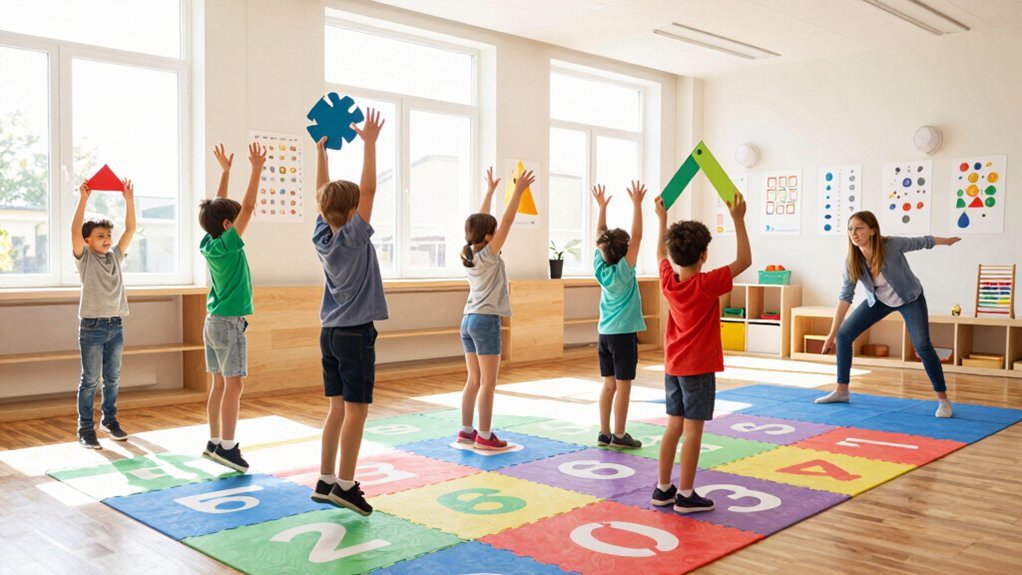
You boost math skills by pairing fast‑paced, whole‑body moves—like timed hops, balance drills, or bead‑stair climbs—with real‑time arithmetic. Each hop or hop creates numeric data you can instantly log, turning physical effort into numbers for mean, median, and mode calculations. Skip‑counting beats and rhythm games map multiples, fractions, decimals, and ratios onto claps, taps, or jumps, embedding patterns in your memory. Quick 30‑second bursts generate fresh data sets, and shared Google Sheets turn those numbers into visual dashboards that track progress. Keep exploring to discover how deeper data‑driven loops amplify learning.
What Is Movement Math and Why It Works

How does moving your whole body boost math learning? You experience movement math when you turn whole‑body actions into numeric symbols, letting kinesthetic learning create vivid patterns and patterns and relationships. By jumping, hopping, or balancing, you build number sense and internalize skip counting faster than scribbling on paper. Gross motor activities fire the brain’s dynamic pathways, raising arousal and attention, which translates into stronger mathematics engagement. Data‑driven movement—timed challenges and class‑wide analytics—gives immediate feedback, reinforcing concepts while you move. This multisensory approach embeds durable memory traces, so you transfer concrete experiences to abstract algebraic and geometric ideas with ease. Incorporating color-coded bead stairs can further enhance numerical understanding by linking physical movement with visual and tactile math learning.
Gross‑Motor Activities for Number Sense & Central Tendency
Often, you’ll see students pair up for Blind Stork drills, timing each other while balancing on one leg; those repeated, whole‑body measurements create a rich dataset that makes calculating mean, median, and mode feel concrete rather than abstract. You then transfer the movement data into a shared Google Sheet, where each trial becomes a numeric entry. By aggregating jumps, hops, or fraction‑ball throws, you generate a large sample that sharpens number sense and reveals central tendency patterns. Quick class‑wide calculations of mean, median, and mode let you compare individual performance to the group, highlighting variability and reinforcing math skills. This gross‑motor data collection turns physical activity into a living statistics lesson, grounding abstract concepts in tangible motion. Utilizing eight-piece classroom reading corner cushions can create comfortable and inviting spaces that encourage students to focus and engage during these active math lessons.
Skip‑Counting Routines to Build Multiples and Patterns
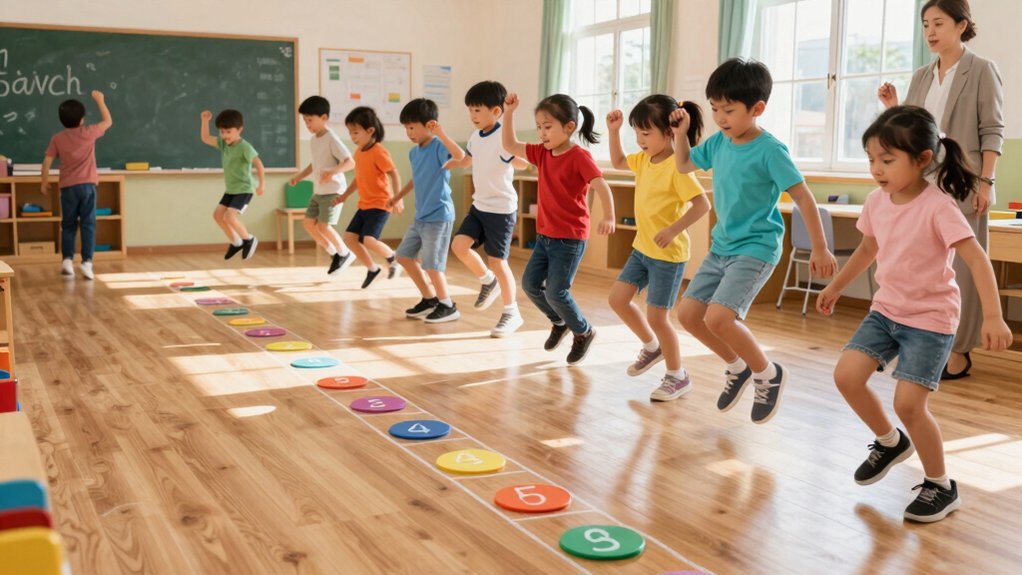
You’ll notice how rhythmic counting sequences turn abstract multiples into a steady beat you can feel. By pairing each step with a visual pattern—like a line of dots that grows as you count—you create a clear map that reinforces the math. This combo lets you move, see, and remember multiples with minimal effort. Incorporating hands-on activities like color-coded designs can further strengthen visual discrimination and memory associations in math learning.
Rhythmic Counting Sequences
Ever wondered why a simple clap‑and‑count routine can turn a string of numbers into a powerful math tool? When you pair skip counting with rhythmic counting, each beat becomes a movement cue that anchors multiplication concepts in your body. You’ll notice that clapping every second number builds math fluency faster than silent rehearsal. The steady pulse reinforces pattern recognition, letting you see multiples emerge naturally. Kinesthetic learning turns abstract counting sequences into tangible actions, so early math education feels like a dance rather than a drill. By timing jumps or taps to each increment, you internalize the jump size, chunk numbers efficiently, and boost fluency in multiplication tables—all while having fun. Incorporating wooden ten-frame math manipulatives can further enhance these kinesthetic learning routines by providing tactile and visual reinforcement.
Visual Pattern Mapping Techniques
How can a simple line of dots become a roadmap for multiplication mastery? You start with visual pattern mapping, laying out dots on a number line and then using skip‑counting beats to jump from one multiple to the next. Each hop or clap becomes a movement pattern that reinforces rhythm and spatial representations. As you connect 2, 4, 6, 8 or 3, 6, 9, 12, the regular intervals pop out, turning concrete counting into abstract math fluency. The visual grid shows how multiples align, prompting relational thinking about growth trends. By pairing claps, hops, or taps with the visual map, you embed the pattern in memory, boosting retention and accelerating mastery of times tables. Integrating water play activities that require precise hand movements can effectively support fine motor refinement, which enhances coordination for better engagement in pattern mapping exercises.
Rhythm Games for Teaching Fractions, Decimals, and Ratios
Rhythm games turn the court into a moving math playground, letting you map fractions, decimals, and ratios onto specific spots and beats. You step to the 3‑point arc for a whole, then hop to ¼, ½, ¾, ⅓, and ⅔ zones while a beat counts down, turning abstract fractions into kinetic cues. As you dribble, you convert scores like 0.50 to ½, cementing the fraction‑decimal connection through kinesthetic learning. Assigning a quick shuffle to a 2:1 tempo or a slow glide to a 3:2 ratio weaves ratios into movement patterns, sharpening spatial reasoning and movement‑based math fluency. Integrating realistic role play costumes can further enhance engagement and collaborative learning during these rhythm-based activities.
Quick Transition Challenges That Generate Math Data

You’ll see how short, timed movement bursts instantly create data sets you can track in a spreadsheet. Each 30‑ to 60‑second trial yields counts, averages, and distribution metrics that reveal speed and accuracy.
Running multiple trials in pairs or small groups builds a robust dataset for comparing performance across different transition conditions. Using tools such as the Montessori bead stair set can provide tangible data for counting and sequencing activities during these trials.
Generated Data Sets
Ever wonder how a quick burst of movement can become a treasure trove of math data? When you launch a rapid‑fire jumping‑jack set, each hop becomes a data point. You log the time, feed it into a shared sheet, and instantly turn raw movement into meaningful datasets. The class watches the numbers shift, discusses variability, and pinpoints central tendency. By comparing means and medians across pairs, you sharpen math skills while practicing data analysis. The routine repeats, building a robust collection that supports deeper statistical conversations and reinforces the link between physical activity and quantitative reasoning.
- Record trial duration in seconds for each student
- Swap roles in “Blind Stork” to double sample size
- Input results into a shared Google Sheet for real‑time stats
- Highlight mean, median, mode to illustrate central tendency
Timed Movement Challenges
How can a 30‑second sprint turn into a math lesson? You set a timed movement challenge, count jumps or sprints, and record each result. Those rapid trials feed into data collection that builds a class dataset in minutes. You then guide students through mean calculation, compare median and mode, and spot outliers. Because the tasks are short, engagement stays high and movement patterns repeat, swelling the dataset for reliable statistical analysis. You store the numbers in a shared sheet, let learners visualize trends, and discuss why a faster sprint shifts the average. This loop of physical effort and arithmetic reinforces math skills while keeping the classroom lively and data‑driven.
Digital Tools for Analyzing Movement‑Math Metrics
Where can you capture, store, and instantly analyze the movement data that fuels math learning? Use a cloud spreadsheet as your central hub. You log each trial, share the sheet with the whole class, and run formulas that compute mean, median, and mode for movement metrics. The shared file guarantees class‑wide reproducibility, while built‑in charts turn raw numbers into visual feedback. You can revisit the same dataset for new pair‑level or whole‑class comparisons without rebuilding the workflow, keeping the focus on math skills rather than setup.
- Google Sheets for real‑time data collection and storage
- Automated calculations of central tendencies across the class
- Visual dashboards that display movement‑math trends instantly
- Exportable CSVs for deeper statistical analysis or reproducible reporting
Frequently Asked Questions
How Does Movement Enhance Math?
You boost math by moving because physical activity raises arousal, sharpens focus, and links concrete actions to abstract concepts, letting you experience patterns, collect data, and engage kinesthetically, which strengthens understanding and retention.
What Are the 4 Causes of Dyscalculia?
You’ll find dyscalculia stems from weak number sense, poor symbolic processing, limited magnitude representation, and working‑memory deficits. These core causes disrupt how you perceive, manipulate, and retain numerical information.
What Role Do Patterns Play in Mathematics?
You see patterns as the scaffolding that links numbers, shapes, and operations; they let you predict, generalize, and translate ideas, turning abstract concepts into intuitive, solvable problems.
What Activities Strengthen Math Skills?
You’ll boost math skills by doing bean‑bag counting jumps, rhythm claps for skip‑counting, fraction‑ball target throws, algebraic dance steps, and walking‑while‑solving drills that weave movement into numbers.



Leave a Reply