You’ll boost your child’s brain by giving them fun bilateral coordination activities—toss a ball while holding a pillow, paint with both hands, or run a simple obstacle course. These actions fire motor‑planning circuits, tighten white‑matter tracts, and strengthen inter‑hemispheric links, which sharpen working memory, executive function, and problem‑solving. The core and balance moves free up cognitive resources, while hand‑eye games sharpen attention. Keep the routines short, playful, and consistent, and you’ll see richer language and social skills as you explore more.
Our Recommended Product on Amazon

As an Amazon Associate we earn from qualifying purchases.
Why Bilateral Coordination Matters for Brain Development
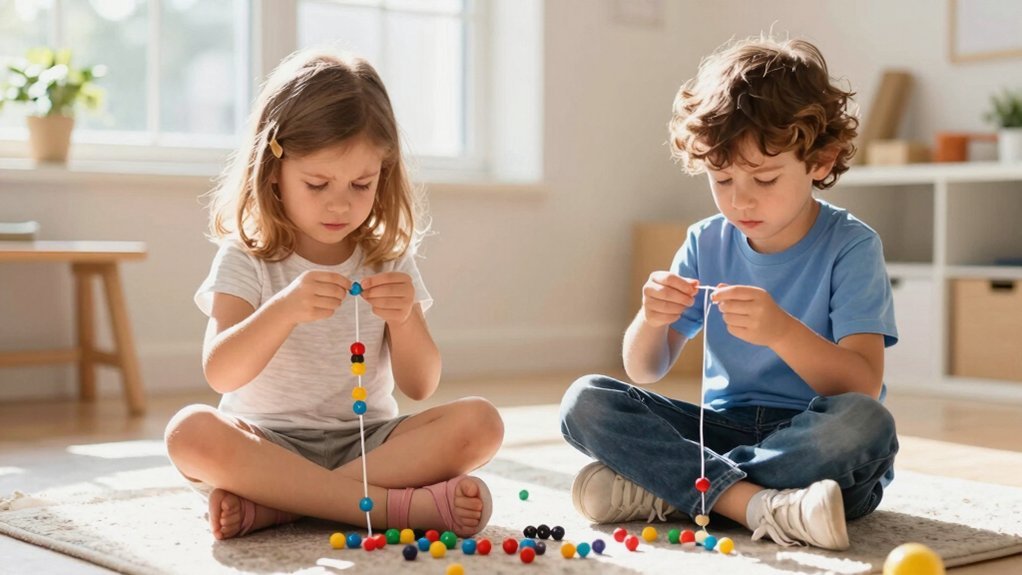
Why does bilateral coordination matter for brain development? When you practice using both hands together, you’re not just learning to button a shirt or hold a spoon—you’re wiring neural circuits that underlie motor skills and cognitive growth. Each time you stabilize a block with both palms or switch hands during play, the brain integrates sensory feedback from opposite sides, strengthening pathways that support problem‑solving and resilience.
Early signs like one‑handed play or difficulty stabilizing objects signal a need for more bilateral practice. By weaving playful, daily activities into your routine, you boost movement automaticity, enhance independence, and lay a foundation for long‑term developmental success. Consistent effort often shows noticeable progress within four weeks, reinforcing the link between coordinated motion and robust brain development. Using tools such as a Kitchen Step Stool for Kids with Safety Rail can encourage children to engage in more independent and coordinated activities at home.
How Bilateral Coordination Strengthens Neural Pathways
When you engage in bilateral activities, you’re wiring both hemispheres together, creating stronger neural connectivity across the brain. This synchronized movement trains your motor‑planning circuits to communicate efficiently with cognitive centers.
Over time, those reinforced pathways boost problem‑solving, resilience, and overall development.
Ateral Neural Connectivity
Bilateral coordination engages both sides of the body, prompting the brain to link motor and cognitive regions more tightly. When you practice two‑handed tasks, you boost neural connectivity that underlies motor planning and problem solving. Those repeated actions tighten the white‑matter tracts between hemispheres, letting signals travel faster and more reliably. You’ll notice smoother dressing, steadier feeding, and quicker grooming as the pathways mature. Early signs—like favoring one hand or struggling to stabilize objects—signal that these connections need reinforcement. By weaving brief, daily routines into play, you forge stronger synaptic links, paving the way for lasting functional independence and richer cognitive development. Incorporating activities with open-access shelves can further enhance coordination by encouraging children to independently select and manipulate materials within their reach.
Motor Planning Integration
Ever notice how a simple two‑handed game can make planning a task feel effortless? When you guide a child through a ball‑passing drill, bilateral coordination sparks a dialogue between the cerebellum and prefrontal cortex. This dialogue tightens neural pathways that underlie motor planning and executive function, turning deliberate play into a brain‑boosting workout. Balanced motor demands force rapid adjustments, sharpening attention, working memory, and cognitive flexibility. Over time, consistent two‑handed activities embed automaticity, curbing impulsive reactions and letting motor plans flow smoothly into cognitive tasks. Incorporating Montessori metal insets tracing activities can further enhance fine motor precision and hand steadiness, critical for early writing skills.
| Skill | Brain Region | Benefit |
|---|---|---|
| Ball‑passing | Cerebellum & Prefrontal | Enhanced motor planning |
| Rope‑skip | Motor Cortex | Improved bilateral coordination |
| Clapping patterns | Basal ganglia | Strengthened executive function |
| Mirror drawing | Parietal lobe | Better spatial sequencing |
| Puzzle assembly | Temporal lobe | Faster decision‑making |
Core & Balance Moves That Boost Working Memory

How can simple core and balance moves sharpen your working memory? You can boost your brainpower by doing sit‑ups, planks, or yoga poses that stabilize your core. Strong core control eases posture and frees mental resources, letting you focus on memorizing information. Pair those moves with balance tasks—single‑leg stands, heel‑to‑toe walks, or standing on a wobble board—to engage the core while you maintain static and dynamic stability. This dual challenge reduces cognitive load, so your working memory can hold more items longer. Adding animal walks, obstacle courses, or dancing mixes dynamic coordination with core activation, sharpening motor planning and sequencing. The result is clearer attention, better executive function, and stronger memory retention during school tasks. Activities encouraging cognitive and motor skills development, like Montessori-inspired play kitchens, further enhance brain growth and executive function.
Home Activities for Bilateral Coordination & Hand‑Eye Skills
You can start with simple bilateral coordination activities like tossing a ball back and forth while holding a pillow with the other hand.
Hand‑eye tracking games—such as moving a wand to tap floating bubbles on a screen—sharpen visual focus and timing.
DIY tools like a homemade pulley or a two‑handed paintbrush let you practice both sides of the body together while having fun.
Bilateral Coordination Activities
Why not turn everyday moments into fun practice for both sides of the body? You can weave bilateral coordination into daily routines like dressing, carrying groceries, or crawling up stairs. When your child pulls a shirt over both shoulders, they’re strengthening motor development and learning to stabilize objects with two hands. Encourage them to open a jar together, stack blocks, or toss a pillow from one hand to the other while you walk. Simple games—like “mirror moves” where you mimic each other’s arm swings—boost independence and school readiness. Consistent, playful two‑sided actions build movement automaticity, problem‑solving, and resilience, turning ordinary tasks into powerful brain‑building practice. Including natural wooden peg people in play can further enhance fine motor skills and creative coordination as children manipulate and customize these figures.
Hand‑Eye Tracking Games
One simple way to boost bilateral coordination is to turn everyday moments into hand‑eye tracking games. When you toss a scarf or launch a balloon for a quick volley, your child practices hand‑eye coordination, visual‑motor integration, and timing while receiving tactile feedback. Popping bubbles or reaching for a specific target encourages finger isolation and precise grasp control, sharpening fine motor skills needed for bilateral tasks.
Copycat drawing and shape‑based pattern play blend visual‑motor planning with creativity, reinforcing sequencing and spatial representation. Embedding these drills into daily routines heightens attention persistence and processing speed across fine‑ and gross‑motor activities.
Trusted resources such as the OT Toolbox, Physiopedia, and the NAPA Center offer evidence‑based exercises that specifically target hand‑eye coordination to support pediatric motor development. Incorporating toys with fine motor skill building like natural wooden spinning tops can provide a fun and effective way to enhance these coordination activities.
Simple DIY Skill Tools
A handful of everyday items can become simple DIY skill tools that turn routine moments into targeted bilateral‑coordination and hand‑eye practice. You’ll notice that using two objects together—like a spoon in each hand while stirring a bowl—helps your child develop motor skills and reinforces the neural pathways needed for independence. Keep the activities short, engaging, and woven into daily routines so at‑home practice feels natural, not forced. Consistency is key; a few minutes each day can yield noticeable progress within weeks.
- Towel‑fold race: place a small towel on the floor, have your child use both hands to fold it repeatedly.
- Spoon‑and‑ball transfer: move a ping‑pong ball from one spoon to another across a table.
- Dual‑hand painting: use two brushes or crayons on a large sheet of paper, encouraging simultaneous strokes.
Including safe, age-appropriate kitchen tasks using tools with features like child-safe peelers can further enhance coordination and fine motor skill development.
How to Track Bilateral Coordination Progress at Home
Curious how you can see real growth in your child’s bilateral coordination? Start a simple tracking sheet and note the date, activity, and success level each day. Use a 1‑5 rating: 1 = child uses one hand, 5 = both hands work smoothly. Choose home practice tasks like interlocking blocks, rolling a ball between hands, or pulling a towel while crawling. Record any shift from one‑hand dominance to two‑handed stability. Review the chart weekly; a steady climb signals progress, while a flat line after four weeks suggests it’s time to consult a pediatric OT/PT for tailored support. Keep the routine playful, embed it in dressing, feeding, and tidy‑up chores, and you’ll witness measurable improvement without extra hassle.
Structured Play That Improves Self‑Control & Impulse Regulation
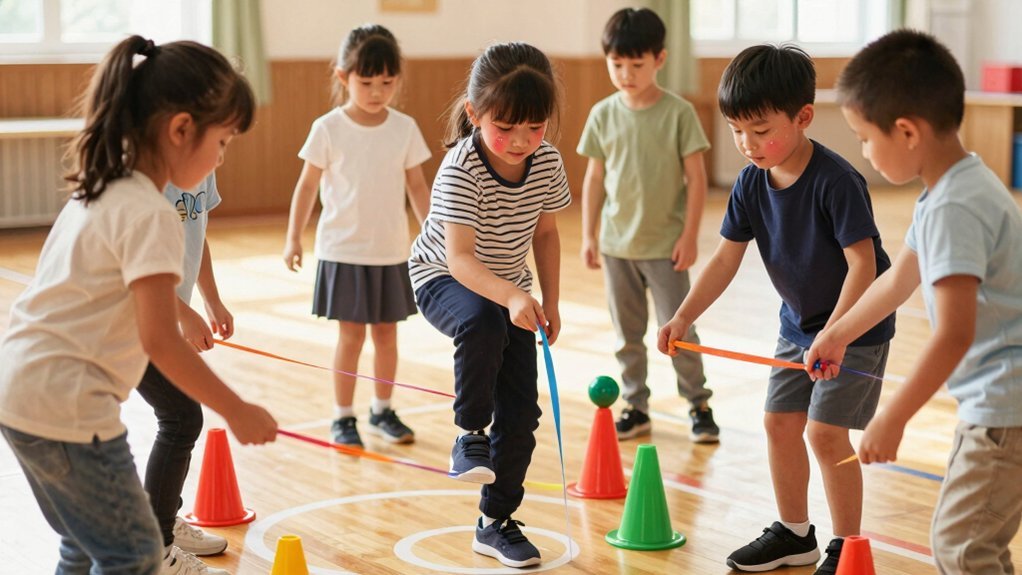
You’ll notice that control games like Simon Says teach you to pause before acting, sharpening impulse‑delay skills.
When you guide kids through obstacle‑course challenges, they learn self‑regulation strategies by planning each move and correcting mistakes.
These structured play moments build the executive‑function foundation they’ll rely on for life.
Control Games
How can a simple game teach a child to pause, think, and act deliberately? Control games give kids a clear set of rules, a predictable prompt, and immediate feedback, so they practice self‑regulation while having fun. Each round forces them to inhibit an impulse, remember the last move, and switch strategies on the fly. That repeated challenge strengthens executive function, linking motor planning with rapid decision‑making. When you weave these games into daily routines, children transfer patience, persistence, and goal‑directed behavior to schoolwork and chores, building a solid foundation for lifelong self‑control.
- Turn‑taking challenges that require waiting for a signal before acting
- Rule‑switch drills that swap objectives mid‑game to test flexible thinking
- Stop‑and‑go tasks that pair motor actions with quick cognitive decisions
Impulse‑Delay Activities
Ever wondered how a simple pause can turn a playful moment into a brain‑boosting exercise? When you introduce impulse‑delay activities, you ask kids to hold back before they act, forcing the prefrontal cortex to practice inhibitory control and planning. Games like Simon Says, go/no‑go challenges, and delayed‑gratification tasks weave motor planning with cognitive restraint, sharpening error monitoring and response selection. Each round taxes working memory because children must keep rules in mind while suppressing impulsive urges. Repeating these short, varied sessions builds self‑regulation and strengthens executive function, laying a foundation for independence, smoother classroom behavior, and healthier peer interactions. Gradually extending the pause length and adding rule complexity keeps engagement high while deepening the brain benefits.
Self‑Regulation Strategies
Can a simple game turn a chaotic playground into a training ground for self‑control? You’ll see how structured play sharpens self-regulation by turning predictable rules and turn‑taking into mini‑workouts for executive function. When kids follow Simon Says or navigate a guided obstacle course, they practice waiting for cues, delaying gratification, and monitoring their actions. Adult scaffolding—modeling calm responses and offering clear feedback—helps translate in‑game control to real‑world behavior, fostering independence and resilience.
- Turn‑taking drills: reinforce inhibitory control and attentional focus.
- Goal‑directed obstacle courses: boost planning, flexible thinking, and coordination activities.
- Cue‑waiting games: strengthen patience, impulse regulation, and executive function.
Gross Motor Skills That Support Language and Social Interaction
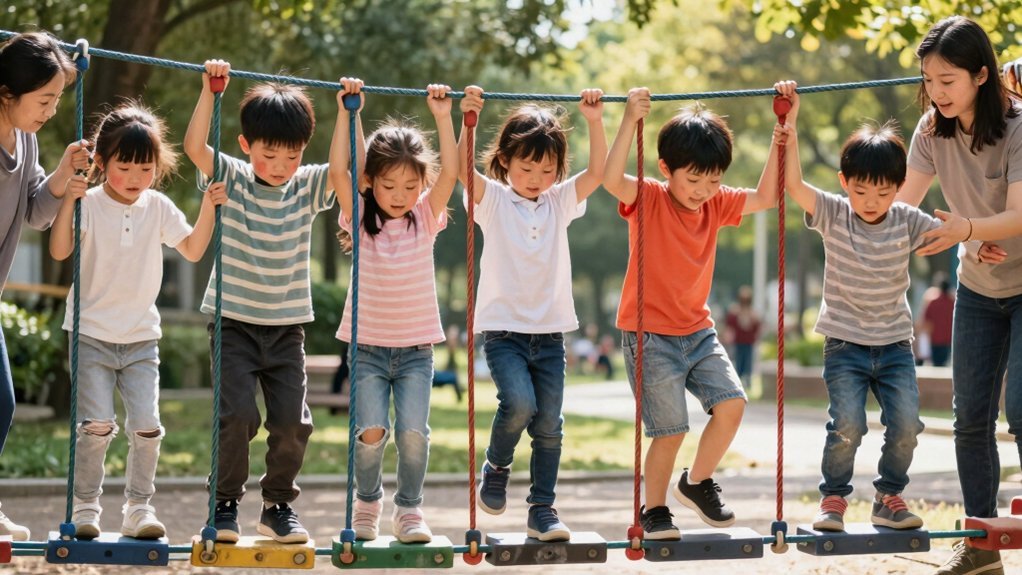
Why do you notice kids who can run, jump, and dance seem to chat more easily and join games without hesitation? Their gross motor skills give them the confidence to move fluidly, which sharpens attention and boosts language development. When they hop through an obstacle course or mimic animal walks, they practice sequencing and turn‑taking, core ingredients of social interaction. Dance‑based play adds rhythmic cues that reinforce vocal timing and expressive gestures, deepening peer connections. Regular, varied movement—balancing on beams, tracking a ball, or marching to music—improves visual tracking and spatial awareness, laying a foundation for richer conversations and collaborative play. Integrating these activities into preschool routines strengthens executive function, setting the stage for lasting cognitive and communicative growth.
Sensory‑Motor Tasks for Spatial Awareness & Problem‑Solving
How might you transform a simple playground into a training ground for spatial reasoning? You can turn a sandbox, a set of cones, or a hop‑scotch grid into a sensory‑motor adventure that stretches spatial awareness and sharpens executive function. When kids weave through obstacles, they fuse vision, hearing, and proprioception, learning to predict movement paths and adjust balance on the fly. Repeated cross‑body jumps and coordinated hops force them to plan, monitor, and correct actions, building the mental flexibility needed for problem‑solving.
Turn playgrounds into sensory‑motor labs, boosting spatial awareness and executive function through dynamic, coordinated movement.
- Dynamic balance beams: encourage forward‑backward and side‑to‑side shifts while tracking visual cues.
- Cross‑body animal walks: integrate proprioceptive feedback with spatial mapping.
- Simon Says with directional commands: demand rapid motor‑cognitive integration and executive control.
Dance Moves That Enhance Bilateral Coordination and Brain Health
Ever wondered how a simple dance routine can sharpen both sides of your brain? When you practice dance moves that require alternating steps, arm swings, and turns, you force each hemisphere to communicate, boosting coordination and cognition. The rhythmic timing of footwork trains your executive function, sharpening inhibitory control and working memory.
Regular sessions link motor skill practice with heightened attention, spatial awareness, and cognitive flexibility, while the emotional lift from music reduces stress and fuels motivation. Compared with other activities, dance demands complex, engaging patterns that keep you mentally active. So you’ll notice faster decision‑making, better problem‑solving, and a healthier brain as you move to the beat.
Quick Tips for Parents to Keep Coordination Fun and Effective
Looking for ways to turn coordination practice into a game your child actually wants to play? You can weave coordination into everyday moments, boosting motor skills while sharpening executive function. Keep sessions short, lively, and varied so the child stays engaged. Use familiar settings—kitchen, living room, backyard—to turn routine tasks into playful challenges that nurture bilateral movement and spatial awareness.
- Obstacle mini‑courses: set up cushions, chairs, and tape lines; ask your child to crawl, hop, and balance, encouraging both sides of the body to work together.
- Animal walk races: pretend to be bears, crabs, or frogs; these drills improve core stability and dynamic balance while making sequencing fun.
- Two‑handed art projects: draw, paint, or build with both hands simultaneously, reinforcing fine motor control and planning skills.
Integrating these tips daily makes coordination enjoyable and effective.
Frequently Asked Questions
How Often Should Children Practice Bilateral Coordination Activities Daily?
You should aim for 15‑20 minutes of bilateral coordination practice each day, spread across several short sessions, to keep kids engaged and steadily strengthen their brain’s cross‑hemisphere connections.
Can Specific Music Genres Improve Coordination Skill Acquisition?
Yes, you’ll find that rhythmic genres like funk, hip‑hop, and classical percussion trains timing, while upbeat pop and electronic beats boost movement speed, helping you acquire coordination skills faster.
What Age Is Bilateral Coordination Become Essential for Academic Success?
You’ll find bilateral coordination becomes essential around ages five to seven, when children start tackling writing, reading, and math tasks that demand both hands and eyes working together smoothly.
Do Digital Games Effectively Develop Bilateral Coordination Compared to Physical Play?
You’ll find digital games can improve bilateral coordination, but they lag behind physical play’s tactile feedback and full‑body movement, which more robustly engage neural pathways for synchronized hand‑eye and cross‑sided control.
How Does Nutrition Influence the Brain’s Response to Coordination Training?
You’ll find that proper nutrition fuels neurotransmitter synthesis and stabilizes glucose levels, so your brain reacts faster and more efficiently during coordination training, enhancing learning speed and long‑term motor memory retention.