
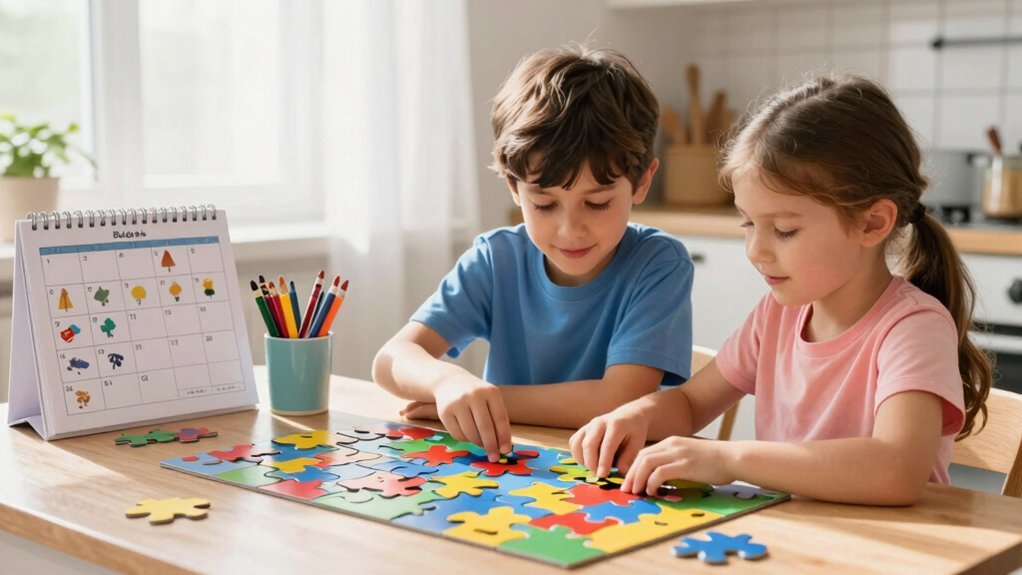
You’ll notice your child solving puzzles faster because predictable routines give them a clear, repeatable framework that turns each step into a mental shortcut, freeing cognitive bandwidth for creative problem‑solving. Repeating tasks builds strategic thinking, while visual checklists let them compare actions with plans and spot bottlenecks. Consistent transitions act as low‑stress mini‑experiments, boosting confidence and encouraging risk‑taking. If you keep going, you’ll discover how to turn these habits into powerful learning tools.
How Predictable Routines Enable Problem‑Solving
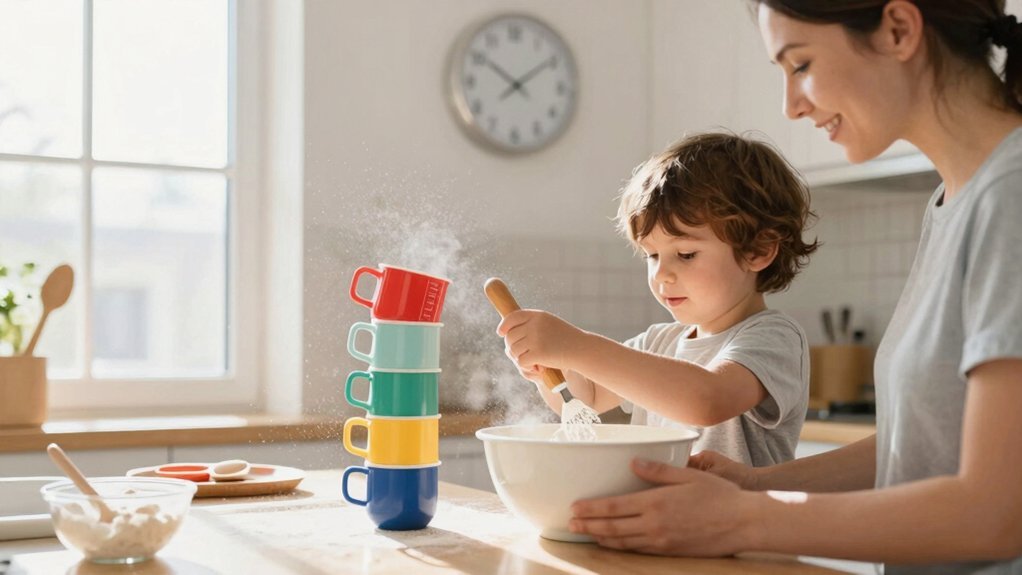
How do predictable routines sharpen a child’s problem‑solving? You see a clear sequence of steps, you rehearse that sequence, and you start applying it to new challenges. Predictable routines give you a framework that reduces cognitive load, so you can focus on identifying the problem and testing solutions. When you follow visual checklists and step‑by‑step cues, you learn to hypothesize, act, and evaluate outcomes independently.
Regular practice strengthens self‑regulation, letting you pause, plan, and choose a strategy before you act. Each transition becomes a mini‑experiment, showing cause‑and‑effect and reinforcing effective problem‑solving tactics. Over time, these consistent patterns turn abstract reasoning into habit, making you more confident and adaptable when faced with unfamiliar tasks. Incorporating tools made from premium natural wood in activities can enhance fine motor skills and spatial awareness, further supporting problem-solving development.
Why Repeating Tasks Builds Strategic Thinking
Repeating tasks sharpens strategic thinking because each iteration forces you to internalize a sequence of actions, turning a simple routine into a mental blueprint.
Repeating tasks internalizes action sequences, turning simple routines into strategic mental blueprints.
When you follow Routines daily, you learn to anticipate outcomes and plan several steps ahead, which strengthens executive function.
Rehearsed routines let you transfer memory and sequencing skills across different activities, so you can apply a familiar pattern to a new problem without starting from scratch.
As you practice checklists, you become more aware of your progress and can adjust strategies on the fly.
This metacognitive awareness boosts attention, cognitive control, and goal‑directed planning, turning repetitive practice into a powerful engine for strategic thinking.
Using tools designed for children, such as a Montessori step stool, encourages independence and hands-on learning, which further develops problem-solving skills through real-world application.
How Daily Structure Boosts Cognitive Flexibility

When you set up a daily structure, you’re giving children a predictable rhythm that lets them practice switching tasks and planning ahead without taxing their minds. Routines create a scaffold that repeatedly triggers anticipatory planning, so kids learn to move smoothly between activities. Each predictable sequence frees cognitive resources, allowing them to focus on problem‑solving rather than on the mechanics of change. Consistent patterns also reinforce memory, making it easier to recognize familiar cues and adapt quickly when a new task appears. Just as organized storage features in shoe care kits help streamline access and efficiency, structured routines simplify cognitive processes for children.
How Visual Schedules Promote Independent Decisions
Ever wonder why a simple picture board can turn hesitation into confidence? When you place a visual schedule on the wall, you give kids concrete cues that map out each step. They scan the images, compare options, and pick the next activity on their own, which builds independent decisions. Consistent prompts cut down on verbal reminders, so children start tasks without waiting for a cue. Updating the board as they master steps reinforces mastery and nudges them toward greater autonomy. This approach aligns well with developmental skills focus in Montessori-inspired learning, fostering fine motor skills, concentration, and creativity.
| Benefit | How it works |
|---|---|
| Anticipation | Pictures show upcoming steps |
| Choice | Child selects the next listed activity |
| Initiation | Reduces need for verbal prompts |
| Comparison | Visuals help weigh options |
| Mastery | Updates signal progress and confidence |
Sample Visual Schedule Templates for Problem‑Solving

Curious how a simple visual template can turn a chaotic problem‑solving task into a clear, manageable routine? You can start with a visual schedule that shows three columns: Goal, Action, Check. In the Goal column, write the problem you’re tackling. The Action column lists step‑by‑step visuals—like “Identify the issue,” “Brainstorm two solutions,” “Try the first idea.” The Check column includes a checklist: “What’s the problem? What can I try? Did it work?” Use icons or photos for each step so kids can point and speak. Consistently using these problem‑solving templates builds independence; children recognize cues, select strategies, and reflect on outcomes. Over time, the routine transfers to new challenges, sharpening executive function and systematic thinking. Incorporating Montessori materials such as 3D figurines can enhance hands-on learning and reinforce problem-solving concepts effectively.
How Mini‑Challenges Turn Routine Tasks Into Puzzles
You can turn everyday chores into games by setting quick challenges, like racing to put on shoes before a timer be out.
Adding time limits creates a sense of urgency that pushes you to plan and act faster.
These mini‑puzzles keep kids engaged while sharpening their problem‑solving skills.
Using child-size tools with ergonomic grips can further support fine motor development during these tasks.
Turn Tasks Into Games
Turning everyday chores into mini‑challenges taps the power of gamification, turning routine steps into puzzles that spark problem‑solving. You can set a simple rule—like “pick up the toys in under two minutes”—and watch your child plan the fastest route, adjust when a block falls, and celebrate the win. Clear goals and instant feedback let them compare strategies, so each repetition feels like a fresh puzzle rather than a dull routine.
Rotate the objects, change the order, or add a constraint such as “use only one hand” to boost cognitive flexibility and persistence. Visual progress trackers turn the task into a measurable game, reinforcing self‑monitoring and strengthening executive‑function skills while keeping the experience fun.
Add Time Limits
Ever wonder how a simple timer can turn a mundane chore into a fast‑paced puzzle? When you set time limits on everyday routines, you create mini‑challenges that push kids to plan steps, estimate how long each will take, and monitor progress as the countdown ticks. A 60‑second toy‑cleanup, for instance, spikes focus and engagement, training sustained attention and selective prioritization. As they race the clock, children tweak strategies—speeding up, slowing down, or finding smarter shortcuts—so each repeat of the routine builds flexible problem‑solving.
The timer also offers concrete feedback, letting them compare attempts, set personal goals, and practice self‑regulation. By reframing chores as playful puzzles, you reduce resistance, boost patience, and nurture persistence.
How to Encourage Self‑Reflection After Routines
Why does reflecting after a routine matter? You’ll see that self‑reflection turns ordinary routines into learning labs. After a cleanup or a morning prep, pause and ask, “What helped you stay focused?” Children can answer verbally or point to a checklist, noting successes and gaps. Use visual step‑by‑step charts so they compare actual actions with the plan, spotting patterns that repeat.
Prompt them to think about emotional cues—did a calm start make the task easier? Encourage brief journal entries or drawings that capture the data.
Over time, these micro‑reviews reinforce metacognition, letting kids adjust strategies before the next routine. The habit builds a feedback loop, sharpening problem‑solving without extra pressure.
How Routine Success Grows Confidence and Risk‑Taking
Do you notice how a child’s smile widens after they master a simple routine? When you observe that moment, you’re seeing confidence take root. Successful routines give them a predictable framework, so they can anticipate steps, recall sequences, and apply learned strategies without mental strain. Each completed routine reinforces self‑efficacy, and when you sprinkle choices into the steps, you create a safe space for risk‑taking. The result is a child who approaches new challenges with calm, systematic thinking instead of impulsive reactions.
A child’s widening smile signals confidence blooming from predictable, choice‑rich routines.
- Predictable problem‑solving opportunities reduce cognitive load.
- Repeated successes build confidence and ownership.
- Choice‑filled steps encourage measured risk‑taking.
- Structured transitions calm emotions, fostering deliberate thinking.
- Research links routine practice to stronger executive function.
- Engaging children with sensory activities during routines also supports cognitive and fine motor development.
How Montessori‑Style Routines Foster Critical Thinking
You’ll notice that Montessori‑style routines let you drive your own learning, giving you the freedom to pick tasks that spark curiosity. Each choice you make becomes an independent opportunity to test ideas, compare outcomes, and refine strategies.
As you navigate these structured yet flexible cycles, your critical thinking sharpens naturally.
Driven Learning
How can a day’s predictable rhythm sharpen a child’s mind? You’ll notice that Montessori‑style structures turn everyday tasks into mini‑experiments, letting kids test ideas and adjust on the fly. The routines give them a safe scaffold, so they can focus on planning, sequencing, and error‑checking instead of scrambling for direction. By repeatedly navigating these cycles, they build confidence in autonomous problem‑solving and develop sharper executive functions.
- Hand‑washing steps become a quick planning drill.
- Preparing materials teaches sequencing and resource management.
- Packing up reinforces self‑monitoring and closure.
- Visual checklists guide error‑checking and reflection.
- Hands‑on exploration within a routine sparks curiosity and flexible thinking.
Independent Choice Opportunities
Ever notice how a simple choice—like picking which tray of beads to use—can turn a routine into a thinking workout? When you set up independent choice within routines, you give children a predictable framework plus options, so they decide which material to use, which step to tackle next, and how to reflect on the result. This structure lets them plan, sequence, and test hypotheses without adult prompting. As they repeat the sequence, cognitive schemas form, boosting flexibility when new problems appear.
Selecting tasks or ordering steps strengthens working memory, cognitive flexibility, and self‑regulation. Each self‑directed decision becomes a mini‑experiment, encouraging error correction and analytical thinking. The result is sharper problem‑solving skills built on everyday, purposeful choices.
How Transition Moments Provide Natural Problem‑Solving Practice
Ever noticed how a simple shift from play to cleanup becomes a mini‑lesson in planning? Those transitions hand you a predictable problem to solve, letting you practice sequencing, attention, and flexible thinking. When you add visual cues or a step‑by‑step guide, you turn a routine moment into a low‑stakes problem‑solving arena. You’ll see confidence grow as you forecast next steps, choose strategies, and test them without pressure.
- Predictable challenges appear each time you move from one activity to another.
- Visual cues scaffold the planning process.
- Repeated practice builds flexible thinking.
- Low stress frees cognitive resources for deeper problem‑solving.
- Explicit coping strategies embed skill use into everyday routines.
How to Track Routine Progress With Simple Checklists
You can start each day with a simple checklist that lets your child tick off every step, turning abstract tasks into concrete milestones.
Pair the list with a visual progress chart so patterns of success or bottlenecks become instantly visible.
This quick feedback loop encourages self‑monitoring and helps you fine‑tune routines for stronger problem‑solving skills.
Simple Daily Checklists
A simple daily checklist breaks a routine into bite‑size, repeatable steps, so kids can anticipate what’s next and practice problem‑solving as they move through each task. You’ll see that checklists give concrete feedback, letting you spot where a child stalls and tweak support. Consistent sequencing—wash hands, put away toys, pick a book—reinforces mental schemas, while ticking off items fuels achievement and self‑efficacy. Over weeks, the data reveal patterns, guiding targeted interventions that sharpen planning and transition skills.
- List tasks in the same order every day.
- Use simple, visual icons for each step.
- Encourage the child to check off each item independently.
- Review completed lists together to celebrate progress.
- Adjust items gradually as competence grows.
Visual Progress Tracking Charts
Most kids thrive when they can see their progress visually, and a simple chart turns a checklist into a clear, color‑coded roadmap of each routine step. You’ll notice that updating the visual progress chart after every segment reinforces the cue that a task is done and signals the next action. Color‑coding or adding icons gives instant feedback, so younger children quickly recognize what’s completed and what’s left.
Over weeks, the chart reveals trends—more steps finished without prompts, fewer reminders—showing measurable growth in routine mastery and problem‑solving independence. When you share the chart with caregivers, you turn it into a collaborative tool, allowing both of you to discuss smoother transitions and tweak steps as needed. This simple system turns abstract routines into concrete, trackable achievements.
Frequently Asked Questions
Why Are Routines so Important for Children?
You need routines because they give you predictability, help you self‑regulate, build independence, keep you engaged, and create a safe base that lets you focus on learning and solving problems.
What Is the 3 3 3 Rule for Toddlers?
You follow the 3‑3‑3 rule by giving toddlers three activities, each lasting about three minutes, with three minutes for transition between them, keeping tasks short, predictable, and manageable.
What Is the 7 7 7 Rule in Parenting?
You follow the 7‑7‑7 rule by giving your child roughly seven hours of sleep, seven hours of wakefulness, and seven hours of focused learning or play each day, balancing rest and enrichment.
Why Is It Important for Children to Learn Problem-Solving Skills?
You need problem‑solving skills because they help you navigate everyday challenges, build confidence, and adapt to new situations, while fostering critical thinking, resilience, and independence that benefit school and life.