

When you let kids spot and fix their own mistakes, each slip becomes an instant lesson that sparks curiosity and confidence. The brain lights up in the prefrontal cortex, anterior cingulate, and hippocampus, turning surprise from a high‑confidence error into a memory‑boosting “hypercorrection.” This self‑generated feedback builds concentration, independence, and a growth mindset, while removing fear of failure. Keep exploring, and you’ll discover how Montessori materials and practical‑life activities turn error control into lasting motivation.
Intrinsic Motivation Through Error Control in Montessori

Ever wondered why Montessori kids seem so keen to keep trying? You see, error control fuels intrinsic motivation by letting you correct mistakes yourself, without adult prompts. When you place a Knobbed Cylinder in the wrong slot, the material instantly signals the error, prompting you to try again. That tangible feedback turns each slip into a learning cue, not a failure. You develop concentration, independence, and a sense of competence as you repeatedly practice until the piece fits perfectly.
The environment normalizes errors as informative, reducing fear of failure and keeping you engaged. By aligning activities with your liberty and mastery, Montessori nurtures an inner drive that outlasts any external reward. Just as child-safe tools like silicone-coated whisks combine safety and independence in learning kitchens, error control materials offer kids a safe space to explore and grow through trial and error.
What Happens in the Brain When Kids Fix Their Own Mistakes?
When you correct a mistake on your own, your brain lights up in a way that’s different from simply confirming a right answer. fMRI scans show that error processing triggers a cascade of activity in the prefrontal cortex, anterior cingulate, and hippocampus, regions linked to attention, conflict monitoring, and memory consolidation. This pattern contrasts with the more passive response seen when you only receive a correct cue. The result is deeper encoding of the correct solution and a stronger sense of agency.
- Prefrontal cortex spikes, boosting executive control.
- Anterior cingulate detects conflict, prompting adjustment.
- Hippocampus re‑encodes the revised information.
- Neural connectivity strengthens, cementing long‑term understanding.
Montessori children display these dynamics consistently, indicating that error‑focused learning reshapes brain pathways for lasting mastery. This approach aligns with sensory learning tools such as tactile discrimination boards, which enhance independent exploration and problem-solving skills through progressive feedback.
Montessori Materials That Demonstrate Error Control (Knobbed Cylinders, Bells, Etc.)
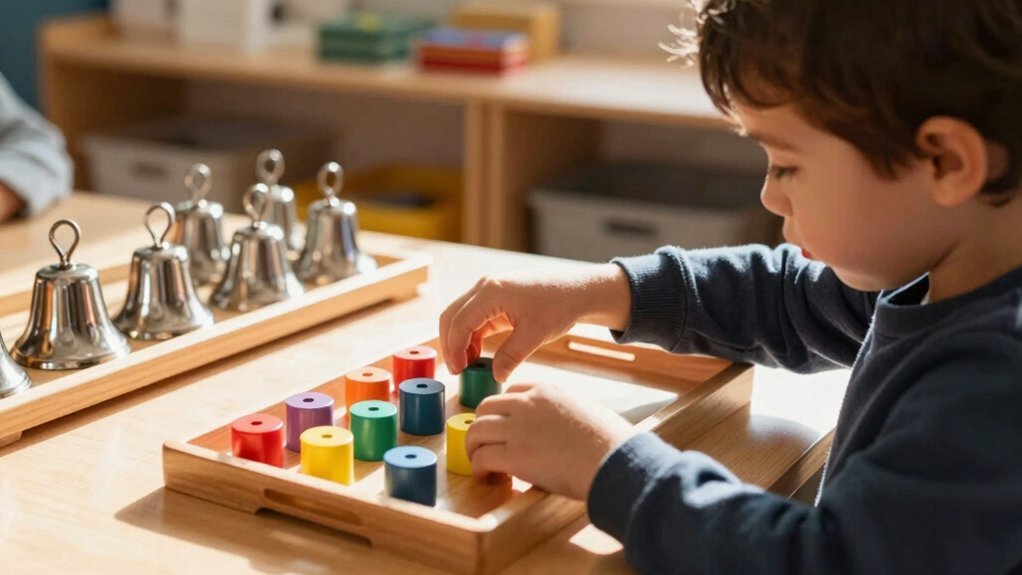
How do these materials make error control tangible for a child? You watch a child grasp a knobbed cylinder, feel the resistance when it won’t fit, and instantly know the mistake. The bell’s tone rings wrong if a note is out of sequence, and the pink tower’s blocks betray misplacements with uneven steps. Spindle boxes shout “too many” or “too few” as you count, while dressing frames snap mismatched fasteners, prompting immediate correction. For hands-on learning, tools with precise temperature ranges and quick response times provide immediate feedback that enhances a child’s understanding of cause and effect.
| Material | Error Cue | Learning Benefit |
|---|---|---|
| Knobbed Cylinders | Physical fit mismatch | Visual‑tactile feedback |
| Bells | Incorrect pitch | Auditory error detection |
| Pink Tower | Uneven height | Spatial reasoning |
| Spindle Boxes | Count overflow/underflow | Numeracy awareness |
| Dressing Frames | Wrong snap/button | Fine‑motor self‑correction |
Practical‑Life Activities That Turn Error‑Control Mistakes Into Learning Moments
The tactile feedback of knobbed cylinders and bells shows how error control works with concrete objects; the same principle carries over to Practical‑Life tasks where the child’s own actions reveal mistakes. You watch them snap a dressing frame, notice a mis‑aligned button, and self‑correct without adult interference. You set up a dish‑washing station with a soapy bowl, a rinsing bowl, and a silent, deliberate motion that lets the child see the clean result as proof of success. This error‑control environment builds concentration, independence, and intrinsic motivation.
- Dressing frames expose mismatches instantly.
- Dish‑washing encourages slow, observable cleaning.
- Safe, age‑appropriate setups invite exploration.
- Gradual observation distance lets the child verify correctness.
Creating environments with smooth surfaces and burr-free edges enhances the child’s tactile experience and safety during learning.
Language & Math Tools for Independent Error Detection

Ever wondered how a child can spot a mistake before anyone points it out? You’ll see that Language tools like Metal Insets demand precise pencil placement; a stray line hides the hidden pattern, instantly signaling an error. In Math, Spindle Boxes contain a set number of spindles per slot, so a miscount leaves an empty space that can’t be ignored.
Both devices embed error control into every activity, letting you verify work without adult prompts. As you adjust strategies based on that immediate feedback, you sharpen concentration and build self‑reliance.
The process cultivates metacognitive awareness, helping you recognize when your counting or writing is off and correct it on the spot. This independent detection fuels deeper engagement and lasting mastery. Step stools designed with Montessori principles, featuring safety rails and non-slip surfaces, provide children the independence and stability needed to engage confidently in such self-correcting activities.
How Error Control Boosts Confidence and Reduces Fear of Failure
When you let kids check their own work, they start trusting their judgments and seeing mistakes as clues for growth. This self‑assessment cuts down the anxiety that comes from waiting for adult approval, because they know they can correct themselves instantly. As they gain independence, confidence rises and the fear of failure fades. Using tools designed for practical life skills can enhance this process by providing structured opportunities for self-directed learning and error correction.
Self‑Assessment Builds Trust
Why does a child’s confidence soar when they can confirm their own work? You notice that self‑assessment lets them verify completion, turning a vague task into a concrete achievement. This instant validation builds trust in their judgment and reduces reliance on adult correction. The process also reframes errors as learning signals, easing fear of failure and keeping motivation high. When children see a puzzle piece fit or a cylinder slot click, they internalize that their choices matter.
- Identify completion through personal review
- Gain immediate, non‑punitive feedback
- Reinforce intrinsic motivation and self‑reliance
- Strengthen trust in one’s own judgment
These steps turn error control into a confidence‑boosting habit. Incorporating activities like threading beads supports this process by providing tangible ways for children to experience success and develop fine motor skills through self-directed practice.
Mistakes Reveal Growth Opportunities
How can a single misstep become a catalyst for growth? When you let a child notice a mistake, you give them a chance to self‑correct, turning a slip into a problem‑solving lesson.
Error control creates a safe space where they can verify results independently, which cuts fear of failure and encourages experimentation.
Immediate feedback on each error reinforces the correct procedure, cementing memory and boosting confidence over time.
By framing errors as informative signals rather than punishments, you nurture persistence and a growth mindset.
In Montessori‑inspired settings, structured error control helps children internalize distinctions, making them more self‑reliant and eager to tackle new challenges without dread.
Independence Reduces Anxiety
Confidence blossoms when children can verify their own work without waiting for an adult’s nod. You’ll notice that error control lets them self‑review, cut reliance on external validation, and lower anxiety. When feedback appears instantly inside the task, interruptions shrink, and a calmer, more confident flow emerges. Visible mistakes—like a knob not fitting a slot—signal that success follows correction, easing fear of failure. Independent verification builds intrinsic motivation, concentration, and self‑reliance, creating a sense of mastery over outcomes.
- Self‑review replaces adult checks.
- Immediate in‑task feedback reduces interruptions.
- Visible errors teach that correction leads to success.
- Independent verification fuels intrinsic motivation.
Connecting Error Control to the Hypercorrection Effect for Better Retention
When you correct a high‑confidence mistake, the surprise spikes your attention and locks the right answer into memory. This “surprising confidence correction” triggers the hypercorrection effect, so the corrected information sticks longer.
Surprising Confidence Corrections
- Identify the confident error.
- Deliver clear, corrective feedback.
- Prompt metacognitive reflection.
- Reinforce the correct concept.
Memory Boost Through Surprise
How does a sudden “aha!” moment turn a mistaken belief into a lasting memory? When you catch a high‑confidence error, the surprise of being wrong spikes attention. Your brain flags the mismatch, then reroutes processing through the medial frontal cortex, sharpening focus on the correct answer. This hypercorrection effect means you remember the right fact better than if you’d been unsure.
Overconfidence, confirmation of prior beliefs, and heightened metacognitive awareness each channel surprise into stronger episodic storage. Feedback that corrects a confident mistake triggers a mental reassessment, cementing the new information. By leveraging that surprise, you turn fleeting errors into durable knowledge, boosting retention and fostering a growth mindset.
Creating a Quiet, Observation‑Focused Classroom for Self‑Guided Learning
Ever wonder how a quiet, observation‑focused classroom can spark self‑guided learning? You’ll see children thrive when adults stay non‑intrusive and materials deliver a built‑in control of error. The space lets mistakes surface—like mismatched snaps on Dressing Frames—so kids self‑correct without prompts, building concentration and inner motivation.
- Passive adult presence – observe, intervene only for safety.
- Self‑correcting tools – tactile items (Knobbed Cylinders) give instant private feedback.
- Reduced external rewards – shift focus to intrinsic drive and growth mindset.
- Repeated cycles – children repeat tasks, notice errors, and adjust autonomously.
Frequently Asked Questions
What Is Control of Error in Montessori?
You use Montessori’s control of error when you let children check their own work through materials that give instant, built‑in feedback, so they can self‑correct without adult intervention, fostering independence and focus.
What Are the Benefits of Self Correction?
You’ll gain confidence, focus, and persistence as you spot mistakes, correct them, and see progress. Self‑correction sharpens metacognition, boosts problem‑solving skills, and fuels intrinsic motivation for independent learning.
What Happens When a Child Develops Independent Thinking?
You’ll notice you start solving problems without asking, stay focused longer, feel confident in your choices, and keep trying even when setbacks arise, because you trust your own judgment and perseverance.