

You’ll find self‑correcting sensorial materials are purpose‑built tools—like cylinder blocks, pink towers, and color boxes—that give you immediate tactile, visual, or auditory feedback when pieces fit right, letting you explore independently. They blend mechanical, perceptual, and social error controls so you can see and feel mistakes without adult prompts, strengthening fine‑motor skills, hand‑eye coordination, and concentration. By mastering these challenges you build confidence and intrinsic motivation, and the next sections reveal how to choose the right ones for your child’s age.
What Is a Self‑Correcting Sensorial Material?
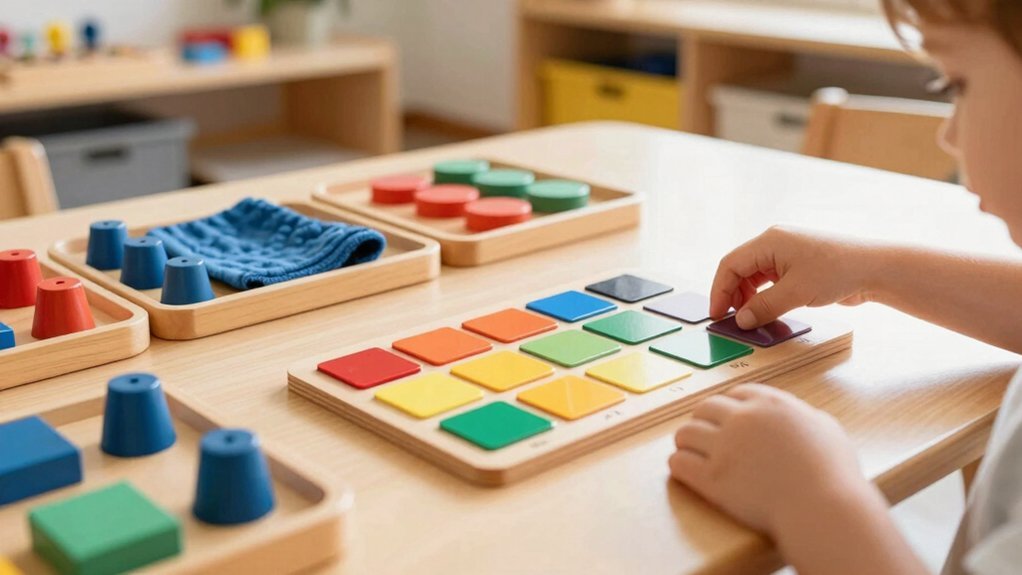
When a child picks up a self‑correcting sensorial material, the piece itself tells whether it fits—through matching shapes, colors, or tactile cues—so the error is obvious without an adult’s voice. You’ll notice that each item is engineered to give instant feedback: a cylinder only slides into its matching hole, a red block only snaps into a red slot, and a textured piece resists an incorrect placement. This built‑in cue lets you spot mistakes instantly and correct them on your own.
Because the material handles the error signal, you develop independence, concentrating on the task rather than waiting for adult prompts. The design encourages intrinsic motivation, turning play into a self‑guided learning loop. Many self-correcting materials also feature non-toxic dyes and smooth edges to ensure safe, enjoyable handling for young learners.
Mechanical, Perceptual, and Social Error Control Explained
Because each mechanism targets a different cue, mechanical, perceptual, and social error control work together to guide a child’s learning. In a self‑correcting environment, mechanical error control means the pieces only fit in the right spots, so you feel the click and know you’ve assembled correctly.
Perceptual error control taps your senses—visual patterns, tactile textures, or auditory feedback—so you spot a mismatch without an adult’s intervention.
Social error control lets a caregiver observe, then later re‑present the task, letting you revisit the challenge on your own.
Montessori‑style sensorium materials blend these controls, encouraging trust, independence, and the habit of self‑correction while keeping you engaged and confident.
Natural wooden animal figurines, designed with Montessori-inspired features, often incorporate these self-correcting principles to support sensory exploration and independent learning.
What Independence, Concentration, and Intrinsic Motivation Look Like in Self‑Correcting Materials
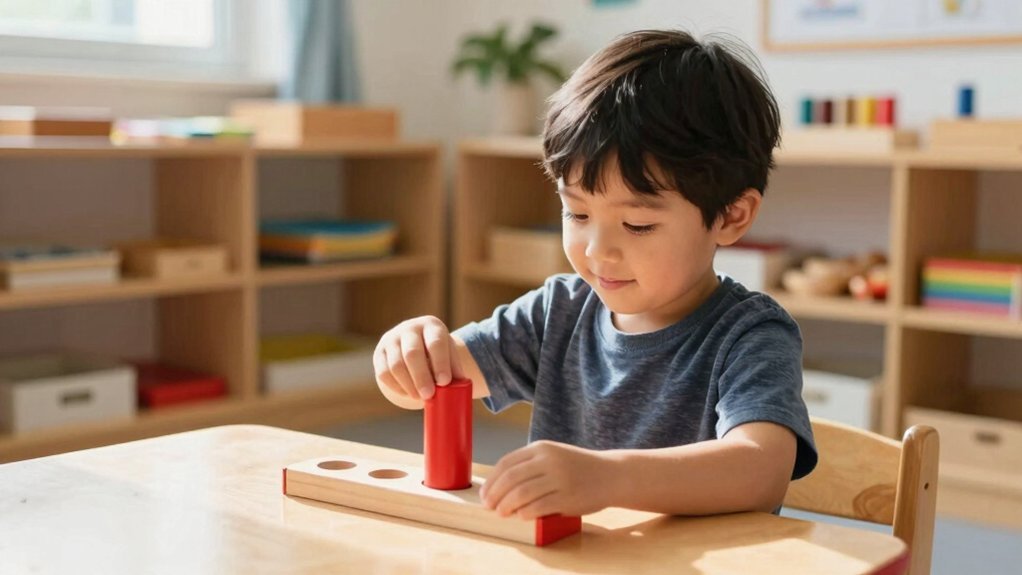
Ever notice how a single click or a bright hue tells you instantly you’ve done it right? With self‑correction built into sensorial materials, you feel independence the moment a piece fits or a tone sounds correct. The immediate visual, tactile, or auditory cue sharpens concentration, letting you stay in the flow without adult prompts. As you adjust based on the material’s feedback, intrinsic motivation rises; you’re driven by the satisfaction of solving the puzzle yourself. This hands‑on loop strengthens fine‑motor control and hand‑eye coordination while you internalize problem‑solving strategies. You become a self‑directed learner, relying on the material’s built‑in guidance rather than external commentary, and you keep experimenting until the correct pattern emerges. Just like with Montessori step stools that support independent access, these materials encourage children to explore and learn confidently on their own.
Classic Self‑Correcting Sensorial Materials: Cylinder Blocks, Pink Tower, and Color Boxes
How do classic self‑correcting sensorial materials turn play into precise learning? You’ll notice Cylinder Blocks demand that each graded cylinder fits its matching hole; a wrong fit produces a tactile “click” that tells you to try again, sharpening spatial discrimination.
With Pink Tower, you stack uniformly sized cubes from largest to smallest; any mis‑alignment or tip reveals an error instantly, encouraging careful visual‑motor coordination.
Stack uniformly sized cubes from largest to smallest; any mis‑alignment or tip instantly reveals an error, honing visual‑motor coordination.
Color Boxes require you to pair identical shades; mismatched colors won’t lock together, prompting you to adjust until the match is perfect.
Each self‑correcting tool engages sight and touch, letting you discover the correct solution without adult prompts, building concentration, problem‑solving confidence, and refined sensory perception.
Child-sized tools with ergonomic grips similarly support developing fine motor skills and encourage independent learning in young children.
How to Select the Right Self‑Correcting Sensorial Material for Your Child’s Age
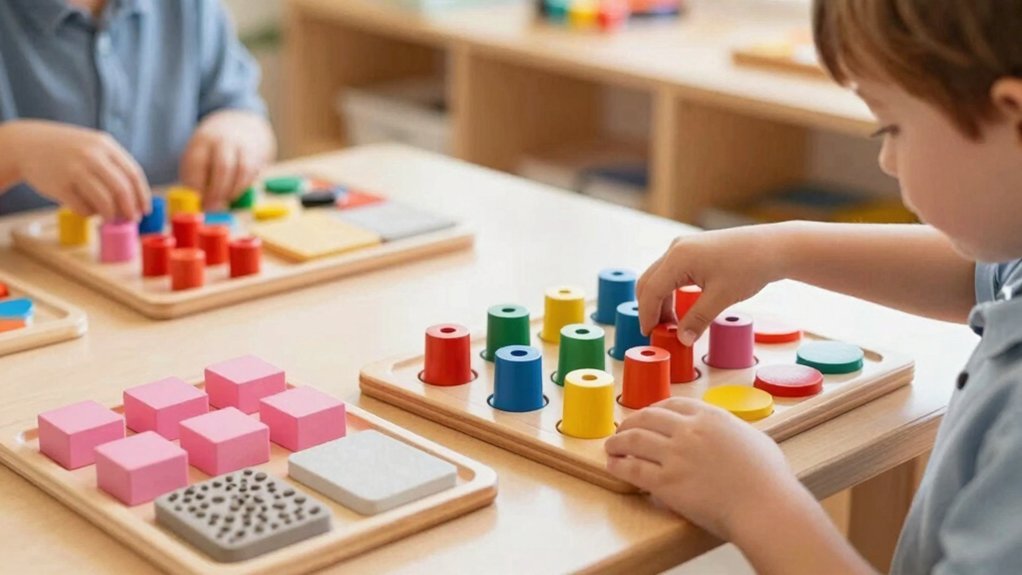
Which self‑correcting sensorial material fits your child’s developmental stage? Start by matching the material’s complexity to the age‑appropriate developmental stages you observe. For toddlers, choose simple cylinder blocks that demand basic hand‑eye coordination; the self‑correcting feedback will reinforce independence while keeping tasks achievable. Preschoolers benefit from pink tower sequencing, which adds height and ordering challenges, prompting deeper concentration and problem‑solving. As children approach early elementary years, introduce more intricate sensorial materials that require nuanced discrimination, like color boxes with subtle hue variations. Always evaluate whether the material’s feedback loop aligns with your child’s current abilities, ensuring that each activity nurtures independence without causing frustration. This targeted selection supports continuous growth and confidence. For example, the Montessori Pink Tower offers graduated cubes that reinforce spatial relationships and visual perception development.
Designing a Home Environment That Supports Self‑Correcting Sensorial Materials
Choosing the right material is only half the battle; the space you create determines whether your child can actually use it independently. In a home environment, keep self‑correcting sensorial materials on low shelves or in clear bins that invite easy access. Arrange each set in a dedicated zone, free of clutter, so the child can see the pieces, hear the clicks, and feel the textures without distraction. Use labeled trays or color‑coded baskets to signal where finished work belongs, reinforcing error‑detection and reflection. Position lighting so visual cues stand out, and place a small mat to define the work area and protect surfaces. This layout nurtures autonomy, letting the child explore, correct mistakes, and repeat tasks confidently. Incorporating well-designed Montessori metal insets supports fine motor development and independent skill-building within these spaces.
Long‑Term Impact on Confidence, Critical Thinking, and Growth Mindset
Why do children who regularly use self‑correcting sensorial materials become more confident, sharper thinkers, and more resilient? You notice that each successful self‑correction reinforces confidence, while each error becomes a learning cue rather than a setback.
Over weeks, the constant loop of trial, feedback, and adjustment sharpens critical thinking; they learn to analyze patterns, predict outcomes, and refine strategies without adult prompting. This habit builds a growth mindset, because mistakes are framed as data points that guide improvement. As they master counting, measuring, and spatial puzzles, they internalize perseverance and see ability as expandable. The cumulative effect is a durable sense of self‑efficacy that fuels curiosity and lifelong learning. Incorporating tactile tools such as wooden shape sorters enhances hands-on exploration that strengthens these developmental benefits.
Frequently Asked Questions
What Are Examples of Self-Correcting Materials?
You’ll find cylinder blocks where only the right‑size hole fits, pink tower pieces that stack only in the correct order, and shape‑sorting cubes that click together solely when matched, all guiding you instantly.
Why Is Montessori Against Pretend Play?
You might think Montessori discourages pretend play, but actually it values purposeful work; it limits fantasy when it distracts from concrete learning, yet encourages imaginative exploration through real‑world materials.
Are Montessori Materials Self-Correcting?
Yes, you’ll find most Montessori materials self‑correcting; they give instant visual, tactile, or auditory signals when you fit pieces correctly, so you can spot errors and adjust without adult prompts.
What Are Self-Correcting Toys?
You’ll find self‑correcting toys that instantly tell you when you’ve succeeded or made a mistake—like blocks that only fit one way, puzzles that click correctly, or games that light up when you complete a pattern.