
You can help your anxious child thrive by giving them predictable, limited choices that boost confidence while keeping safety in view. Offer two snack or outfit options at each transition, set up simple two‑choice stations, and keep rules short, framed positively with natural consequences. Arrange the space so options are clear and accessible, and gradually add a third choice as self‑control improves. Continue exploring these steps to see how each one builds lasting independence.
Explain Freedom‑Within‑Limits for Anxious Kids

How can you help an anxious child feel safe while still encouraging independence? You apply Montessori’s freedom within limits by offering a small, predictable set of choices that match the child’s abilities.
Offer a few predictable choices, matching the child’s abilities, to foster safe independence.
In a prepared environment, each activity is laid out clearly, so the child knows what to expect and can act without hesitation.
Structured boundaries—like a set time for snack or a designated reading corner—create a safety net that reduces uncertainty.
When you present options, pair them with gentle guidance and calm, immediate feedback.
Consistently framing limits positively helps anxious children self‑regulate while still practicing autonomy.
This blend of choice, routine, and supportive scaffolding builds confidence without overwhelming the child.
Including educational tools like Montessori wooden puzzles can enhance tactile learning and provide reassuring structure within freedom.
Create Structured Choice Points in Daily Routines
When can you turn everyday moments into confidence‑building opportunities? You can by weaving structured choices into routines. Offer two snack options at lunch, two outfit choices at dress‑up, or a pair of bedtime books. Place each decision at predictable transitions—mealtime, dressing, bedtime—so the child knows when freedom appears. Prepare the environment with age‑appropriate items and limited but meaningful options, fostering autonomy without overwhelm. Use gentle prompts like “water stays in the sink” and “choices now, consequences later” to keep boundaries clear. Pair each choice with an immediate, natural consequence and positive framing, such as “If you help pick dinner, you’ll set the table.” This pattern builds anticipation, reduces stress, and reinforces mastery. Incorporating tools like the Kitchen Step Stool with Safety Rail can further empower children by providing safe, independent access to daily activities.
Design a Safe, Accessible Environment for Exploration
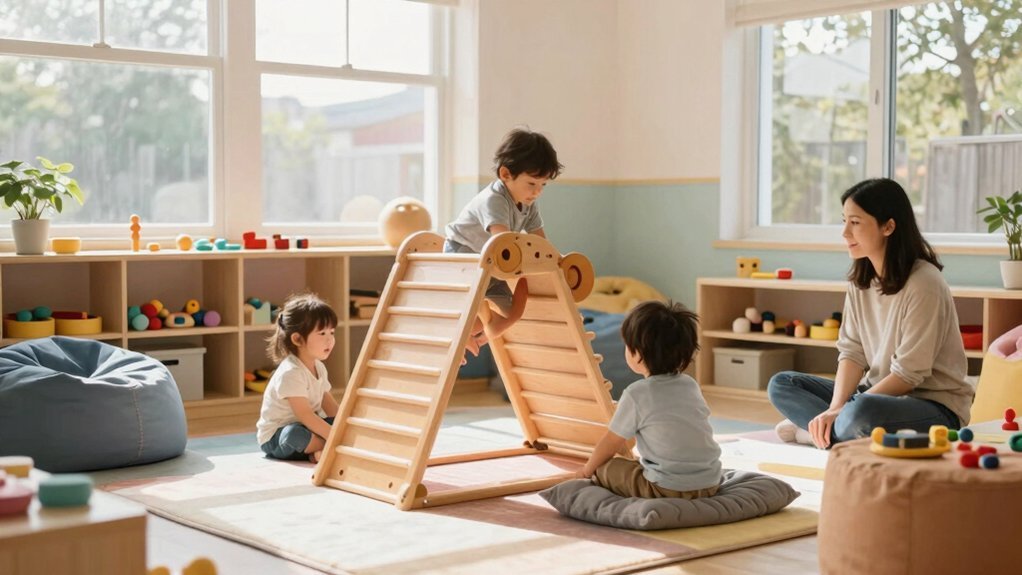
After giving kids clear, limited choices in daily routines, you can extend that sense of control to the whole room. A prepared environment lets them see what’s available, how it works, and where to find it. By setting gentle boundaries, you keep anxiety low while inviting independence. Offer two‑choice stations—like a puzzle bin or a water‑play tray—so they decide without feeling overwhelmed. Arrange items from small to larger, matching their attention span and confidence. Your calm presence offers reassurance, yet you step back so they can explore freely, embodying Montessori principles that blend freedom with structure.
Prepared environments empower children with gentle choices, fostering calm independence and confidence.
- Low‑shelves with clearly labeled, age‑appropriate tools
- Two‑option activity stations for easy choices
- Soft flooring and rounded edges for safety
- Visual cues that mark boundaries and pathways
- Simple, self‑correcting materials that promote independence
Including age-appropriate design elements such as ergonomic handles and safety features ensures tools are safe and manageable for children, further encouraging confidence and independence.
Set Positive House Rules With Natural Consequences
Ever wonder why a child feels calmer when rules feel like choices rather than commands? You set positive house rules by drafting them with a partner, framing each as a possibility—“You can put the book back when you’re done”—instead of a prohibition.
Keep the list short: water stays in the sink, plates stay on the table.
When a rule slips, apply natural consequences that match the behavior, like setting aside a toy that isn’t returned.
Stay close, offering a calm presence without hovering, so anxious children learn self‑regulation.
Give gentle reminders, then a safe redirection and a “one try again” chance.
This freedom within limits builds confidence, teaches responsibility, and reduces anxiety while preserving a nurturing home atmosphere.
Using well-designed Montessori trays with natural wooden handles can help organize activities, supporting children’s independence and reducing overwhelm.
Adapt Freedom‑Within‑Limits as Children Grow

- Begin with binary choices linked to demonstrated competence.
- Introduce a third option once self‑control improves.
- Provide self-correcting materials that reveal errors instantly.
- Align new freedoms with consistent routines and clear limits.
- Continuously assess readiness, scaling responsibilities step by step.
Frequently Asked Questions
What Is the 3-3-3 Rule for Anxiety Children?
You practice the 3‑3‑3 rule by naming three things you see, three you you hear, and three things you feel, grounding yourself instantly and easing anxiety in the moment.
What Is the Biggest Criticism of Montessori?
You’ll hear critics say Montessori’s biggest flaw is its reliance on child‑led learning, which can produce uneven academic results, vague benchmarks, and inconsistent teacher quality, leaving core skills underdeveloped.
What Are the 4 C’s of Montessori?
You’ll find the four C’s are Freedom within limits, Community, Concentration, and Choices. They let you guide children toward independence, respect, deep focus, and responsible decision‑making in a prepared environment.
What Was Maria Montessori’s Famous Quote?
You’ll recall Montessori’s famous line: “To let the child do as he likes when he has not yet developed any powers of control is to betray the idea of freedom.” This highlights balanced, guided autonomy.




Leave a Reply