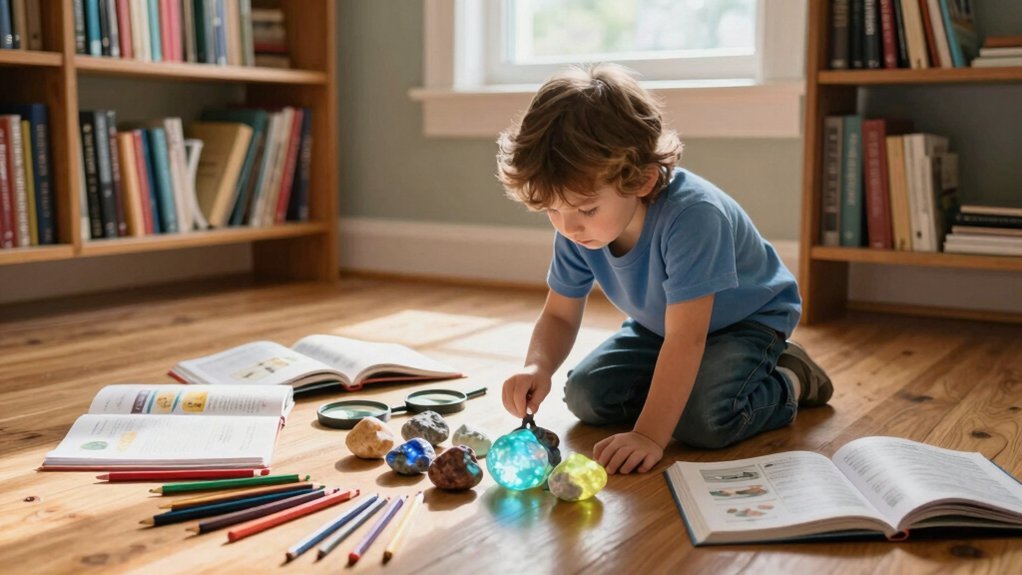
Your child’s genuine learning interests show up when they stick with an activity—like puzzles, storytelling, drawing, or outdoor exploration—over time and across settings, even when it gets tough. Look for patterns of persistence, role‑imitation, and repeated return to the same themes. Open‑ended, screen‑free materials let those interests surface naturally, and noting “aha!” moments helps you track strengths. Keep watching, and you’ll discover how to turn those tiny wins into deeper projects.
Define a Child’s Genuine Learning Interest

What really counts as a child’s genuine learning interest? You notice a pattern when your child consistently picks puzzles, storytelling, drawing, or outdoor exploration and keeps at them even when they get tough. That persistence signals an intrinsic interest, not a fleeting fancy. You also see them imitate admired roles—teachers, doctors, dancers—and then return to similar activities, confirming deep engagement. Providing the right environment, such as a Montessori-friendly step stool with safety features, can encourage independence and sustained learning.
Spot Patterns That Reveal Genuine Learning Interests
You’ll notice that certain activities keep drawing your child back, like a favorite puzzle or a storytelling game. Those recurring play themes act as clues, showing where their curiosity and confidence truly lie. Observing your child’s engagement can be as insightful as identifying practical tools for maintenance that help keep spaces organized and purposeful.
Observation Patterns
A child’s repeated choices—like returning to puzzles, sketching for hours, or exploring the backyard—signal genuine learning interests. Observation lets you notice which activities they gravitate toward and keep at, whether it’s assembling blocks, drawing, or chasing insects. Pay attention to how they engage socially: a talkative child may lead group games, a quiet observer might watch and then mimic, and a team player will collaborate on projects. Track patterns across settings; when a child lights up in both classroom and home environments, you’ve uncovered a core interest.
Imitation of admired roles—pretending to be a teacher, doctor, dancer, or builder—offers clues to emerging passions. Consistent observation provides feedback that reveals latent talents like art, storytelling, or leadership, even when those skills aren’t explicitly pursued. Introducing hands-on toys like wooden spinning tops can also highlight a child’s developing fine motor skills and cause-and-effect understanding, reflecting deeper learning preferences.
Recurring Play Themes
When you notice a child gravitating toward the same puzzles, stories, or backyard quests day after day, those recurring play themes become a reliable map of their genuine learning interests. You can spot the hidden curriculum by watching how they replay roles, organize toys, or narrate adventures. Each pattern signals a learning opportunity you can amplify with open‑ended, screen‑free activities that respect their natural curiosity.
- Puzzle‑centric play reveals problem‑solving drive and spatial reasoning.
- Storytelling loops highlight language, literacy, and imagination.
- Structured toy sorting shows design‑thinking and pattern recognition.
- Outdoor exploration reflects scientific inquiry and kinesthetic learning.
- Choosing products made of BPA-free, food-grade materials ensures safety while nurturing these natural interests.
Create a Free‑Choice Exploration Space

You can set up a corner filled with open‑ended materials—blocks, art supplies, costumes, instruments—so your child can choose what to explore.
Give them unstructured, screen‑free play time and watch the patterns that emerge as they return to certain activities.
Open‑Ended Materials
Ever wonder how a simple box of blocks, a stack of crayons, or a discarded costume can spark a child’s deepest curiosities? When you stock open‑ended materials, you give your kid a toolbox for imagination. Let them pick a drum, a fabric scrap, or a magnetic tile and watch patterns emerge without your constant direction. A sensory‑rich corner, free of screens, invites spontaneous discovery and reveals hidden strengths. Observe how they combine a feathered hat with a cardboard tunnel—you’ll see interests surface that guide future learning.
- A mixed basket of building blocks, loose parts, and recycled objects
- A portable art cart with crayons, watercolors, and textured paper
- Simple musical instruments like shakers, xylophones, and drums
- Costume pieces and fabric swatches for role‑play and tactile exploration
Unstructured Play Time
How can a simple, screen‑free corner become the catalyst for a child’s authentic curiosity? Set up a cozy nook with blocks, puppets, art supplies, and costumes, and step back. When you let unstructured play unfold, your child leads the activity, revealing natural interests and strengths. Watch for patterns: which materials they revisit, what excites them, how they collaborate or explore alone. A sensory‑rich environment—bright textures, varied sounds, outdoor access—sparks latent talents. Resist the urge to direct every move; risk‑taking and authentic problem‑solving thrive in open‑ended spaces. Keep a quick journal of recurring themes, language, and material choices. Those notes let you tailor future opportunities, nurturing genuine learning interests without scripted instruction. Including child-size kitchen tools like mini mashers can also encourage practical life skills and hands-on exploration during play.
Provide Open‑Ended Materials for Emerging Talents
Ever wondered why a simple block of wood can spark a lifelong passion? You can ignite curiosity by offering open‑ended materials that let kids shape their own narratives. When you place a box of art supplies, a set of musical instruments, or a costume chest on a low table, you hand them the freedom to experiment without a preset script. Their play stays screen‑free, unstructured, and self‑directed, so genuine interests surface naturally. Keep the environment safe and encouraging; watch for repeated patterns that hint at emerging talents. By stepping back and letting the child lead, you reveal authentic preferences and skills.
- Wooden blocks and building kits
- Sketchpads, crayons, and modeling clay
- Simple percussion instruments and a keyboard
- Dress‑up clothes and props for role‑play
Choosing durable, age-appropriate materials ensures their creative space is safe and promotes independent exploration.
Capture “Aha!” Moments to Track Strengths

Why wait for a formal assessment when a child’s own excitement can reveal hidden strengths? When a kid returns to a puzzle, a story, or a science experiment without prompting, you’ve captured an “aha!” moment that signals a genuine learning interest. Jot a quick note: what they did, what sparked joy, and the questions they asked. Look for patterns—repeated engagement, sharper problem‑solving, richer vocabulary around that topic. Turn those observations into a simple strengths log, like a “strengths chain” or an “accomplishments box,” to visualize progress. Follow up with reflective prompts—what was today’s favorite part? What do they want to explore next?—to link their passions to concrete learning opportunities. This habit turns fleeting excitement into a clear map of emerging strengths.
Celebrate Small Breakthroughs in Genuine Interests
When you spot a child’s tiny win—like naming a new word, extending a play session, or repeating a drawing pattern—immediately name the skill or interest they just displayed. By labeling the achievement, you turn a fleeting moment into a clear signal for learning, reinforcing confidence and curiosity. Keep a simple log or a quick sketch of each breakthrough; this visual record shows progress and helps you spot patterns over time. Celebrate imperfect attempts as stepping stones, not failures, and ask open‑ended questions like, “What did you enjoy most?” to deepen engagement and guide future exploration.
- Praise the specific behavior and link it to a broader interest.
- Record the moment in a notebook or photo for later review.
- Highlight the wonder behind the act, emphasizing curiosity.
- Use a reflective question to invite the child to suggest the next step.
Turn Everyday Questions Into Structured Learning
Spotting a child’s tiny win is great, but the next step is to turn the curiosity behind that win into a mini‑project. Ask “why,” “how,” or “what if,” then map the answer onto a short, real‑world activity—like measuring flour for a recipe or counting leaves on a walk. Scaffold the inquiry: state the question, gather supplies, run the experiment, record findings with drawings or photos, and reflect on next steps. Let the child choose the direction while you provide prompts and safe boundaries. This structure deepens understanding, builds sequencing and cause‑and‑effect skills, and creates a multimodal record that reinforces language and memory. Introducing hands-on tools such as wooden pounding toys can further enhance fine motor skills and sensory learning during these projects.
| Phase | Example |
|---|---|
| Question | “Why does ice melt faster in warm water?” |
| Materials | Ice cubes, two cups, warm water |
| Experiment | Place ice in each cup, time melt |
| Record | Draw timer, note temperature |
| Reflect | Discuss heat transfer, plan next “what if” |
How Green Valley’s Play‑Based Approach Supports Genuine Interests
Ever wondered how play can become the catalyst for a child’s true passions? At Green Valley, you’ll see play‑based, inquiry‑led activities woven into every EYFS lesson. You watch your child dive into art, music, movement, outdoor quests, and multilingual games, each designed to surface authentic learning interests. Teachers record observations, reflect, and then fine‑tune experiences so those interests align with broader skills. Ongoing parent‑teacher chats keep you in the loop, reinforcing progress and encouraging deeper exploration. Collaboration, storytelling, and reflective practice let your child lead while you provide gentle structure.
- Diverse sensory stations spark curiosity
- Real-time observation guides personalized activities
- Regular updates strengthen home‑school partnership
- Collaborative storytelling builds confidence and skill development
Frequently Asked Questions
How Do You Answer What Are Your Child’s Interests?
You should observe what they gravitate toward during free play, note repeated activities, and listen to the roles they emulate; then describe those patterns as their genuine interests.
What Are Your Child’s Interest Examples?
You’ll notice them gravitating toward pattern‑based puzzles, inventing stories during play, sketching or crafting for hours, organizing friends into roles, and constantly asking “why?” while dismantling toys.
What Is an Example of the Best Interest of a Child?
You’ll find the best interest is the one that sparks endless curiosity—like a child who can’t stop exploring butterflies, counting wings, naming colors, and creating stories while you join the adventure.
What Is an Example of Interest Based Learning?
You let your child explore dinosaurs by building a model habitat, then you ask them to label bones, compare sizes, and narrate a story, turning play into hands‑on scientific inquiry.