
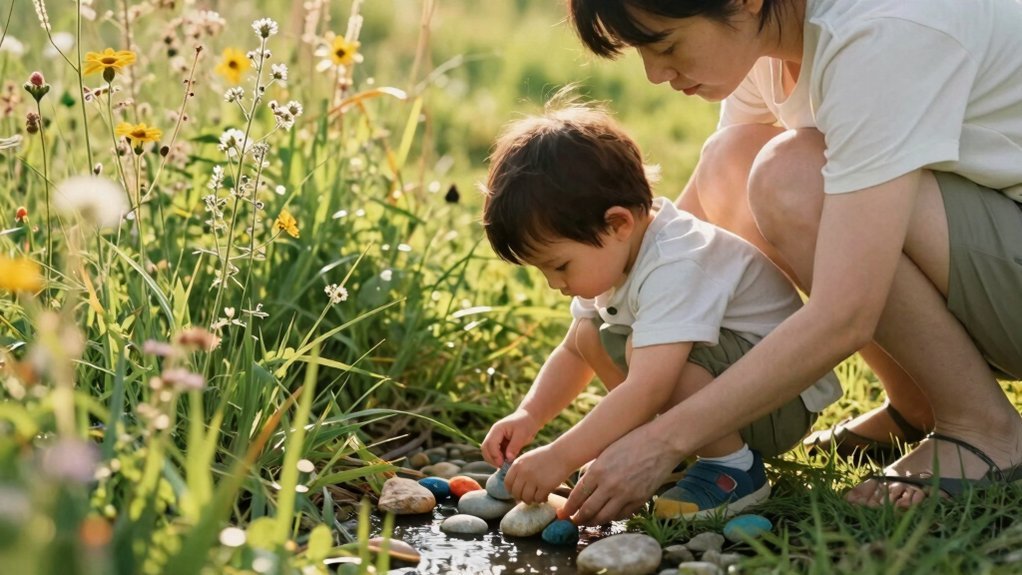
Start by watching your child during free‑time play, staying present with mindful breathing. Notice the activities that spark rapid, sustained engagement—those moments signal genuine interest. Jot down patterns across days, paying attention to language, energy, and the toys they gravitate toward, like bendable wooden animals that boost fine‑motor focus. Use these clues to introduce low‑pressure, related experiences and gentle conversations, creating a safe space for enthusiasm to grow. Keep exploring, and you’ll discover deeper ways to nurture their passions.
Why Mindful Observation Helps Uncover Your Child’s Passions

A few simple observations can reveal a child’s hidden passions. When you practice mindful observation, you tune into free‑time activities and note patterns across days, spotting recurring curiosities that signal intrinsic motivation. Your caregiver responsiveness—paired with a nonjudgmental presence—creates a safe space where the child’s enthusiasm shines, allowing you to gauge emotional awareness without pressure. Careful listening to the language they use and the energy they display gives you concrete clues about what truly excites them. By documenting these moments and asking gentle, open‑ended questions, you turn fleeting interests into clear exploration opportunities. This focused approach transforms everyday interactions into a roadmap for nurturing the child’s developing passions. Incorporating toys designed for fine motor skill building supports the development of focus and tactile engagement, enhancing their natural curiosity.
How to Notice Moments That Reveal Your Child’s Passions
When you shift from understanding why mindful observation matters to actually spotting the clues, the process becomes a series of tiny, intentional checks. Begin with mindful watching during free‑time play; notice children’s interests that spark rapid engagement and track patterns and routines across days. Observe behavior that shows sustained engagement—like a child returning to a drawing or a sport without prompting. Use mindful breathing to stay present, allowing emotional awareness to guide you toward moments of joy or calm. Record these instances, noting how they build resilience and reduce stress after activity. Over time, recurring curiosities reveal hobbies and passions, giving you concrete data to nurture genuine interests while filtering out fleeting fads. Incorporating Montessori-inspired features can further enhance a child’s engagement and developmental skills during play.
How to Turn Observations Into Mindful Activities for Your Child’s Passions

If you’ve already spotted the moments that light up your child, the next step is turning those clues into gentle, purposeful experiences. Your mindful watching turns observing children into a roadmap for mindful activities that nurture passions. Start by noting patterns, then use gentle conversations to clarify interests. Pair each interest with low‑pressure opportunities that spark sustained engagement.
- Identify a recurring interest – capture the activity that repeatedly holds their attention.
- Choose a related, low‑stakes experience – a library program, a short class, or a simple project at home.
- Invite gentle conversations – ask what they liked, what felt challenging, and what they’d explore next.
- Document and adjust – share findings with caregivers, refine opportunities, and keep the momentum alive.
Engaging children with thoughtfully designed bendable wooden animal figurines can support dexterity and imaginative play, enhancing their learning experiences.
These steps turn observations into mindful activities that deepen engagement and guide your child’s passions.
Frequently Asked Questions
What Is the 3-3-3 Rule for Children?
You practice the 3‑3‑3 rule by pausing, then naming three things you see, three sounds you hear, and three sensations you feel, helping you ground yourself and stay present.
What Is the 7 7 7 Rule for Parenting?
You apply the 7‑7‑7 rule by pausing seven seconds before reacting, then giving your child seven minutes of calm, focused conversation, and finally waiting seven days to review the outcome and adjust your approach.
What Are the 5 C’s of Mindfulness?
You’ll find the five C’s are Calm, Concentration, Clarity, Curiosity, and Compassion—each building on the others to help you guide your child’s focus, awareness, learning, and empathy.
Which Sibling Is Usually the Favorite?
You’ll often find the child who gets more praise, resources, and responsive attention becomes the favorite, but it can shift with age, gender, temperament, or changing parental expectations.




Leave a Reply