

Set up a simple morning checklist that links a goal to a visual cue, then use picture schedules and countdown timers for each transition, pairing them with a short song or watch sound. Teach your child to label feelings and request help, and reinforce with emotion flash cards. Create social‑story scripts and role‑play new situations, and schedule regular sensory breaks with headphones or a quiet corner. Practice belly breathing during waits, and finish activities with a quick self‑evaluation and a small reward. Keep exploring for deeper strategies.
Create Kids Self‑Management Routines
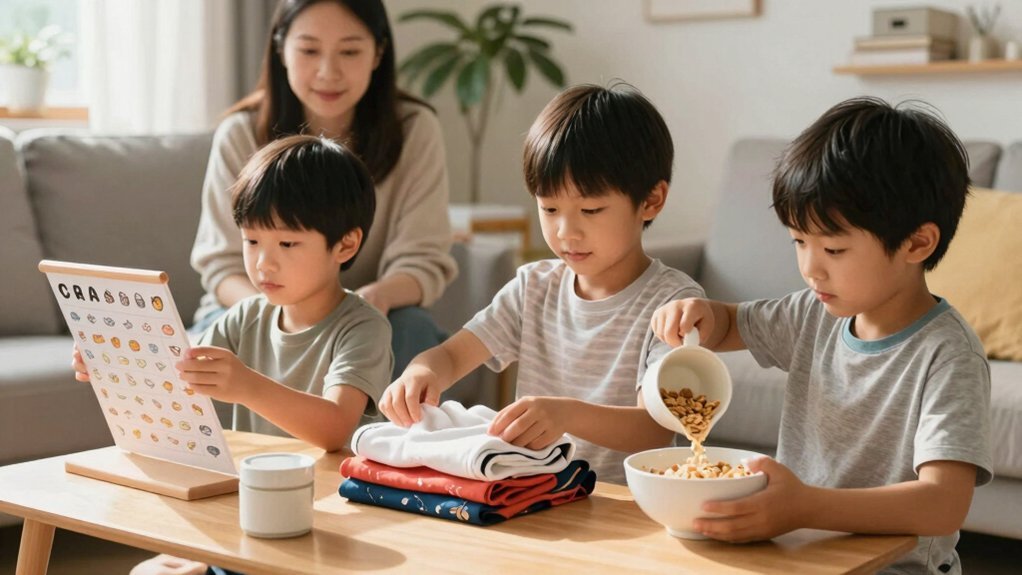
How can you turn everyday moments into a self‑management routine that actually sticks? Start by linking a simple goal‑setting step to a visible cue—like a morning checklist that prompts your child to pick a learning target, write it down, and rate confidence. Use time‑management logs to record how long each task takes, then review the data together to spot patterns. Model the planning process aloud, showing how you break a big assignment into smaller steps, which sharpens executive function. Reinforce progress with immediate praise or a small reward, then ask reflective questions that connect actions to outcomes. Over weeks, these routines become habit, fostering independence and reducing disruptive behavior without extra scaffolding. Incorporating Montessori tools such as a step stool with safety features can enhance independence by allowing children to safely engage in tasks at elevated surfaces.
Use Visual Schedules and Timers for Smooth Transitions
You can start by posting picture schedules that show each step, so kids know exactly what’s coming next.
Adding a countdown timer gives a clear signal when one activity ends and the next begins, reducing hesitation.
Pair the visual cue with a short transition song or watch sound to reinforce the change and keep the flow smooth.
Picture Schedules
Picture schedules act like a roadmap for kids, laying out each step of a routine in clear, illustrated icons. You’ll notice that picture schedules boost self‑management because kids see exactly what comes next, so transitions feel predictable. Use visual supports such as a song or a designated watch to cue each change; the cue paired with the schedule speeds up the shift and cuts anxiety.
When you draw or select simple icons for each activity, you reinforce predictability and help the child pace themselves independently. Review the schedule together each morning, previewing upcoming steps to keep engagement high and reduce disruptions. By embedding these visual cues into daily routines, you create a smooth, self‑directed flow that kids can follow without constant prompting.
Countdown Timers
A countdown timer turns an abstract waiting period into a concrete, visible cue, helping kids know exactly when a transition will happen. Pair it with visual schedules and a brief verbal prompt—“What happens next?”—to boost self‑management and keep routines flowing. Use a 5‑minute timer before moving from play to lunch, and watch anxiety drop as the cue becomes predictable. Consistency is key; rehearse the timer‑and‑schedule combo in new settings so children generalize the skill.
| Activity | Timer Length |
|---|---|
| Free play → Snack | 5 min |
| Snack → Homework | 3 min |
| Homework → Outdoor time | 2 min |
| Outdoor → Bath | 4 min |
| Bath → Bedtime | 1 min |
These simple steps anchor transitions, reinforce routines, and give kids a clear sense of control.
Transition Cue Songs
Ever wonder how a simple song can turn a chaotic hallway into a calm, predictable flow? When you pair transition cues with visual schedules and timers, kids instantly know what’s next. Play a short, upbeat song as a signal that a task is ending, then flash the next picture on the schedule. The countdown timer reinforces the song’s rhythm, giving a concrete time boundary. This combo reduces anxiety, sharpens self‑management, and smooths movement between routines. Consistency is key: use the same song and visual cue each day, and keep the timer visible. Over weeks, children internalize the pattern, shift tasks independently, and stay engaged without frantic reminders. Incorporating sensory tools like calm-down sensory bottles can further enhance emotional regulation during transitions.
Teach Kids to Name and Communicate Their Needs
You’ll start by helping kids label their feelings clearly—happy, sad, angry, anxious—so they can recognize what’s inside. Then model expressive language, showing them simple phrases like “I feel frustrated and need a break.” Finally, encourage them to make brief requests, such as “Can you help me?” to turn needs into action. Using age-appropriate design features in everyday tools helps reinforce independence and self-management skills.
Identify Label Feelings Clearly
How can you help kids turn vague emotions into clear words that guide their actions? Start by building emotional awareness: ask them to name feelings like happy, sad, angry, or anxious. When they label feelings, pair the word with a regulation strategy—say, “I’m frustrated, so I’ll take a brain break.” This connects labeling to self‑management and shows how language fuels self‑advocacy. Use short scenarios, such as Carl feeling upset and choosing a sensory break, to illustrate the process. Encourage simple requests: “I feel anxious, can I’ve a quiet corner?” By consistently modeling this pattern, children learn to translate internal states into actionable steps, reinforcing both emotional literacy and practical coping tools. Incorporating tools like emotion flash cards can further aid children in identifying and managing their feelings effectively.
Model Expressive Language
A clear, simple phrase—like “I’m frustrated and need a break”—turns a vague feeling into an actionable request. When you model expressive language, you show kids how to turn internal states into words that guide self‑management. Say, “I’m feeling anxious, so I’m taking three deep breaths,” then label the feeling and demonstrate the regulation strategy. Use scenario‑based prompts: “Carl felt upset, asked for a brain break, and returned focused.”
Encourage them to practice requesting help with statements such as “I need help understanding this.” By expanding their emotional vocabulary and pairing it with concrete regulation steps, you empower proactive communication, reduce off‑task behavior, and strengthen their ability to self‑regulate.
Encourage Simple Requests
Ever notice how a simple phrase like “I’m stuck, can you help?” can instantly shift a child’s frustration into a constructive request? You can teach that shift by pairing emotion naming with explicit prompts. When a child says, “I feel angry and I need help,” you model self‑management by suggesting a coping strategy—like a quick breathing break—before you assist. Use real‑life scenarios, such as Carl feeling upset and taking a break, to normalize help seeking. Reinforce the habit with short, repeatable phrases and consistent praise.
Providing children with age-appropriate design features can support their ability to independently manage emotions and requests effectively.
| Prompt | Example |
|---|---|
| Need help now | “I need help with this now.” |
| Feeling stuck | “I’m stuck, can you help?” |
| Emotion + request | “I feel sad and I need a break.” |
| Coping cue | “I’ll take three deep breaths.” |
| Positive outcome | “I felt better after the break.” |
These tools embed coping strategies into everyday language, fostering independent self‑management.
Add Social Stories and Role‑Play for New Situations
One effective way to ease a child into unfamiliar settings is by using social stories and role‑play together. You’ll notice that social stories break down new situations into clear, bite‑size steps, letting the child picture what’s coming. Pair that with role‑playing, and they can rehearse reactions, building confidence and self‑management. Visuals and scripts help preparation, reducing anxiety before the real event. When you practice a dentist visit or a first day at school, the child learns to anticipate cues and choose calm responses, making the transition smoother.
Social stories and role‑play break down new situations, building confidence and easing transitions for children.
- Write a short story describing the setting and expected actions.
- Include simple pictures or icons for visual cues.
- Script key dialogue and choices for the child.
- Role‑play the scenario twice, swapping roles.
- Review what went well and note any adjustments for future preparation.
Schedule Sensory Breaks to Keep Kids Focused and Calm
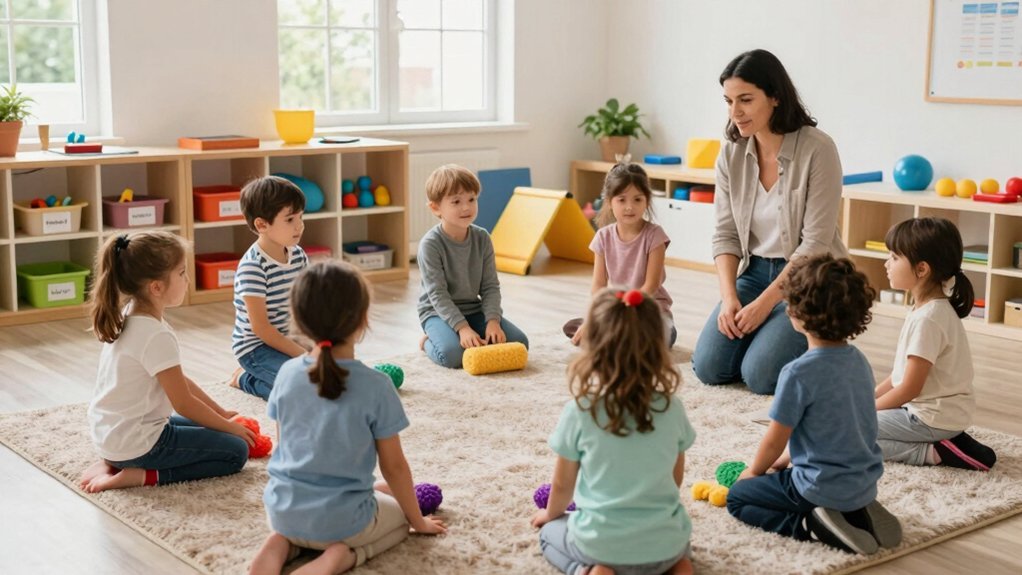
When you schedule regular sensory breaks, you give kids predictable moments to reset, which keeps them focused and calm throughout the day.
Plan those breaks ahead of noisy events, busy transitions, or any activity that could trigger overload.
Use headphones, a quiet corner, or a tactile tool as immediate regulation strategies.
Identify each child’s preferred calming activity—stretching, deep‑pressure toys, or a short walk—and weave it into daily routines.
By embedding sensory breaks into the schedule, you teach self‑regulation and protect attention spans without constant prompting.
Over time, kids learn to recognize when they need a reset, strengthening their ability to stay engaged and emotionally balanced.
This structured approach turns brief pauses into powerful allies for sustained focus.
Practice Patience With Breath‑Work and Celebrate Small Wins
How can a simple breath become a patience‑building tool? You can turn belly‑breathing into a self-management habit that stretches patience and fuels intrinsic motivation. Guide kids to inhale through the nose, watch the belly rise, hold briefly, then exhale slowly through the mouth. Use a straw or a moving toy to visualize the flow. Pair this breath‑work with a short activity—like reading—during waiting periods, and set a visual timer for 1–2 minutes, extending it as they improve. Celebrate each successful round with praise, a choice, or a progress chart, reinforcing that effort leads to growth.
- Teach belly breathing with a visual aid
- Use a timer to practice patience
- Pair breath‑work with brief tasks during waits
- Offer praise or a choice as a celebration
- Track wins on a chart to boost intrinsic motivation
Reward Progress and Use Simple Self‑Evaluation Check‑Ins
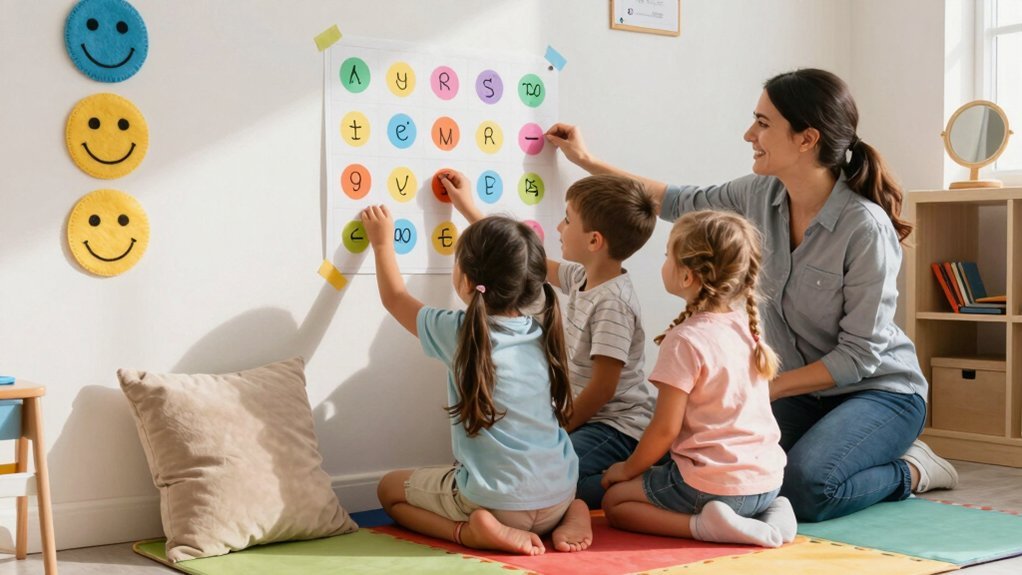
Ever wondered how a quick “check‑in” can turn effort into excitement? You can turn self‑management into a habit by pairing simple self‑evaluation check‑ins with tangible positive reinforcement. After each activity, ask the child to rate their focus, note one success, and identify one tweak for next time. Record those notes on a chart for effortless progress tracking. Celebrate each entry with praise, a sticker, or a small privilege—anything that feels rewarding. The routine builds confidence, because the child sees concrete evidence of growth. Over weeks, the visual log becomes a roadmap, showing how small adjustments lead to bigger wins. Keep the process brief, consistent, and fun, and watch self‑regulation flourish.
Frequently Asked Questions
How Can I Adapt Routines for a Child With Unpredictable Energy Levels?
You’ll keep routines flexible: set core tasks, then let them pick start times within a window, offer short “energy breaks,” and adjust expectations daily based on their mood and stamina.
What if My Child Resists Using Visual Schedules Altogether?
You can start small, offering a single picture and praising any use, then gradually add more. Keep the schedule flexible, let your child choose the order, and reward consistency with fun activities.
Can Self‑Management Skills Be Taught to Children With Limited Language Abilities?
Yes, you can teach self‑management to kids with limited language by using visual cues, consistent routines, and hands‑on practice. Keep instructions short, pair them with gestures, and reinforce successes with immediate praise.
How Often Should I Update or Rotate Social Stories for Relevance?
You should refresh or rotate social stories every two to four weeks, or whenever the child’s interests, routines, or developmental milestones change, to keep them engaging and relevant.
What Is the Best Way to Involve Siblings in Supporting Self‑Management?
Invite siblings to model the routine, assign them simple helper roles, praise their effort, and let them track progress together. This builds teamwork, reinforces consistency, and makes self‑management feel collaborative.