Start by modeling calm, clear language: make eye contact, smile, and say a simple phrase like “Excuse me, I’m passing by.” Break the greeting into four steps—eye contact, friendly phrase, pause, and response—so the child can repeat each part. Use short role‑plays that mirror real moments, then guide them from joint practice to independent use. Keep the tone gentle, offer choices instead of commands, and praise quietly when they succeed. Keep these ideas in mind, and you’ll discover deeper strategies for everyday courtesy.
Why Grace & Courtesy Matter in Montessori Parenting

Grace and courtesy aren’t just nice‑to‑have traits; they’re the backbone of Montessori parenting.
Grace and courtesy form Montessori parenting’s backbone, shaping respectful, empathetic children.
You notice how calm, clear speech and attentive listening become the quiet lessons that shape a child’s social world.
When you consistently model grace, you give your child a living example of respect that they can imitate without formal instruction.
Your gentle narrations—“Excuse me, I’m moving past”—show how courtesy works in everyday moments, turning simple interactions into practice for polite greetings.
By inviting cooperation, you reinforce the idea that kindness is a shared responsibility.
This modeling aligns home and school, fostering confidence, empathy, and a sense of community that lasts a lifetime.
Using thoughtfully designed Montessori tools like a step stool with safety rail supports a child’s independence while ensuring safety during these daily interactions.
What Makes a Polite Greeting Work?
How does a polite greeting actually work? You notice that a greeting works when you practice it as a calm, intentional demonstration, then let children repeat it throughout the day. You break the interaction into clear greeting steps: eye contact, a friendly phrase, a pause, and a response. When you use calm modeling, kids see confidence and predictability, which builds social connection. Role‑play demonstrations let them rehearse scenarios, discuss why each action matters, and internalize the “polite and friendly thing to do.” Consistent practice turns the abstract idea into real habit.
- Make eye contact first
- Offer a warm, simple phrase
- Pause and listen for a response
- Mirror the calm modeling you demonstrate
- Use role‑play demonstrations to rehearse and reflect
Model Calm, Clear Language for Grace & Courtesy Greetings

You’ll model calm language by speaking slowly and using simple, direct phrases like “Excuse me, I’ll walk past.” Keep each step short and precise so kids can repeat the sequence without hesitation. Pair each demonstration with a quick chat that invites their ideas, reinforcing the clear, courteous wording. Using tools with spill prevention technology can help maintain focus and avoid disruptions during teaching moments.
Model Calm Language
Ever wondered how a simple, calm greeting can set the tone for a whole day? You’ll notice that using calm language when you greet a child creates a gentle ripple of manners throughout the classroom.
Model a phrase like “Hello, good morning” with a slow smile and steady eye contact. Speak the words deliberately, then narrate the action: “I’m saying hello so you know I’m here.” Repeat the same greeting sequence during arrivals, transitions, and departures so children recognize the pattern and feel safe.
- Speak slowly, emphasizing each word.
- Use consistent phrasing each time.
- Pair words with relaxed facial expressions.
- Demonstrate before asking children to imitate.
- Reinforce the routine daily for lasting manners.
Use Clear Phrases
After practicing calm language, you can strengthen the habit by using clear, specific phrases that tell children exactly what to say and do. Model greeting behavior with simple scripts like “Excuse me, I’m going to greet you” or “Hello, nice to meet you.” Narrate each action—“I’m reaching out to shake your hand”—so expectations stay concrete. Sprinkle polite joining cues such as “May I join you?” or “Would you like to join our activity?” and remind them to make eye contact and tone with a gentle voice. Consistent feedback—“Thank you for saying hello”—locks in the right tone and reinforces the habit. Using an ergonomic handle design in child-safe tools helps reinforce concepts of gentle control and coordination that support smooth social interactions.
| Situation | Phrase | Key Element |
|---|---|---|
| Initial greeting | “Hello, nice to meet you.” | eye contact, tone |
| Request to join | “May I join you?” | polite joining cues |
| Handshake intro | “I’m reaching out to shake your hand.” | greeting behavior |
| Feedback | “Thank you for saying hello.” | tone reinforcement |
Role‑Play the Greeting Sequence With Young Children
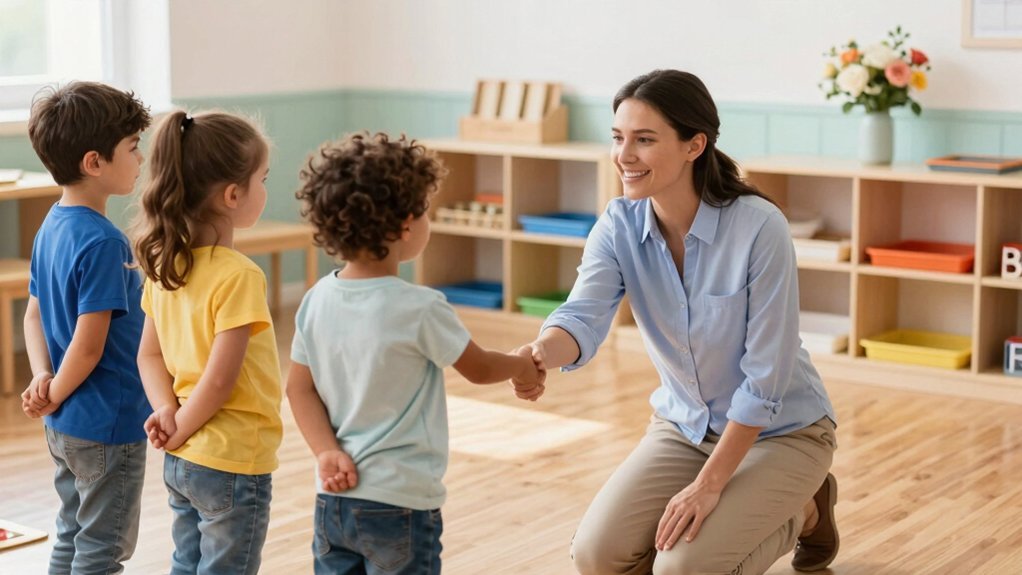
How can you turn a simple greeting into a fun, repeatable routine for a child? Break the sequence into five clear steps—eye contact, smile, handshake or wave, name introduction, and a polite inquiry. Model each step with calm language, then cue the child with a brief, positive prompt if they forget. Use role‑play scenarios that mirror real moments, like meeting a new friend or greeting a teacher at the door. Start with joint demonstrations, move to guided support, and finally let the child practice independently, adding variations such as “Nice to meet you” or “Thank you for greeting me” to reinforce grace and courtesy.
- Demonstrate each step before practice.
- Choose realistic role‑play contexts.
- Provide concise cues for missed parts.
- Transition from joint to independent practice.
- Include polite variations for generalization.
Adapt the Greeting Lesson for Nido & Toddler Age Groups

A gentle routine on the rug becomes the perfect stage for teaching Nido and toddler children polite greetings. You guide them to walk around the rug, then pause to carry a chair or stool. This movement builds coordination and respects personal space. Start with a short, calm demonstration: a wave, a smile, a simple “hi.” Emphasize nonverbal cues—eye contact, a gentle nod—because language is still emerging. After each demo, ask the group to mimic the gesture, then discuss what felt respectful. Repeating the sequence reinforces polite behavior and supports toddler development. Using a variety of cushion shapes and sizes can create inviting, comfortable spaces that encourage children to gather and engage during these lessons.
| Focus | Example |
|---|---|
| Greeting | Wave + smile |
| Nonverbal cue | Nod + eye contact |
| Transition | Hand over chair gently |
Bridge Classroom Practices to Family Life
When you bring the calm, deliberate greeting routine from the rug into your home, you create a seamless bridge between classroom and family life. You model the same Grace and Courtesy you teach in class, narrating actions softly—“Excuse me, I’m passing by”—so children hear polite language everywhere. Offer choices instead of commands, like “You may join if you like,” to nurture cooperative spirit. Role‑play greetings, eye contact, and handshakes repeatedly, reinforcing steps both publicly and privately. Align expectations at home with school standards, ensuring Home‑School Consistency that builds self‑respect, respect for others, and respect for the environment. Integrating age-appropriate tools during activities supports skill development in alignment with teaching respectful and deliberate actions.
Seamlessly blend classroom grace with home life, modeling courteous greetings, choices, and consistent expectations.
- Mirror classroom greetings during meals or playtime
- Use soft narration for transitions
- Provide options rather than orders
- Practice role‑play with feedback
- Keep consistent expectations across settings
Use Narrative Cues Like “Excuse Me, I’m Passing By
Ever wondered how a simple phrase can turn a chaotic hallway into a respectful space? You can model Grace and Courtesy by using the narrative cue “Excuse me, I’m passing by.” Speak it calmly, step aside, and make eye contact—this three‑part greeting, acknowledgment, and passage sequence becomes a visual lesson.
Slip the cue into classroom routines: entering a room, moving through a line, or passing a table. Let older peers demonstrate the response, then discuss why the courtesy protects focus and comfort.
Repeat the cue during demonstrations, then prompt each child to reproduce it independently in real‑life interactions. By weaving the phrase into daily practice, you normalize polite passing and reinforce effective greetings throughout the school day.
Teaching children about ergonomic handle design in tools they use daily helps them appreciate mindful movements and safety.
Invite Cooperation Instead of Giving Commands
After students have practiced the “Excuse me, I’m passing by” cue, you can shift to inviting cooperation instead of issuing commands. Use greetings that feel like invitations, not orders, and model the calm, neutral tone of a Montessori classroom. Frame each request as a choice: “Would you like to help set the table?” or “You may join if you like.” This approach builds cooperation, respects autonomy, and encourages children to participate voluntarily. Mirror the language you want to hear, and keep the atmosphere relaxed so kids feel safe to decide.
- Use inclusive phrases like “You may join if you like.”
- Offer options: “Would you like to help?”
- Mirror courteous greetings in your own speech.
- Emphasize joint tasks: “We can work together.”
- Maintain a calm, neutral tone to reduce pressure.
Including tools like child-safe cooking thermometers in cooking activities can help children learn responsibility safely while reinforcing calm, cooperative behavior.
Practice “Please” and “Thank You” in Everyday Routines
How can you turn everyday moments into polite practice? You embed “Please” and “Thank you” into everyday routines so they feel natural, not formal. When you hand a snack, say, “May I please have that?” and follow with “Thank you for sharing.” While setting the table, ask, “Could you please pass the salt?” then smile and thank the helper. Pair each request with eye contact and a gentle nod to reinforce respectful presence.
Praise correct usage privately—“Great job saying please!”—and publicly—“Thank you for remembering the words.” If a phrase slips, gently re‑teach it in the same context. Consistent, calm modeling turns polite language into habit.
Transition From Greeting to Respectful Goodbye
When you finish a friendly chat, smoothly shift from the initial greeting to a polite farewell by pausing, making eye contact, and saying something like, “Goodbye, see you tomorrow.” You’ll notice that graceful transitions reinforce respect and keep the conversation balanced. Use a calm voice and a gentle smile to signal the end, then wait for the other person’s response—this turn‑taking moment shows you value their input. A brief wave or nod adds warmth, turning a simple goodbye into a courteous ritual that models social harmony.
- Maintain eye contact while saying Goodbye.
- Pause briefly before the farewell.
- Use a gentle, clear voice.
- Wait for the other person’s reply (turn‑taking).
- Add a supportive gesture, like a smile or wave.
Reinforce Greeting Skills With Daily Micro‑Lessons
Ever wonder how a few seconds of modeling can turn ordinary greetings into lasting habits? You can embed greeting behaviors into daily micro‑lessons by slipping calm demonstrations into natural classroom moments. When a new student arrives, pause and say, “Excuse me, hello, nice to meet you,” while making eye contact and smiling. Have older students echo the phrase in real‑time scenarios, asking, “What’s the polite and friendly thing to do?” Reinforce the response with brief role‑plays—holding doors, offering seats—then give immediate, private praise. Repeating these short, explicit actions each day builds a rhythm of Grace and Courtesy. The consistency of micro‑lessons ensures the skill stays fresh, while the private reinforcement celebrates progress without embarrassment.
Troubleshoot Common Challenges When Politeness Is Forgotten
Why does politeness sometimes slip away? You might notice a child skipping eye contact or rushing a greeting.
First, pause and give a brief, calm demonstration of the exact step you expect. Then use roleplay to break the cue into tiny actions—eye contact, approach, greeting, response—letting the child practice each piece until it feels natural.
Follow every attempt with private, positive feedback like “I liked how you said hello calmly.” Re‑introduce the scenario later in a real‑world moment, such as arriving home, to reinforce the habit.
Keep a simple log of forgetfulness patterns so you can schedule spaced repetitions.
- Demonstrate calmly and succinctly
- Roleplay in small, manageable steps
- Offer private, positive feedback each time
- Revisit the cue in natural daily contexts
- Track patterns to tailor future practice
Next Steps: Embedding Grace & Courtesy Into Daily Family Life
You’ll start by speaking calmly and clearly, saying things like “Excuse me, I’m passing by.” Then you’ll invite cooperation with phrases such as “You may join if you like,” instead of issuing commands. By consistently modeling these habits, you’ll weave grace and courtesy into every family interaction.
Model Calm, Clear Language
A calm, clear voice sets the tone for every greeting, so narrate each step—“Excuse me, I’m going to greet you now”—as you move through daily routines. You’ll notice how calm language guides children toward polite participation. When you pick up a dropped item, say, “I’ll pick this up since it fell,” and watch them mirror the courtesy. Keep your narration brief, purposeful, and inviting, avoiding commands. This modeling builds confidence and makes greetings feel natural, not forced. Over time, the family internalizes respectful speech and cooperative habits.
- Use “Excuse me” before initiating a greeting.
- State actions briefly: “I’m setting the table now.”
- Invite participation with “You may join if you like.”
- Mirror calm language in every interaction.
- Celebrate polite participation with positive reinforcement.
Invite Cooperation, Not Commands
After modeling calm, clear language, shift to offering choices that invite the child to participate rather than obey a command. You might say, “You may join if you’d like,” or “Would you like to help set the table?” This invites cooperation and shows that grace isn’t a demand but a shared experience. Narrate your actions calmly—“I’m going to walk past you slowly so you’re not disturbed”—so the child sees respectful manners in motion. Replace corrective pressure with collaborative tasks: “Let’s tidy the toys together.” Consistently model courteous phrases like “Excuse me” and “Thank you for waiting,” then reflect on them with the child. Over time, these habits embed grace, cooperation, and manners into everyday family life.
Frequently Asked Questions
How to Teach Grace and Courtesy?
You teach grace and courtesy by modeling calm, polite behavior, using simple role‑plays, giving clear prompts like “Excuse me,” reinforcing with gentle praise, and repeating the actions daily until they become natural.
What Are the 4 C’s of Montessori?
You’ll find Montessori’s four C’s are Care, Calm, Courtesy, and Cooperation. They guide you to nurture respect for self and others, model peaceful behavior, teach polite interactions, and foster collaborative teamwork.
What Does Grace and Courtesy Mean?
You see grace and courtesy as everyday kindness—polite greetings, calm tone, respectful gestures, and thoughtful listening. You model calm, respectful behavior, showing children how to enter, ask, and respond graciously.
How Can You Incorporate Grace and Courtesy Lessons Into Daily Interactions?
You weave grace into daily chats by modeling calm language, inviting others politely, and praising courteous moments aloud; use brief role‑plays, gentle reminders, and real‑time narrations to embed respectful habits naturally.